Island Energy Super Heroes: How one Jamaican PhD Student is Transforming Energy Literacy


 RSS Feed
What happens when a nuclear engineering PhD student realizes that the book she needed as a child… doesn’t exist?
She writes it.
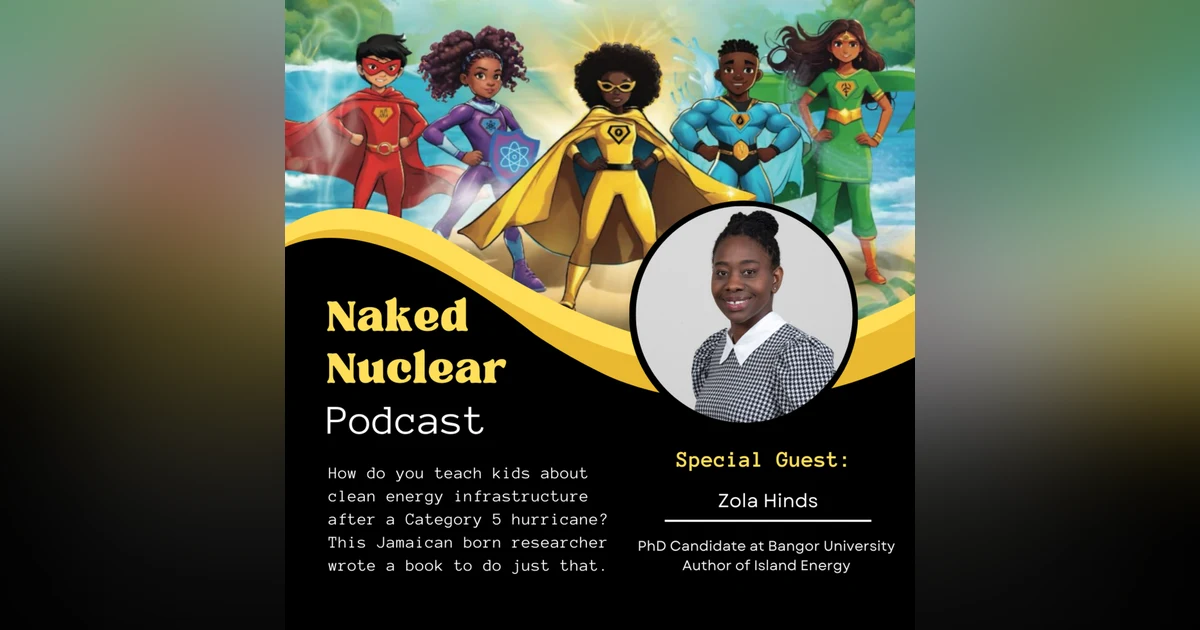
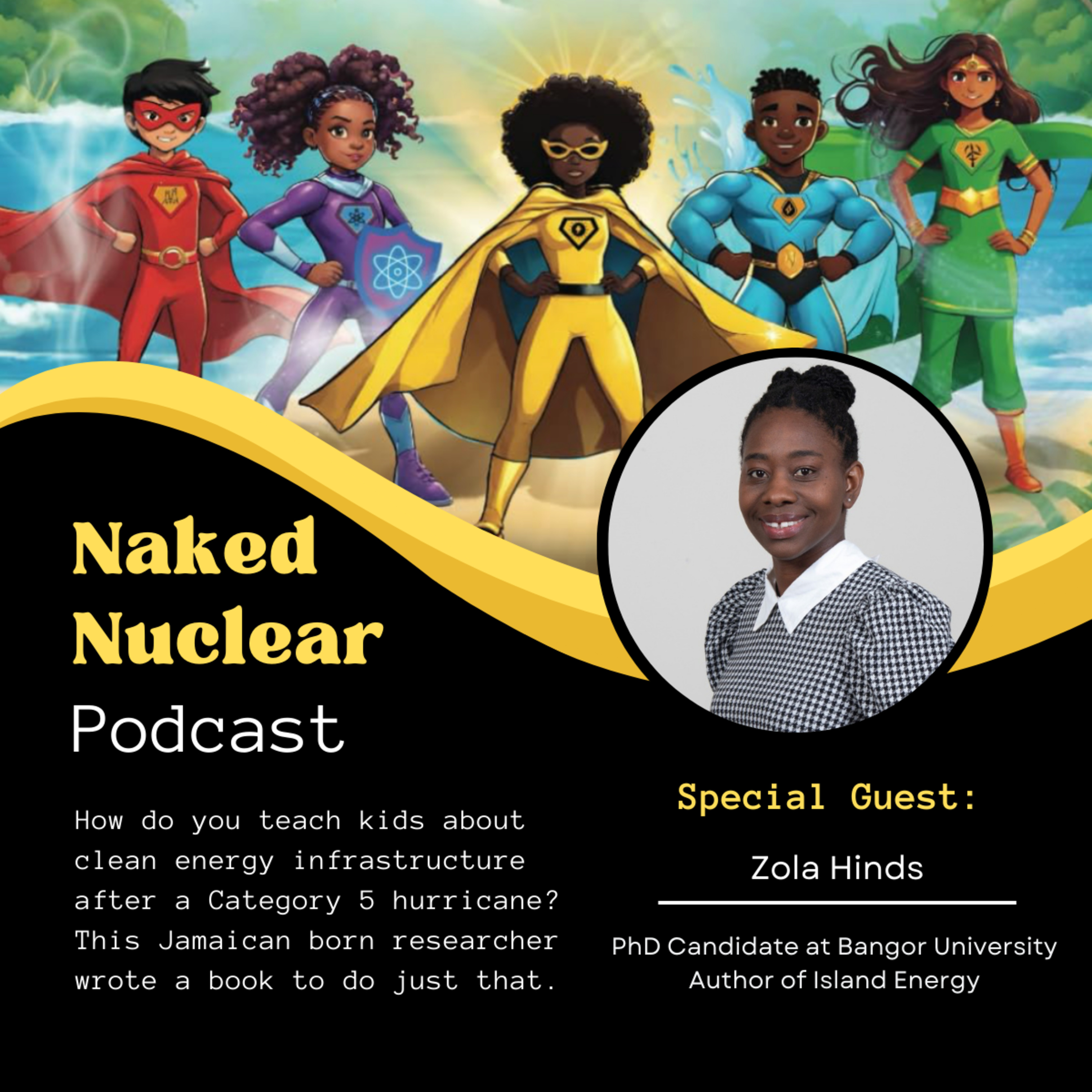
In this episode of Naked Nuclear, Danielle sits down with Zola Hind, Jamaican-born computer scientist turned nuclear engineering researcher at Bangor University — and author of Island Energy Superhero: A Kids’ Guide to Energies in the Caribbean.
From visualizing nuclear fuel behavior using astronomy-inspired methods… to printing her book in braille for visually impaired students… Zola is building an energy-literate Caribbean one classroom at a time.
This conversation explores:
- Why representation matters in energy education
- How nuclear engineering “chose” her
- What it means to fail forward in a PhD program
- The role of clean energy in Caribbean climate resilience
Whether you’re a student, parent, educator, policymaker, or just energy-curious , this episode will leave you thinking differently about who gets to be part of the energy transition.
Get the Book
Island Energy Superhero: A Kids’ Guide to Energies in the Caribbean
Amazon:
https://www.amazon.com/Island-Energy-Superhero-Energies-Caribbean/dp/1998245098
Official Website:
https://islandenergybook.my.canva.site/#home
The book is also available in select Jamaican bookstores and at Norman Manley International Airport in Kingston.
About Zola Hind
Zola Hind is a PhD researcher in nuclear engineering at Bangor University with a background in computer science and data visualization. Her research focuses on novel methods for modeling and visualizing nuclear fuel behavior.
She is passionate about:
- Energy literacy
- Climate resilience in the Caribbean
- Accessibility and inclusion in STEM
- Making complex science understandable for everyone
0:00 When's the last time you walked into a bookstore? Specifically a children's bookstore, or maybe even the children's section. Let's say you're looking for a book about clean energy in the Caribbean. Solar, wind, geothermal, hydro, maybe even nuclear. A book that reflects the islands, the culture of the people. A book where the heroes look like the kids reading it. Now imagine having that realization that that book doesn't exist, and instead of walking away, you decide. I guess I'll write it.
0:40 I used to love Captain Planet so much as a child growing up trying to save the planet with the powers combined. Imagine if we have all these clean and resources working together. We need to be very representational of the Caribbean culture, spirit and people. Today's guest did exactly that. Me Zola Hein, a Jamaican born. Computer scientist turned. Nuclear engineering PhD researcher at Bangor University and the author of Island Energy Superhero, A kids Guide to energies in the Caribbean, a book that's already landing at schools, bookstores and even in the airport in Kingston.
1:21 This episode is about representation, science communication, failing forward and building an energy literate Caribbean one child at a time. So let's get. Started how did. The vision for this book come about. The history or the vision behind the Island Energy book came across when I just started my PhD in my first year. I was very curious as to nuclear energy being used in the Caribbean, if any. I was also trying to find out different sources just to understand the material to do the research, something that's very simplified. And I notice that yes, we do use nuclear in the Caribbean. There's actually the island slab in Jamaica out by the Imona campus, and they use it for medicinal purposes also in the agricultural sector for nuclear forensics using neutrons. However, we haven't been able to use nuclear energy in the Caribbean.
2:27 And I don't know if you've seen in the news a big thrust of Rolls Royce and the SMRS. And so now persons are looking to energy all across the world. Recently, Jamaica even signed a memorandum of understanding with Canada to look into setting up nuclear power generation in the Caribbean. My interest in starting the book was thinking about how will parents be able to explain this new concept, this new source that's been added to or could be added to our energy grid? How will they be able to explain it to their children children, and will they even understand it themselves? So I was there having this idea in mind, and I reached out to a publisher and we were basically looking around, doing some research, seeing if there are other books that covered energy in the Caribbean or looked at clean energy overall.
3:26 And to our surprise, there wasn't anything like this available. So the idea was, let's try to create a book that introduced all these concepts in a very simple way of what is clean energy, the different types that are currently being used and also nuclear energy as an energy source that will be introduced to the future. So this book, the Island energy book, the superhero energies that for the Caribbean is now available for children and parents to learn more about different kinds of clean energy sources. This is currently being used in the Caribbean, such as solar, geothermal, wind, hydroelectric energy and the introduction of nuclear.
4:13 When Zola began her PhD, she searched for simple explanations about nuclear and clean energy in the Caribbean, something parents could use to explain a rapidly changing energy landscape to their kids. She found Advanced Research papers, technical reports, scattered examples of nuclear applications in agriculture and medicine. But there were no children's books, nothing that represented Caribbean identity, Caribbean imagery. So she reached out to. A publisher. Together they. Realized they had something, a vibrant, superhero driven way to explain energy systems to kids to the adults who raised them. So think back to your own childhood. When did you first learn what energy was? Did anybody ever show you diagrams of solar farms, or talk about nuclear medicine, or explain why electricity bills rise and fall?
5:09 Most of us didn't get that education until adulthood. If ever. Zola's book wasn't just about clean energy. It was deeply tied to her journey, one that didn't start in nuclear. At all. So how does someone go from computer science and data visualization to simulating nuclear fuel behavior? Well, I'd like to say that nuclear engineering shows me because I really love computer science. I love working with computers. I also really love doing visualizations. A big part of my master's dissertation was visualizing data sets, and the opportunity presented itself for me to visualize nuclear data in a way that's never been done before.
5:56 I didn't really have a nuclear background, but I thoroughly enjoyed physics, you know, thanks to my teacher, Mr. Goodnight, Glenmere High School, you know, really fell in love with physics and you know, it would be a great opportunity to continue with that. So I took the leap. My master's dissertation was looking at how different research papers use colors in visualization charts and bars. That was pretty cool. Analyzing from medical journals or engineering journals and creating a how to guide for persons in the research field what colors are recommended based on historical data. So that's one way in which I've used data and I found that really awesome.
6:44 It was great to work with that data set now in nuclear, using experimental data to predict the behavior of the fuel in the reactor. Propel Research and innovation. I was at the end of completing the masters and literally there was just a blast e-mail saying that I didn't even know my university had a nuclear institute. They were congratulating someone and saying that they have opportunities. I thought I'm looking for opportunities. So I reached out to the director and went in and had a lovely chat. Went around and saw the labs and it just carried me back to high school. Some of the things we were talking about that I learned in physics, hearing about different concepts from chemistry. I've, I've been doing so many things in computer science. I was just like, this would be great to broaden my scope and try and see how it goes because it sounds like a mammoth task. But if he thinks I have the capability and the skills to do this, then who am I to say no in that way? I, I say nuclear chose me and I've had really good support, even though sometimes when I speak, I'm very surprised by myself.
8:03 You know, I'm saying, Oh my gosh, actually know this thing. It's been interesting. It's been a true growth opportunity. I can say when I told my friends and family, they were not surprised. It wasn't a question of can I do it? It's like she's going to do it. They know I'm always up to something, to be honest, always putting myself out there, trying new things, trying to live life fully. I had tremendous support from friends and family back home and even here in the UK. It's been so good in terms of support within the university from my supervisors, from my industry partners sending me on trainings, making sure that I, you know, have to have access to any resource and every resource that would help me improve and make progress throughout the research. Zola didn't plan on nuclear engineering. She loved computer science, visualization, and the challenge of turning messy data into meaningful insights. But an unexpected e-mail from her university celebrating a nuclear institute she didn't even know existed sparked something new.
9:16 She met with the director, the labs, and suddenly the physics she loved in high school came rushing back. And she kept showing up. Somewhere along the way she surprised herself. And that got me thinking, when's the last time you were pulled in the direction of your curiosity? Somewhere you didn't expect to go? Because what Zola did next, bringing her love of visualization into nuclear fuel modeling, is a perfect example of how non traditional backgrounds strengthen the nuclear field. So I would say that my research mostly looks at a novel method. Traditionally to visualize the performance of the fuel in the reactor, we use mesh based techniques. My research currently is a more meshless technique and it's actually coming from astronomy, so it's never been used in nuclear industry before.
10:16 And so even that's within itself, trying to verify the method, try to validate the method and making sure that it is at the correct standards and the acceptable standards for academia so that you know this is reliable. So you know that you know, we can trust this information and how it is presented, the standards and seeing how best I can get the good quality information from very reliable sources. It does take its time, but it's been so great, especially working with persons and speaking to persons who do more experimental work and trying to see how best I can properly understand the information that they give and that I read an extract from other research papers so that I can properly fit my model and get it to simulate the behaviors that are needed to predict something novel. The best way to explain it is how my supervisor really reiterates a lot.
11:18 We are on the beach, on the sand, looking out into the sea and we don't really have an idea of what's out there, so we just have to take it a step at a time. Sometimes you think innovation is changing a lot of things and seeing how it happens, but sometimes it can just be tweaking 1 parameter or one aspect and just seeing how that affects the whole. Doing some in depth analysis, sensitivity analysis to see what variables, how it affects it, what can be changed, how just a little thing can make such a big impact. And for me that is the scientific research, doing little tweaks and seeing the impact. Sometimes it is colossal, sometimes it is minute, but you have to start from what you know or what is known and then slowly venturing to the unknown.
12:12 And, you know, sometimes there are persons who have gone ahead and done something similar to you. So it's always good to try to do as much research as possible to see what's already been done. Try to understand your method, try to understand the mistakes and the limitations of what's been done before so that you can say, OK, maybe I could try to tweak this instead, or I'll tweak this in a different way and see what the result is. That is the innovation, I think, that is applied in scientific research. Most of us think visualizing data means bar charts or line graphs. But Zola's work goes deeper, much deeper, Using methods barred from astronomy to visualize nuclear fuel behaviors in ways the industry has never tried before. She studies how to validate novel mesh free visualization techniques.
13:10 She analyzes experimental data. She runs simulations that help us understand what the fuel is doing inside a reactor, information that influences safety, performance, and design. Her background in color theory, visual communication, and even the psychology of how humans interpret shapes and gradients give her a unique perspective on nuclear data, one the field desperately needs. So with this scientific foundation, how do you turn energy into a story, one that Caribbean children can see themselves inside? Having sat down and I spoke with Cabrina, the manager and director of Eva Michelle Publishing, responsible for publishing the book. We sat and we were literally on the same page. Both Jamaicans are just like, OK, this book needs to represent the Caribbean, so we need to make the graphics visually capture in the Caribbean essence, spirit and culture. I was like, for sure, we have to make it be that true representation of the melting pot that we are. So the characters need to be very representative of the diversity in the Caribbean.
14:24 And then we both agreed we love Justice League and Captain Planet. I used to love Captain Planet so much as a child growing up trying to save the planet with the powers combined. And I think it's the same strategy here with the Island Energy book. Imagine if we have all these clean energy sources working together, how valuable it would be to the Reach on how sustainably it would be as well. So the concept behind it was OK, We need to be very representational of the Caribbean culture, spirit and people. And also we need to make it fun. And what's more fun than having superheroes? So recently I was able to get the book brailled and I did a book reading at the Salvation Army School for the Blind and Visually Impaired.
15:14 So that was good. I had a regular coffee of the book, had it in large print and also had it Braille and everyone could be a part of the conversation. No one was missing out. So things like those mean inclusive, you know. Each superhero embodies a clean energy source, solar, hydro, wind, geothermal and nuclear, combining forces to protect the islands. Kids immediately recognize themselves in the characters. Teachers loved it. Parents learned things they've never been taught. In one of the most touching moments, Zola had the book printed in Braille so visually impaired students could join the conversation, too.
15:58 Representation isn't a buzzword. It shapes who we believe we can become. Imagine being 8 years old, living through a Category 5 hurricane to hit your island and learning that you can be a part of the energy solution. This story is much bigger than a book. It ties into real energy challenges and opportunities in the Caribbean. Growing up in Jamaica, one of the most expensive bills that my mom had to cover for us was the energy bill. You know, many people always on the news saying, you know, even persons from the manufacturing sector, you know, they wish they could do more, but the energy bill is so high. So persons turn to doing different things, whether it's like using more smart devices so that they can lower energy consumption, just adopting as many different principles and techniques to try to lower the bill. If we can personally try to invest in clean energy sources and utilize solar because we are so blessed in the Caribbean with sunshine.
17:06 Even after the hurricane, the sun came out and that was a blessing to help persons rebuild. The resources are there and naturally available in the Caribbean. Again, very blessed where we are in the region to access geothermal energy, the sun, water, wind and in the future nuclear as well. I've been doing a few in person and virtual book readings. It's a surprising especially when I see that children have covered the topic of energy previously in class, but they probably didn't go in depth looking at the different kinds of energy. It's always so, you know, they're very animated. They are saying, Oh my gosh, this superhero looks like me. No, it looks like Chantelle.
17:57 No, it looks like Mark and which superhero they want to be because they want that power. And you'd be reading and just see how engaged the teachers are as well. And also you can see as well, parents who bought the book, the feedback is they read it. They enjoyed it too because they didn't know any of this information themselves. I love that. It's such a great learning opportunity, opportunity for not just children, but adults as well. The book has been available in the Cosy Kids Bookstore in Kingston and they also have a branch in Falmouth in Jamaica. It's available online on Amazon. You can order from Walmart, Barnes and Nobles as well.
18:41 It is available at the Norman Manley Airport in Kingston. Passing through, there's a things Jamaica also at the Devon House Ice cream stop if everybody loves to get ice cream and you know where it is in Kingston to get your copy of the Island Energy book. The reception has been great and the support and the love and just the appreciation for a book like this has been overwhelming. I think my aspiration would be to see more collaboration. If we truly come together within the region and try to utilize the resources collectively, it would be beneficial for all in terms of applying for climate grants or trying to whether it's from like commercial residents or for industry. I think working together is always best and we can achieve even more.
19:38 It would be great to see all the nations within the Caribbean coming together accessing grants or putting in proposals and actually building out the infrastructure needed to support different clean energy sources because we are naturally blessed and we are under utilizing the resources and it's a pain. It's very sad to see and persons are at the end of the day suffering for it. You don't have access to energy and everyone needs energy. It's all around us and we need it everyday in daily life. Growing up in Jamaica, Zola saw first hand how high energy bills shaped daily life and how storms expose the fragility of island infrastructure.
20:24 The Caribbean is blessed with natural resources, sun, wind, heat, water and now potentially nuclear energy. But these resources are underutilized. Infrastructure is aging, and resilience, especially after hurricanes, is critical. Zola's hope? Greater regional collaboration, shared infrastructure, collective climate grants, unified energy strategies, and an approach to clean energy that gives everyone from manufacturing to agriculture to families rebuilding after a storm. So what does energy justice mean in your hometown, your region, or your community?
21:08 Who gets left behind when these systems fail, and who gets prioritized when they need to recover? Because Zola's commitment to inclusion and resilience doesn't stop with her research, it shapes how she approaches learning itself. I'll definitely be working in the energy space, advocating for accessibility and inclusion in the discussion of energy and climate in climate change, climate resilience. This is something that I am very passionate about. I have to say, shout out to Girls Care, which is an organization that kind of helped me start this journey of making the Caribbean more climate resilient and sustainable. So that for me is just a continuing what I've started building on this and trying to see how much more of an impact and change I can make.
22:06 And for our audience, I wanted to ask solo. What advice does Zola have to help out when you might need a little? Push or encouragement? I would say definitely lean on your support system. Don't be afraid to tap into that. I would also say don't be afraid to ask questions. If you don't understand and you really want to do something, just put yourself out there. If you are trying to help yourself and others see you trying to make an effort then they will help you too. That's literally what's helped me so far. It's OK with being an impossible, you don't know everything and that is fine.
22:49 Be very comfortable sometimes with not being the smartest person in the room because that gives you an opportunity to grow and learn. It's really just an amazing thing because you get to learn so much. That would be my. Advice. Many times, and it could be whether you are brave enough to ask the question in front of others or you reach out to your teacher or lecture and say can I have 5 minutes at the time that is convenient to you just to get some clarification on things I did not understand. I've done that so many times. I'm so comfortable now with just asking. I know that persons will be more happy to help.
23:31 So yeah, just ask. So yeah, just ask. Don't be afraid to ask or lean on your fellow students or classmates, those who know a little bit more than you understand the topic better. Just go and ask and more than likely people will assist. Zola's philosophy is simple. Fail forward, ask questions, lean on your support system, don't pretend to know something you don't, and don't fear being the least knowledgeable person in the room because that's where growth happens. Her advice is crying it out, venting, regrouping and trying again. Asking for 5 minutes with a lecturer.
24:12 Reaching out to classmates with more experience. Building resilience, one question at a time. Because if kids can't see themselves as these resilient students who become energy superheroes, what happens to them when they grow up? And now it's time for our rapid fire questions. So the first one is, do you have any hobbies? I love going out to the beach. I love eating, going to a nice restaurant. Those would be my tops. I love listening to music dancing. Your hobbies feel very Jamaican because I love all of those things as well.
24:53 I was like beach food and dancing. Yeah, sign me up. If you had to give a Ted talk or a speech, that's not nuclear or computer. Science related. What would? You give it on. I think it would be failing forward. Many things I am no expert in, but I try and I fail so that that would be my. That's great, I guess. When you do. Fail. Or like when anybody fails, how do you emotionally recover from that? Because I think that maybe is one of the reasons why people just stop after they fail. How do you build that resilience muscle? You have to process it the best way you can. If it means you have to stop and cry, then you go again. In there.
25:38 Reach out to someone to vent, share your frustration, try to journal and look at the positives that happened during that event. Do whatever works for you, but try again. I love that. So yeah, make sure you get it all out emotionally. Dust yourself off and get back out there. If there is one place you think everybody should visit, whether it's a beach, a restaurant, a dance, like where? Where should people go? I think everyone should go to Jamaica. It's amazing. I am very proud of my country. There's so many amazing things from the beaches, the food, the people, the events.
26:20 There's something there for everyone to enjoy. Jamaica is amazing if you haven't been used to go. Yeah, I definitely got to go back. Do you have a? Favorite Jamaican food that you absolutely love? The hard one because I had to think about this for a while myself. There's so many. I do love a good sweet potato pudding Christmas time and the Christmas cake. You know, mango season, the jewelry, mango the fruits, the vegetables, the Curry, the party. So. The answer is there is no answer. There is no favorite. I think by quantity it's a toss up between beef patties.
27:01 Like if you sat me down in front of a. 100 of them. I could handle them just like a fresh mango like could also just so many of them. Last question, if you had to build and design the city of the future, what would that look like to you? Well, first of all, it would be a city filled with diverse clean energy sources like in the Island Energy book, for sure. My future city would definitely be a space that is very innovative. It would be very inclusive, you know, and it would just be a city that there's collaboration in every way, so no one gets left behind, no one is excluded, and everyone benefits.
27:53 And I think that's what the city should be like. Everyone should be positively impacted and positively contributing. Amazing. If you're ever running for office, let me know. I'll be on your campaign. Just tell me where to sign up. OK. So we talked about the places that we can find the island energy. Superhero book, we said. Amazon if we're. Out in Jamaica, it's in the. Airport as well. Do you guys have a website? The Island Energy website is also available, so it's the Island Energy book dot my dot Canva dot site to it gives all the resources.
28:36 You can see interviews, articles as well. And in the future, hopefully, maybe there are some fun games to come and activities that you can access. After her PhD, Zola plans to stay in the energy sector, advocating for accessibility, climate resilience, and regional collaboration. She's shaping future policy leaders, researchers, engineers and curious young minds. Outreach are all a part of the bigger mission to make sure no one gets left behind in the energy transition. My final message would be find something that you love and work towards it. Do the best that you can to make a valuable contribution. So at the end of the day, you can look back and have no regrets.
29:25 You can say, you know, I contributed to this and it positively impacts someone's life. Maybe you won't know in what way, but in all things just do the best that you can. My mom always said if you are going to be a street sweeper, be the best St. sweeper. Just give the best effort that you can and it will be reflected. Zola, we want to thank you for creating a book that didn't exist until you imagined it, for showing kids the future of energy belongs to them, and for reminding all of us that curiosity paired with courage is a superpower. You can find Island Energy Super Hero on Amazon, Walmart, Barnes and Noble, in Jamaican bookstores, and at the Kingston Airport.
30:14 We'll have the links in the show notes. If you enjoyed this episode, share it with someone who needs a reminder that they're capable of more than they think. And I wanted to thank you so much for listening to Season 2 of Naked Nuclear. And I just wanted to say this season was super exciting for me to create. Because we looked at. Where people first got. Curious about nuclear? Sometimes it was a class, a podcast, a headline, a teacher. Season 2 has been about the moment someone decides to take the step forward. Not about megawatts or containment domes, but about people pathways. About the very real.
30:58 Human journey into one of the most powerful industries on earth and. What we discovered. Is this there isn't one way into nuclear? There are dozens. We highlighted Marcellus Boykin at the Georgia Institute of Technology, a football player and math major, turd mechanical engineer, then nuclear PhD student. He openly talked about his imposter syndrome walking into Idaho National Laboratory wondering if he belonged. But he did the thing anyway, showed up, asked questions, built relationships, and that's how careers in nuclear begin. We got to chat with Doctor Fiona Raymond, who gave us a Longview perspective on leadership, diversity, responsibility, and why culture inside of this industry matters as much as the technology.
31:51 We stopped by BWXT and chatted with Bob Duffy, who showed us the world of advanced manufacturing and welding. What it takes? To build precision instruments and when there was a shortage of welders. Decided that BWXT was. Going to take the reins and create a program to train more. And getting into nuclear doesn't necessarily mean a PhD. When we chatted with Kelly Davis at Cape Fear Community College, we explored something incredibly important. Two year programs, certifications and technical pathways. There are numerous ways for students to become operators, maintenance technicians, instrumentation specialist.
32:35 These are high skilled, high impact careers and they are absolutely essential. Meeting with Doctor Arturo Dominguez at Princeton Plasma Physics Lab, we sat down and zoomed in on fusion, plasma physics, diagnostics, the frontier of science, different technology, but same curiosity. Education is just the starting point for the number one University of Nuclear Engineering, University of Michigan. We spoke with Doctor Todd Allen about how universities are preparing students not just to understand reactors, but the big picture for them. Not just to focus on math, but be holistic students understanding why art is just as important.
33:19 We heard from PhD candidates Ryan Zerpa and Sarah Cole about how to earn scholarships as well as follow your curiosities and passions. We got to. Explore maritime Nuclear with Doctor Rory Megginson and Toby Menzies at Core Power. Floating nuclear power plants, nuclear powered shipping, new workforce pipelines. They're not just building the technology, they're building the training programs, academic partnerships, and industry networks. We learned that just because you're quote UN quote, not good at math doesn't mean you can't be an engineer. We sat down with Veronica Anila, who started the nuclear advocacy resource organization Narrow at Texas A&M University. Veronica reminds us that education isn't confined to classrooms.
34:10 It's advocacy communication, making nuclear understandable to communities who may have never stepped inside a reactive building. And here's what I love most about this season. Every guest said some. Version of the same thing. Reach out, send the e-mail, apply for the internship, show up to office hours. Ask the question. Connect on LinkedIn The nuclear industry is relationship driven, and the barrier to entry is much smaller than you think. If you're listening and wondering whether you belong in nuclear, you do. If you're thinking about pivoting, you can and if. You're already a. Seasoned veteran? Bring someone else with you. Consider being a mentor because that's how industries grow. Season 2 has been about entry points, but now we zoom out because education is the foundation. But the next question is how do we even build the thing? Next season?
35:09 We're following the entire arc of construction from idea to operation. We're sitting down with Bechtel, GE, Verdova, Rano, Paragon and more companies across the supply chain. We'll be exploring licensing and site selection, manufacturing and fuel fabrication, workforce coordination and operation. What it really takes to bring gigawatts online. So. We want to say thank you to every student who share their journey, to every professor who opened their lab, to every professional who answered questions generously. Thank you for making Nuclear feel a little more human.
35:50 And if something sparked your curiosity this season, act on it. Reach out to someone, have the conversation. The industry is growing and the space is here. Thank you so much for listening to Season 2 of Naked Nuclear. It was all about learning, but Season 3 is about building, and we're just getting started. Until next time, stay curious.