3 Degrees, 1 Football Player: How Marcellus Boykin Earned His Spot at a TOP PhD Program


 RSS Feed
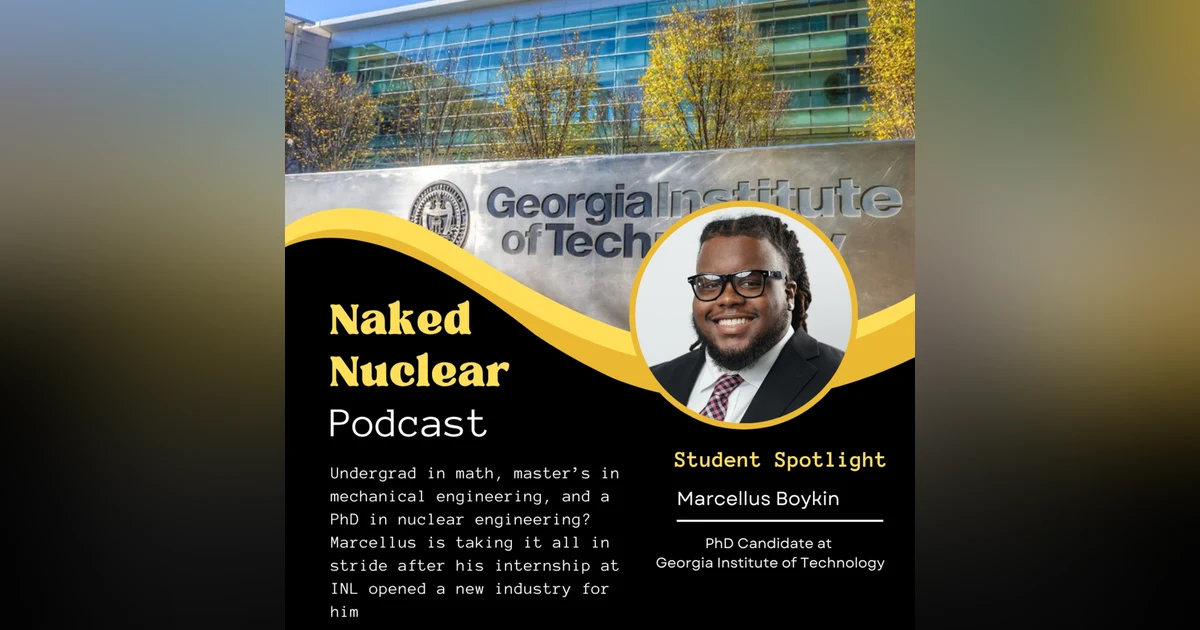
 In this episode, we continue Season 2 with our second Student Spotlight, featuring Marcellus Boykin, a PhD student in nuclear engineering at Georgia Tech. Marcellus shares his journey from math major and football player to shielding sensors in hot cells at Idaho National Lab, presenting at ANS, and navigating imposter syndrome in graduate school.
Learn how he went from:
math --> mechanical engineering --> nuclear engineering
Links & Resources:
-
Learn more about the GEM Fellowship
-
Find internships at Idaho National Laboratory
Listen & Subscribe: Follow Naked Nuclear on your favorite podcast platform and stay tuned for more student spotlights, industry insights, and the future of nuclear energy.
**Naked Nuclear** strips down nuclear energy so it actually makes sense. New episodes weekly. 🎙️ [Listen on Apple Podcasts](https://podcasts.apple.com/us/podcast/id1781924674) · [Watch on YouTube](https://www.youtube.com/@TheNakedNuclearPodcast) 💡 Curious about nuclear careers? Visit [nakednuclear.com](https://www.nakednuclear.com) for episodes, resources, and guest spotlights.
Full Transcript
[00:00:00] Danielle: Imagine walking into your first day at a national lab surrounded by world renowned scientists working with radioactive materials and shielded hot cells, and you're thinking, what am I doing here? That was Marcellus Boykin just one summer ago.
Today he's pursuing a PhD in nuclear engineering at Georgia Tech. But his journey there is anything but typical.
[00:00:25] Marcellus Boykin: The first day was very nerve wracking for me 'cause I get imposter syndrome. I have this idea of where I think I should be at. Just trying to a perfectionist, not necessarily reach perfection, but just. Do as best as I can.
[00:00:40] Danielle: On today's episode of Naked Nuclear, we have a very special student spotlight. Our guest is someone who rewrote his own future, Marcellus Boykin. From a math degree, at a DIII college in Alabama to a mechanical engineering master's at Georgia Tech.
And now into the nuclear space. Marcellus brings heart, hustle and honesty. We talk hot cells, shielding sensors, the GEM fellowship, the nerves of presenting at ANS, and the faith and focus it takes to pursue a PhD program in one of the country's top nuclear departments.
Please stick with us during this episode. We had a few audio glitches, but Marcellus still has so, so much to offer in this episode.
[00:01:24] Marcellus Boykin: My name is Marcellus Boykin. I'm currently a nuclear engineer and PhD student here at Georgia Institute of Technology. I also received my master's in mechanical engineering here at Georgia Tech I received my bachelor's degree, in math at Birmingham Southern College.
[00:01:43] Danielle: Marcellus didn't start out aiming for nuclear. In fact, his first love was fixing cars inspired by his father, also an engineer. Marcellus saw mechanical work as hands-on path that can combine problem solving with physical skill, but an unexpected detour during his undergrad sent him down a different road.
[00:02:05] Marcellus Boykin: Growing up, my dad was an engineer but, I just kind of always watched, that was kind of at the back of my head, but on other side of things, I always loved cars. I kind of wanted to be a mechanic, just like a person who always wanted to have their hands inside of a hood of an engine. I played football within College in Birmingham, Alabama for undergrad. but my sophomore year, they, the list of schools that you could transfer to kind of dwindled down to like two schools. And it ultimately, wasn't any of the schools I wanted to transfer to. So I ended up having to choose, a finite degree at that moment. I kind of weighed my options and I was like, science, I didn't really too much like physics that time, English.
I really don't that either. So. Math was kind of like the final option. I'm pretty sure I can just get through math here, obtain a math degree, then pursue this mechanical engineering degree elsewhere.
Kind of backwards, like how I managed to get there on the lines of how I found out about it.
[00:03:00] Danielle: That math degree turned into an application to Georgia Tech where a mentor introduced him to the GEM Fellowship, one of his chosen placements, Idaho National Lab. One call later, he was headed west even though he didn't know anything about Idaho.
[00:03:17] Marcellus Boykin: So, getting into Georgia Tech, I was working with Dr. Strickland, she works in the C office and so she helped me with the admissions process into getting into Georgia Tech. And so I met all the qualifications. She helped me just like make sure my application was well-rounded. Within meeting Dr. Strickland, she introduced me to the GEM fellowship.
So within the GEM Fellowship you list three companies that you would like to work with, of the companies they have listed. And fortunately enough, INL was one of them.
When I say one of 'em, they were the only one, that reached out to me. For me it was a no brainer because GEM Fellowship helps, financially. I was just like. Okay. I'm spending the summer in Idaho.
[00:03:59] Danielle: So what did Marcellus do at INL in short shield? A highly sensitive Infrasound sensor from massive radiation inside a hot cell. A shielded working space used for handling radioactive material.
[00:04:13] Marcellus Boykin: Whenever I got there, I figured out that the project that I was gonna be working on this summer was shielding an infrasound sensor for INL's field conditioning facility. And within their, field conditioning facility, or they acronym as FCF, they house, a hot cell And so within that hot cell it's a bunch of different processes specifically we was focusing on the element chopper. And what they were trying to accomplish was to sit. A infrasound sensor inside of that hot cell, like a meter away from the element chopper just to pick up readings of the element chopper running. And so just trying to sit that infrasound sensor in that hot cell by itself would obviously just malfunction right away. And so my objective was to shield that in sound sensor. So I did, a lot of CAD and Autodesk inventor, just trying to configure a way that I could shield this Infrasound sensor, but also allow there to be shielding all the way around the infrasound sensor, to put inside of that.
If I had to explain this to a high schooler, I would say nuclear energy is on the rise. The part that I played in is this nuclear energy that's being used uses nuclear fuel and these nuclear fuel in the shape of rods. And as these rods, become old, you have to find a way to rid of them. One of the processes that I was specifically focusing on was the chopping up of these fuel rods. And so within the chopping of these fuel rods, in order to report back to the IAEA that y'all are actually chopping these fuel rods at this time, just to, you know, keep, standards. They use infrasound sensors. infrasound is just sound that's beneath the audible, range of the human ear. They put in these strong sensors that detect sound inside these cells.
This is what they're wanting to do. Just to report these back to the IEA and keep track of what they're doing. Where I step in is I'm gonna create a shield to go around the sensor to stick inside this, very irradiated cell. This, cell is so irradiated that no one can enter in there. At all where it's just like, you'll definitely have, very harsh effects.
[00:06:39] Danielle: As a student, who do you work with and how do you get mentors? Your first time at a national lab can be super overwhelming. So I wanna know if Marcellus had any mentors.
[00:06:51] Marcellus Boykin: My mentor was Dr. Luis Compo and. Was very helpful. We all, he also had three other interns that I was working with, but we all had completely different, projects between Luis and my other three, interns I was working with, really that whole floor of D 200 and so, D 200 and I know everybody in there was very helpful.
I could go all day name and everybody in there. It was very helpful because you're working with a whole group of world renowned, scientists.
Just to have them right there at the palm of your hand, just down the hall, it was, helpful in case I needed to understand how another software worked or if I had another question and we just happened to step away, I know there's somebody else down the hall or around the cubicle, that I can go to.
[00:07:40] Danielle: We'll definitely have an after pop breaking down all things hot cell related. But first I wanted to know. What was Marcellus first day at INL? Pregame Jitters Imposter syndrome, living across the country in a completely new state.
[00:07:56] Marcellus Boykin: So, the first day was very nerve wracking for me 'cause I get imposter syndrome. I feel as if sometimes I don't belong where I am. That was very heavy for me, especially, because I was all the way in Idaho 'cause I have this idea of where I think I should be at. Just trying to a perfectionist, not necessarily reach perfection, but just. Do as best as I can. And sometimes I don't give myself grace. The first day, well the first couple of weeks were very similar because they were full of training.
I spent days doing trainings and then the next two weeks doing literature reviews. It was very different for me, not only because I was at a national lab, but because that was my first time sitting behind a computer streaming for nine hours straight. And so that was very difficult.
Definitely, had picked up a coffee habit. I had to drop it just as quick as I picked it up. 'Cause that was, I didn't, that wasn't something that I wanted to bring back to, Georgia Tech. I did enjoy, run at National Lab. And so you just have, like, you, you're able to stick your hands in a bunch of different areas.
Luis was able to open my eyes to that which eventually, pushed me to pursue my PhD in nuclear engineering.
[00:09:08] Danielle: This is not the first intern or researcher we've had on the show, but a pattern is definitely emerging, which is the power of a good mentor and a strong network. A colleague that could even inspire you to get your PhD in nuclear engineering. Marcellus didn't just intern though. He presented his work at the ANS Winter Conference right after a full-time researcher.
Nerve wracking. Absolutely, but I think it was worth it.
[00:09:38] Marcellus Boykin: It was directly related to the work that I did that was actually what I presented on. And so while I was at my mentor, Dr. Louis He, he was just like, hey, I think you should, create an abstract. And it was funny how I played out 'cause I think the abstract was due like the end of the week, and I had to put it together in a couple of days.
You had to have, introduction, you had to have, theory, you had to have a methodology section and you had to have results.
And so, yes, course he helped me with it, but it was how quick it had to be put together, we got put together. And so, yes, that was, I put that together during the summer that got accepted and then I presented my research and the American Nuclear Society one conference, this past November.
It was very nerve wracking because it wasn't a student presentation. This was actually, a real presentation that like others, scientists were up there, probably somebody's professor out there was up there presenting. And so me being a student, I was right after them. I definitely did a lot of practices, but it was crazy because I had to take, a midterm school doesn't stop
and so, I definitely prepared the best as I could and I did, well, it even helped me get into the PhD program here at Tech just because, the head of the department was, but my, session and so. Nonetheless, it was very nerveracking. I, I know I was up there sweating.
My presentation, didn't get a lot of difficult questions. They were basically just asking me like, okay, if I would do this different, like, how would I change it? And I know, like some of the people were saying, one of the suggestions that they, that, they would probably look at did get a hard, that I had no clue. But luckily he didn't ask me in front of everybody.
And at that time, he was a mechanical engineer or trying to get that, so I knew nothing about what he was talking about, and I was just like, yeah. wow. I'm definitely looking at that next time.
[00:11:34] Danielle: As someone who played football and came from a small liberal arts college, the academic transition to Georgia Tech wasn't always easy, but Marcellus found a rhythm by owning his learning gaps and showing up consistently. I wanted to know what makes Marcellus's tick, what motivated him to strive to be better in the face of difficult challenges?
[00:11:57] Marcellus Boykin: Truly, honestly, I didn't want to do this. It was nobody but God. I would definitely say that. I sat down and I was trying to be finished after I got this mechanical engineering degree. but I felt as if that's what he placed over my life. It looks like I'll be at Georgia Tech a little bit longer. So let's see if I could get into, one of these national labs around here, after I'm finished with this. But definitely I didn't, I didn't know I was gonna be doing this, to be honest. But, now that I'm in it, it's just like, okay, and for me, I just had a mindset, okay, if I start something, I'm gonna finish it.
Continually trying to just motivate myself, each and every day. 'Cause it's hard. I'll be lying if I sit here and say it's easy. I haven't had the same major, none of the three different degrees that I've tried to achieve. so I really don't have the total background of all these, different disciplines that I'm jumping in. it's definitely difficult. But, taking it day by day, that's all I can taking it day by day.
[00:12:58] Danielle: Taking it day by day is a good mindset to have. Simple but sometimes difficult to execute.
One of the questions I always want to know, like every student has to figure out. How are you going to pay for it all? Marcellus breaks down his journey through fellowships, scholarships, and the importance of simply asking
[00:13:19] Marcellus Boykin: So pertaining scholarships. Fortunately undergrad I was at a DIII school so we could get academic help, but, for undergrad I'm still kind of working on that 'cause I unfortunately had to take out student loans. But for my masters, I was able to get scholarships. And so scholarships and fellowships.
So I was a GEM fellow as a master's student, and I'm a GEM fellow as a PhD student. And so, pertaining scholarship, you definitely have to go look for 'em. Dr. Strickland, helped me, just kind of point me in the right direction, pertaining scholarships, that Georgia Tech provide. I'm still trying to figure out the whole scholarships thing for the PhD because the GEM fellowship, they cover you for the first year. And so concerning like your PhD, you have to have funding for the next three or four years after the first year. And so I'm still applying for follow fellowships right now. And some, some haven't opened up right now, but I'll definitely be applying to, more fellowships this upcoming fall that will be activated for the next fall. fall of 2026.
I wouldn't necessarily say it's the easiest thing it is not like, you know, instantly you, whether you receive these scholarships or not. Once you submit your application. So it's like you kind of have to leverage, schoolwork apply for scholarships, and then also having a social life after all of that has gone on.
If you submerse yourself in school the whole time, you'll go crazy. Some people, do it real well, but, that's not me. You definitely have to set aside time for it. You have to take it just as serious as you do your, your, your coursework. And so with it at Tech, like I was saying, I think they have like a tab to where they provide you with, scholarships and fellowships and then the, the, like the links to apply. You definitely have to plan it out accordingly. But I would also say ask peers. So, definitely peers who are older than you. I know that in the graduate space that I'm in right now, peers are also looking for scholarships and fellowships. you may have peers who have scholarships and fellowships, and so, hey, I'm looking for funding, like, how did you find funding?
What did you do for funding? Where did you apply? And so, just reaching out to others as well. Not only using. the resources that tech provides for, your peers as well?
[00:15:34] Danielle: Scholarships can be tricky, but like we've heard in other student spotlights, start early. Get help and ask around.
I also wanted to learn what it was like in Marcellus classes and how hard being in a PhD program has been.
[00:15:50] Marcellus Boykin: They haven't been the hardest. So right now I've, in reactor engineering and I'm in radiation detection. Radiation detection has a lab. You have a 50 minute lecture and then a two hour and 45 minute lab once a week. This was the first time I've had to write a lab report since my freshman year of undergrad, just having to dive back into lab reports, wasn't the best, but we just submitted our last one for the semester this past Monday, so I'm happy that that's over. But yes, all of it has been hard just because, it's a, it is a totally different language and so me trying to. this totally different language, not being at the undergrad level, but being at the graduate level they expect you to come in already knowing X, Y, and Z. And by me having that, I'm having to learn X, Y, and Z plus and the, all the other things that they're. Continuing to provide you to learn and then build on top of that
I'm in, reactor engineering and that's full of heat transfer and, fluids. It is just all the, all the like small meticulous things that happens within a, a reactor that make all the synergy.
And so that's been interesting, because it involves a lot of math, but you also have your engineering skills within that math. It's other courses that you have to understand in order to get that my keys transferred. I definitely say, both of 'em have been pretty difficult, but I'm getting along pretty well. Classes, end, in about two weeks and I'm looking pretty good, heading to the end of things. Definitely had to take it one day at a time.
I entered Tech as a mechanical engineer I know the first week of class coming from Birmingham Southern, was just walking around and after I left my first, class, I was like, why is everybody on their computer so much?
But then, as I went into that second class of the day, I quickly realized, why everybody is on the computer so much? Georgia Tech is very demanding. It's not a regular university. It's an institution. They harp on research they are. Already expecting you to know a lot, and so it's just like, okay, I have a lot of catching up, within the mechanical engineering department, the class sizes are. A max of 50. Although you have 50 students in there, you can still get that one-on-one experience with your professor.
You just have to, you know, sign up for their office hours sure that you're attending class, attending those office hours just so you can create a. That connection. And so that connection was very big for me, because that has allowed me to understand, a lot more just continuing to go into those office hours, trying to, get as much information as I can out of those professors, make those connections, make those relationships. kind of helped me graduate, with my mechanical engineering degree. For the NRE program, so nuclear engineering, the class I just went to about 50 max to about 15 max. And so you still have that, very one-on-one relationship with your professor. But all professors that I've ran into have been very helpful, that I kind of lay down like, okay, what, what, like my background, I have no engineering background whatsoever. Once I laid that down to them, they kind of understood that. And so that allowed them to kind of understand where I'm coming from to help me get to where I need to be. The faculty has been very helpful in both departments. so, yeah, very helpful.
And what advice does Marcellus have to students. Some advice I would give was, don't be afraid to reach out. I had to quickly learn, I don't know everything. I can't do all this homework by myself. I have to reach out to the peers in the class. Coming from a very small private school to a big school like tech, reaching out was the most important thing.
people say, tech is competitive, but it's like the competitive with other schools. And so, but within Tech I don't think you'd find as much competition as you would think. Everybody's willing to help as long as they're not dragging you, they be willing to help.
So what that looks like is showing up in class, not being that person that just shows up once every week instead of twice or once every three weeks. Taking the initiative. I still have imposter syndrome to this day. It happens every semester. Every semester I run into a new challenge and it's just like, okay. I'm at this roadblock, like, am I supposed to be here? Like, why is this so hard? but opposed to reaching out, more advice I would have is sure you in contact with your professors, that has helped me because if you don't show up to class. And whether you know it or not, professors like, no, no. I wouldn't say no matter how big, once you get up to this graduate level, like your classes go from 200 to 50 to now 15 for me. So they pay attention
like you showing up to class every day. That was another one that helped me just by showing up to class every day. I may not ask questions in class because I'm still trying to learn all this information, but if I have questions after going to office hours, being present, making those relationships, will also say, just, just. active on campus because you never, you never know who you run into. They may not be in your discipline, but they may know somebody else who is in your discipline. Reaching out and being active on campus. Has helped me along with, staying in contact with my professors, reaching out to peers, just creating those relationships. 'Cause like you never know who they know.
This is my train of thought. I don't know how to put it into perspective. For others, it was like, I don't want to fail. You want to do good, you're gonna step out there and ask, because if you don't why are you in school?
Nothing worth obtaining. Is gonna be easy. And so if you, because it feels easy, everybody would do it. Because a majority of the time others in there are wondering the same questions that you're asking. Well, they're just not gonna ask. And I guess they'd rather figure it out themselves. But for me, if I don't want to feel, you know, quote unquote dumb, then I'll wait until after class approach that professor, Hey, this is some questions that I have based off of what you just taught.
Like, if you can't, if you don't have enough time right now, cannot schedule an office hour. So if you don't feel comfortable asking in class. Definitely try to schedule office hours. So it was at one point I was taking, mechanics of, dynamics of mechanical systems and I didn't miss one office hour.
[00:22:13] Danielle: I was there every time, every week. all of which are amazing pieces of advice that are simple in the mind, but sometimes tricky to execute. Now it's time for our rapid fire questions.
First question is, do you have any hobbies?
If so, what are they?
[00:22:30] Marcellus Boykin: Hobbies. Whenever I do have free time, I like to take, set a time, set aside time to play the PlayStation five. Outside of that getting together with friends, in Atlanta, other hobbies outside of that. I like to hike so whenever I wasn't working, had. Yellowstone National Park around me, Grand Teton National Park, around me, crazy like the moon. And so I was just like seeing different things. Also working in my car. So having a 2008 Ford Mustang. So, I've had that since I was like 15 and I'm 24 now. So whenever, I have time to wash the car, take it for a drive, just enjoying the world.
[00:23:08] Danielle: Okay, next question. If you were to develop and design a futuristic city. What features would you want in it?
[00:23:19] Marcellus Boykin: City of the future? I'm not a big city type of guy, even though I live in Atlanta. We may have a couple of big buildings. Public transportation. I'm trying to figure out all the problems that I have in Atlanta with transportation and try to deviate from those, so something that you wouldn't have a lot of traffic in.
If I had to create my own city, I wouldn't want it to be big. I wouldn't want 'em to be heavily populated we keep a very small population. And just people that are living there. I think that's like my number one thing that gets on my nerves the most is traffic.
Other things in the city? Just a friendly community where everybody knows everybody. Very quiet.
[00:23:59] Danielle: Favorite food to eat or like favorite dish, like your go-to meal.
[00:24:05] Marcellus Boykin: My go-to meal every day is chicken, rice and broccoli, but when I don't want that, it's either a steak or a steak quesadilla.
[00:24:16] Danielle: What position did you play in football?
[00:24:18] Marcellus Boykin: Tackle the Birmingham Southern number 90.
[00:24:22] Danielle: You had to give a TED talk on a non engineering or nuclear related topic, what would you choose? This is a good question because it's like many pathways I can go down. Okay. slow drivers not driving, the appropriate speed in the fast lane. That's something that I think a lot of people need to understand. You have different lanes for different speeds, that's the TED talk. Knowing how to drive at certain age, you should take the, the drivers test again. I don't think once you get it at 16, you should still use the same test, I think there needs to be certain lanes for certain ages or certain experiences. That is the TED Talk?
Final question, let's see. If you were to go, vacation, travel anywhere and spend a whole week, all expenses paid, where are you going?
[00:25:13] Marcellus Boykin: I'm gonna go outside of the United States. I want to try, Tokyo. Just because I'm a big car guy and I know the car scene is really popular. To, try different culture, see things I've never seen before, all expenses paid. I know that flight probably cost an arm and a leg, so I definitely wouldn't want to take, all expenses paid like somewhere in the United States. I'm pretty fashionable outside of school. I would like to say something like, I like trying different stuff when it comes to clothes and so, you know, when, when the school I, I, I keep it nice, clean cut, but outside I try different things.
[00:25:48] Danielle: Awesome. Okay, so for the future, for what you're looking at doing, after you get your PhD, what's next for you that you, you know, you wanna kind of tackle? You wanna challenge?
[00:25:59] Marcellus Boykin: After this PhD it's time to get into the real world. It's time to find a job. I'd definitely be looking for a national lab setting, that can kind of house what I like to do, what I'm interested in at that point. 'cause with me, I'm still trying to figure out like what I'm going to tailor my PhD towards.
It'll be towards the non-proliferation sector just texture and measurement. After that, school is over with. I've had enough school by then, that it's time to okay, actually use what I've learned, and, and be an impact somewhere else.
Thank you so much for allowing me to come on here and talk about what I've been through, what I have going on, have a blessed one.
[00:26:35] Danielle: From hot cells and shielding to hiking in Yellowstone and dreaming of Tokyo Marcellus Boykin's journey is one of bold pivots, quiet determination, and a whole lot of learning on the fly. If you're a student wondering if you belong in nuclear, this episode might be your sign.
You don't have to know it all. You just have to keep showing up. A huge thanks to Marcellus Boykin. for sharing his time, insights, and honesty with us, and another thanks to his mentors. If you enjoyed this episode, please, please leave a review, share it with your friend, or better yet, share it with a student who's on the fence about nuclear.
Until next time, stay curious.