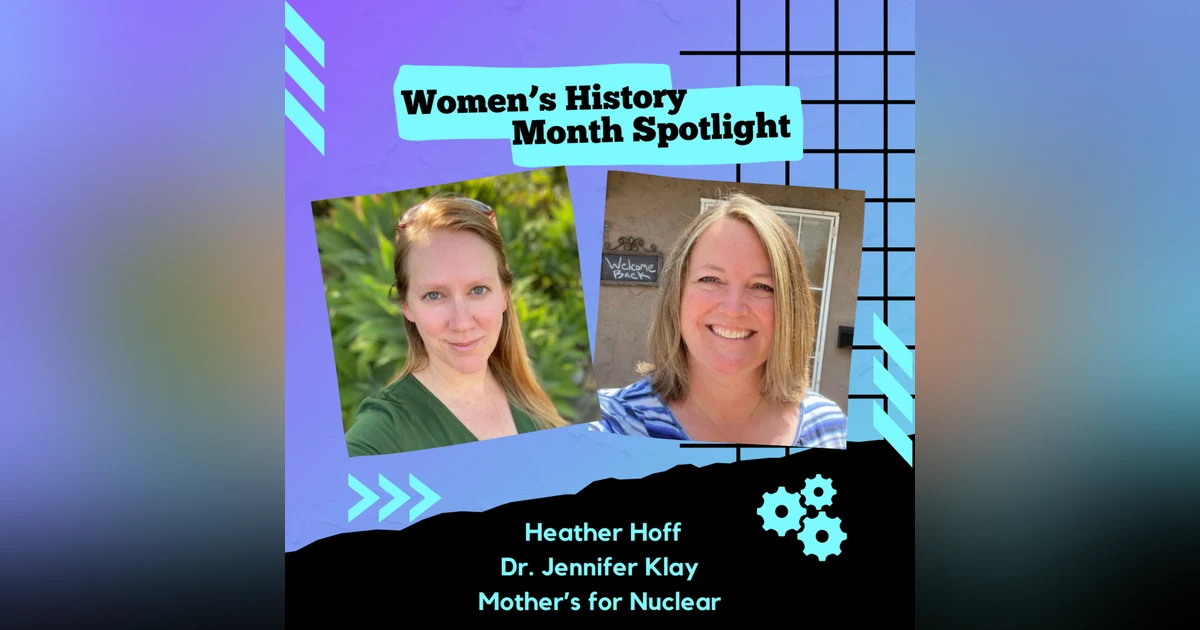
Women's History Month Spotlight: Mothers for Nuclear & The Diversity of Thought


 RSS Feed
 In this special Women's History Month episode, we dive into the world of nuclear advocacy, mentorship, and the wisdom of motherhood with Heather Hoff , Co-Founder and Vice President of Mothers for Nuclear, and Dr. Jennifer Klay , a nuclear physicist at Cal Poly and Secretary of the organization. Together, we explore how mothers, educators, and industry professionals are shaping the future of nuclear energy.
From the role of storytelling in advocacy to keeping Diablo Canyon open, to tackling the nuclear waste conversation with communities, Heather and Jennifer share their unique experiences and insights into why diversity of thought is essential in the nuclear industry.
- The origins of Mothers for Nuclear and why moms make powerful advocates for clean energy.
- How the younger generation is shifting perspectives on nuclear energy.
- The pivotal role of storytelling in changing the narrative around nuclear power.
- The challenges and rewards of being women in the nuclear field.
- Consent-based siting and why community engagement is key in nuclear waste storage.
- The importance of mentorship and education in nuclear energy.
Stay curious and join us for this inspiring conversation that challenges assumptions, celebrates scientific curiosity, and highlights the power of advocacy.
Learn More & Get Involved:
Mothers for Nuclear – Explore their mission and how to get involved.
Connect with Us: Follow Naked Nuclear for more insightful conversations on the future of energy.
Subscribe & Follow
Don't miss our Women's History Month series , featuring inspiring leaders in nuclear energy—from students to industry pioneers. Subscribe to Naked Nuclear and follow us on social media to stay updated on the latest episodes.
#NuclearEnergy #MothersForNuclear #CleanEnergy #WomenInSTEM #NakedNuclear #DiabloCanyon #EnergyAdvocacy
Full Transcript
[00:00:00] Danielle Allen: So welcome to this special edition of Naked Nuclear where we are celebrating Women's History Month by highlighting the voices of trailblazing women in nuclear science and engineering. So today I've got the privilege of introducing two extraordinary guests whose work is like literally shaping the future of clean energy, which is like pretty exciting.
We have Heather Hoff and Dr. Jennifer Clay. So Heather Hoff is the co founder of Mothers for Nuclear, a movement that challenges misconceptions around nuclear energy and advocates for its role in sustainable futures. As a mother and a nuclear professional, Heather's journey is deeply personal. She once questioned her role in nuclear before outside of working at a plant.
But now she realizes the potential of being able to help future generations understand why nuclear energy is so impactful. Dr. Jennifer Clay is a professor of physics at Cal Poly. She specializes in high energy nuclear physics, and that is as amazing as it sounds. Um, not to mention she's also shaping the future of future generations of physicists and engineers by bringing complex nuclear concepts to life in the classroom with her research.
Together, Heather and Jennifer are embodying what it means to be both activists and scientists and engineers while shaping the future of this industry. And I'm super excited to have you guys on the show today.
[00:01:26] Heather Hoff: Thanks so much. We're excited too.
[00:01:27] Danielle Allen: And I've never actually interviewed two guests at once. So I'm like even more excited, um, for this.
So one of the first things is I wanted to kind of understand from your guys perspective of being parents. Um, and Why is it that the climate crisis, energy generation, why is that so important as a parent to kind of really understand? Yeah, you, yeah,
[00:01:54] Jennifer Klay: Should we just jump right in? I'm happy to,
[00:01:57] Danielle Allen: Jennifer, I see you nodding first, so we'll go with you.
[00:02:01] Jennifer Klay: you know, I have three children. They're all now teenagers, a 16 year old and 13 year old twins, and I care about the that we're going to leave for them. And I want to make sure that climate change, which is the biggest existential threat to our civilization at this time. That we address it. And so, uh, you know, being an advocate for nuclear is a lot about trying to show them that I am doing something to ensure a safe future and a clean energy future for for their generation.
[00:02:36] Danielle Allen: Nice, nice. And Heather?
[00:02:38] Heather Hoff: yeah, it's a great niche to be in because, um, yeah, we could advocate for other clean energy, but there's a lot of people that do that already and nuclear has been, um, you know, kind of on the kind of hidden side of clean energy generation for a long time. And so, as mothers and women, I think it's really vital that we speak up and share our voices and experiences and help other mothers and women feel comfortable that nuclear is the right answer and.
part of the solution and um, also rewarding to have our, our children, you know, see that we're doing something that's going to impact their futures in a positive way.
[00:03:11] Danielle Allen: Yeah, for sure. And just getting into some of those like, Misconceptions or reluctances around nuclear energy. To me, it sounds like nuclear energy almost feels like the minivan of the energy world where it's kind of boring in in in in this actual energy production. Um, but then what we also have is the ability to generate lots of energy and lots of power.
And so I know for, you know, Yeah. Myself. I'm like, I don't want to buy a minivan because it's not the cool thing to do. So I guess, how are you guys showing other people within the energy space or just like moms and dads, you know, across the country, why nuclear energy is that vehicle that we need to like hop in the van for?
[00:03:59] Heather Hoff: Well, I would say that, um, maybe moms aren't always, always the coolest, um, you know, with our vans, but, um, I'm super excited that there's other people that are making nuclear cool, like young people and influencers and people that are making really cool videos about, um, bananas. Climbing containment domes and and doing like all the stuff that maybe moms aren't leading the the conversation on but um Yes, nuclear is definitely a workhorse and, um, does so much of, uh, the, the results driven like cleaning up our grid that people don't realize is happening in the background.
And so I think we need to talk about it more and we need to recognize it more.
[00:04:42] Danielle Allen: And for Jennifer, yeah, you, you as well, like some of the reluctances and, and you have worked with students. So what are you seeing kind of on the student end as well?
[00:04:51] Jennifer Klay: You know, I see because this generation didn't grow up with the same fear of nuclear that, that my generation did, they're just generally curious about it and they want to learn more and they don't have the same, um, preconceived ideas about it, although they've, you know, what they've learned from the cultures, the things like the Simpsons and, um, you know, movies and, and pop culture has certainly influenced them, uh, but I find that they're just generally curious and they want to learn more. And, um, some of my most well attended, uh, presentations and talks are the ones I give about nuclear energy because students just, they, they haven't heard enough about it. And once they do, they want to learn more.
[00:05:42] Heather Hoff: You're on mute.
[00:05:46] Danielle Allen: That's awesome. The generational differences I think is another big one that we don't really maybe consider when we're thinking about just like energy production and things like things like that. Um, I guess one of the, the, the next questions I had was on this movement of like the Save Diablo Canyon.
Can you guys take us through kind of the What I think we'll look back on in American history and be like, that was the movement to to maybe follow suit. Um, that maybe has a lot of global, um, um, a way that the global, um, How, hmm, but what I was going to say is, yes, the global repercussions of closing down nuclear power plants versus what you guys are doing, which is actually, hey, we actually need to not do that.
Yeah. Yeah.
[00:06:34] Heather Hoff: an iconic plant, and you can see some pictures back here. This is with a whale jumping in front of Diablo Canyon, and this is like this amazing poster that we made. It's surrounded by nature. It's beautiful, and it has a lot of history, too, of anti nuclear protests. Some of the largest in our nation happened right here in San Luis Obispo, um, speaking of generational gaps or divides, you know, a lot of those people are aging up now, and it's just, uh, Some of them are changing their minds still, which feels pretty amazing and impactful. You know, Jane Fonda, when, um, the, the proposal to like keep Diablo Canyon running was still first kind of floated said, well, I don't really like it, but yes, I think we need Diablo and that was just huge, you know, she was in the China syndrome and, um, it, that, that it's just, it's, it's showing a big shift and, um. I think also some of those people maybe won't and aren't able to change their minds and think again and that's what's so refreshing about students. I don't see them quite as much as Jennifer does, but every time I go to a classroom and I talk to students I'm just like, oh my gosh how come I don't do this more because old people's minds is hard, but like just kind of like shaping young people is just so invigorating and encouraging and they're so curious.
And so I would like to say to all people, regardless of your generation, curiosity is really key. For me, I had to ask a lot of questions about nuclear before I was able to start kind of realizing how great it was and realizing that a lot of my fears were misplaced. And so, yeah, stay curious and ask a lot of questions until you get to your truth.
And for me, my truth is definitely centered around nuclear energy being a huge part of our clean energy future.
[00:08:17] Jennifer Klay: Well, and I think back to your question and your point about the Save Diablo campaign and the influence that it's had, I think part of that is because so many of us stood up and said we want this plant to stay open, and we were coming from so many different directions, and the Mothers for Nuclear was a new voice in that advocacy space. It gave, uh, people the opportunity to, you know, take a second look and rethink. And, you know, I think the fact that our state government, you know, recognized the value and importance of this plant to making sure that California has a reliable, clean energy on the grid, able to deliver to all the people that need it. was wonderful. And I think we helped make it possible for them to recognize that there's public support behind this as well. So I think that, uh, it was really gratifying to all the grassroots efforts we put in, uh, to, you know, advocate for this, to talk to people, and to see that shift and that change, um, it, it, it, you know, it, it feels good to know that we made a difference.
[00:09:27] Danielle Allen: Yeah. And that's, I guess one of the questions is, how does one just like organize people? I think that's, that's something that to me from the outside, I'm like, that looks very difficult, like maybe herding cats.
[00:09:38] Heather Hoff: don't know. We know nothing about that.
[00:09:43] Jennifer Klay: Well,
[00:09:43] Danielle Allen: Yeah.
[00:09:44] Jennifer Klay: Heather is an expert at it and she's brought a lot of people together. She brought me into the fold as well. And so, um, you know, it, it does take dedication and passion and willingness to go have hard conversations with people. And that's something that, that, you know, she's. Heather, I'm going to compliment you here.
I mean, she's been, uh, you know, a role model for so many of us in how to do this. And, and I think, uh, we we've all learned a lot together and from her and, uh, yeah, it's amazing to be a part of this group.
[00:10:18] Heather Hoff: Thank you. And I think that speaks a little bit to diversity of thought and why that's important also is I feel like I'm a little bit bonkers sometimes. And maybe, you know, because I've been an operator at Diablo Canyon, like it's kind of a thing that we're like, operators are obnoxious. You got to be a little obnoxious to like, keep talking about the same thing. over and over and over again when everyone thinks it's a lost cause, you know, so it's um, but yeah, we need like every angle of people pushing and talking about it to, to really, you know, reach all the people that need to make a decision to change the future.
[00:10:52] Danielle Allen: Yeah, that that is actually really important. I think is the diversity of thought. One of them is being able to get a group of people who have different angles and perspectives of being able to see a problem from multiple different sides. But I guess the other thing that I wanted to go just a little bit deeper on is how do you start to pull in people into your sphere and like, like, you just, You hear people and you're just, hey, like, I think you'd be good at this.
Like, what does that like recruitment process look like?
[00:11:22] Heather Hoff: Well, yeah, it's interesting. And it's honestly, when I said, I don't know anything about it. I'm kind of telling the truth that we kind of just decided to put our stories out there like here we are. And maybe we'll do some good just by existing. And we do people are like mothers for nuclear. That's So, um, you know, having that name out there and that concept out there I think has been powerful and then just providing mechanisms for people to write in and share their experiences I think is powerful like everyone has this story and that's something that our nuclear industry hasn't really focused on much in the past.
And at Mothers for Nuclear, we're all about storytelling, like who are you and what about you, you know, like makes it that you support nuclear. And yeah, I think that's just very, very powerful for a lot of people.
[00:12:15] Danielle Allen: Yeah, I think the storytelling aspect is definitely one that within the nuclear space. It's not leading the charge. And so it was, it's a very different I encourage people who are listening to like go to your guys's page and then start to get into the stories. Because I think people see themselves in the stories, which is another really amazing thing.
I guess one of the things that I was wondering about as well. Um, for you, Jennifer, with working with students, um, how, how long have you been a professor and an educator?
[00:12:47] Jennifer Klay: Yeah, so I've been at Cal Poly since 2007. Um, and so 18 years, something like that. And, uh, interacting with students, uh, both, uh, doing undergraduate research. So we're an undergraduate institution and don't have graduate students. So all of our research is done with undergrads and teaching classes and getting to know them and bringing them into this. Um, you know, this field, uh, it's, it's, it's been gratifying. It's something I'm very passionate about because, um, you know, when I was an undergraduate, I wanted to get into research and I wanted to work with people and so I'm hoping and I try to provide that opportunity to students who, like me, might not have been like the top of the class and like, you know, next Nobel Prize winners, but really passionate and interested in physics and want to learn more.
[00:13:36] Danielle Allen: Okay, that's good to know, like that, that passion is also what can get you into a lab and into doing research as well. I guess over, over the span of 18 years, um, what have you seen change within students as it relates to, you know, what they're saying about the climate or what they're saying about nuclear energy?
[00:13:55] Jennifer Klay: Well, I would say definitely climate change is the issue that they are most concerned about as far as, uh, you know, like impact for the future. and that's been true ever since I got here. Um, I would say we didn't do a lot of talking about nuclear energy until I started being more engaged and actually Became a mother for nuclear in, in 2016. Um, and it's part of my story, like this transformation of realizing how important nuclear energy is. And the fact that it's my field of study, that I can be a voice that can help students learn more. Um, and so I've built a lot more into it. So I would say. Since I started, you know, getting into that, um, advocacy, I, I'm having a lot more conversations with students. They're more interested in it. They're learning to be advocates themselves. Um, and, uh, not to be experts. I tell them, you don't have to be an expert in this to be an advocate for it. And if you express to other people, hey, I'm just learning still too, but do you want to learn with me? Because we need to make good decisions and the best way we do that is to learn more about. All of these topics. So that's, that's been the last eight years or so, you know, like the, the way that I've engaged with students and, uh, we, we actually last year helped, uh, Cal Poly create a new chapter of a club called, uh, NICE, which stands for nuclear is clean energy. And, uh, the club is going strong and, uh, they're, they're headed to Diablo Canyon to do a tour together, uh, in early March and, uh, they have weekly meetings and they're really excited about it.
[00:15:41] Heather Hoff: I feel like you felt my brainwaves right now, Jennifer, because I was like, tell her about nice, tell her about nice. Yeah,
[00:15:50] Danielle Allen: That is that is awesome, though. And I think, you know,
[00:15:52] Heather Hoff: passionate.
[00:15:55] Danielle Allen: in from from the perspective of like, you know, research and studying and things like that nature, also being an advocate, I think, definitely give students a very different perspective, maybe. Um, because I, I think about the professors that I've had and when they are passionate about like, you know, telling the world about a certain topic, um, it usually has a lot more authority, almost like this is a very scientifically minded person.
Here they are saying like, Hey, we should maybe go further down the road with this thing. Um, so I think that's another kind of interesting, um, probably impact that you have on your, on your students as well. Uh, right.
[00:16:35] Jennifer Klay: right before, uh, this podcast, I was doing an event where we bring students from high schools, uh, to Cal Poly to learn more about. Our programs and what we do and I met a student who's uh, interested in nuclear physics because now interestingly it's because he saw the movie Oppenheimer but he wanted to learn more and he's passionate about nuclear energy and nuclear physics and I was like, oh come, come join California, we want you. and uh, it's, it's, yeah, it's exciting to talk to those students who are really passionate about it and them know that there's a place for them here and that we will So, you know, bring them in and let them learn and grow and, and, and explore those interests that they have and, and, uh, their own expertise.
[00:17:20] Danielle Allen: Yeah, that's amazing. And I guess from, you know, from my perspective, um, I'm not a mother, but I have taught a bunch of science classes, English classes and all that. And I guess I'm just wondering, you know, from, Mothers for nuclear's perspective. Um, it almost like shepherding these younger generations just kind of seems very natural for you guys to be like, Come on, students.
Like, I know you're not my kid, but you're somebody's kid. Like, come along. Um, what have you guys found amongst other mothers? I would say, um, that maybe don't know anything about nuclear or just are interested. Like, how does that conversation and dialogue work? Um, especially because you are shepherding so many of these students into, into this advocacy.
[00:18:05] Heather Hoff: I'd say it's been an interesting shift for me when we first started Mothers for Nuclear. Our kids were pretty young, and so it was a lot of, like, the mom groups and the playdates where, like, I can't stop talking about nuclear, and they're all like, What is this other mom talking, you know, like? And so it just like it became a part of our play dates and I don't think anyone really expected that including me and when we first started also, we were largely focused on saving existing plants and the conversation has shifted so much that we're, you know, reopening plants. And we're, um, definitely like not even, you know, really talking about plans that are under threat, except, you know, in Germany and Belgium, they have some work to do. so yeah, we're, we're still working on those, but largely we're shifting as an organization to a more like future, looking, um, strategy where we have to, you know, bring up the nuclear workforce, um, so that we can build more nuclear and new nuclear and, um, encouraging the future generations to help make this happen.
[00:19:13] Danielle Allen: Yeah, that that is awesome. I think just like the magnitude of, Hey, we're looking at shutting down all of these nuclear plans to actually want to keep them open, actually want to build some new ones. I think that that story arc is really quite, um, quite large. Um, and, and definitely goes to show like, you know, the power of a, of a grassroots, um, movement.
And I guess As women in the field, like, have there been, you know, do you find that there's more camaraderie among other women within STEM, within engineering, within kind of academia, um, that you, that you are able to work together a little bit better?
[00:19:57] Jennifer Klay: Well, you know, it's interesting. Um, I think people and my generation who are in, you know, roles of being professors say at Cal Poly, you know, they may also come with those preconceived notions about nuclear. And, uh, even among, you know, colleagues in the physics department who aren't nuclear physicists, they just don't know very much, and their, um, awareness of nuclear, you know, is from, from the culture or from whatever their background is, and so we have conversations now more frequently about things that they don't know much about.
And they come to my talks and learn things that they didn't know. And, um, you know, several of them have told me, I, I had a negative opinion of nuclear until I started learning more and talking to you about it. And, you know, you're a colleague that I respect and you clearly have thought through this carefully and you have, um, A lot of information that I wasn't aware of, so tell me more, and I, I, they feel a bigger sense of trust because they know me, they know my expertise, and, um, they're rethinking their own, you know, ideas about nuclear based on that, so that's rewarding.
[00:21:09] Heather Hoff: And regarding camaraderie of women in our industry, like at the plant, you know, I was, when I started as an operator, I was the only female operator and I was the first, you know, operator to ever go through pregnancy at the plant. And there's, you know, like a lot of things where I was kind of alone. And, um, It's funny when I got my day shift job writing procedures instead of, you know, being on shift and operations.
Now I have a desk in the admin building and I would go in the restroom and there would be another girl and I'd be like, hi, how are you? I'm Heather, you know, like, let's be friends. And, um, it's, it's really, um, great that. Of the women that work in nuclear, we, we all are really supportive of all each other because we recognize that there, there is, you know, some strength in numbers and um, we, we do have to, you know, change some things about our culture to make it easier for women to be in these roles where we, we haven't historically had, had much of a presence.
And, um, sometimes companies don't think about all the things that are just kind of inherently built in. That make it hard for a mom, you know, to be an operator. It's, it's a pretty challenging thing and also a pretty limiting, um, you know, set of solutions. And so I hope we get a lot more creative in the upcoming years and we bring more and more women into these spaces because I've seen the diversity of thought. in an operations crew, it's way different when there's a woman or two or like hopefully a little more balance and we do a better job. We cover all the bases and just different ways and it's really valuable. And so, yeah, I hope to see a lot of shifts.
[00:22:45] Jennifer Klay: Well, I would say, uh, one of the interesting things we did recently here at Cal Poly is we hosted, uh, the American Physical Society. We were a host site for one of the conferences for undergraduate women and gender minorities in physics. So we brought about 150 students from around California and the western region of the United States, uh, to our site for a three day conference. And we took advantage of our proximity to Diablo Canyon. And we had a plenary speaker, uh, who gave like a, a keynote address to our students about, um, nuclear energy, careers in nuclear energy. That was Kristen Zaitz, another, uh, board member of our Mothers for Nuclear team. And also, uh, an employee out at Diablo Canyon, and we had, um, her speak on Friday evening, and the students, I mean, all of us, I would say, were just, uh, totally blown away by her presentation, and,
[00:23:45] Heather Hoff: I cried. Yeah.
[00:23:48] Jennifer Klay: inspired.
She told her story. She talked about the experience, why she supports nuclear. the next day, we had a career fair, and PG&E and Diablo Canyon were there with a table at our career fair. And it had so many students. And I was eager to learn more about that opportunity and I and we've basically sent them more information and follow up after the conference about internships with Diablo Canyon. And I think that that just created a lot of excitement among that group of young women who are women and gender minorities who are, you know, looking for what am I going to do with my future with my career and this is now an opportunity. that we showed them is there for them. And I think that that was really rewarding to be a part of that from the physics, uh, department perspective, but also from Mothers for Nuclear and, and our connection with Diablo.
[00:24:47] Danielle Allen: Yeah and I think what's always funny is we maybe sometimes look over the idea of like a role model um and you know you say like if you can't see it you can't do it or if you can't see it you can't believe it but there is actually a lot of power to that sentiment of like the roles that you all are playing right now people can see it and be like oh I never considered doing that I want to do that.
And it kind of goes the same way with with women who are in spaces that have there have never been women before, where they're like oh yeah we never considered you breastfeeding at work, a closet. Does the closet work?
[00:25:24] Heather Hoff: Yeah.
[00:25:25] Danielle Allen: And so I think it's, it gives, you know, this holistic perspective, um, that's definitely much needed within the science fields, uh, to be able to have this balance and this more, this greater, you know, uh, heuristic that we're, that we're really working from.
Um, one of the other things I, I saw you guys, were doing is the consent based citing, um, and, and got a grant for that. And so can you guys like just go into what was that process? Like why you thought that, you know, that was necessary that you wanted to apply and, and really what, what even is it?
[00:26:02] Heather Hoff: Okay. Jennifer's being silent. So, yeah, I mean, um, I spent a lot of years of Mothers for Nuclear kind of like, I don't want to talk about waste, you know, I want to talk about clean power generation. Like, the waste is not a big deal. I just, I don't want us to focus on it. And then this kind of opportunity presented itself and we're like, okay, maybe we should, you know, like. pretty good at communicating about nuclear now. We've had some practice and we have some ideas of what we need to do a little differently that might work and maybe we should enter the conversation a little bit more on waste. It's one of the biggest issues that a lot of people have and we, you know, go into communities and talk about that differently and help change some minds?
And so, yeah, that was part of our thinking, is pretty practiced now at talking about nuclear, maybe we could do some good in terms of, know, advancing our progress on that situation and making it so that that big question, what about the waste, doesn't get in the way of more nuclear, new nuclear, all the other advancements that we need to make.
[00:27:08] Jennifer Klay: it was interesting this morning. I, I gave a presentation in a class called Energy System. society and the environment. Um, and I was invited by the instructor to come and talk about nuclear energy. And I, I, I chose to use my time to ask them questions. And I asked the students to tell me what they knew and what they were. Concerned about and, uh, long term storage of waste was their primary concern and so we that's what we focused on as far as talking information wise and it connects back to our consent based siting like the what we're doing to help people understand, um, what that is and how it's managed and what it would mean if it was brought to their community, that's a really important piece of what we're doing right now. And having those conversations is helping, helping us be better at communicating about it and helping get that information out to people who, who have those concerns.
[00:28:09] Danielle Allen: Gotcha.
[00:28:10] Heather Hoff: so interesting to talk about consent. Generally from communities on projects like this, and we just met with 1 of our local legislators where recently we've had a battery fire in our district. And we've had some other legislative changes that kind of take the community out of the conversation for new new new energy. Projects and the states like we want to do this clean energy project. We're not even going to ask you. We're just going to do it. um, yeah, and so we had a great, um, kind of opener to talk about how nuclear leads the way on the idea of consent based siting and why that's so important and how, you know, we have some hard lessons from Yucca Mountain to learn and, um, that, Maybe other energy types should kind of follow in the footsteps of how to talk about all the issues, even if they're complex, you know, communities need to have a say and they need to have some buy in.
Otherwise, projects are going to fail a lot. And we've seen that for renewables and transmission, you know, as well as nuclear waste.
[00:29:15] Danielle Allen: Yeah, definitely. I think that's that's one of the, the ones that the idea of consenting with a, with a community or with a, with a group of people to the actions that the state, or, you know, maybe a utility company is going to do is maybe a little foreign to some people the idea of that like, we've never talked about this before like of us giving an okay like you want our input and I think earlier this season, we, I got to talk to Ryan, um, and then with the tribal consent based coalition and going through and, and answering a lot of the questions around, you know, what is nuclear waste?
How much of it, what does long term storage look like? Um, and I guess one of the questions they have is, is, is from these, um, meetings, um, do you guys have like a before and after? Like somebody comes in, they don't really know anything, but it sounds like nuclear waste just. Sounds bad versus to like the after even Jennifer with your students that you were you were talking with Um, what was like that before and after looking like
[00:30:19] Jennifer Klay: Well, with the students, for sure. I need to close the loop with them now that, you know, we've talked about it. I gave them some information. on that specific topic that they were curious about and concerned about. Um, and I told them I would follow up later and just find out like, you know, how they felt about it after having talked to me. And I think that, that'll be an important way to, you know, kind of understand what is the effectiveness of, of these conversations and, and um, you know, where are the issues that, that linger and still need To be addressed. and that can you rephrase your question again? Make sure I answered. I want to make sure I answered it
[00:30:58] Danielle Allen: yeah Yeah, it was just mostly like when when you have somebody who is concerned about nuclear waste going into you know, a meeting or a talk Um, what what are their concerns and then I guess how do they feel after those concerns are addressed?
[00:31:12] Jennifer Klay: Yeah, and I mean, I think in the way that we have done our workshops as part of this consent based signing project, um, that has been a piece of it, uh, and so one of the things we do is, you know, introduce ourselves and, and talk about the, um, you know, why, why we're there and what we're there to talk about and, and get, and take a snapshot of their, um, opinions before and after the workshop to see how they, you know, You know, their opinions have evolved after, um, those dialogues, and, um, you know, that's, that's data that we're gathering and, and analyzing and, and plan to publish when it's ready.
Yes.
[00:31:54] Heather Hoff: the students questions, and we do that in our workshops to, um, we, we want to really kind of dig into why is someone concerned and what exactly are they concerned about? And a lot of it is kind of listening rather than telling someone, like, your concern doesn't matter because it's so safe because of all these barriers and all this concrete and all this stuff, you know, like. What are you really worried about? And so we've had some kind of surprising revelations on that. One guy when we have had a workshop in Salt Lake City, um, you know, kept making comments about the nuclear industry and how like we didn't manage risk very well. And we're doing all these dangerous things.
And like, Oh, gosh, this guy is going to like kind of impact our whole workshop and everyone there who's listening. But we kind of you. We asked him some questions and really dug in and he had overheard some conversations with people in advanced nuclear talking about kind of rolling back some regulations. And, um, you know, people outside of our industry, when they hear stuff like that might get pretty skeptical, like, Oh my gosh, that sounds scary. That's bad. Like, nuclear, they don't want to have regulation. And so he had this perception that, um, we were then, you know, able to talk about and like, we think about it, what do we see, you know, in our jobs and really gave him some different context. I was totally surprised at the end of this kind of tabling session that we had with him, he was like, guys gave us a whole lot of, gave me some different information. I'm going to go back and like, re examine my assumptions. I'm going to go look at like, where did these things come from that I'm thinking, and I was just blown away, you know? So, um, I think it's really important to, to try and understand. A concern before you try and address it.
[00:33:43] Danielle Allen: Yeah, okay, gotcha. That, that actually is really fascinating because I think that's, that's a really useful skill that is practiced frequently in science, where you make an assumption and you're like, I think this is right and then you test and you're like, ooh, it was really wrong. But that's not necessarily the case for everybody's career field and what people do on a day to day basis.
They kind of work out of these frameworks that, you know, I've been doing this for 20 years the same way and it's worked that way. And to put yourself in a new perspective of being like, oopsies, I was wrong. Here's new information. Here's my evolved thought processes. Quite refreshing. Um, so I think it is, you know, really cool to see that you guys are, um, having this impact of, of, you know, not just coming in and saying, like, let me tell you all about nuclear, but opening up the dialogue to be like, what questions do you have?
And what are your concerns? And then using the information that you have to be able to inform, um, because it seems like it is pretty effective for, for the, for the audiences that you are, you're reaching out to, um, which is like,
[00:34:50] Heather Hoff: our workshops so far have been, you know, fairly small, like 20 to 30 people. But, um, the surveys that we've done and the data that we've collected with Robert Hayes from North Carolina State University. He's a nuclear engineering professor there. um, like Jennifer said, the surveys where we kind of test, you know, what do they think before and then what do they think after we have these workshops with them have shown a lot of improvement in terms of, know, general attitudes towards nuclear.
So we think it's working.
[00:35:20] Danielle Allen: Nice. And are you guys in a certain area or are you going around the nation?
[00:35:25] Heather Hoff: So there's 12 different teams that were awarded this grant from the Department of Energy, and they are geographically spread out, and we also want to be geographically spread out. We want to have conversations and kind of capacity building across the country at this It's a very open or early phase of the consent based citing process and it's basically like the more conversations and the more people that you can interact with and just kind of explain what consent based citing means or might mean and get their input on what they think it should mean. The better. So yeah, we're trying to go, um, to, to lots of variety of places and maybe also to places that have, you know, historically not been involved in conversations like tribal, um, entities and, um, mothers and women.
[00:36:13] Danielle Allen: Yeah. Um, and now that I'm kind of really thinking about it, it does kind of shift the perception of nuclear in a different light and like through the future of like, just how you go about. engaging with the community. Um, and I think it's super impactful as well because it's a lot of trust based. Um, like my assumption would be like, most mothers wouldn't want nuclear waste in their backyard.
It sounds like, uh, um, but have you kind of found that, you know, these conversations are kind of shifting the way that people think and react to things like nuclear waste or radiation?
[00:36:52] Jennifer Klay: Um, yeah, and I think, you know, you touched on it a little bit, like, if you just approach it directly with, I want to go put this waste in your backyard, what do you think of that?
[00:37:02] Heather Hoff: It's terrifying.
[00:37:02] Jennifer Klay: Yeah, it sounds terrifying. But if you start by having a conversation about what, what are your values and what, what, what's important to you, and then how does this potential, you know, consent based siting, how does, how does this repository in your community, how would
[00:37:20] Danielle Allen: Yeah.
[00:37:20] Jennifer Klay: align with your values? Like, those are, those are a way you can talk about it that invites people to think more curiously about, oh, Something I would have thought was scary and dangerous might actually be beneficial and, uh, good for my community. And I had no idea of that beforehand, but because we're talking about it, what, what are our values?
We care about the environment. We care about clean energy. Um, and, and starting from that perspective and then, and then bringing in the conversation about how, how can we support those values by doing things like You know, placing, placing a, a repository for used nuclear fuel in this or that community and would that mean?
Like that, that's how you get to, to talking to people and building that trust. And it's not a direct assault, but more of a conversation and a dialogue.
[00:38:15] Danielle Allen: Yeah, that's and I feel like it also goes back to like the diversity of thought idea of, you know, if we're if we're taking like that, you know, 60s mindset and being like, all right, in the 1960s, we did it this way, we're going to continue to do it this way. I don't think you're going to have the same exact.
Response from communities, and they're probably gonna shut you out and be like, No, thank you. I don't want to do it that way. Um, so I think it is also really cool to see this evolution of the way that things are done and not just, you know, for the climate but for communities as well and Probably does also help just to have that perspective of mothers in this seat being like, Hey, I'm a mom and I would like it maybe somebody to explain to me, you know, would this, you know, help, hurt, be neutral for my children and my children's children.
Um, so I think that's like a really
[00:39:08] Heather Hoff: and, yeah, kind of delicate point still, you know, I think disadvantaged communities often get stuck with, um, these projects and, you know, pollution and things that, um, it's, it's a huge, you know, environmental justice and social justice issue that we keep kind of sticking them with everything that no one else wants. it's, um, now we're having the conversation like here's why you might actually want nuclear waste and, um, why there's like very little risk, you know, like construction is a mess. So like the constructions are risk, but nuclear waste itself, like here's the benefits that it could give to your community and why you should definitely want that instead of a gas plant or instead of a battery storage facility. And, um, so yeah, we have to be, you know, a little bit careful of that. We don't want people to feel like they're, they're getting something stuck on them, but, um, we also want them to understand that it is. You know, not a whole lot of downside and could be, you know, something that would be actually valuable for their community, bringing in scientists, bringing in, you know, all these different entities that would want to, you know, see how the facilities run and, um, know, take part in maybe eventual recycling of the used fuel, you know, like there's science opportunities and.
And, um, community infrastructure improvement opportunities, you know, if you have to build more roads or bridges, you know, in order to host this facility that could be really good for a community.
[00:40:30] Danielle Allen: gotcha, gotcha, amazing. Um, just shifting gears here a little bit, um, for the women's history month, for just understanding, you know, women in science in general. Um, are there any pieces of advice you would give to students, um, moms, other scientists, um, that, you know, feel like as a woman, like, what am I supposed to give to the industry that I'm working in?
[00:41:01] Jennifer Klay: I guess, uh, for speaking as an educator, um, and working with students and it's. Specifically with, uh, women who, uh, you know, might be interested in physics, but feel like, do I belong? Is this a place for me? I, if I'm not an expert and understand all this right away, does that mean I shouldn't be studying this? And I, I had a conversation the other day with a student. I said, if you're passionate and you want to answer questions and you're curious about how the universe works, you belong here. if you find physics hard, That is okay, because I find it hard too, and I'm an expert in physics, right? I'm a professor and a chair of a department, and that is okay. And I think, um, that's something that I try to do, is I try to normalize that it's a hard field, um, and that, that wanting to be in it and wanting to answer questions about the universe is what makes you part of the community, because you want to be there.
[00:42:02] Heather Hoff: I think it's also great to be willing to kind of examine your own assumptions and to do something that might not feel like you want to do in the first place, like for me. I realized kind of recently like I really didn't want to work at Diablo Canyon and I was doing my best to avoid it you know working at clothing stores and for the garbage company and like finally I was like okay. But I'm just, I'm so glad that I made that leap and I'm so glad that I kept, um, kind of trying through the, the things that were challenges out there, you know, um, I remember at one point I, I wrote up like a whole bunch of just, you know, minor leakage on these valve stems, like spent all night, like identifying all these valves and The next day, everyone made fun of me because they're like, don't you know, you can just fix that.
And I was like, no, but I just, I kept going. And like this other operator who was my friend in my class kind of like showed me like, here's how you adjust the packing on all these valves. And we went around to all the ones that I'd written up the night before and fixed them. you know, like, I pretend to be good at mechanicing, but I'm not really.
And, um, so I, I just, yeah, like take, take a leap and have some faith in yourself that you can, you know, like take the criticism and change and adjust. And, um, I, I got to be, you know, really good at what I do out there. And, um, um, I don't know if it was, you know, the, the most natural fit, but, um, I, I think anyone can do it if they want to and, and try hard.
[00:43:29] Danielle Allen: Yeah, that's amazing. I think, yeah, definitely for, for, for women, for girls, challenging assumptions about yourself about, I think, you know, even in my life, if I'm not perfect at something like the first time I'm like, it's not for me, shouldn't be doing it. I should just set it down. But it's so different. I think there's so much to be learned while you're going through and be like, actually, I feel that there's like 14 times and I've learned so much, but I'm going to keep on doing it.
Um, so that's always super helpful. I think to, to be able to know yourself in failure and know yourself through failure as well. Um, and I think that's like a really good takeaway for a lot of women just to be like, Hey, like these dudes are out here failing. It's fine. Awesome. So the last part of our show is we just do a rapid fire.
We're just going to alternate back and forth between you guys. Um, and it's just questions that are non nuclear or and or science y related, um, that we just kind of get to know you a little bit better. So Heather, um, if you were to build a futuristic city, What features would you want in it?
[00:44:34] Heather Hoff: I struggle with this so much is a really hard question. It's not rapid fire at all because
[00:44:39] Danielle Allen: I
[00:44:39] Heather Hoff: like a back to nature and a small is beautiful person at heart. And like, is this a whole like, like industrializing and modernizing and technology and stuff is really hard for me. So, like, I would build a city with small houses that are really spread out and where you don't have to see humans very much.
[00:44:55] Danielle Allen: love it. I'm also a hermit myself. I'm like, if I could just be in the woods, like far, far away, like, like a cute little monorail, it like takes me to town.
[00:45:04] Heather Hoff: Yeah. Yeah. Some clean technology, fast solutions that make lives easier. I love that.
[00:45:11] Danielle Allen: Awesome. And Jennifer, if you had to give a TED talk on a random subject that, you know, is not related to nuclear physics, what would you give it about?
[00:45:20] Jennifer Klay: I know exactly. Octopus encephalopods.
[00:45:24] Heather Hoff: Oh, yeah,
[00:45:26] Jennifer Klay: weren't a nuclear physicist, I might have become a marine biologist and studying octopus encephalopods. Thanks.
[00:45:35] Danielle Allen: really love octopi and all the things around cephalopods. I think they're amazing. Um, maybe they're mainly aliens. I don't know. They are fantastic. So that, I mean, if I could rate an answer, I'm like five stars. Five stars for that answer. Um, Heather, do you have any hobbies?
[00:45:56] Heather Hoff: not nuclear hobbies,
[00:45:59] Danielle Allen: It's very hard for
[00:46:00] Heather Hoff: struggling here. Um, yeah, again, I like being out in nature. So I love hiking and I love reading. I used to go to the park and read a lot. Um, hopefully, yeah, maybe, maybe gonna make some time for that more this year.
[00:46:15] Danielle Allen: Nice. Jennifer, you're taking your three kids on vacation somewhere. Where do you want to go?
[00:46:22] Jennifer Klay: Oh, that's a great question. Well, my kids have only, well, my two boys have only flown in an airplane once. So wherever we're going, we're going on an airplane because they're very excited about that. Um, I've been thinking about a trip to Hawaii because that's where they want to go, but I was just looking at how expensive it was.
So if, if money's no option, we're going to Hawaii.
[00:46:44] Danielle Allen: Very nice. Do you have a specific island or just like all the islands?
[00:46:48] Jennifer Klay: I've been to Maui and the Big Island, and I loved both of those, um, so I'd love to take my kids there so that they could experience them too, um, but yeah, I mean, know, can't go wrong in Hawaii.
[00:47:01] Danielle Allen: Nice. Nice. Awesome. And then Heather, this one is kind of nuclear related. Um, are there any stories from, you know, working at Diablo Canyon that, you know, looking back, you're like, wow, like that was a pivotal, like amazing moment.
[00:47:18] Heather Hoff: Yeah, amazing or embarrassing. I mean, when you say that, I think of, um, when I first returned to work after becoming a mother and was trying to figure it, you, you mentioned breast pumps earlier, um, or pumping. And, um, I had heard that we had a room specifically for this and no one seemed to know where it was.
And they're like, go ask the HR guy. So I'm like, I go to this guy's office and I walk in and I was like, um, you know, I kind of heard that you might be able to tell me where the pumping room is. And his face, like, I could just see, like, the confusion, like, there's pumps in the power plant, you know, like, pumping, like, what, what does this girl talk, like, I should have said, you know, I'm a new mom, but I didn't give him any context, and I, so I was like, this guy's freaking out, so I was like, you know, for boobies, and like, I even did the hand, the hand sign, and, um, yeah, so I, I, I don't know, like, pivotal moments that were amazing, I think, um, for me, like, took a while to kind of come into, like, it's all right to be a female at the power plant, and um, how to navigate some of these conversations is challenging, and it's okay to share those stories with people that come after you, so maybe it's easier for them, even if it wasn't easy for you.
[00:48:33] Danielle Allen: Amazing. I mean, that's a hilarious story. Sorry, I had to put myself on mute because I was like about to start crying laughing, but hand signals, you know, awesome. And then last question for Jennifer, um, your favorite meal, like you're going out. I, I feel like it gave you all the, like the, the travel and dining, um, but yeah, your, your favorite go to meal.
[00:48:53] Jennifer Klay: Uh, I love Thai food, so I would go out for Thai food, pad see ew, um, cashew nut chicken, I don't know, there's lots of tom kaga lots of good things in a Thai restaurant, so that's where I would go.
[00:49:09] Danielle Allen: I also love that answer. I'm a big Thai fan.
[00:49:12] Heather Hoff: Okay.
[00:49:13] Danielle Allen: Awesome. Well, thank you guys so much. Um, my last question for both of you is for specific topics, um, that you would like to hear on podcasts that you feel like I would like to hear more of this or that, um, within the nuclear energy space. It doesn't really have to be anything specific.
What would you like to hear about?
[00:49:34] Heather Hoff: I want to know how people think nuclear education should change. Yeah, because, um, our curriculums, I think, you know, like we do some science y stuff and not everyone responds to that. And like, do we need more of how the grid works? And, um, uh, lots of different things about why kind of nuclear is important in the mix and how it fits into addressing climate change.
And like, what should nuclear education look like going forward?
[00:50:06] Danielle Allen: Oh, that's a good one. I have to write that down. And for Jeff.
[00:50:12] Heather Hoff: to figure that out too. So yeah, I want to ask more people. That's what I do. Ask questions,
[00:50:15] Danielle Allen: Yeah. Yeah, for sure. Awesome.
[00:50:19] Jennifer Klay: Yeah, and I would say, uh, you know, uh, just, just addressing some of the, the big questions people have about, um, you know, the, the three main, like, I'll call them disasters that have occurred in nuclear in history. Like helping people better understand the, the context of those and, and how, um, you know, some of them were not severe at all, didn't cause any, you know, lasting impacts to humans. And I think sort of, um, Dispelling some of the fear and myths around those disasters.
[00:50:54] Danielle Allen: Ooh. Okay. Those are both really good. And I'm like, very excited that you mentioned both of them. Cause I'm like, Oh, okay. Excellent. Very awesome. Well, thank you both for hopping on this. Uh, podcast, being able to share both your insight and then just like your general wisdom about like how to move forward within these spaces, how to, you know, nurture like future generations, as well as like being really insightful and thoughtful and applying like scientific processes to things that we haven't in the past.
Um, I think that's a really amazing and being able to give people information that they have the ability to like change their mind with. Um, I think that will really be instrumental and. in the future, even right now, um, to, to really get people on board with like, Oh, Hey, nuclear is actually probably the way to go.
So thank you so much for on this podcast, but also what you're doing within the industry. It's like very amazing.
[00:51:48] Heather Hoff: Thank you so much for having us. And yeah, thanks for having great conversations like this with a whole bunch of other people too. Like we said, we need all the input and all the voices.
[00:51:56] Jennifer Klay: Yeah, and I, I've really enjoyed it and I feel like we should go out and, uh, you know,
[00:52:00] Danielle Allen: We're going to go. Yeah. We're going to talk about octopus and
[00:52:04] Jennifer Klay: Exactly, and then maybe go to Hawaii and find some.
[00:52:07] Danielle Allen: yes, exactly. Hey, I feel a vacation brewing. Awesome. Well, you guys have a good rest of your day.
[00:52:15] Heather Hoff: Thank you.
[00:52:17] Danielle Allen: Bye.
**Naked Nuclear** strips down nuclear energy so it actually makes sense. New episodes weekly. 🎙️ [Listen on Apple Podcasts](https://podcasts.apple.com/us/podcast/id1781924674) · [Watch on YouTube](https://www.youtube.com/@TheNakedNuclearPodcast) 💡 Curious about nuclear careers? Visit [nakednuclear.com](https://www.nakednuclear.com) for episodes, resources, and guest spotlights.