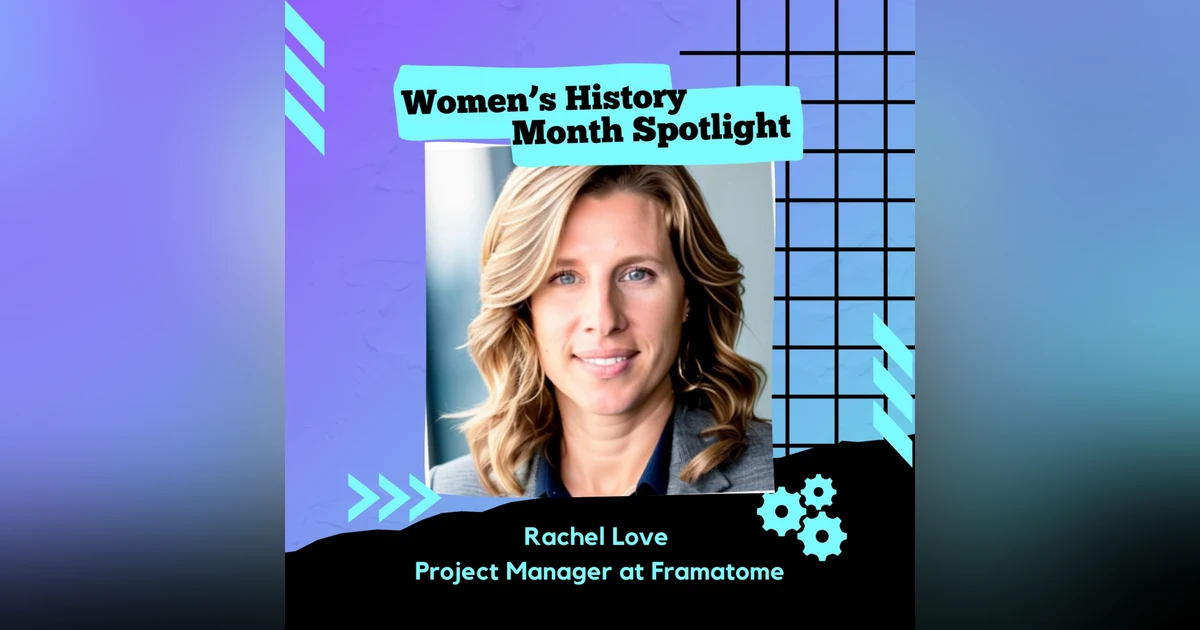
Women's History Month Spotlight: Evolving Leadership with Rachel Love


 RSS Feed
 In this special Women's History Month spotlight, we sit down with Rachel Love , a seasoned project manager in the nuclear industry, to explore the invaluable skills of leadership, problem-solving, and adaptability. Rachel shares her unique career journey from pre-law to nuclear engineering, the challenges of high-pressure environments, and how leadership rooted in empathy can drive successful projects.
From navigating midnight crisis calls to ensuring critical fuel equipment meets stringent safety standards, Rachel's experience offers a compelling look into what it takes to manage teams and projects in an industry as complex as nuclear energy. She discusses the importance of receiving and integrating feedback, the power of teamwork, and the evolving role of women in STEM fields.
Whether you're an aspiring engineer, a project manager looking for leadership insights, or someone curious about the nuclear sector, this episode is packed with actionable takeaways and career wisdom.
Episode Highlights:
-
(00:01:00) The parallels between great project managers and sports coaches
-
(00:02:30) Rachel's journey from pre-law to nuclear engineering
-
(00:06:45) Lessons from high-pressure work environments and handling 3 AM problem-solving calls
-
(00:10:00) The transition from project engineer to project manager and the unexpected emotional challenges of leadership
-
(00:15:30) How feedback strengthens leadership and why self-awareness is key
-
(00:22:00) Managing stress in the workplace and fostering a culture of collaboration
-
(00:26:00) Rachel's experience as a woman in nuclear engineering and her perspective on the industry's inclusivity
-
(00:28:30) Advice for women entering STEM and the importance of resilience and adaptability
-
(00:32:00) Rapid-fire questions: Rachel's dream TED Talk, futuristic city design, and career-defining moments
Key Takeaways:
-
Strong leadership is built on empathy, accountability, and effective problem-solving.
-
Feedback—both giving and receiving—is essential for growth in technical and managerial roles.
-
Women in nuclear engineering are thriving, and initiatives to encourage more young women into STEM are making a difference.
-
The nuclear industry is one of the safest and most highly regulated sectors, thanks to lessons learned from historical incidents.
-
The ability to adapt to high-pressure situations and navigate uncertainty is a critical skill in project management.
Connect with Us: If you enjoyed this episode, please share it with a friend, leave a review, and subscribe to Naked Nuclear for more insightful conversations about nuclear energy and careers in the industry.
Next Up: We continue our Women's History Month series with more inspiring voices before launching Season 2: Nuclear Education! Stay tuned!
LINKED Resources:
Solutions to workplace stress
A wee bit of light reading on leadership
Full Transcript
[00:00:00] Danielle Allen: What's your favorite sports movie? Remember the Titans, A League of Their Own? Rocky? Sandlot. In almost every great sports movie, there's an amazing coach, somebody on the field facilitating players, helping the technical aspects of the game, and also the emotional ones, managing the ups and downs of several people on a team,
[00:00:22] Rachel Love: I always felt like I was driving a ship and one person would jump overboard and I'd be like, no, no, no. And then we'd get him back on. And next person would be like, ah, jump off the side. I was like, guys, we're going to get to the destination,
[00:00:31] Danielle Allen: providing feedback and also critical thinking skills to the overall objective, which is to win the game.
And as I sat down with today's guest, I realized that the role of a project manager is not unlike the role of a coach. Great project managers, like great coaches, have often played the roles of several employees at one time.
They've gotten their hands dirty and know the stress of producing a good quality product.
On today's episode of Naked Nuclear, we are continuing our Woman's History Month spotlight with Rachel Love. Rachel is a project manager and she's here to talk to us today about what it means to be a project manager through empathy and
creative problem solving.
[00:01:14] Rachel Love: I've had to call people three in the morning And I said, Hey. Can you get on a flight in two hours? You're going to fly out there, deliver this, stay the night and come back. And they're like, can I run home? And I'm like, no, you can't,
[00:01:27] Danielle Allen: So aside from problem solving at three in the morning and keeping people from figuratively jumping ship, what does Rachel officially do exactly?
[00:01:37] Rachel Love: So my current role or title is a nuclear fuels equipment qualification business manager. I think business manager is kind of a vague term. Sometimes it can be used in a lot of different manners, but basically I manage a team of project management individuals and help them optimize and guide them through, good practices and those types of things.
[00:01:57] Danielle Allen: Most seven year olds aren't gonna tell you that their dream job is to be a nuclear fuels equipment qualification business manager. I asked Rachel what did she wanna be when she grew up, and how did that look like to get to where she is now?
[00:02:13] Rachel Love: I come from a divorced home, so I jumped back and forth a lot between California and Pennsylvania, if you would ask me when I was a kid, I would have said marine biologists, you know, I think like the standard, like I want to work with animals, and.
Growing up, I wouldn't say that engineering or technology was something in my background. It was probably like a classic 80s, 90s kid where girls was more like animals and those types of things. And, when I got older, I didn't want to become a lawyer. That was, it was kind of a big push to be a lawyer, but my dad and I really liked that idea and it's not quite how it worked out I was always really good at math. I did take all the way through calculus when I was in high school in physics. So it just kind of came, it was natural to me. When I started college though, I was. Pre law. After the first semester, I was like, I hate this so much. Not that I hate it, but I was not genuinely interested in any of the classes.
I'm one of those people where if I am bored, I do not strive. Because I took physics and calculus, I went and I said, Hey, can I go, I switched my major and study physics and engineering. And I think they were pretty reluctant. Because I was pre law, but when I explained I had taken those courses in high school, they were like, okay, we'll give it a shot and see how it goes.
After, the first semester of physics and some other classes, I came back to my advisor and said, I don't know if this is working out. I'm so confused in physics. And he said, oh, good. That's a good sign. If you felt like you knew what you were talking about, then I'd be worried about you.
It wasn't exactly reassuring, but, I stuck with it and it did, get better.
physics in particular, it really is true that you'll take a course. You really don't understand the material well, and then you'll take the next one. When you're taking the next one, you're confused, but you start to understand the previous course a little bit better, so it kind of builds on it.
So I come from a very military family.
My mom and my dad were both in the army. My grandparents, my uncles, it's a lot, just a lot of people. And my dad was very fixed on raising us that way. So it just kind of was something, it was like, you're going to go take your ASVAB. You're going to look into this. At the time it fed my narrative of becoming a lawyer.
I was looking at maybe going to the Naval Academy, instead I went to bootcamp between my junior and senior year of high school in the army national guard. And then, I was like, I don't want to do this for four years, to be honest, I didn't want to be in bootcamp for four years through college.
I thoroughly enjoyed it. And it was a great experience. But it didn't quite fit into the engineering scenario.
I think the way that I was raised a big part of it was, I was like, where can you make good money? It's kind of like frowned upon to say that, but in reality, it was like, what is natural to me? What do I like? And. where I can make a really good career out of this.
And so, you know, nuclear engineering is one of the higher paid engineering. I was originally in school for chemical engineering and then I took chemistry and I was like, Oh, it's okay. But I didn't love it. Then I took atomic nuclear physics and it just clicked. There really isn't a lot of guidance when I changed majors to nuclear, everybody was like, Oh my God, why would you do that?
It's a dead industry. Why would you go into this role? I was like, well, I did my research. there's enough reactors that I know I will get a career out of this, but I don't know about anybody else. It has greatly changed. So I would just. Caution anybody go with your gut and do your own research.
Sometimes people give you bad advice, actually.
[00:05:35] Danielle Allen: Okay, so if you're a student, here's some good advice. So Rachel starts off as wanting to be pre-law and being from a military background knows that she's gonna pursue a path in the military, but then starts to realize pre-law is not for her.
She looks into engineering and physics classes realizes chemical engineering is not for her, but nuclear engineering is. And despite these classes being difficult, she's still interested in them. So that's a good takeaway if you're a student, strive to look for classes that you're both interested in, but also challenged by.
So what is it like to pursue a nuclear engineering program?
[00:06:19] Rachel Love: A lot of how your program is set up is different for each school. So I happen to go to Penn State for nuclear engineering and they have a, their program is very much based off of going into the commercial nuclear industry.
They work closely with Westinghouse so my program was very much geared towards, it, it did, it did help. We, we did, we ran codes, we did things like that. So I had like a good understanding of it, in reality, you learn so much on the job. So it's like, you don't really expect anyone to know anything when you come in.
Other than that, they have demonstrated the capability of understanding what they need to do.
And I Started off doing, deterministic large break LOCA analysis.
And so it was like Safety analysis work that I got to do. Throughout the summer. I said, Hey, I want a job. I kind of stayed with them and once I graduated, I came right there. When I first started I didn't do LOCA I went into a group with, my first boss in, chapter 15 safety analysis events.
So it seems like main steam line breaks, steam generator, two ruptures, those types of things. And I did that for a couple of years.
I have a lot of friends. We all took different paths I think a lot of times there's a push to go into management, and I wish the industry would do a better job of allowing different avenues
a lot of people don't like doing that. There's a perception that if you're in management, you're valued more than somebody at an individual contributor level. But there's so many valuable people on the technical side. We have advisory engineers, stuff like that. And that is a path that sometimes takes a lot longer.
For me, I've always been kind of a lead person. I like to control my own destiny type things. So I just take a lot of ownership of my stuff and I'm proactive in engaging. So going into a leadership role, I took on a lead engineer role pretty quickly.
I was offered leadership. very, very early. I was older and as an adult learner because I got deployed when I was in college. I don't feel like I was really that young, but I was relatively new in the field when they offered it to me and, I turned it down to be a project engineer.
And I, and I, there was many times where I look back and I thought, wow, should I have done that? But I really feel like I got to round myself out as a person more by not taking that. So I was a project engineer for refueling and steam generator services, which means you're dealing with like outages and they're typically you, you prep for 'em ahead of time, you repair as much as you can and there's always an emergency during, and it's on critical path.
And if you delay outages it costs a couple million one to $2 million a day . People get pretty heated. There's a lot of feelings about it. And so it was a very intense fast paced environment and I really enjoyed it. It also got me to see some of the bad behaviors people develop when they're under pressure.
And it helped me learn like, Hey, when you're feeling a certain way, reminding yourself that, that's not an excuse to talk to somebody in a rude manner, there's just so many better ways to motivate people to help you. I wouldn't have gotten to experience that in a supervisor role in engineering.
I wouldn't have been able to experience that pressure. And I really value the time I had
there.
[00:09:21] Danielle Allen: Not every great coach has played the game, but most of them have, and I think there's something really important to be able to say that you have worked as a player under pressure. It is because that pressure allows you to manage people with so much more empathy because you understand what your team is probably going through.
Oftentimes there is a race to get to high level management positions because of the pay, but you don't truly understand that role around you. So I asked Rachel, what were those high pressure, fast paced environments like and how did she adapt to them?
[00:09:57] Rachel Love: So unfortunately, a lot of times it's like you get a call at three in the morning. An example is we had to send, a generator or pump. A large piece of equipment up to a plant in the north during the wintertime, and it wasn't working. If we can't get this machine working, we're slipping hour for hour on our critical path.
It means I get up and start calling people. We ended up needing to tent it. Turns out you have to put it on a pallet and have it seven inches off the ground. So there's adequate air flow. So it doesn't freeze up. So it's like you, you end up.
It's crazy, you're just trying to solve problems, trying to get to the right person, the right answer. I've had to call people in the middle of the night, three in the morning, one time I didn't even have their number, I had to look them up, to be honest, I was like, I hope I don't get someone, in trouble calling his house at three in the morning. You do a lot of that and, it's really actually super fun. I've snagged somebody out of the hallway and handed them a suitcase full of equipment that we needed because it was the fastest way to get them there.
And I said, Hey. Can you get on a flight in two hours? You're going to fly out there, deliver this, stay the night and come back. And they're like, can I run home? And I'm like, no, you can't, we need you to leave right now. You can run to the airport. We'll expense what you need when you get there sometimes you get really creative on how you get to solve these things. And it was, really fun. I've never been really sensitive, so when people get upset, it doesn't bother me too much, but to me it's more like, huh, okay, I want to make sure I don't do that to somebody.
I don't want to make somebody else feel that way when I talk to him so I try not to get heated, if something doesn't go the right way.
Counselors actually give you this is like, is a tendency that people like fight with each other they, Turn at each other and treat each other like the problem, in reality, what you have to do when you lead people is turn them to look towards the problem so that they're fighting the problem together
I learned so much as a P. E. as well, I wasn't in a direct technical role. I was facilitating the technical discussions. I was like, I think I want to go back to engineering for a little bit. I want to learn more before I get to that age where I'm like, I don't want to learn anything.
Hopefully I don't ever get there, but like, you know, sometimes you get tired or burnout. I went to our neutronics division. It's called our fuels or neutronics. That's where they do core design, neutronics, input to safety, those types of more analysis stuff. The group that I went to gave me a mix of the things that I was doing before.
Cause also while I was doing engineering and the PE, I used to travel about twice a year on the road with the technicians. You know, the one thing that I found going into an office, cause I grew up, doing manual labor, we used to cut down trees, stuff like that. And even in the army, I like hands on stuff.
Sometimes when you're sitting in an office, it can get kind of boring also going to site, it's like, I get to work on the steam generator. I just did an analysis on it really puts some reality to what you're doing. You get to understand how massive and how these things operate.
When I left being a P. E. I went to do reactor startups and physics testing. I got to do analysis work, but I also got to travel to site and be in the control room when they did start up. So I got a little bit of the best of both worlds. And for like engineers, we sometimes have a classic joke because engineers live in a paper world and anyone who has to like build or function with something sometimes that engineers make they're like. Do you have any common sense? Because, you know, the translation between engineering design into like practical application, the people technicians who have to use it are usually like super frustrated with the engineers.
So going to site and getting to get your hands on and like see how they have to work with it and do it like it gives you such a deeper understanding of what you're doing in engineering space and how everything fits together. If I had one piece of advice for any engineer is like, if you design something, do something, go, go put your hands on it, listen to the person who has to use it, because they're going to give you so much information and make you such a better engineer.
Ikea is a perfect example of fantastic engineering, right? I mean, some people might not agree with me. And sometimes there's a lot of pieces to put together, but like, as an engineer, I deeply appreciate how they think about each step.
The current role I'm doing, I'm managing people where I have done their role before. So like that empathy is massive, right? I think sometimes a failure that leadership has is they don't take that time to put themselves in their shoes. And so I, there's actually a conversation I just had recently about leading by example.
One thing that I will give the military credit for is you would typically never ask somebody to do something that you wouldn't do yourself. A lot of times as leaders, we provide delegations or rules like, Hey, this is what we're going to go do. And you need to make sure you have really good trust and collaboration with your team so that they feel comfortable to come back and say, Hey, Rachel, that thing you asked me to do is unworkable, like it is dumb and, sometimes I say, okay, let's sit down.
Let's go through it and like, help me understand what's going on. There's a tendency sometimes to be like, well, you just don't want to do it. Or you're being lazy most people really want to achieve stuff. So if they're giving you feedback that it's difficult, you should be listening, and seeing what they have to say.
[00:15:03] Danielle Allen: Receiving feedback. This is what made me think of the sports analogy. Receiving feedback and getting feedback is almost like being coached. You can get coached on how you swing a bat or how you throw a ball. However, if you never integrate the feedback, you're not going to become a better player.
Because you keep making the mistakes that you've already made. This is something I find really fascinating within this episode, how Rachel talks about feedback and why it's important for us in the engineering space to integrate it appropriately.
[00:15:43] Rachel Love: Everybody has this ego, right? Like whether it's massive or smaller, everybody, no matter what they say has ego. And so culturally from places I work the most.
It was a good culture of, if you are coached, where you given feedback, you say, thanks for the feedback. I appreciate it. Whether you feel that way or not. Over time you realize.
How beneficial it actually is. I mean, I won't say that I haven't had somebody say something where I'm like, roll my eyes I just listened to something today. And I was actually saying the same thing to somebody if I ever feel like I'm, not receiving something well or wanting to be dismissive. It's like, maybe I should listen a little bit more to that. Right. Cause there's always like a sting of, you know, there's that sting when you know is a little bit true. When I was first being eyed up for leadership, I had to do a 360 review.
That thing was brutal and it's where, you basically get a printout book and it's like everybody's feelings about you, at your peer level, below you, above you. At the time I was pretty new my peers were super brutal in that one.
It was rough. It's probably the roughest day I had at work because maybe I did something to make somebody upset that week or I pushed too hard on them. Some people just don't hold back. As much as it's supposed to be anonymous, you tend to know who wrote certain comments my peers were very critical. And, the HR lady that goes over the 360 said, well, Maybe , just take a look at what your, your, like, senior people and experienced engineers are saying. They have a lot of positive things to say, sometimes peers can be a little bit aggressive and not help.
But it was like, Oh, my gosh. And I won't lie. That stuck with me. And it is kind of hard to get past that when I moved on and ended up with a different supervisor, a few of them messaged me and said, please come back and it was some of the same people who were very aggressive in comments.
People are humans. They're all over the place. Many times when people are reactive with you. There's something going on with them and it's not necessarily about you. That I keep in mind. Or I think, I've really made a choice that has set this person off.
So let me just listen to them. I haven't had any experience where I've not sat down and talked to people where we end up in a good spot at the end. It is a journey and you have to constantly want to improve in it. Some people have a harder time with self reflection.
And so I think if you really want to be a good leader, I think if you really want to be have a warm reception from people you need to want to work on the hard stuff. Receiving feedback is really, really hard. I got used to it in my role as a project manager at my last job for five and a half years, I would get part of my performance review with surveys going out to everyone I interacted with.
So it could be a supply chain, the engineers, other supervisors, managers, just a variety of people. They would rate me and then they could write comments and I'd get to read 40 comments about myself every Friday, one Friday a year. I was really lucky that most comments were really positive.
But there'd be a few that would be critical I only had a few that were one year where someone was pretty brutal about it. At first you get upset about it, but in reality, that kind of stuck in my head and when I would be in a meeting and I'd be doing something that I think, , maybe this is what they were talking about.
So I would elaborate more. I would talk through it more. So I'm like, okay, I'm going to try to take this and like, especially if they're taking something that I do in a way, I'm not intending it. I'm going to figure out how I can elaborate on it more. So maybe they don't take it in that way.
And I think that helped a lot. By the end, I don't think I got any. Really critical feedback other than, some of the usual stuff people say in project managers, like, why did you let the customer get away with that? Why didn't we charge him more? And I'm like, well, there's other reasons we do that and it's okay.
[00:19:26] Danielle Allen: So what does that transition look like from being a project engineer to a project manager? How do you take the lessons learned from one end of the spectrum and apply it to the next one?
[00:19:39] Rachel Love: you know,
So when I was a PE role, I was like leading technical stuff. So it's just like driving people in the right direction.
I will say the one part I did not expect as a project manager is that you think, okay, I'm going to be a project manager because I don't want to be a people manager, in reality, you are more of a people manager than even a people manager, to be honest, especially if you have an open door policy you become everybody's therapist and I won't lie in the first six months I was like, Oh my God, I don't know if I can emotionally handle this because, you're just, you're like, you gotta be the strong one for everybody and everybody brings their gripes about each other to your door.
At first I was like, Oh my gosh, this is overwhelming. But as I worked with people and talked through it and like, you get to see them kind of grow and function better as a team, it was very rewarding. Now I have a different perspective on it. To me, it's really enjoyable.
I get to, I have the power to like, develop a team to help people be as functional as possible. And so, I think, there's obviously the stereotype, of engineers. We're all, very binary and there's like a classic like understanding our expectation that engineers are just awkward or like not, you know, they don't have high EQ and I think that's really damaging because in reality, we should want those expectations for engineers because engineers who can collaborate together just become some of the best people.
And so that's what I kind of try to do a lot is help translate their feelings. Maybe they're doing this because they're concerned about that. Taking them out, outside of like the story, especially engineers, if they're introverts, they, they build a big story in their head about what somebody else is doing.
And so they get themselves really heightened about things. And when you just kind of talk them through it and just say, well, maybe they were looking at it from this perspective, or let's talk through it. Let's ask them why. The other thing is they're not always the most direct.
And so being very direct about it, we would just work through things very quickly. And I think through that exercise, they would learn to start self solving these things themselves too. They didn't have to come to me as much. They would do like, oh, I talked to so and so and we worked through it.
And so just kind of giving them the tools. to do that Ithink as a people manager, you really need to have those skills to be successful, but it's a skill that's great for everybody to have. If you can do that within your own team, just with the people that you interact with, it's super valuable.
[00:21:55] Danielle Allen: A 2018 study published in the Cambridge University Press on the perceptions of work-related stress showed that most participants cited management as the primary reason of stress. This included unrealistic demands, lack of support, unfair treatment, poor communication, and lack of transparency.
Let's be honest, in most companies, management is responsible for their employee's stress levels. So looking at this problem objectively, how do we implement the best practices in order to change this outcome?
It is exactly like Rachel outlined, being able to solve interpersonal relationship problems at the lowest level possible. Teaching employees how to speak directly to each other with respect and compassion, being understanding and empathetic
to the stresses related to problem solving and workload. All of this helps smooth over the work environment to be able to function well and efficiently as a team.
So how does that play out in the real world?
[00:23:00] Rachel Love: We were doing some advanced fuels work, at the time a large portion of our manufacturing was in France.
Was a lot of challenges in the manufacturing process of it and then COVID hit there was a lot of publicity around it, a lot of PR. And a lot of pressure for it to be successful. It was outside the norm for a lot of our engineers.
You know, we do kind of Nth of a kind type work. And this was a first of a kind and a first of a kind licensing approach too. So, we shifted gears a lot and, at the end of the day. I think we were very successful. We actually got a tip award for it.
When it was happening, I always felt like I was driving a ship and like one person would jump overboard
[00:23:43] Rachel Love: and, and I'd be like, no, no, no, no. And then we'd get him back on. And next person would be like, ah, jump off the side. I was like, guys, we're going to get to the destination, but everybody would just, and it was different things, different days.
You know, trying to keep people in, in the comfort zone, even though we're doing something that's outside their comfort zone. It just took a lot of reassurance. I think, accountability is really huge. When people are anxious, I would just remind them, I'm in this with you, I'm helping you make this decision. We collectively have made this decision and me as the project manager, I take ownership of the whole thing because I'm the one that's saying we're going to go in this direction, along with a bunch of other technical people. Right?
Success is a collaborative effort. It is not one person. That one took a lot of people management, a lot of negotiation across, cultural differences, it's near impossible to get the French to work overtime, but, the team that worked over there were phenomenal and really stepped up and helped us out, dealing with a lot of people being out sick that was when we were like, you can't just come say you're okay, where you're monitoring people, testing them, everything.
So even if you felt fine, but you had. Tested positive. You couldn't come in and do manufacturing. And we were manufacturing a large scale on prototype machines. So there was a lot of complications there. But it worked out and, they went into operation and they had already operated multiple cycles and they did well, so it was a really good success story.
One tip for project managers is if you are fixated on your initial idea, you're probably going to be disappointed, you have to be like really flexible and change and really define what successes because you, so you have to be realistic.
And in our case, we had planned to do more fuel assemblies and ended up having to make the call to cut it down we would rather have. Yeah. As one successful one, then risk the chance of not being successful overall. And then we had to adjust and do other things to make do with it.
We had to change analyses and core designs but at the end of the day, it really worked out. And I think everybody was happy. And it takes a lot of communication, right? Because, changing the narrative, a lot of people are not happy about that. And they have an image in their mind about what success looks like and you have to kind of get them to say, Hey, we're still making all the progress that we really needed. It's just changed a little bit.
[00:25:51] Danielle Allen: Okay. Being that this is a Woman's History month episode, I asked Rachel, what does it mean to be a woman in this industry? Especially environments where. Being critical and receiving feedback are integral to improving as an engineer or project manager.
[00:26:08] Rachel Love: When I first started, I had people that I worked with. And, they could be pretty snide to me about like, you don't know how to do this. You don't know how to do that. Cause a lot of them knew, were encouraged and they wanted to be engineers from a young age. Like they had computers and knew what Excel was.
Like, I didn't know what Excel was until college. I mean, I love it. It's my favorite now, but like. I didn't know how it worked. And they were like, well, you're an idiot. And I think that's the biggest part of it I mean, now there's such great initiatives to get girls involved in STEM and those types of things.
I think it's phenomenal.
I don't think a lot of the women that I meet in the industry. I don't ever feel like I'm in a male dominant, like we know, obviously, majority of our coworkers are male for the most part, but most of the women I work with are not intimidated by a male at all. They really love the technical work and it shows, I personally have not seen where somebody is devalued in our organization because they're female.
I think, technical judgment is way harsher than whether you're a male or female. So I think we have of a reluctance to speak up because in technical world, there can be an environment that's like, if you say something dumb, we're going to judge you versus. An environment where if you say something dumb, you'll get educated on it, right?
And I've worked with different engineers senior engineers there are some really phenomenal ones really help you understand without making you feel dumb. But yeah, I haven't, I haven't really experienced the female stuff.
[00:27:33] Danielle Allen: And her advice for women looking to get into the industry.
[00:27:36] Rachel Love: I was thinking about this question and I was like, what is my advice to people?
And I think it goes, it's like the advice for anything, right? If you don't try, then you never give yourself the opportunity, so like, I think a lot of people. If things are hard or if it doesn't go right the first time, it's like, okay, well then I shouldn't do this. And my approach I've always taken is I'll just do it.
I don't care if I look stupid. I don't care what anybody else says. I'm a little bit bad about not asking for help, but I think some people maybe ask for too much help and it can be perceived as , maybe you shouldn't be doing this. And in reality, if you just.
Do your best and try really hard. Even if you're not succeeding, if you try really hard, the people around you will be like, man, this person really is dedicated to it and they will help you. Versus sometimes there's a perception of , everybody should help me. And I don't mean that to it sounds a little boomery.
What I mean is just give it your all. And you'll probably get help. But then if it doesn't work out, I think, you end up realizing that maybe this one is not going to work,
my husband is a very different personality type to me. He has a perception of if you don't try, you can't fail. And I'm like, no, I don't like that. When you fail is when you learn, right. If you succeeded everything, you actually don't learn that much.
. But when you fail over and over again, you learn so much key information.
I was listening to something the other day. It was lady was talking about how You know, some people are like, well, that's just you're an extrovert or you're charismatic. I'm actually an introvert. I get very spent in having conversations sometimes.
The perception that you can't get better at it is just a bad thing for people to have you have to want to. That's the hardest part you have to want to be willing to change. I'm certainly not the same person I was when I started at 20 something years old.
I was a lot more black and white. I was more harsh. I was like, just go do your work. Through being married and having kids, and living through stuff with coworkers, they have cancer or something happened with their family. You really start to realize it's more important.
To be thinking about the people. It's just remembering to balance those two things.
[00:29:46] Danielle Allen: So much amazing life advice. Applicable to your job, but also your personal life as well. And so lastly, it's our final part of the episode where we do our rapid fire questions.
If you had to give a Ted talk about like a non nuclear topic. What would you choose?
[00:30:03] Rachel Love: I think I would be like, I would have deep anxiety about talking at a TED talk, but maybe one day I'll get over that. I have a real strong feelings about leadership and I know there's a lot out there, like, airport books and self help and stuff like that, but really the recipe for.
Strong leadership where you inspire your organization versus, taking more of a commanding approach. The military is probably not a great example for this. If you take that military approach, like I'm going to demand that you get something done that works in theory, but it works like.
When you're in a non war situation, but guaranteed you don't take the same approach when you're in the trenches with people, right? When you're under fire, you're working as a team, you're collaborative. It's so important to trust each other and have each other's back. You think about every day, what would I do if we were in the trenches and under that, high pressure, high stakes, So that would be my TED talk,
[00:30:54] Danielle Allen: The next one is, do you have any hobbies?
[00:30:58] Rachel Love: Yes, I have a lot of hobbies. I'm a real sports person. I don't watch them, but I love to play them.
I am obsessed with tennis. I've been playing it for like the last 15 years competitively on a club level to clarify. So like nobody's going pro here, but, it can be good. People can get intense about it, but, I really love it. It's uses your brain. There's still a strategy to it , it's just great exercise.
[00:31:21] Danielle Allen: If you had to build out like a futuristic city, are there any key features that you would want to put in there
[00:31:27] Rachel Love: I'm a big fan of efficiency. So I think functionality is like people who can design things that are just really functional and efficient, are the most brilliant people in the world.
My whole life philosophy is how can I make this? The lowest maintenance, the least I have to clean, like all of those things that are just so much work. So I would do that, you know, how can your city be the most functional?
[00:31:51] Danielle Allen: Are there any exciting moments that you've had in your career that you feel like you've learned the most from?
[00:31:57] Rachel Love: Yeah. Usually I learn the most when things don't go right.
I learned a lot about myself. And when you're under pressure you either Excel or, struggle with it. During some of my reactor startups, things. Would go wrong and I learned that I am like an adrenaline junkie thankfully, I don't know if I would feel the same way if things had gone wrong, but I was able to help and really fix things.
I do well under pressure. It's like really fun. It's like your moment to shine and it can bring out the worst in people.
But if you can learn to be steady under those types of things, you become such a foundation for other people that they want you in the trenches with them,
[00:32:35] Danielle Allen: . My last question is, within the context of nuclear energy podcasts. Are there any people or subjects that you want people to know more about or people that you would suggest to the podcast?
[00:32:48] Rachel Love: I think one thing because I have friends and engineers that are in different industries. is understanding how significantly different it is than other industries, even in energy generation, those types of things, because we are so highly regulated. I don't even know how to quantify how much cost is associated with how much dedication we are to that.
And it is through lessons learned in the industry, obviously, right? Chernobyl, TMI, Fukushima, all of those things. have made us one of the safest industries in the world. But like TMI, I actually worked with a guy who provided the letter and had to testify because guidance had been provided.
It actually, a similar event happened to, Davis Bessie prior, like a month or two prior to that. The guidance was provided. It just did not get communicated well. If the operators had not intervened, the plant would have actually shut down properly. But the operators to be fair, we're only operating for 3 months.
So these were all brand new. This is 1979. We don't have a vast amount of reactor operators in the country at that time. They manually intervened and misunderstood what was going on. That's what happened. Just people understanding, how we actually operate, how we are regulated, the levels that we go to, are really significant.
To talk to people in the industry that work day to day, how much it has shifted from times of TMI and that closed off communication. I have never felt like. I could not bring up a safety concern. It is very highly regarded
one last thing, related to women in the industry is I work with some of the most amazing women in the world. We're all very independent and we don't always hang out in the same friend group, but we get together and like,
they're some of the most amazing people. I have always found a group in every place I've worked where they're just have your back phenomenal. They're great as a support system to just say, Hey, are you guys dealing with this or not? And they're just there for you.
I love working with people. It is the most rewarding thing in the world to influence somebody's decision in life. Like it's so much power. And, and if it's, especially if it goes in a positive direction, it's just so rewarding. So, thank you for allowing me to share.
[00:34:59] Danielle Allen: I want to thank Rachel for accepting my invitation via LinkedIn to hop on this special podcast for Women's History Month and share her insights and expertise from being a project engineer to a project manager and all of the iterations that she made to improve who she is at work, I think the advice given in this episode is super pertinent and can be applied to every place of business. If you enjoyed this episode of Naked Nuclear, please do share it with a friend.
Please like and comment. If you wanna learn more about any of the different subjects you heard about in this episode, we're almost a little bit halfway through the month, but we still have a few episodes to bring you for Women's History Month before we launch season two, which is all about nuclear education.
I wanna thank you so much for listening to this episode of Naked Nuclear. Remember to be kind and stay curious.
**Naked Nuclear** strips down nuclear energy so it actually makes sense. New episodes weekly. 🎙️ [Listen on Apple Podcasts](https://podcasts.apple.com/us/podcast/id1781924674) · [Watch on YouTube](https://www.youtube.com/@TheNakedNuclearPodcast) 💡 Curious about nuclear careers? Visit [nakednuclear.com](https://www.nakednuclear.com) for episodes, resources, and guest spotlights.