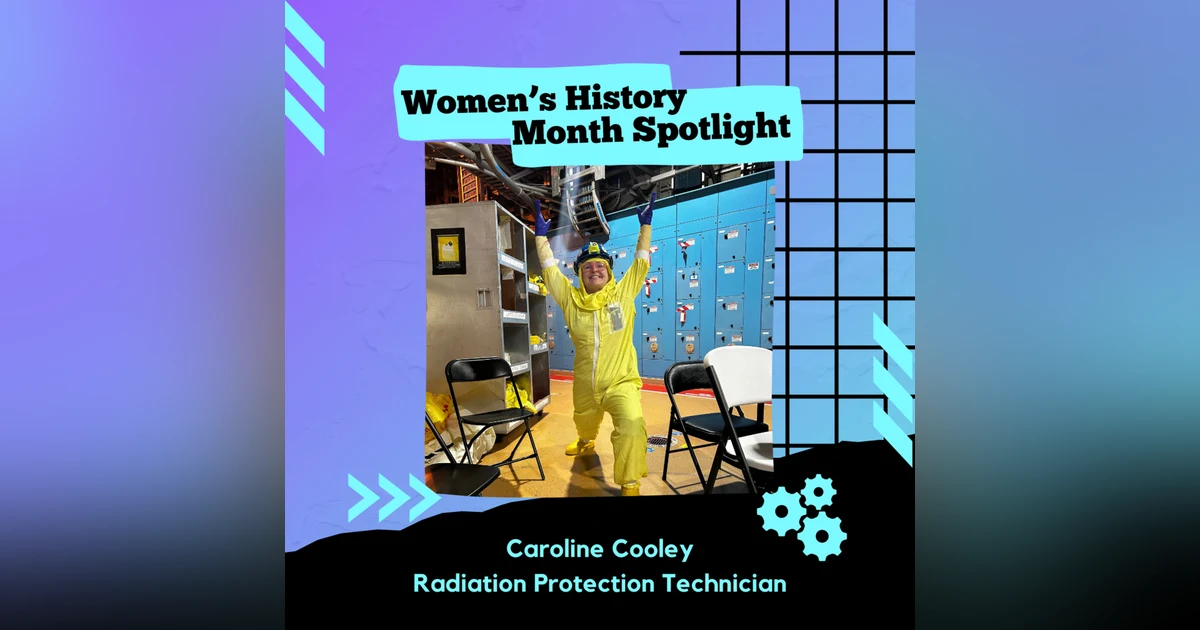
Women's History Month Spotlight: Caroline Cooley, Radiation Protection Technician


 RSS Feed
 Join us as we spotlight women in the nuclear industry.
One of our previous episodes with Caroline Cooley showcases how she became a radiation protection technician:
My yoga teacher, the tree-hugging radiation protection technician... In this episode of Naked Nuclear, host Danielle speaks with Caroline Cooley, a tree-hugging, Prius-driving, vegetarian yoga teacher who unexpectedly found her way into the nuclear industry as a Radiation Protection Technician.
Caroline shares her journey from corporate America to working alongside her husband in the nuclear field, offering insights into the roles and responsibilities of decontamination workers and radiation protection technicians. They discuss the safety protocols, personal protective equipment used, and the exposure levels to radiation, debunking some common misconceptions about the industry.
Caroline also touches on how her background in yoga helps her remain calm and handle fear in this demanding job. This episode provides a unique look at a non-traditional career path, the evolving diversity in the nuclear industry, and the importance of stringent safety measures. Listeners will also learn about pathways into the field and the potential for travel and financial benefits.00:00 Introduction to Caroline Cooley00:27 Diving into Nuclear Reactors01:00 Getting Started in the Nuclear Industry02:14 Roles and Responsibilities of a Radiation Protection Technician03:31 Safety Measures and Equipment07:03 Radiation Exposure and Monitoring13:11 Career Path and Personal Journey17:54 Diversity and Evolution in the Nuclear Field19:46 Nuclear Safety and Environmental Impact20:51 Yoga and Mindfulness in Nuclear Work22:52 Rapid-Fire Questions and Fun Facts26:20 Final Thoughts and Conclusion
Looking for where to get started as an RP?
Cape Fear Community College Nuclear Technology
https://cfcc.edu/nuclear-technology/
Westinghouse RP Program
https://westinghousenuclear.com/media/zhdbuk4m/how-to-become-an-rp-technician-2024.pdf
https://westinghousenuclear.com/operating-plants/outage-services/rp-alara/radiation-protection-training/
Wanna learn more about radiation levels?
Radiation Levels:
https://www.epa.gov/radiation/radiation-sources-and-doses
https://www.energy.gov/ne/articles/5-radioactive-products-we-use-every-day
Sober Spaces at Jam Band Concerts
https://www.pbs.org/newshour/arts/looking-for-sober-friends-at-a-concert-find-the-deadheads-with-a-yellow-balloon
Full Transcript
[00:00:00] Danielle Allen: Hello and welcome to another episode of Naked Nuclear. This whole month of March, we are spotlighting and highlighting some of the women in the nuclear industry for Women's History Month. So. I hope you enjoy this former episode that we have with Caroline Cooley, who is a radiation protection technician.
Caroline travels all across the world servicing nuclear reactors and power plants. I actually got to meet her when I was doing beach yoga at my sister's bachelorette party. So aside from being a radiation protection technician, she's also a yoga instructor. I hope you enjoy this episode for a Woman's History Month.
Tree hugging Prius, driving vegetarian yoga teachers do not clean radioactive equipment. Or do they. In today's episode of Naked Nuclear, we're talking to Caroline Coolie, who is in fact, a tree hugging Prius, driving vegetarian yoga teacher, who I met during a yoga class on the beach. And she happens to work in and around radioactive machinery. We're diving into the world of nuclear reactors and what it looks like as a radiation protection technician,
[00:01:09] Caroline Coolie: I probably have picked up more radiation getting x rays on my teeth, I do at work
[00:01:14] Danielle Allen: how to get your foot in the door.
[00:01:16] Caroline Coolie: I would connect you with a recruiter.
A lot of people go through Cape Fear still to get involved.
Some people go to school just to be radiation protection
[00:01:24] Danielle Allen: And most importantly, how much money you can make,
[00:01:27] Caroline Coolie: I have a better income now than I ever did at corporate America working as a certified alcohol and drug counselor with every certificate and diploma
[00:01:37] Danielle Allen: So let's dive in today's episode came about in a very interesting way, because I was at my sister's bachelorette party on Carolina beach next to Wilmington, North Carolina. And we were doing yoga on the beach, our beach yoga instructor told me that she worked in nuclear and I said, huh, that's fascinating because I have a podcast about people in the nuclear space.
How did my yoga teacher get into the nuclear space as a radiation protection technician.
[00:02:14] Caroline Coolie: I've had several positions since I've gotten into it. I'll start off by saying that I'm 45 years old. , I have a degree in human resources and business management.
I worked in corporate America for a long time, and this is a newer career to me. My husband's been in the industry for like 15 years. So basically I got laid off in 2021 from my previous job, which was a whole different career. I was working in the mental health fields, working in, intensive outpatient treatment for people with substance use disorder.
And he said, why don't you try coming on the road with me? So. That's what I did. I decided to give it a try.
But to get my foot in the door, I actually started out as a deconner, which is basically just a nuclear, janitor
[00:02:58] Danielle Allen: Deconner short for decontamination. So what does a nuclear janitor do? Exactly?
[00:03:06] Caroline Coolie: In the beginning of 2022. I used stock, the PPE that employees wear. You take out the radioactive trash, you clean up messes, that kind of thing. And that was how I got my foot in the door, and then over the summer of 22, I went to training. there's a training facility for Westinghouse, and I took training for radiation protection. , so that's one of the jobs that I do, and one of the jobs that my husband does is radiation protection. And what we do is when the power plant has their shutdown for refueling, we go in, , we work in those areas to make sure that the radiation and contamination levels, stay where they're supposed to or if they get elevated, we mitigate whatever could happen as far as contamination.
[00:03:49] Danielle Allen: Okay, so nuclear janitors or a deconners can stock and repile PPE clean up messes and take out the trash. While, radiation protection technicians can do a little bit more. They can mitigate problems and detect where radiation is coming from when these plants shut down for refueling.
But like how safe is that?
[00:04:12] Caroline Coolie: We make sure that the people working on projects are being safe, that they're using the correct PPE, they're using the correct tools, they're using the correct procedures to make sure that they don't spread contamination or contaminate themselves, and there's a lot of routine stuff we do as well in our job.
You asked me what a typical day looked like. So as an RP, that's what we call radiation protection. , We go in, we usually have a staff meeting every day that for specifically what we're doing, and you could be assigned to any different part of the plant.
This last job I was on, I was assigned to the undervessel. Yeah, it was kind of pretty crazy. It was like adult chutes and ladders under there. There's a lot of climbing involved.
But you'll go in and you'll have your staff meeting and then you'll usually go to your station to work. And we work three on three off. So you're on your station doing whatever your job is. You might be covering workers while they're replacing a valve, or they might be going in to do some temperature testing and you just have to go with them and lead the way because you have to check the radiation fields as you're going through.
[00:05:11] Danielle Allen: Okay. So let's break this down. You have an RP, which is your radiation protection, who does a morning briefing with staff. You've got to make sure that your staff knows how to use all the proper equipment and tools correctly. You debrief on where in the plant you'll be going and what the job is for that day. All the while you're monitoring radiation and contamination levels of both the fields and yourself. Then once you're at your work site, you can work for three hours on and three hours off.
And learning this made me have a billion other questions. Such as what kind of equipment are they using? Like Geiger counters. What kind of PPE are people wearing and what happens after you have your three hours on a shift?
[00:05:56] Caroline Coolie: So we use instruments, we use different kinds of meters to check for radiation in the area, depending on where we're going, it will, you know, dictate what meter we'll use. There's a ton of different types of meters. Mostly we use an ion chamber, , which measures the ionizing radiation with, it's just like a little metal box. We generally use like an ion chamber or a telepole.
A telepole allows you to stretch it out further so you can stay further away from the source. And it has two types of detectors in the tip of it. Then when you go Come out of the area. You have to walk through several detectors as well to make sure that your body's clean and your clothes are clean and all that good stuff.
[00:06:34] Danielle Allen: I had to ask, what does the PPE look like for radiation protection? Because forgive me. I could only imagine the same type of PPE that the monsters wear during Monsters, Inc. You know, the whole bright yellow suits.
[00:06:51] Caroline Coolie: So you wear scrubs underneath and then you've got like orex or either fabric coveralls. Orex is a paper, Like somebody in the nuclear field, a radiation protection person created orex. It's like a paper plastic is disposable. Some of them use launderable coveralls. And then you have several layers of gloves. You have a hood on. You have booties, shoe covers.
We wear these hoods called pappers. It pushes air into your hood so that you don't breathe the air around you. And depending on what job you're doing, you may or may not, that, that one's a pretty, like that would be a dirty job for you to be wearing that.
Most of the time you're good with just, being covered and your face is okay exposed as long as there's not a lot of water splashing around or airborne.
[00:07:40] Danielle Allen: And what about these three hour shifts? How do those work?
[00:07:44] Caroline Coolie: We call them jumps. So you do a three hour jump. Then you come out and go on break and then you do another three hour jump. Now there are some places in the plant where you might would work more consistently but most of the places especially if they're kind of like a higher radiation area or it could be hot, , and you're in most of the time you're in full PPE.
[00:08:04] Danielle Allen: This led me to another question. What are the standards for the levels of radiation you can be exposed to?
[00:08:12] Caroline Coolie: There's the standard, which is like you're in the RCA, which is the radiologically controlled area in there you can have no food or drink, but you can wear your scrubs and usually have on like some safety toe shoes. Then if you go into a contaminated area or a CA, it's going to be marked off differently.
Once you're inside the RCA, it's going to have a boundary to let you know you're going into a contaminated area. And depending on what job you're doing at minimal. You would have on a lab coat, gloves, shoe covers, and booties. , that would be if you were just going in there to do something real generic, real quick, you weren't going to be rubbing against any components.
Like you were just kind of walking in to do a job and come out. You would have that on. Otherwise you would have what is called a single set, which is just like one set of PCs. Then if you go into a highly contaminated area, which when I was an undervessel this past job, a lot of times in the very bottom, there's the sump pumps.
There's a lot of contaminated water down there. You might be in double set of PPE. You might have on a plastic set outside of your cloth or paper set, several layers of gloves, several layers of shoe covers.
[00:09:19] Danielle Allen: I thought of this like a stoplight. Green is your RCA, which is your radiologically controlled area. Yellow is your CA so your contaminated area. And red is your HCA, which is your highly contaminated area. And depending on which light you're operating under, you have to have a different set of PPEs.
[00:09:43] Caroline Coolie: It's separated by different boundaries. So if you were in a HCA, which is a highly contaminated area, You would shed your outer layer of PPE when you come out of that area.
And then you're in another area, they call it a double boundary. So everything is very, particularly roped off or cordoned off so that, you know, exactly, you're not going to just walk in a room and be like, surprise, I'm in a contaminated area. Like signage and boundaries is a very big thing in nuclear.
[00:10:11] Danielle Allen: So I have my PPE. I have my signage. I have my instruments. But how do I know if I'm getting too much radiation?
[00:10:21] Caroline Coolie: So you always, You always know before you go into the controlled area exactly the highest dose that you should be exposed to, which usually They overestimate that to keep you safe just in case you walk by something that's giving off a lot of radiation and the highest amount of contamination.
We wear a little electronic dosimeters on us. And then we also wear a DLR is what they call it now. It's a dosimeter of legal record. So that one is constantly tracking your dose. And then your little ED that you wear is like your. It tracks you for each time you go inside of the controlled area.
Like part of the job that we do is we give briefs. So when people come into our area and they say, okay, we're going here to work on this valve, . We pull up a map. Somebody on the last shift went in there and took a survey. And we're going to tell you like, when you're over here, you might get five millirem, but over here you might get 50 millirem.
So you want to try to position your body, say on this side of the work area, the highest contamination is 10 K.
[00:11:22] Danielle Allen: Let's use a banana for scale. So. 0.01 millirems. That's how many millirems a banana has after you eat it. Standing outside on a sunny day. You're looking at 0.01 millirems to 0.02 millirems an hour. That would be eating one to two bananas an hour. Now a chest x-ray. A, chest x-ray has about 10 millirems per image. A, cat scan of the abdomen or pelvis has about a thousand millirems per image. What's the lethal dose though. The LD50 causing 50% of mortality within 30 days without treatment. That would be 300,000 millirems. or 300 REMS. And all of this exposure is done without massive amounts of shielding and PPE.
[00:12:24] Caroline Coolie: So let's say for example you were going to go work in an area and I told you that the general area in there is like 10 millirem per hour because that's how the radiations measured is in millirem per hour. You get set points. So you know that your maximum dose rate if your general area was going to be 10, I might tell you 50 as your, , dose rate and then your maximum dose depending on how long you're going to be in there.
It's a good equation of figuring out what you think your exposure will be times the amount of time that you're going to be in there and if, if you get to 80 percent of your dose, so say your dose is 200 millirem, that's the maximum you should pick up on this job.
If you get to 160, you need to come out and higher risk jobs, we put a teledose on people so they have a tracker where we can actually watch them on a computer screen and their little monitor has its own little meter in it and you can see the field they're in and how much dose they picked up so that if we need to, we can tell them to come out.
[00:13:22] Danielle Allen: I equate it to scuba diving. If you've ever gone scuba diving, and you're swinging around seeing the fishes, the sharks. Then all of a sudden your dive master waves at you checks your air and then tells you. It's time to go up. Oftentimes, they also plan for a safety stop.
But all of this is to make sure that you don't run out of air. In this case for radiation protection. It's to make sure you don't hit your maximum dose.
But when I asked Caroline, if this stringent regulated rules of nuclear, radiation protection, It was something that she always had in mind . This is what she said.
[00:13:57] Caroline Coolie: Absolutely not.
It's crazy. I I've never known what I wanted to do when I grow up. , it took me until I was 35 to finish my bachelor's degree. I worked in like restaurant. So I had an associate's degree in hotel and restaurant management. Verizon Wireless came here to Wilmington and opened up a big call center and I got hired on with them. I stayed in that corporate place role for like 12 years just and I got really burned out on it.
So in 2015 I did my yoga teacher training and my teacher was like, you will quit that corporate job before the end of the year.
I made it to January so that I could get my last bonus. Did yoga and did some side hustle stuff and then I fell into the job working at the treatment center. And then I ended up in nuclear and it's not anything I would have imagined.
, the way that we got introduced to it, my husband and I, we've been together for, 25 years. He was a welder by trade. And he got laid off during the recession back in I think it was 09. And a friend of ours, had joined, Cape Fear Community College and do reactor services technician training for people to actually go and work on the reactor. And so my husband, got hired doing that, and that's the way we both got introduced into the nuclear field.
[00:15:13] Danielle Allen: And did Caroline have any preconceptions or misconceptions about what working in nuclear looked like?
[00:15:21] Caroline Coolie: Well, I mean, you always. . only hear the bad stuff. I remember having to watch Silkwood. You hear about Chernobyl, you hear about Three Mile Island and even like our family, they always make jokes like, "Oh, are you glowing yet?"
"Are you not worried you're going to get cancer?" That's what everybody says when they find out you work in the field. And I'm like, I probably have picked up more radiation getting x rays on my teeth, I do at work. Like, because There is the Nuclear Regulatory Commission, there are, , standards set in place by them, and then, the plants themselves are even more conservative on how much you can pick up every year.
I think just the misconception that it's super dangerous and that it's bad for you. I had no idea how stringent the safety was inside of a plant until I went in there I mean you have to go through major background checks if you lie on your background check you were not getting into nuclear
[00:16:16] Danielle Allen: let's say that you want to get into the field. Where would Caroline point you?
[00:16:22] Caroline Coolie: I would connect you with a recruiter. , I work for several different recruiters and there's a lot of different pathways. I mean, Cape Fear still has the program here that teaches and we have a GE plant here in Wilmington that builds the fuel for the nuclear reactors and does a lot of other maintenance type stuff for the machines that they use to, work on the reactors.
Some people go to school just to be radiation protection. Last year I was working out in, Alabama and a bunch of kids were in school for nuclear engineering, but they were doing a semester where they had to come work with us as contractors.
So there's all kinds of different ways that people get in, into the field.
[00:17:02] Danielle Allen: So if you like to travel, take a listen to what Caroline has to say about contracting.
[00:17:08] Caroline Coolie: Because we are contractors, our job is 100 percent travel.
So we're either at work or we're not. And right now we're off work. Um, we have our life kind of set up in a way where we work most of the spring and winter, and then we're home for the summer and the beginning of the fall. We travel all over. My husband's been out of the country a bunch before COVID.
Since we started working together, we take the camper and we take the dog. We don't have kids so it's a great setup for us because, we have everything we need.
You can train and do what I do in a short amount of time and make decent money. And then if you want to go do something else, you can, but you know, I make, I have a better income now than I ever did at corporate America working as a certified alcohol and drug counselor with every certificate and diploma I ever had as a trades person.
[00:17:57] Danielle Allen: And according to Glassdoor and other online searches, you can make up to $140,000 as a radiation protection technician.
[00:18:08] Caroline Coolie: And when I went into it, I was just like giving it a try. I was very leery of it. And I told my husband, I don't know if it was in the spring or fall. I was like, I'm done. This is my last career. I like it here. Yeah. Like I am made to work in a physical job where I get to climb around and do crazy stuff and not sit at a desk all day.
[00:18:24] Danielle Allen: A physical job where you get to climb around and do crazy stuff all day and not sit at a desk.
That sounds great, but it sounds like it might be a little male dominated.
[00:18:37] Caroline Coolie: And it's interesting, too, how it has been a male dominated field for a really long time.
And there's a younger generation coming in. There's a lot more women coming in. I mean, the old guys at the plants will tell you, Oh, well, back in our day, we didn't have women. , but it's cool to watch the evolution because every, Every job we go to, depending on the area, but more diversity, more men and women, more younger people. It's cool to see it changing and evolving. And I think with college being so expensive, like I have friends that are high school age now, and I'm like, get a trade.
Like, if you don't know what you want to go to school for, don't go. up a bunch of loans.
[00:19:13] Danielle Allen: So it sounds like the field is changing from male dominated to more diverse. In addition to younger people joining the trades. And for somebody who's worked in white collar jobs, it might've been quite a shift. So Caroline walks us through what that shift was going into the trades.
[00:19:32] Caroline Coolie: Yeah,
I was terrified. I mean, I've always worked quote unquote white collar jobs, and this is more of a blue collar job. And I was terrified of going into that trade. And I mean, honestly felt a little insecure, like. I don't know what it was and everybody else in my family. I mean, my sister's a nurse, my mom's a nurse.
My aunt is a doctor of business professor. Like they all had the very square, like, this is what we're going to do. And I've just never been like that. And I think when I told them that I was going to go work in nuclear, especially the first year when I was going as a deconner, I was like, I felt like my mom was like, And now they're all like, I was like, I freaking love this.
This is awesome. Like we have a great setup and it's so cool. And I never would have believed it, but I, you know, the opportunity just presented itself because one job ended because of COVID and the universe just keeps on being like, here's your next job.
[00:20:23] Danielle Allen: So after working in the field for a few years, I asked, Caroline, what is it like in terms of nuclear safety? , had she form any opinions on the industry?
[00:20:34] Caroline Coolie: If everything is done to the book the way that it's meant to be, it is completely safe and it is clean. The amount of space that it takes to store irradiated like spent fuel rods is very small in comparison to how much space it takes to have coal, in comparison, it's a drop in the bucket.
I mean, I've been able to see with my own eyes, like the places that they store the spent fuel at plants, and it is, it's not a huge space, like even the big events that you hear about, are human error for the most part, it's not like things are just going to melt down.
It's such a clean energy source. , it, it has the power to provide so much energy for the growing population. It's, I mean, I am, I'm, I'm very pro.
[00:21:28] Danielle Allen: And being my beach, yoga instructor were there any times that her yoga practice played a role as a radiation protection technician?
[00:21:37] Caroline Coolie: I would say, I mean, some of the fear stuff, there's places that we have to climb that can be kind of scary and you have to wear fall protection sometimes.
And I think just being calm and I breathe a lot, actually, one of the pictures I can send you is of me doing warrior one in my full get up at the last job. Cause I was like, give me a, get a picture of me doing yoga in my outfit. But I mean, I think that yoga prepares me for life in a lot of ways.
I mean, it helps me to just kind of go with the flow a little bit better. And the other part, the other aspect of it too, besides working in nuclear is like the people you work with, , and learning how to, to cohabit in a space with people for 12 hours that might not necessarily be the same as you.
I meditate every day before I go into work.
That's something I got from my yoga practice just to help myself calm down. Cause when I first started to get into this. I was terrified. I didn't, it was all new to me, and change is scary. And as you're growing in your career, you have to take tests and you have to do practicals and you, you're constantly having to learn.
[00:22:40] Danielle Allen: And does yoga play a role in her energy philosophy?
[00:22:45] Caroline Coolie: I definitely think we have to be mindful of our waste and our energy because I'm a tree hugger, I drive a Prius and I freaking love it, you know, 50 miles a gallon most of the time. which also people think is odd as a person that works in nuclear, but I mean, it's just so much better for the environment in the long run. It's not perfect by any means.
I mean, there's always ways that we can improve, , the energy itself is clean, but a lot of the waste that's created from producing the energy could be trimmed down. I think that as we continue to move forward, we've got to do something because. Coal ain't it, .
, I just think we have to be mindful of it going forward because, I mean, the, the environment's in, you know, chaos right now.
[00:23:25] Danielle Allen: Now that you got to know a little bit of the conventional questions about Caroline.
Let's dive into some of the nonconventional questions our rapid-fire ones.
, so our first question is if you had four and a half minutes to, you know, prepare a TED talk on a completely different subject.
That's not yoga or not nuclear energy. What are you talking about?
[00:23:48] Caroline Coolie: It would definitely probably be. Music, like live music, attending concerts, and doing so in recovery, like sober music events. I could do a TED Talk on that in a heartbeat.
There's a huge community. I am a jam band fan.
I like fish and grateful dead . There's recovery community very prevalent in that space. But when I worked , in treatment, I also learned there are other musical, like James Taylor has one now, a lot of the EDM festivals have like a sober gathering place.
[00:24:22] Danielle Allen: When you're not working or teaching beach yoga, what other like hobbies and activities do you get up to?
[00:24:28] Caroline Coolie: Live music is a huge one. We spend a lot of time on the beach.
My husband likes to surf. I just like to play in the ocean. I like the paddleboard. Right now I'm obsessed with going scuba diving. We travel. We love to travel. , this community we live in is great. And we ride our bikes all over, visit our friends, go play disc golf, go watch the fireworks. We like to cook at home.
I'm a vegetarian, so I cook a lot of veggies. , I can make a main like cashew cream sauce for my vegan friends.
[00:24:54] Danielle Allen: Another question would be, , what is an unlikely fact or, or piece of information that people don't know about the work that you do?
[00:25:06] Caroline Coolie: Well, I think you might, people wouldn't realize that this is a job that you can literally do, like into retirement age. , there are so many different. Little places that you can work with in the job itself. Once you get to a certain age, if you can't be physical anymore, that's another thing that attracted us to it is that like you as a contractor, you can pick up one job a year.
I work with a lot of guys, girls, older people that they're pretty much retired. They're already getting social security or whatever, but they just pick up one job a year to keep their certifications, to make a little extra money and to stay in , industry. And it's. Pretty cool. I mean, I would have never thought that.
[00:25:46] Danielle Allen: For this series, you know, we're looking at, , people who work in in and around the nuclear space. Are there any, fields, departments, people, , things that we should. cover in some of these topics, anything that you would want to hear, like , on a podcast of, of this nature.
[00:26:03] Caroline Coolie: Yeah, I would really love to hear you interview the people that work in chemistry and within the nuclear power plant, the, the water. The water chemistry is a huge, huge part of, the shielding, , how they, you know, cool heat.
There's so much that goes into the water chemistry and they have several, most places I've been have several labs throughout the building and people are always taking water samples and we take, As radiation protection, we take air samples, but we, what we sample, we send off to chemistry, you know, they, we send it off to the lab to get analyzed and stuff like that.
And I just, I think that part's fascinating about, because they have to use so much boron and everything has to be like perfectly balanced. Yes. And I would love, I mean, I don't know, some people might think that's dry,
[00:26:50] Danielle Allen: , any final thoughts, anything that you want to add, any questions that you want to kind of shoot out, shout outs, anything like that.
[00:26:57] Caroline Coolie: I can't really think of any other than just the experience of being a complete opposite of, I don't know what I thought it would be, but it's just been such a fun adventure and one of the cool things about the contract part, part of it is you, we're always going to different places.
Since I started, I've only been to the same plant. I've been to one plant twice and everywhere else has been new places. So it's so cool to just get to meet all sorts of different people. And there's just a lot of good people in the industry. , I make friends everywhere I go.
I would have never went to the Mississippi river Valley in Minnesota for a fall season. It's gorgeous up there. And I never would have known. And it's just like. Every place we go, it's an adventure and I just love it so much.
[00:27:41] Danielle Allen: So if you are working a corporate white collar job and you think, Hmm. Maybe I need a job where I can crawl around and do crazy stuff and not to that desk all day. Radiation protection technician. Again, this episode came about because I met Caroline on the beach and she was my beach yoga instructor for my sister's bachelorette party on Carolina beach. , she was grateful enough to accept my invitation onto the podcast. So again, thank you so much to Caroline.
This is Danielle with Naked Nuclear stripping down the bulky layers of nuclear technology to help career professionals pivot into the industry. For upcoming episodes, we'll be looking at uranium mining, as well as other fields like manufacturing and construction. Check us out on social media to see what's going on in the world of climate talks. Like in Azerbaijan. Thanks again for listening and I hope you tune in next time.
**Naked Nuclear** strips down nuclear energy so it actually makes sense. New episodes weekly. 🎙️ [Listen on Apple Podcasts](https://podcasts.apple.com/us/podcast/id1781924674) · [Watch on YouTube](https://www.youtube.com/@TheNakedNuclearPodcast) 💡 Curious about nuclear careers? Visit [nakednuclear.com](https://www.nakednuclear.com) for episodes, resources, and guest spotlights.