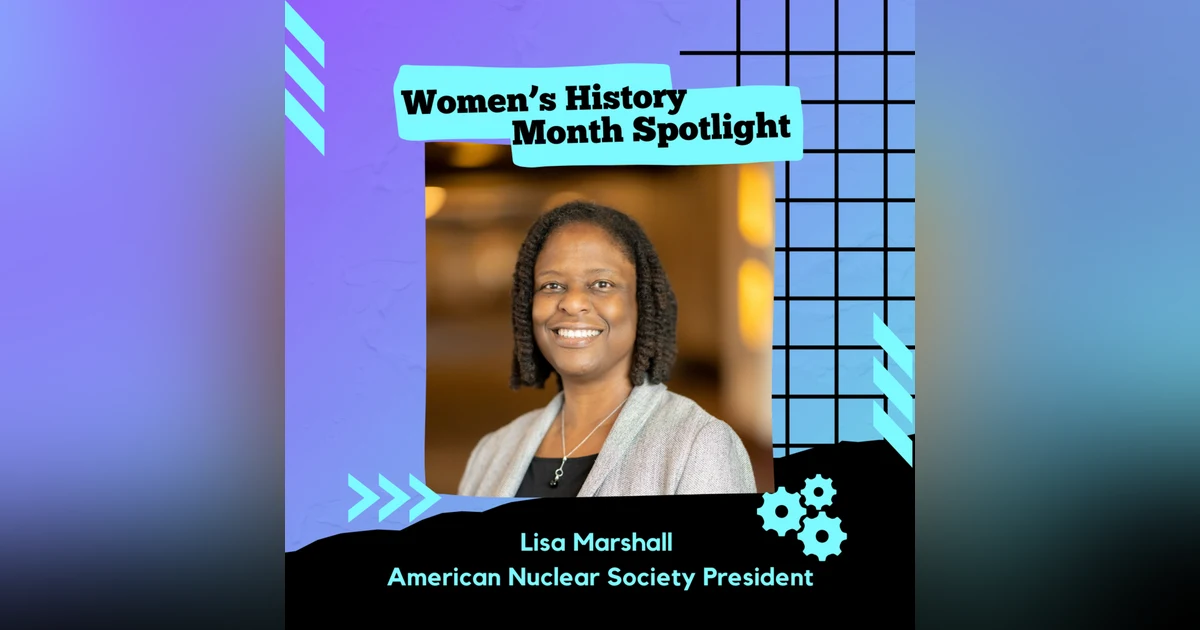
Women's History Month Spotlight: ANS President, Lisa Marshall


 RSS Feed
 Have you ever met a legend? In this final episode of our Women's History Month series, Danielle sits down with Lisa Marshall , President of the American Nuclear Society (ANS) and longtime Director of Outreach and Engagement for NC State's Department of Nuclear Engineering .
For over two decades, Lisa has been a tireless champion for students, a trailblazer in outreach and retention strategies, and a visionary leader within the nuclear space.
From building one of the nation's leading outreach programs from scratch to her presidency at ANS, Lisa shares her journey with wisdom, humility, and humor.
🔹 In this episode, we cover:
- How Lisa built a career by saying yes to opportunities — and how you can too
- What retention really means in a nuclear engineering program
- Professional (not "soft") skills every student needs but rarely gets taught
- Advice for women entering STEM fields and how to stop disqualifying yourself
- What it's really like being ANS President — and how many flights it takes to lead the industry
- Her love of science fiction, roti, and futuristic green cities with tiny homes
💡 Quote to remember:
"How dare you not give your talents to an industry that has such an impact on society—not only within the United States, but internationally." — Lisa Marshall
🧠 Perfect for:
Aspiring nuclear engineers, students navigating STEM fields, educators passionate about retention, or anyone curious about the human side of nuclear energy.
🔗 Links & Resources:
✨ Stay tuned for Season Two , where we dive deep into nuclear education, career pathways, and how YOU can transition into the industry.
Full Transcript
[00:00:00] Danielle Allen (2): Have you ever met a legend? Several years back. I was walking through the airport and one of those long carts that zip by slipped past us, I noticed a really, really large man and sat next to him was a daughter who was just as big. They looked strong, and as they looked closer, it was Muhammad Ali.
And his daughter, Layla Ali. It was fascinating to be able to meet a living legend, one of the most prolific boxers, poets, and civil rights activists of all time. And that got me thinking, how obtainable is it to meet a legend?
Before this episode took place, before this podcast existed, I looked up how do I become a nuclear engineer? See, my background was in firefighting and paramedicine, so making a leap into nuclear energy seemed a bit large.
Being in North Carolina, I looked over at NC State's website and came across the profile of Lisa Marshall.
I sent her an email. She replied we set up a quick meeting to discuss what it would be like to be a non-traditional student.
It wasn't until I started this podcast and started networking within the nuclear energy community that I started to hear more and more
about. Lisa, have you reached out to Lisa yet? Oh, I should introduce you to Lisa. You should really talk to Lisa. Unbeknownst to them, I already had, Lisa was one of the first people I reached out to when deciding to make a transition into the nuclear energy. field.
Unbeknownst to me, Lisa was much more than just the director of outreach for NC State.
So for our final episode for Women's History Month,
we're bringing you Lisa Marshall,
President of the American Nuclear Society and Director of Outreach and Engagement for North Carolina State.
She's also a champion for nuclear energy students, both in the state and around the country.
[00:02:04] Lisa Marshall (ANS/NC State)-1: I say to our students stop disqualifying yourself, apply. If you are not a good fit for that particular organization, they'll tell you. But how will they even know if you don't apply,
[00:02:17] Danielle Allen (2): Just to make sure I don't perjure myself, I looked up Oxford's dictionary definition for what or who a legend is, and one of the definitions listed is an extremely famous or notorious person, especially within a particular field.
Not having been in this field long, I've had at least a dozen people tell me that I should reach out to Lisa because of the amazing work that she's doing within the nuclear energy space and for students. and
for me, that's enough to consider her somewhat of a legend.
And I was sure to mention that to her during this interview.
[00:02:53] Lisa Marshall (ANS/NC State)-1: Thank you to everybody else that has been speaking my name. I guess that's why my ears are burning. You know, when your ears are burning, it's like, okay, someone's talking about me. I started my career. , in Ottawa, Canada at Carlton University, and my husband and I had an opportunity to move to the states.
I have family here as well, not too far from North Carolina on either side. , there was a great opportunity for him professionally. And I knew I wanted to continue in education and that I would land. So we took the big leap and we moved down here. , also something to do with the weather as well. Right? And then I start to apply. To a number of positions, , or a number of universities and smaller colleges in the region when you look at the Raleigh and surrounding area, there's some big powerhouse universities and then the smaller colleges, they're not bad themselves. So I started to apply accordingly. There was one at NC State, that was very attractive to me. I put in the application and got a Dear Jane letter I thought, oh, I'll continue to look. They promised to keep my resume on file. And I thought, yeah, yeah, yeah, that's what they all say.
Right? But a few weeks later they asked me to apply for a newly formed position. And when you're talking about a new position and you could put your stamp on things, I, it was, I'm in. So I applied, I got the interview, and, the rest is history really because, I thought I would say maybe four or five years in the position, and it was a director of outreach for the Department of Nuclear Engineering at North Carolina State University, and I'm in my 24th year. I did not think this was gonna happen, but I've enjoyed it. Right. And there are new challenges every day, especially when you're building a program. And I remember when, you know, we started outreach and then we were talking about in, retention and an engagement as well. I remember going into my department head's office and saying, so we need to work on retention.
Because if we are to have individuals be successful and thrive in this environment, we can't just admit them and have them take classes and not have some sort of engagement with them. And how then they would make a smooth transition over to, their careers upon completion of the academic career. And he smiled, which meant that tag you're it.
And so I said, okay, I'm up for the challenge. I've got a good support mechanism around me. And the college is doing, a lot of good work in this particular area. How then do we engage with students and help them to walk through their various programs?
So I took it on and then it just kept on growing and growing, right? The different aspects of things. I did some research, and then I went into another department head's office, to ask a question. He looked up and you could see a little twinkle in his eye and it's like, do you wanna teach?
And I'm going, yeah, of course. I wanna teach. I had started to do some of that. Back in Ottawa. So it just seemed to be something, a natural progression, so to speak. Right? So I did, and before I knew it, it was, a career where I was helping assisting students to find a little bit more about nuclear engineering, and the possibilities, right?
Whether they were thinking of going on to do graduate work or step into their careers with a position somewhere. You add onto that. Study abroad programs, also other co-curricular programming. I'm having fun, I'm taking students places. We're writing that up, we're doing presentations, et cetera.
And before I knew it, I had found my home. Right. And when you find your home, you know, you kind of go, okay, I don't know if I can recreate this anywhere as an inaugural director or, some of the activities that I was able to do and still I'm able to do. I think it was at year 10, someone said, how long have you been in the department?
And I started counting on my fingers. I was like, oh my gosh, it's a decade. And from then on I've been counting, so to speak, but it's been a good time. And then two years ago, I moved over from professional staff to academic. So, I'm the assistant extension professor. In the department and, you know, your land grant institutions, they've got that particular designation and they're to work with community, right?
So whatever we're doing within higher ed, it's supposed to be transferable and it is. but they've designated, this particular designation of a university that we're supposed to do that more so. And, I like that title extension, right? Because then you are working with, a wide array of individuals from, students who are in the K 12 space, community college, other universities.
You are working with community organizations, professional organizations, and it's at a number of different tiers from the, the local, state, region, and then doing national work. So, that's kind of my progression into the position and finding myself in this space.
[00:08:12] Danielle Allen (2): So let's pause 24 years in service to students, helping them create a better experience , retaining them within the school systems, helping them finish out their degrees, integrating them with careers on the other side, as well as creating interdisciplinary outreach programs from K through 12 to community colleges,
to the broader community.
So when I started this episode talking about legends. I wasn't kidding. To create a brand new program. is not easy to say the least.
I remember what it was like being an undergrad student, and I am not afraid to admit that on more than one occasion, I hid from my thesis advisor in a bush and I had to think back as to what would've made my experience a little bit better.
So I asked Lisa, how does their department improve retention? What does that mean?
[00:09:07] Lisa Marshall (ANS/NC State)-1: Students will have a conversation with a faculty member and then, they won't have certain conversations that they needed to have with faculty members, right? So you act as that conduit for that discussion to happen. And also just to give them a little push.
It's like, yeah, go talk to, you wanna talk about this and these are the sets of professors you should be chatting with about, those topics. So do it. And then also a kind of a division of labor as it were. So that I then, I'm working with students, on. How do you prep for , your job interview?
How do you consider graduate school? What are some of the variables, the questions you need to be asking, the kind of research work that you need to be done and then getting a better, outlook things like a checklist and you're okay. I need to have these types of experiences and I need to also chat with individuals in my particular interest areas. And just to have someone, 'cause the life happens, right? And sometimes you just need to, to talk with someone who's nonjudgmental, will always sit with you and do planning.
If you come to me too late when you should have talked to me beforehand, right? It's like, okay, how are we gonna fix this? Those were some of the key parts when you talk about retention, right? And then you are looking at the curriculum itself. And how then can you connect what is going on in the classroom or in the labs with. What's really happening in industry and being able to connect. And I've done so many field trips to so many nuclear organizations with students, just so that they have that type of experience. I wish I could do more.
Right. They just at times seem, it's like, oh my gosh, the fall went. I thought, oh man, I, we were gonna do something in the fall. But, to try to at least have what you, do done, and then see if you can add on to it as time goes by.
[00:11:08] Danielle Allen (2): There's a number of hidden soft skills that no one really seems to talk about between high school, college, graduate school, and the professional world. It's how to communicate when you're uncomfortable, and for a lot of college students, this is the first time that they've ever had to communicate while feeling overwhelmed and anxious to talk to professors about grades, understanding the materials, personal matters, and also how to find a job.
Planning for your future can be stressful. And all the while we've really never taught 18 year olds how exactly they're supposed to do this. And so I think the retention piece is really filling and bridging a gap. That many students are facing. It's giving students the capability of taking initiative, but also giving them a sounding board on how to navigate all of these waters for the first time, especially with professors who might not seem warm and fuzzy on the outside.
[00:12:06] Lisa Marshall (ANS/NC State)-1: Sometimes you have some that are, have the harsh shell outside, but you know, get to know them. These individuals are good for a long period of time, right? So get to know them, hear about their experiences, what they're forecasting into the future. Where the gaps are that maybe you are talking about an area to them. And it is not until you start to talk with them that they realize it's like, oh, I've got X person who, is looking for someone to do research. Or, you should chat with this other individual because this is the area that is up and coming. Or they're having a hard time finding individuals that have those expertise and you say you're interested, so therefore you should chat with them a little bit more. Or opportunities of doing research as an undergrad or as a graduate student. How are you gonna fund all of this, right? All of these components, right? We sometimes call them soft skills. I call them professional skills, because at the end of the day, you've gone through NC State's Nuclear Engineering program, you know what you know, and you know what you don't know, which is just as important. You're competent. What organizations are looking for is to, identify if you are a good fit for that division, for that company, for that organization, and that you have to interact. You can't remain in the bubble. And I'll ask that next time or I'm not gonna ask any questions at all, right?
As you go through this. There's more of a recognition coming from engineering education that retention is a key component if we are going to have the success of students, period. With the requirements for, or the demands on workforce development, the number of individuals that are needed just to keep the current fleet and non-energy applications kind of humming along and contributing new knowledge and innovation, et cetera. we can't afford to have students that are competent, but maybe a little bit on the shy side of asking for assistance. 'cause it is complex information, right? It is nuclear engineering, but it doesn't mean that one can't get assistance. Sometimes that's all one needs.
[00:14:16] Danielle Allen (2): I have a very vivid memory of sitting outside my calculus professor's office. I knew she was in there and I knew this was the time she had opened for office hours, but I was so nervous asking for help because this was the first time that I had ever been quote unquote bad at math. So I thought there was something wrong with me.
I thought I shouldn't be doing math because I wasn't as good, and it didn't come as easy as it did in high school.
Four times. Four times I showed up to office hours and never stepped foot inside. Instead, I convinced myself that I should probably be doing something else, something completely different away from math and engineering and science. And this is not uncommon with women in STEM fields.
So I asked Lisa, what advice does she have for women who are entering into these departments?
[00:15:10] Lisa Marshall (ANS/NC State)-1: Don't , short change yourself. Right. I make references to my husband because I'm constantly talking with him.
He's a science educator, a professor, at another institution. And we have these types of conversations, so if you have an open job that, a a, a guy will, yeah, I can do this. And they'll apply. And if there's a part that they don't know, it is like, yeah, yeah, yeah.
If I get the job I no problem. Women on the other hand, we have to tick off each and every criteria. And we've got to get past that and take the leap. And I have to take my own advice as well. The leap is very important and, to give your talents to kind of the betterment of society as a whole.
When you look at nuclear science and technology and all of its various contributions, you're doing yourself a disservice, but you're also doing society a disservice as well by not leaping. So I had this morning, a group of students from one of the local high schools just to be able to tell them about the breadth and the depth within the industry and that they are needed, wanted, take the leap, so to speak.
And you, you know, some of them, it's like, yeah, no, and then you have others that are okay, I, you know, it's on my radar, right? So I'm trying to get that word out to students. And then also to think of life as a journey, as opposed to a destination. And there'll be forks in the road and many choices. Based on an assessment at the, any, any fork in the road, one will will go and you'll always have, should I have done that? No one's saying that you, you have to be like me and 10, 24 years in one position, right? Or maybe you are going to do that. And then you are going to use your talents for the breadth with that particular organization. Also, remember to consider it as a journey. That's an important lesson I am still learning. You're giving your talents to, stops on the road as you're moving forward through life.
Because we're going to be professionally sound at the end of whatever degree we decide to do and whatever industry we decide to go into. I say to our students stop disqualifying yourself, apply. If you are not a good fit for that particular organization, they'll tell you.
But how will they even know that you may be a fit if you don't apply, if you don't go and talk to that individual right in front of you now. I'm not saying that you'll always get a positive answer when you leap, right? But. You don't know until you try. So why not?
Why not do it? And it's also a nice practice, the first couple, they may or may not work out the way one wants to, but you refined how you present yourself and the messaging about your particular talents and why you think you are a good fit for a volunteer position, a research position, a full-time position, whatever, right? And we only perfect, I think, when we practice and, you find out information as well, right? From that conversation that you're having with the other person.
[00:18:24] Danielle Allen (2): In short, take the leap. Start practicing, start pitching, find out what you don't know and then work from there. Work to improve, get better and better and better. Now the other hat Lisa Marshall has is that of the American Nuclear Society. President, and I wanted to know what all that entails, how that, came to be. And whether or not she likes the position.
[00:18:47] Lisa Marshall (ANS/NC State)-1: So I joined the organization in 2005, rolling up my sleeves. One of those department heads had had asked me to edit a paper and then said, oh, guess what? You're giving. The paper at the conference. So off I went to give this paper and I got hooked by the number of individuals at the time, especially in the education training and workforce development division. They were just happy and I was very happy that they were happy and I rolled up my sleeve and started working on different aspects with them. I've joined a number of other divisions, environmental sciences. We had at the time the professional women of ANS and that has evolved over so that you look at the, the intersections of individuals identities and now it's ANS care there's a number of divisions, committees, special committees, you name it.
I stepped down from being on the board of, of direct, well at, at my end of my term for the three years with the board of directors, a great learning experience. And then before I knew it, got another call that said, um, we'd like you to run for the presidency position. And I went, Hmm. Because I don't have the, your traditional background for the field. And, they talked me through it in the sense of why, because I. I got this call that I, that I had won.
And they said, you've been vetted. Is a yes or a no, just answer the question. So I said yes, and then I immediately went back to my department to tell my superiors. It's like, so, uh, I was asked to run and I said yes.
And before even I got to that part is they were like, yes, yes, yes, you should run. Yes, yes. Right. And I went through that process, and pleasantly surprised that my colleagues, the students, the young professionals, I got the call that said, congratulations.
It's a three year commitment, so you're looking at, VP president elect for one year. So you are the understudy. And I had a wonderful president, Ken Petersen, that was very, very helpful to me just to get the, the 30,000 view properly and then the, the day-to-day of being at the, the helm of a professional organization. Right. And then, I stepped into the presidency at the end of the third week in June, the end of June. And it's a year long, so I'm about halfway through and then I have another year as past president. So yes, they've got you on the hook for three years, which is a good thing, because you just get used to it. . And then you get started with your own set of initiatives and the other initiatives that really do need to continue. And then you'd like to see things develop a little bit more or a little further along. And then they have some other duties for the immediate past presidents. So, and then you are also serving as the council for the new, individuals coming up, right? So the, the, the president, vice president and the executive council as a whole, I must say that, that the executive committee, in addition to the staff of ANS, the, the staff of ANS, they are the backbone. They are what makes it run right.
They're, they'll be friendly and, helpful to any president that comes through. But I've been with them since 2005, so we know each other. And you're not trying to figure out how to get to know someone. Instead, we're just hitting the ground and we're running with what we do.
You see me on LinkedIn and I'm posting pictures. It's like I've, I've visited various schools. I've visited various local sections. Typically there's a tour that is attached to that, so that then I am going into labs, national laboratories companies, and then school systems,
so academia as well to interact with individuals and for them to tell me what they're doing on the ground and just getting to know, the high points and some of the challenges that they have there are some national conferences and meetings that we do , as a society, I was going to them before and I'm gonna go as their president, so I'm thinking of the conference on nuclear training and education, around the corner is the American Nuclear Society student conference coming up and that rotates from, different universities there's something about seeing all these students, or professionals all at once around a variety of technical, topics, talking about their research or thinking through how we're going to be innovative in the training and education space. I've enjoyed that.
And those can be anywhere in the United States. And then, you know, you have. These topics, whether it's advanced reactors or you're talking about nuclear fuel or materials, or you're talking about the governance. And that happens at the international level, and I've been going to those as well.
[00:23:51] Danielle Allen (2): Okay. . Before recording this episode, we chatted a little bit about the level of travel being the ANS President entails. Lisa mentioned that her students run up to her office to see whether or not she's in the country and, and then check her LinkedIn to see if she's in Kazakhstan or Texas A and M. Whether she's here or abroad. One of the organizations. that she speaks highly of is OECD's Nuclear Energy Agency. Earlier this year, we actually did a Black History Month episode, spotlighting their director.
[00:24:24] Lisa Marshall (ANS/NC State)-1: The director general is Mr. William Mag iv. And he, to me has always been a visionary. He was with the Nuclear Regulatory Commission, he was with the Department of Energy, and he took the helm of this organization, and has made it a powerhouse in the industry. Right. Whether you're talking about the technical research and reports, or you are talking about boots on the ground helping new in emerging nations, or you're talking about, inspiring young girls. And partnering with, organizations that are, on the ground year round. And we're coming in to give another dimension, of, of what's going on internationally, in this space.
The International Atomic Energy Agency, they have a general conference, right? So you have individuals from around the world, nuclear science and technology and we're getting together, right? And you have established countries and new and emerging ones, and we're making those connections, So that's another component of it. And then public policy, of course, plays a key role in this, and the list kind of goes on and on. So if I, I didn't own my home, I would seriously think or suggest to any individual. It's like, so you're gonna be living in hotels, you're gonna be driving around, you're gonna be flying around. You won't be needing a lot of food when you do groceries, all worth it for the time that you're, you're in these positions because you're, you are forging new relationships. You are also confirming the ones that you already have and there's, you know, we can do things by Zoom or any of the other technologies, but there is something about sitting in a room or going out to dinner after a meeting and, and sharing a meal
[00:26:14] Danielle Allen (2): And what might the future hold in store for lisa Marshall?
[00:26:19] Lisa Marshall (ANS/NC State)-1: , I don't know. Um, it has given me some great ideas of where we as an industry need to focus as a university or as a department, it's no different, just as a different scale. I report to the department head and to be able to, to chat with him about, oh, we should do this, or he has an idea.
It's like, oh, I know what we could do in that realm. I'm definitely gonna continue with the American Nuclear Society, what I was doing and my approach. I'm a service leader. I roll up my sleeves we started a special committee on STEM education and there are already quite a bit of instruments that we have, in this space. To continue that work make sure that material is still fresh, and that we are expanding it. So what impact does, VR or XR have to it, or what's the implications for AI in this particular space.
And then something that's really important that there are other organizations in this space and that we do the work together. So each one has a bit of a different mandate. How cool is it that we are working together? We're working on various MOUs to identify initiatives that we want to work on those are active MOUs as opposed to just signing a whole bunch of documents. It's tackling the challenges we have together and hopefully we can, have a product or a program or service or, do away with that challenge together.
At the end of the day, the product of what I do are people and I really appreciate that honor. That has been, put on me that, that this is, this is all about people development. People to people, right. You have to take care of other things to get to that particular point, but then how cool is it that, that's pretty awesome.
[00:28:12] Danielle Allen (2): And now it is that time of the show where we launch into rapid fire questions.
[00:28:17] Danielle Allen: if You could leave a lasting impact, as a piece of advice for people coming into the nuclear industry in like a sentence or two,
[00:28:26] Lisa Marshall (ANS/NC State)-1: A sentence or two
oh, no.
[00:28:31] Lisa Marshall (ANS/NC State): I want individuals to take the leap. If individuals stay on the sidelines, giving your talents to something that you're passionate with or something you're interested, and it, it just continues to grow and grow. Do it right, do it. We need everyone all on board for this if we are to continue to make the strides that we have made and then we are to make future strides and take, innovation to another level.
How dare you not give your talents to an industry, that has such an impact on society, not only within the United States, but internationally.
[00:29:14] Danielle Allen: What is your favorite, like meal to eat? What's your favorite go-to meal?
[00:29:19] Lisa Marshall (ANS/NC State): I am from Trinidad, so I love what we call roti, but it's flat and it's round and it's big. And then you put curried items within, right? So, um, I'm vegetarian, so it's a whole bunch of vegetables and chana, which is chickpeas that is curried. I'm just getting hungry now thinking about it. And then you fold it and you bite into it. It is the most delicious thing.
and then it might be a tie would be, um, Ethiopian food. So the injera, right? This also flat, you see how I like my carbs and then they don't use curry, but there's other spices, that make it very unique. And I love my legumes. my favorite. It's red lentils and it has a kick to it,
[00:30:14] Danielle Allen: now I gotta look up some recipes. Do you have any hobbies outside of the nuclear space?
[00:30:19] Lisa Marshall (ANS/NC State): Hobbies. I am a big science fiction fan. I will read or watch Right. Get my hands on that's in that space. So I kind of, I geeked out on star Trek, the books, putting them in order and then reading them in order. And then when the television shows came out, I've seen all the movies and then you have one author, two authors, , Octavia Butler she has passed But her books are fabulous, and then Nnedi Okorafor, so she is Nigerian American, and she writes in the African futurism, not Afrofuturism, African futurism, and I read it and I was like, I need more. I searched her up and she responded to me
I picked up Pilates, recently I needed to do something, you know, you, you tend to, you sitting all day, or you're traveling you're still sitting, and to get into a different type of habit. So, I started Pilates.
[00:31:22] Danielle Allen: One of the next questions is, if you had to build a futuristic city, what would you want in it?
[00:31:29] Lisa Marshall (ANS/NC State): oh my, oh, lots of green, lots of nature. Right. I have followed the tiny homes movement and how they can make it functional and beautiful at the same time. then what else would I put in it? Of course, I have to have a, reliable fuel source so you know what I'm, I'm choosing. Right. And then just lots and lots of good friends and family.
Some of the places that I've been, they've intentionally done green, right? So they're not cutting down the trees and they've built into the natural environment.
[00:32:05] Lisa Marshall: I wanna rent one of the tiny homes just to see how it feels. 'cause it looks absolutely comfortable, ? And when you think about how much space do we really need?
How many things do we really need, just to enjoy life, right? And these are the things that, when I'm not working, I gravitate to.
[00:32:23] Danielle Allen: The final question is, are there people, places, topics that you, would like to hear on a nuclear podcast? Any suggestions, things that you find interesting?
[00:32:35] Lisa Marshall (ANS/NC State)-2: That I find interesting. I find all of it interesting. right now I am very much interested in new and emerging nuclear nations. And what they're doing in way of setting it all up or expanding a smaller, industry into something larger. So kind of stepping up to the next level. I would say that is that right now that, rises to the top. I have other things on my list, but that one definitely new and emerging nuclear nations.
[00:33:08] Danielle Allen (2): I wanted to thank Lisa Marshall for being on today's episode and dropping so many nuggets of wisdom, , after 24 years of guiding so many people within the industry.
I'll be posting some links in the show notes. If you're looking to get further information about the American Nuclear Society or NC State's program. We are doing season two, which is all about nuclear energy and education. So we actually have an episode from ANS's Nuclear 1 0 1 course, as well as their certificate for nuclear professionals.
If you enjoyed this episode, please let us know. You can rate and leave a comment or share it with some of the people in your network. Thank you again for listening to this episode and all the episodes that we had out of Women's History Month. I am completely floored and in awe of the women that work in this industry, and it's been inspiring to listen to their stories, how they got there, and how they're paving the way for future generations within the industry.
We'll be back in a few weeks to bring you season two, which is about nuclear education and asking your feedback of what kind of episodes do you want to hear about?
Because we're always looking for a way for you to stay curious.
**Naked Nuclear** strips down nuclear energy so it actually makes sense. New episodes weekly. 🎙️ [Listen on Apple Podcasts](https://podcasts.apple.com/us/podcast/id1781924674) · [Watch on YouTube](https://www.youtube.com/@TheNakedNuclearPodcast) 💡 Curious about nuclear careers? Visit [nakednuclear.com](https://www.nakednuclear.com) for episodes, resources, and guest spotlights.