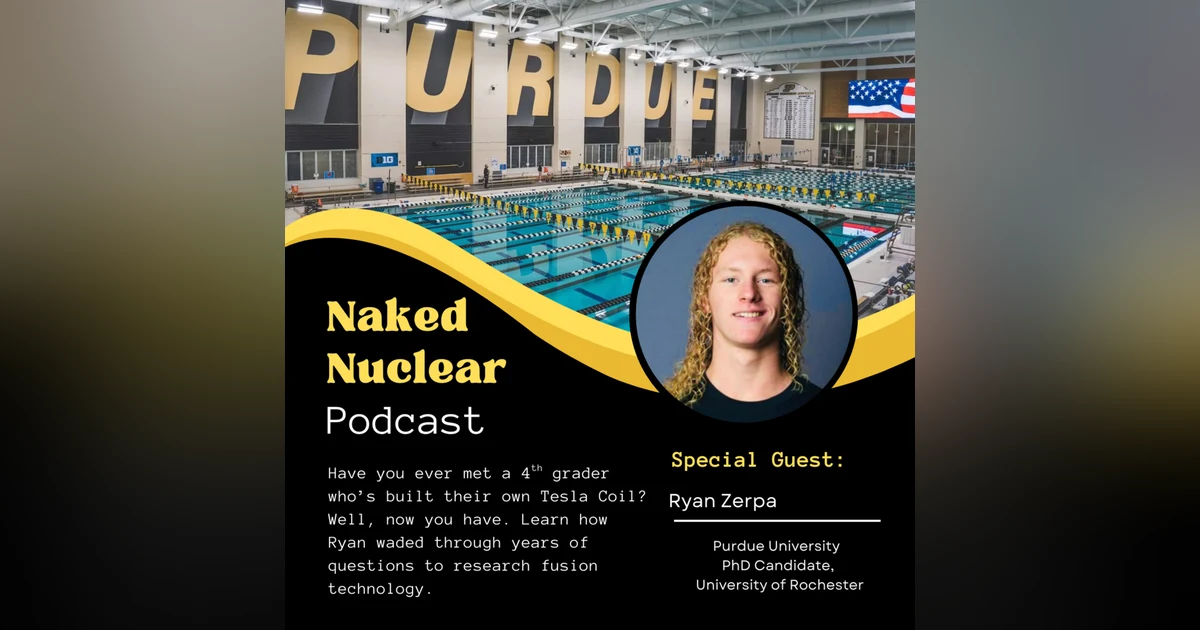
Swimming through Fusion Research: Student Spotlight with Ryan Zerpa


 RSS Feed
 In this Student Spotlight, we trace how childhood curiosity—sparked by Nikola Tesla and MythBusters—led Ryan Zerpa from building a Tesla coil in grade school to pursuing fusion research.
Ryan shares how he reframed a mostly-fission undergrad at Purdue Nuclear Engineering into a launchpad for fusion, what he learned working around pulsed-power experiments like Sandia's Z Machine, and how Division I swimming forged the time-management and grit research demands.
We unpack his plain-language way of explaining fusion (from "why energy transition" to "how plasmas are tamed with lasers and magnets"), then close with his next step: a PhD in high-energy-density physics at the University of Rochester (LLE)—and his advice for students to ask relentlessly and feed their curiosity.
What you'll learn
-
Why Tesla, fields, and hands-on tinkering pulled Ryan toward electromagnetism and fusion
-
How to turn a fission-heavy curriculum into fusion-useful skills (transport theory, fluids → plasmas)
-
What pulsed-power/HEDP experiments aim to do and why nanosecond timing matters
-
The student-athlete toolkit for research: discipline, recovery, and focused practice
-
A simple, audience-friendly way to explain fusion—and why storytelling in science matters
-
Practical advice for aspiring students: persistence beats perfection
-
Sandia National Laboratories (SNL) — overview of the national lab and mission:
https://www.sandia.gov/ -
Z Pulsed Power Facility ("Z Machine") — Sandia's pulsed-power/HEDP platform:
https://www.sandia.gov/z-machine/ -
Purdue University — Nuclear Engineering — program home:
https://engineering.purdue.edu/NE -
Ryan's PhD site — University of Rochester, Laboratory for Laser Energetics (LLE)
https://www.lle.rochester.edu/homepage/
-
**Naked Nuclear** strips down nuclear energy so it actually makes sense. New episodes weekly. 🎙️ [Listen on Apple Podcasts](https://podcasts.apple.com/us/podcast/id1781924674) · [Watch on YouTube](https://www.youtube.com/@TheNakedNuclearPodcast) 💡 Curious about nuclear careers? Visit [nakednuclear.com](https://www.nakednuclear.com) for episodes, resources, and guest spotlights.
Full Transcript
[00:00:00] Danielle Allen: Nikola Tesla was a visionary beyond his time, and those who study electromagnetism follow in his footsteps, piecing together electric mysteries that become tomorrow's breakthroughs. In today's episode, We're meeting one of those students, Ryan Zerpa who's looking at researching fusion technologies
[00:00:23] Ryan Zerpa: remember. In my fourth grade, when I first built that Tesla coil and I looked into Nikola Tesla, ever since then, I was fascinated with understanding how things worked.
[00:00:33] Danielle Allen: we'll be honing in on what curiosities pulled him into studying electromagnetism and eventually fusion.
We'll be tracing his path from a curious fourth grader to a student athlete at Purdue
all the way to studying his PhD. So let's get started.
[00:00:52] Ryan Zerpa: My name is Ryan Zerpa. I will be graduating, from Purdue University, majoring in nuclear engineering and minoring in physics, I've specialized in, I. Research in, what's called fusion energy, which involves rather than the typical fission reactors that we have today that utilize heavy elements such as uranium split apart. We utilize lighter elements like hydrogen extracted from water that can kind of smash the atoms together and release the energy. And the goal is to, to ultimately, use that to hopefully generate a very efficient, electricity.
[00:01:33] Danielle Allen: Ryan is graduating from Purdue in nuclear engineering, minoring in physics with research in fusion, using light elements like hydrogen to release energy by binding nuclei, not splitting them.
So how does someone even get started in studying something like fusion energy
[00:01:53] Ryan Zerpa: I got started in Fusion when I was about a freshman or sophomore in high school, I came from a background of always being very curious and interested in science.
I remember that I was asked, I was fourth grade or something, what I wanted to be when I grow up, and I said I wanted to be an inventor. I was fascinated with minds such as Nikola Tesla, who drew me into the field of electromagnetism. So much so that I built a Tesla coil as a little demonstration for my class project. not great. And ever since then, I was fascinated with understanding how things worked. How did the Tesla coil work? are the origins of the electric and magnetic fields? And that drew me into particle physics, which I went down the rabbit hole of searching into what? the electron is in its wave particle duality. And. As I continued further and further, I got more interested in how I could apply this as well. It was the combination of my curiosity into understanding how things work and that desire to bring something to life that could potentially be helpful.
[00:03:08] Danielle Allen: From fourth grade? I want to be an inventor to building a Tesla coil for his class ryan chased how electricity fields worked and wandered into particle physics finding a home in in fusion's biggest questions, but once that spark, once that flame is lit, how do you keep it going? Where do you draw inspiration from as a young scientist wanting to learn more about the world?
[00:03:37] Ryan Zerpa: One of my inspirations when I was young was the MythBusters Show where I watched, Adam Savage, and the rest of the crew, test common myths that were you otherwise you, you were left to wonder and they would some elaborate device, some robot, some they would blow something up. they would test. in, in a scientific manner, in a very fun and educational way, but in a way that yielded results.
And I felt like that was the most amazing job in the world, and I wanted to do that. And I felt like I was most able to combine my love of. applying science in the interest of the betterment of technology and hopefully mankind, well as my curiosity for understanding how the world works in nuclear fusion.
[00:04:29] Danielle Allen: So how really does this path to discovery work in one big eureka moment or inch by inch along the way?
[00:04:39] Ryan Zerpa: I, I think it's definitely a combination of both. There can definitely come a point and there was a point for me where everything kind of came together and I knew, but that wasn't before years of asking question by question, learning a little bit more. I remember. In my fourth grade, when I first built that Tesla coil and I looked into Nikola Tesla, I was doing, we were tasked with doing a class project on inventors.
And initially I wanted to do Edison. However, Edison had been taken by another classmate of mine, unbeknownst to me. So I'm doing research on Edison and I present to the teacher, and during my research, I come across the famous current war, in the late 1890s, over the, who was going to utilize either direct current or alternating current, to power the world fair at that time. And there was a big, nasty dispute between Nikola Tesla and Thomas Edison. And eventually, as we all know, Nikola Tesla won and alternating current powered the world fair that year. And powers practically everything, we know today.
So I decided to do Nikola Tesla and in researching how the Tesla coil worked, it was fascinating to. To come across, the idea of fields. That was very, that was a very foreign concept. The idea that fields that can reach across air and, you know, deliver work and power to things, was fascinating to me. And so I wanted to learn more. And through that pursuit, through lots of internet research, lots of coming across YouTube videos of public science educators online. Such as the Real Engineering, Cody's Lab, Styro, Pyro, PBS documentaries as well. Things that would light up my curiosity and get, get my feet wet on concepts like wave particle duality and, what is the idea of quantum, mechanics versus classical and how does that shape how we understand the world? little bits and pieces step by step, I would ask a question. I would ultimately reach the limit of my knowledge and far surpass it. I would try to read, I would get lost, and a day or two later I would try again. would ask my professors, what does this mean? I knew, okay, these people who knew particle physics, they know calculus.
I need to learn calculus. I have no idea what a limit is. I have no idea what. What a derivative is. I am still in grade or something at this time, but I ask, and maybe I don't understand the first time, maybe I don't understand the 10th time, but If I keep asking professors and I keep asking, the internet and trying to pool a wealth of knowledge, eventually something will click and sure enough, when I came into the age in which I was taking these classes, I was able to absorb this material a lot more efficiently then I might have been able to otherwise because of the previous exposure.
Even if you don't end up understanding, when you, dive into a venture, the previous exposure can help you one day when it all comes in front of you when you take that class.
I think I was watching a documentary about,PBS documentary about the universe, and it was talking about, Huge stars in interstellar space and how they fuse not just hydrogen, but heavier elements such as carbon into nitrogen, into oxygen, and then even bigger stars can fuse all the way up to iron. I was curious about this process of fusion. And I look it up. I look up how does fusion work in interstellar stars?
[00:08:25] Danielle Allen: Let's pause here. Ryan is explaining the journey of a young scientist. The consistent pursuit of following your why, your curiosity, pulling the threads until you reach an answer and eventually get to the next big question. So how does Fusion work in Interstellar Stars?
[00:08:50] Ryan Zerpa: and. First paper I come across is this paper by Princeton Plasma Physics Laboratory, they talk about how quantum tunneling, is a possible explanation for the lower temperature, the fusion reactions occurring despite the temperature. And I was amazed because I was like, wow, my love of particle physics, my love of understanding the universe and its most kind of extreme, and arguably beautiful, conditions and all of this merges into one place.
This is what I want to do
[00:09:26] Danielle Allen: There are so many fundamental questions to answer about Interstellar stars, supernovas, solar Fusion, but how do you package those questions up into a university curriculum?
But first a message from our sponsors. How do you become successful in the job market? If you are listening to season two of the podcast, you know that networking is key. Why? Because networking connects you to opportunities you didn't know existed. Here's the truth. In nuclear, a lot of the best jobs get filled before they even hit a job board.
That's why you need Nuclear Talent Scout. Their recruiters know the companies, the hiring managers, and what it takes to get your resume noticed. When you register, you are putting your name in front of decision makers who are already looking for someone like you.
Go to nuclear talent boost.com and get started today. Now back to the show.
[00:10:33] Ryan Zerpa: My experience was very, it was very fruitful. I would say that I had a interesting road so at Purdue University, the curriculum largely revolves around, for nuclear engineering largely revolves around conventional fission nuclear reactors. And they basically, they take heavy elements like namely uranium, and so of my classes revolved around understanding how neutrons are transported in a.
Nuclear reactor, how they seep through the fuel and the moderating elements, which are the, are the materials that control the nuclear reactors that make them not only safe, but efficient and operable. How to shield against radiation, understanding how radiation propagates through space and how it. Affects different things, including living beings. there was lots of fundamentals, such as, it's called like fluid transfer, heat, trans heat and mass transfer, which discuss the basic thermodynamic and fluid mechanics properties, that are needed to know in this, in a, power plant setting. However, it was neat because I was able to, despite the lack of fusion specific classes for undergrad, I was able to frame the way that I viewed these classes as a way to build my abstract problem solving skills. Some of these are still definitely applicable in, in all of these classes.
[00:12:13] Ryan Zerpa: particle transport theories and codes that are useful for not only simulating fission reactors, but also simulating fusion, reactors and charged particle transport. In addition, like fluid mechanics is. Very applicable to plasma physics as largely what you do is you, is fluid mechanics with charges. you add the loren force and all of the effects that ensue, as a result.
I was able to have a few fusion specific classes thanks to Professor Choi at Purdue, and he has been a great inspiration and mentor to me, in which he was able to give me some, insight into plasma physics and theory and the, working of. The fusion reactor test devices that we have today, whether it is the Tomac, the big giant metal donut that we all know and love, the laser ignition facility at, it's the National Ignition Facility in Livermore, California. Things like Z Pinch at the Sandia National Laboratory in which I was able to work. These, this exposure in theory and the combination of that as well as exposure due to my physics minor really helped to build the, the wealth of knowledge that made me feel confident to continue to pursue this but despite the lack of undergraduate opportunities to pursue a field that, is so complex and is so tight knit that there, the barrier of entry seems to be largely graduate school.
[00:13:52] Danielle Allen: We've talked about internships at National Laboratories on the show before, but we've never talked about Sandia National Laboratory. Sandia National Laboratories is a federally funded research and development center, headquartered in Albuquerque, New Mexico, with a second principal lab in Livermore, California.
Sandia tackles national security problems with world class science and engineering. Think advanced materials, micro and nanoelectronics, energy, resilience, cybersecurity, high energy density, physics and pulse power experiments like the Z machine.
They work closely with universities, industries, and offer internships for students.
[00:14:39] Ryan Zerpa: So my research at Sandy National Laboratory, first I studied, under Dr. Adam Harvey Thompson and, David Ampleford. They're researchers in the kinda fusion energy research sector of Sandia National Laboratory in which they utilize this machine called the Z Machine, which is a giant, disc with a bunch of electrical. Components on the outside, marks, generators, that charge up and store immense electrical energy. They use a series of triggers within these devices to send all of the electrical energy at once these kind of special conduits that, what's called like pulse forming, where they shape the electrical pulse, they decrease the amount of time that the energy is being, deposited. And eventually they send it through a tiny cylinder that is filled with fusion fuel and this metal cylinder. When you send electrical current through a wire, you generate a magnetic field. about the axis. And the combination of that current the magnetic field produce a force, and that force is inward radially, and so it compresses and causes implosion of the cylinder and that compression in a hundred nanoseconds that compressive force is sufficient to smash these hydrogen atoms together, or deuterium rather an isotope of hydrogen to produce fusion.
And my research revolved around a particular experiment they did where we're trying to understand way to shorten the length of time in which the pulse was delivered while keeping a similar amount of current, traveling through the target. And they utilize something called the Wire Current array, which is a whole mess of really tiny hair thin wires, that explode when the current is sent out.
Imagine two metal plates, in between the metal plates, you have all these hair thin wires of tungsten or aluminum, and on top of this kind of metal sandwich, you have you tiny cylinder of, beryllium.
And on top of that is another, metal, electrode. And the idea is that you are able to perform this and reduce the amount of time that the current flows through that cylinder, which is what you care about to deliver the force to the fusion target from a hundred nanoseconds to 10. And were able to observe this through simulations and things that I helped out with. That research was invaluable for getting into grad school, but also getting my feet wet and in, into the field and really, ensuring that this is in fact what I'm passionate about.
[00:17:35] Danielle Allen: On Sandias Z machine, Ryan continued experiments that compressed tiny fuel filled targets using colossal shaped electrical pulses, wire array tricks shunted current into the target faster, shrinking a 100 nanosecond delivery to 10 nanoseconds. So the magnetic squeeze happens hard and fast, enabling fusion conditions and giving him firsthand high energy density experience.
But even though Ryan spent most of that summer in the desert during the school year, he actually spends most of it in the pool.
So how do you balance the workload for heavy math and physics when you're also training like a collegiate D1 athlete
[00:18:20] Ryan Zerpa: I was a varsity swimmer for the last four years at Purdue, university.
I was, very grateful to have that opportunity, division one, which meant that I was able, I was fortunate enough to get scholarship for my athletics and which helped pay for my school, and that was a vital, piece of my life that I would not have been able to have this opportunity otherwise. And so yeah, we would, we'd swim around 20 hours a week. It, and have many other obligations outside it. It was a full-time job. I would, uh, get up around, five 30 in the morning, eat breakfast, roll into practice around six o'clock or six 30. We'd practice from six 30 to seven 30 or eight in the morning, at which point I would go to class, usually have several hours of class.
My kind of average course load was about, 15 credit hours or so, just not. Terrible, but it's, I'm having, usually I'd go to a three hour lab and then I'd go to two to three long lectures. at which point it'd be about, eat breakfast during class. of course, at which point I would go eat lunch, somewhere in the middle of the day and around two o'clock, two 30, we would go lift weights, for hour 15, until about four, and we'd roll straight over to the pool swim from four 30 to six 30. something about we averaged about. Like 5,000 yards a day. In the afternoons alone, mornings are also something like anywhere from three to 5,000 yards as well. and then we would eat dinner till about. Eight o'clock or so, go home, do homework, usually do at the end of the night, and repeat. three lifting sessions a week. practices Monday through Saturday. three morning practices a week. It was a lot, but a very valuable experience in, in learning how to manage my time and of course, allowing me this opportunity in the first place.
[00:20:33] Danielle Allen: Division one, swimming 20 plus hours a week, pre-dawn practices, labs, and lectures lifts, afternoon yarded, and then homework. That is a full-time job, and I would know I was a student athlete myself, but I played softball and I always felt bad for the swimmers.
However, that commitment and dedication, forged time management, resilience and focus.
So how do you manage near robot-like performance as a college athlete to something completely different? Such as communicating with the public about fusion energy.
[00:21:12] Ryan Zerpa: The biggest thing that I try to, remind people, almost a preface that I like to give, when I, what I do and what I'm interested in, but also science in general. I think anybody who works in the engineering field or in any of the sciences an obligation to attempt to, to bridge the gap between the general public and scientists and our wealth of knowledge.
The purpose of science is to uncover truths and to, hopefully use them to, to better society. And I think, the more that the general public understands what it is that we do, the more efficiently you'll be able to do so. The first thing that I like to say is, be careful not to conflate knowledge and intelligence. Right. There is an important distinction I feel between, how much, like how much it is that you know about a particular subject Your ability to understand that subject. And I think effort. Patience, and I guess resilience. These are very important qualities in intelligence.
And so I try to remind people that it is okay not to understand as long as you're willing to accept something new. that is something that the book I would highly recommend, letters to A Young Scientist by Edward Wilson.
Pulitzer Prize winning, entomologist, I believe. Who discusses all kinds of valuable pieces of advice all throughout, a scientist's career from a young child to, uh, well into their career. I would highly recommend.
[00:22:58] Danielle Allen: Our climate reality is kind of bleak, but the younger generation of students are wasting no time getting to work and finding real world solutions.
That's part of the reason why we're seeing such an increase in enrollment in nuclear energy. Students are wanting to find the solutions to the climate crisis and get paid for it.
So how does Ryan spend his time explaining fission and fusion to high schoolers?
[00:23:27] Ryan Zerpa: if I had to explain. fusion to someone who didn't understand, I would first discuss, I would set the stage by saying that, we are in an energy crisis, right?
Global temperature on average is rising, which you have to remember is the average global temperature that is rising. There are more violent fluctuations in temperature The other piece is the population rising and the demands for energy is rising and it's not something I think people realize.
But one of the first things that we did in my intro to Nuclear, to thermonuclear fusion class at Purdue was we calculated based on the. The knowledge of energy consumption and the population growth rates and the reserves and the, energy density of, oil and natural gas, we calculated how long it would be energy reserves. Until our oil and gas were no longer sufficient to, to supply energy to the world's population.
We need something new. And preferably, ideally, we need something cleaner that does not, output, carbon dioxide and, and per fluorocarbons and thing and different compounds into the air that eat at the ozone layer and pollute the atmosphere.
Nuclear energy has been a key piece of that puzzle. the energy fission is, which is what we currently have with uranium, is million times more energy efficient, in terms of units of energy. Gained per mass of fuel. Like joules per kilogram or something like that, it is a million times more efficient than oil and gas.
As it turns out, fusion, is three to four times more energy efficient, at least than conventional fission nuclear power. And so that is where the interest and the need for this, type of energy is. it comes from. And on top of that, it also does not produce the same types of nuclear waste that. Fission fuel does.
When you have a gas, such as hydrogen that's really hot, hot enough that they're vibration, they break free of the electrons in negative charge. Orbiting this positively charged. Proton. They are moving about so violently that they rip free from their electrons and their ions.
The protons and the electrons flow about freely and separately from each other. You know what's called a plasma? is just a super high gas that does that. And so now you have these protons and these protons are both positively charged and they are, certain distance away from each other.
They're moving really fast As you may remember, like with magnets or with the experiment where you have, rub a piece of glass or plastic on a cloth and you charge it up then you can extend out like a balloon or something and you can repel the balloon. a something positively charged, repels, something else, possibly charged. And so there's this immense force that's Pushing these protons apart, but in the sun, there's so much hydrogen.
There's so many earth masses of hydrogen that the force due to gravity is so intense of all this mass pulling in on each other that it over, it's able to force the protons to overcome that. Proton that positive charge to positive charge, repulsive force that they get so close together that they smash into each other, the protons, and when they smash into each other. A, another force takes over called the strong nuclear force, that only operates under very small distances, extremely, exceedingly small, this force takes over and it binds the protons together.
And when it does, so process actually releases energy,
We don't have the luxury of using gravity. And so we have to use very advanced laser technology and or huge coils of, wire such as electromagnets, to these protons together to produce the same result. hopefully the goal is that we. Are able to do so on a scale that we can use for power generation to hopefully solve this problem.
[00:28:04] Danielle Allen: I have to agree with Ryan we, scientists, engineers, doctors, biologists, physicists owe the public clarity.
We should take the time to explain how we got to the knowledge we did and start to show the messy side of learning, starting with the why scaffolding to the how, and then letting students do the research.
But, but now it's time for our rapid fire questions.
So the first one is if you had, to develop a futuristic city, what three things would you put in it?
[00:28:38] Ryan Zerpa: I would put assuming the technology exists, I would put a fusion reactor. I would put, quantum computing. I guess hardware for the like server internet infrastructure of the city and, material to be used for all manner of appliances and wires yeah.
[00:29:01] Danielle Allen: That's a good one. Next question, what's your favorite meal?
[00:29:05] Ryan Zerpa: Sushi, unagi. Sushi easily. Eel sushi is one of my favorite things of all time. I love it. I can barely afford it, but when I can
[00:29:16] Danielle Allen: Sushi. It is
[00:29:17] Ryan Zerpa: occasions,
[00:29:18] Danielle Allen: Okay, awesome. Aside from swimming, do you have any other hobbies?
[00:29:22] Ryan Zerpa: I play guitar. I have my guitar behind me. I was playing a little bit before I hopped on. love to play video games. I love to code things for fun. I love to, hike, surf, as a California LA native. and I love to, most recently, rock climbing has been a recent, kinda uptake of mine and I've loved it.
It's been awesome.
[00:29:46] Danielle Allen: Amazing. And then if you could travel somewhere to learn more about fusion or just science, where would you go? Where are you traveling to?
[00:29:54] Ryan Zerpa: I think I would have to travel to, Germany to see the Stein seven x accelerator. I think that machine is cool. I almost would've answered the N facility in Livermore, but I live in California and I am going to make a point to see it. So if something harder and something more, something interesting, cool to see would definitely be that machine out there at the Max Plank Institute.
[00:30:21] Danielle Allen: What grad school are you going to, and then what are you gonna be studying at. as you're there.
[00:30:25] Ryan Zerpa: I will be going to University of Rochester in upstate New York I'll be, pursuing my PhD. Studying high energy density physics, which is this field, which includes, nuclear fusion research, which I hope to make my focus, the focus of my PhD. they utilize a. Amazing laser facility called the Laboratory of Laser Energetics, in which I hope to explore the, behavior of materials, namely fusion fuel and the like hundreds of millions of degrees, temperature and hundreds of millions of, Pascals of pressure times the atmosphere. Yeah, very exciting, very, extreme conditions of materials, focused study and I'm very much looking forward to it.
[00:31:16] Danielle Allen: Amazing. and yeah, I'm also looking forward to seeing, the research that you're doing, Publishing things. I'm like, Ooh, that's really exciting.
Before recording this episode, Ryan and I chatted briefly about what it's like to be a nerd, to be driven by your curiosities and sometimes it can be difficult. So I wanted to ask him, what advice does he have for young scientists and other kids labeled as the nerds of the world?
[00:31:46] Ryan Zerpa: I mean, I was bullied a bit when I was young, for being a nerd. Reading I, seventh grade, I'd sit in on AP physics and, didn't understand a thing, but I'd be sitting with all the juniors in high school reading and trying to absorb the best I could. Huge nerd. My best advice is try your best to surround yourself with people or media that are like-minded in your curiosity. Feed your curiosity. I think that is the single most important thing you can do.
I've been introverted for all of my life. I've been able to grow slowly, to the point of, doing things like this podcast for instance, which has been amazing. But. You slowly develop the confidence over, exercising this curiosity by asking people. We, humans are social creatures and I think we stand to gain nothing by venturing into the unknown by ourselves.
I've come to learn that it's much more valuable to be slightly annoying persistent than it is to be, obedient or quiet.
My favorite, scenes that I, think about from a movie to psych myself up to, to ask questions is in the movie Shawshank Redemption, the main character. He's in prison He wants a library for the prison. He wants to help people to, to read and he wants to read himself. and the warden is super corrupt. the warden's like, no, I'm not gonna get a library. So the main character, writes a letter to someone above the warden's head, and they don't respond. He goes, I sent another letter the next week and the next week and the next week, 50 something letters later, they built this library and they sent a letter back to tell us to stop sending so many letters. Think of that every time
of, being persistent and reminding myself that like my curiosity is someone is out there that is willing to lift you up, and I encourage you to stay persistent in finding that person.
[00:33:54] Danielle Allen: Feed your Curiosity relentlessly. Ask dumb questions. Find people and media that nurture your learning. Be politely persistent because the worst thing you can hear is no. And the next yes, could unlock a whole set of new questions.
I wanted to thank Ryan for coming onto the show and giving us a little bit more insight to his world, studying fusion energy
from Tesla coils to the Z machine, from the pool to the desert. And reminding us that curiosity plus persistence is a chain reaction of success on its own.
Next time on Naked Nuclear, we head to the Princeton Plasma Physics Laboratory from quantum tunneling in stellar cores to the machines, and people pushing fusion forward. Until next time, stay curious.