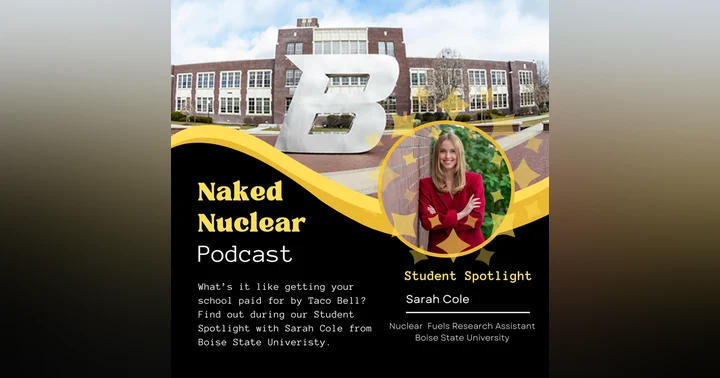
Student Spotlight: How to Win BIG Scholarships with Sarah Cole


 RSS Feed
 In this student spotlight featuring Sarah Cole, a nuclear fuels researcher, we explore her academic journey from high school during COVID-19 to becoming a senior at Boise State University.
Sarah discusses her experiences with internships, nuclear materials research, and building a strong network within the nuclear industry.
She offers valuable advice on applying for scholarships, securing letters of recommendation, and making the most of your undergraduate years. Tune in to learn how Sarah successfully funded her education and her plans for a future in nuclear engineering.
**Naked Nuclear** strips down nuclear energy so it actually makes sense. New episodes weekly. 🎙️ [Listen on Apple Podcasts](https://podcasts.apple.com/us/podcast/id1781924674) · [Watch on YouTube](https://www.youtube.com/@TheNakedNuclearPodcast) 💡 Curious about nuclear careers? Visit [nakednuclear.com](https://www.nakednuclear.com) for episodes, resources, and guest spotlights.
Full Transcript
[00:00:00] Danielle Allen: Picture this, the year is 2020. You are a graduating high school senior and there's just one problem. There's no high school to go to. In fact, all of your classes this semester have been over Zoom, and that was the reality for many seniors during Covid Zoom was their life.
So on today's student spotlight, we have Sarah Cole, who was a senior who went through Covid during high school, but now she's doing something much different.
[00:00:29] Sarah Cole: My current research at Boise State focuses on nuclear fuels. I work with uranium nitride, which is an advanced technology fuel candidate.
[00:00:37] Danielle Allen: Now a senior in college. Sarah has worked as a nuclear fuels researcher and is applying to grad school, she already has an impressive resume serving as the nuclear engineering student, delegations vice chair, and even winning the Taco Bell Live Mas scholarship. Multiple times. This episode is specifically designed for students or people who have students living at home.
We're going to be going over how do you get scholarships, how do you ask for letters of recommendations, and what does it look like to build your network? So let's start off with Sarah's background.
[00:01:11] Sarah Cole: My name is Sarah Cole. I'm originally from Boise, Idaho, and I got into the nuclear industry in high school when I did an internship at Boise State University, which is in my hometown, about 20 minutes away from where I live. And over the course of that year, I really fell in love with research and also. Looking deeper into materials for extreme environments for nuclear reactor applications, and that motivated me to study material science and keep pursuing my undergraduate research in nuclear fuels over the past four years. And now I've decided I love nuclear so much. I wanna go get my doctorate in nuclear engineering next year.
[00:01:47] Danielle Allen: And how did Sarah get her first internship opportunity in high school?
[00:01:53] Sarah Cole: So. And that is how I got the initial internship opportunity. And so it was really just a who, you know, type situation that's changed my life. But as far as what the experience was like my senior year in high school was during the covid year. And so that did bring a really strong benefit in the fact that every other day I was in person in high school versus on, zoom or just not in high school. And so I got, I had a lot more free time than I would've otherwise to spend time on campus at Boise State. That was also a, a lucky coincidence for me as well. But I spent that year under the mentorship of a couple of PhD students working with the nuclear sensors. And so I gotta do, , tensile testing of additively manufactured sensors on structural nuclear materials.
And once I gained experience assisting with that experimentation and data analysis, they run with my own little experiment where. I tested these sensors in a high humidity chamber and designed the experiment from start to finish. And at the end of the year I presented at an Idaho undergraduate research conference at Boise State as kind of my culminating experience and just really loved the whole process and the people I worked with.
[00:03:19] Danielle Allen: Tensile testing of additively manufactured sensors on structural nuclear materials. So what does that mean?
Tensile testing is a way to see how strong a material is by pulling on it until it breaks. You can stretch material, apply force to a material or bend it to see how stiff or flexible it is.
Additively manufactured sensors. That's a fancy way of saying 3D printed sensors being attached to nuclear grade materials. Because these environments are so extreme, they need a test to see if these sensors will actually hold up to the environments of a nuclear reactor.
And because nuclear fuels researcher isn't something that every third grader wants to be, I asked Sarah what you wanted to be when she grew up, and how is it different from what she's doing now?
[00:04:13] Sarah Cole: Oh, great question. I always wanted to be a lawyer because in high school I was a big speech and debate kid, and I also loved math and science, and I would sort of like tangentially do these women in engineering exploration workshops. So I kind of had two parallel visions, and ultimately I went with engineering because I could still channel in that part of my personality that loves to communicate and loves rhetoric, but in a way that's more impactful through nuclear science and technology. And so would I, I have gone on to like something more humanities based if I hadn't gotten that internship maybe. But I'm glad I, I didn't.
My current research at Boise State focuses on nuclear fuels. I work with uranium nitride, which is an advanced technology fuel candidate. Currently, the Lightwater reactor fleet uses uranium dioxide, but there are some challenges associated with UO two, such as lower uranium density and lower thermal conductivity compared to advanced fuel concepts like uranium. Synthesis means as well as, conventionally centering fuel like they would in commercially upscale fuel fabrication facilities. And eventually we wanna look more into both its oxidation behavior and thermophysical properties to add to those knowledge gaps before we can fully utilize UN in advanced reactors and the whole civilian nuclear fleet, potentially one day. so those, that's a little bit about the applications.
[00:05:38] Danielle Allen: If you've listened to previous episodes of Naked Nuclear, you might wonder, haven't we talked about advanced nuclear fuels research before? Yes. Yes, we did. Our first episode was with. Dr. Jennifer Watkins, of the Idaho National Laboratory.
Dr. Watkins was studying accident tolerant fuels, including uranium mono nitride.
So I asked Sarah, does she know Dr. Watkins?
[00:06:04] Sarah Cole: Yeah, she used to work in my research lab and I worked with a lot of the same materials she did. She also worked with tract.
[00:06:11] Danielle Allen: But how common is this in the nuclear world? Does everybody know each other?
[00:06:16] Sarah Cole: One experience that highlighted that for me was I interned in DC through the American Nuclear Society after my sophomore year, and I was writing a policy analysis where I did interviews with nuclear professionals on the policy side. So in the executive legislative. C type spaces. And I got to meet the people whose faces I've always seen plastered all over, like the internet for nuclear and LinkedIn, et cetera. And so now whenever I see any sort of advancement in like, oh, the advance act got passed, or, oh, they're modernizing certain NRC regulations, I see faces that I actually got to meet with in person. And I think it's so cool that nuclear is such a small pond that I've physically like met a lot of these people, and that's one of the things that motivates me to stay in the field.
[00:07:01] Danielle Allen: And, if you're a student who's listening, how do you start networking and engaging? Everybody tells you to just network, but what does that mean? So what's Sarah say?
[00:07:13] Sarah Cole: For me at a university that doesn't have a nuclear engineering program, conferences are really big for me because I can travel to say the a s Winter meeting and go to the a s Young Professionals Congress and meet a whole network of students that turned in to be my friends and future colleagues like. For example, I went to that Young Professionals Congress that I mentioned in DC during my junior year, and I met, um, the current vice chair of the nuclear engineering student delegation, which is a group of students who go back to DC for a week of nuclear policy advocacy and meetings in the nation's capital.
And so by meeting her and some of the other delegates, I then went on to join that delegation, and now I'm vice chairing it for the 2025 year. For me, going in person to physical conferences has been huge to meet people and learn about new opportunities, but I has been really beneficial for me because. Anytime I come across, somebody and I read their bio and it looks like they have a cool series of work and research experiences, I always tend to take note of those and maybe just connect with them and then in the future, um, potentially meet them in person too. And so that's also been a way for me to just see what opportunities are out there .
I'll just Google things like maybe not for a conference, but rather for a scholarship. I'll Google scholarships for students in nuclear material science and you'd be surprised what you don't know about that exists. So I wouldn't be afraid to just blindly Google for really tailored, specific things you're interested in.
[00:08:49] Danielle Allen: The scholarship space can seem very overwhelming as somebody who's navigated it before successfully and sometimes unsuccessfully. I wanted to ask Sarah. Sarah was the recipient of the Talco Bell Live Mas scholarship, which awards up to $25,000 per semester, and she's been so successful that she hasn't had to pay any out of pocket costs for her education.
[00:09:12] Sarah Cole: I started my scholarship journey my senior year in high school, and I had a physical little file cabinet box of scholarships that I found over the summer that I tended to apply for during that school year. So I knew I'd be too busy to actually look them up in the time, in the pressure when they're almost due. So I started early and. Since then, I've ended up getting all of my school paid for and I've made a considerable amount of money back, which I pay taxes on as if they're, it's just a regular income. My approach for that has just been, I do the major ones in the nuclear industry, which would include the American Nuclear Society, the University Nuclear Leadership Program. This year I found out about the Roy G Post Foundation scholarship as well. Those are three big. Scholarships, but I also have received the Taco Bells scholarship. It can be up to $25,000 renewable for four years. And all I did to get that was to make a two minute video about my passion. And of course I talked about nuclear. And every year I remake the video and they've gotten more elaborate as time went on to now I'm sort of doing like fun musical montages of me working in my research lab and showing myself working with radioactive materials in the Glo. Turns out I did get that Taco Bell one,
[00:10:41] Danielle Allen: Sarah's Nuclear education was brought to you by Taco Bell. I was not paid to say that. However, I did want to ask Sarah, how does she differentiate herself in the About Me section? What does she talk about, within her application that has made her so successful?
[00:10:57] Sarah Cole: I typically start with a sentence, something to the effect of my curiosity lies in this, like researching materials, for extreme environments. I pick something that's a little more specific than just a blanket statement of nuclear energy for me, because I'm in materials and nuclear, I'll say like nuclear materials. And then from there I give a very, very brief what one instance anecdote about how I got into nuclear, which is through my high school internship and how that set me on a path to exploring the industry. And then I will say like, now I intend to pursue a PhD in nuclear engineering to do X, Y, and Z and like briefly state my career goals. I'll then typically do a couple of paragraphs about my previous research experiences tying in I intern DC I interned at Stanford doing batteries and I, my current research at Boise, and then I'll conclude with some very specific career goals. So maybe you could mention, oh, I want to work at Westinghouse in nuclear field fabrication.
Or, oh, I want to be a university professor. I wanna be a professor because I would enjoy mentoring and educating students, and just showing that you have a grasp on what your day-to-day would look like and who you'd be impacting and who you'd be serving in that future job.
Just to show you, the wheels have turned in your brain and you can actually see yourself in those positions. I typically end with a final statement that's positive in nature and forward looking like, I'm excited to, pursue nuclear engineering research as A-U-N-L-P scholar, something like.
[00:12:26] Danielle Allen: Something that stops many students from being able to submit their applications is letters of recommendation.
So I asked Sarah, how does she get letters of recommendation and what's her mindset around building relationships with professors?
[00:12:41] Sarah Cole: I would say if you can store as early as possible, like if you're a freshman, just entering college. Get a position in a research group and start building that foundational background so that you have an advocate on your team that's willing to rightly say a lot of great things about your work ethic and your accomplishments. So if you have that capability to start early, I'd say do it. if not, one of the things that can be really effective is giving your recommender a lot of pointers or reminders about what you've actually achieved under their time. Because your professors can be busy and they might not be keeping track of every single one of your accomplishments. So if it's somebody who's maybe less fa familiar with the intimate details of my resume or cv, I'll definitely provide that to them so that maybe if they don't have very specific commentary to make about you due to lack of working with you for a long time, they could still point to, oh, they got this award, or. Um, bring, to, bring to the surface your other accomplishments, not directly affiliated with their mentorship over you. And also recommend starting early and giving your recommender like, well over a month to submit
[00:13:52] Danielle Allen: If you are looking to apply to scholarships, consider these tips.
One, start early, get into a research group position and build relationships with your professors.
Two, your professors might be really busy, so give them your CV or resume a list of accomplishments that you've done to date.
Anything that might be noteworthy or helpful to the scholarship.
And three, do not wait till the last minute. Sarah mentioned that in the summer she uses her time to build a schedule, a plan, and list of scholarships that are upcoming and available to apply to.
Especially when the applications or deadlines are due, when she might not have the time to do so.
and when you do successfully win a scholarship, what's the impact?
[00:14:41] Sarah Cole: The impact's been huge. The most important thing for me, aside from the financial benefit of not having to pay for school, is I'm so much more motivated and like it's kind of a cyclic process where if I get something that's validating my efforts within research and nuclear, it makes me want to do it even more. And definitely I have an intrinsic sense of motivation to do these things because I love nuclear energy and I believe our country needs it. But it also is a big boost to see like, wow, there's great opportunities in this field. Like I've been supported since age 18 by the nuclear industry and by the federal government, by the office of Department of Energy giving me these scholarships.
This seems like a great path to keep walking down. So it's honestly provided me a sense of trust. To dedicate my career to it since they've had my back throughout my educational journey. But also, I can't ignore the fact that because of my scholarships, I can afford to go to college. And also I don't need to get a second job in addition to my research assistantship position. And that gives me a lot more time to work in the lab.
I knew I wanted to stay in the field of nuclear material science since my undergraduate degree is material science focused. And I also think I would've been the best fit in those fields instead of jumping over to something I'm less familiar with. so I looked for programs with strong, research within nuclear materials, first and foremost, and faculty. Seemed like they'd be a good fit and had Zoom meetings with them, and I continued to do that throughout the course of applying to these schools and sort of refining as I went along, or maybe I found a different professor that looks like a good fit even after I submitted my application and just reach out and say, Hey, I'm really interested in X, Y, Z research. Would you be willing to do a. , most of the time they were willing to hop on a Zoom call with me that day, the next day, and I asked them basic questions about the research, their mentorship style, the atmosphere at the university as kind of a litmus test for if I'd like to go there. Most of the time. I generally really appreciated what they had to say and learned a lot.
then I felt like because I had insight into their personality, I was able to distill down my application essay and tailor it more specifically toward their group or to the culture of the university that I wouldn't have known otherwise.
Sometimes, you know, hopping on that first zoom meeting with a big scary professor is a little bit, intimidating. But I think the more I've done those, the more I've grown confident that I can be myself and ask the questions I wanna know, so that, that part was a little bit stressful, but it's, gotten better for me over time.
[00:17:29] Danielle Allen: what advice does Sarah have for young freshmen or high schoolers who are looking to make the most during their time as an undergraduate?
[00:17:36] Sarah Cole: I would say take advantage of every summer that you have in been lived before something. After my freshman year, but sophomore year and junior year, summers, and hopefully this coming summer too, I've lived in Washington DC Stanford and done cool internships. I even did a batteries research internship that had nothing to do with nuclear, just to see if I liked it and to try something new. And those things have been super enriching to me, and I feel like now I have friendships from people, all backgrounds all over the country. And that's been helped me be successful because I have a stronger sense of what I want to do with my life. Like now that I've researched batteries, I know for sure I want to stay in nuclear.
And that's something I'm not just going on a limb about. Like I've actually tried a different branch of material science research. So that would be one thing is use your summers to your professional and academic and social advantage because it's kind of is a fun life adventure too. other would be, you know, try and keep your GPA high as best as you can. I think that is probably pretty important, but I don't think you need to have a 4.0. But just like focusing really hard on your classes, even if it means you've gotta wake up at 5:00 AM and grind on certain days.
[00:18:58] Danielle Allen: As a student, you're told to wake up, study, grind, get into your textbooks, read the material, go to office hours, but no one really tells you how you're supposed to be networking. Everyone says your network is your net worth, but where's the study guide for networking?
[00:19:16] Sarah Cole: I had an early introduction to the other researchers just by virtue of having my high school internship. And so I think that because I was an 18-year-old who was kind of friends with all these 26, 27 year olds, that made me really comfortable forming friendships and relationships with other graduate students and with faculty. Beyond that in my coursework, I definitely utilized the office hours and I definitely wasn't afraid to have her pop in and ask a question, even if initially I was scare of being annoying I would just say these people are here to help you and they want to help you.
So just pick their brain like you are surrounded by amazing minds as a student. And just. Use that to its full advantage to help you grow as well.
I'm the president of our a s student section at Boise State, and thanks to the American Nuclear Society we received, it's called a local and strategic fund grant in the amount of thousand dollars and we. Take about 30 teachers out to Idaho National Lab, which is four hours away from Boise. So it was a little bit of a bus ride, and we got to take all these high school and middle school teachers of all sorts of different science backgrounds like chemistry, physics.
Some of them are teaching technology classes. So they saw some recycling and agricultural research as well as electric vehicles there. That was in the in town facilities. And then INL bust them out to the desert and they got to see first the experimental breeder reactor one. And that's now the museum and then also we went to the advanced test reactor, that, does a lot of work for companies and universities that wanna test certain fuels and materials . That was just a really fascinating experience for a lot of the teachers. 'cause they actually got to see a real life nuclear reactor. They got to see the cooling pools and lean their head over and see the blue glow, Cherenkov radiation. So it was a lot of like real in-person experiences. I hope these teachers will never forget.
And also that they could take back to their. Kids and tell them stories about nuclear and get them really ramped up to get their elementary school kids to maybe consider current science one day.
[00:21:22] Danielle Allen: Now with her hands full with grad school interviews, I asked Sarah, what's in store for the future? Does she wanna go into research, be a professor?
[00:21:31] Sarah Cole: I applied to six schools, North Carolina Knox. Berkeley, university of Florida and University of Michigan.
Grad school. I'm already planning to serve as the vice chair of the nuclear engineering student delegation in Washington DC and so we're already in the works of planning next year's delegation in September. And so that'll look like, preparing an application, interviewing a lot of students who are interested in it, and arranging our meetings for our one week. Delegation that we have.
we have a chair and two vice chairs that plan the delegation, and we work with the American Nuclear Society and the Nuclear Energy Institute to put on the delegation every year. And so in January, that's when we start planning for the delegation in September. We have regular Zoom meetings with the, the other co-chairs and we plan, hotel logistics, recruitment at the various conferences coming up. So I'm gonna the student conference and help promote the delegation we blast out the application. We receive a lot of interest in it, and we interview students in May.
So that's, that's kind of my main extracurricular commitment. Something I'm really passionate about on the side is nuclear policy. So I definitely wanna stick with that. , after graduate school, I envision myself continuing with research in academia and being a professor, but I also wanna do a one year fellowship on Capitol Hill Energy Resource Committee. I help lawmakers write and decide between policies that support not just nuclear, but other areas of a clean energy legislative portfolio. And I think it'd be a uniquely fun time to do that right after graduate school because, you know, I've just gotten a doctorate degree and I've just kind of like put the check on my future research, and then I can take that experience with me back into teaching to grow as a scientist.
[00:23:31] Danielle Allen: I finally wanted to know what has she learned along the way and what advice would she give to other students?
[00:23:38] Sarah Cole: Insights I've learned about myself are, I love to talk, like I said, initially wanted to go into law because I was big. Debater the fact that I still want to be someone that can communicate effectively and that will love to have conversations, not about nuclear energy sometimes. And so I still like to grow as a conversationalist despite working in a field that could potentially like just get so locked down into the science that they don't like to dabble in those sorts of things.
Don't be afraid to. So you see there's a conference that you could go to like the a s Young Professionals Congress, they hold every other year in dc. If that sounds like something that's exciting to you, I would say lean on your university to support you in going and traveling to these things and paying for you to do so. I wouldn't be scared to ask for other support. See this amazing opportunity and do networking. For students going into graduate school, my biggest advice would be make sure you're holding meetings with potential research advisors in advance of actually applying to the school, because I think you'll gain a lot of insight. it could potentially save you an application fee or it can, just elevate you in the application review if you've already made contact with that individual. So yeah.
[00:24:55] Danielle Allen: Firstly, I wanted to thank Sarah for being able to connect with me and hop on the show to do our first of many student spotlights. The student spotlights are really for other students to understand and learn what their peers are doing, what are best practices, how are people finding success within this industry, and how to share that with your classmates.
I enjoyed this interview because not only did Sarah take the time to sit down and talk with me right afterwards, she had a grad school interview, fingers crossed, but I am super excited to see where she goes for grad school, but also for the future.
Thank you for listening to this episode of Naked Nuclear. I hope you got some takeaways or even just to share with people in your network who are students, how to be successful in the scholarship game.
for the rest of season two, we will be digging into more student spotlights, but also looking at industry, what is industry doing in order to train the next generation of nuclear professionals? Thank you again for listening. Stay curious.