Step Into Nuclear: Maintenance Tech Training at Cape Fear Community College with Kelli Davis


 RSS Feed
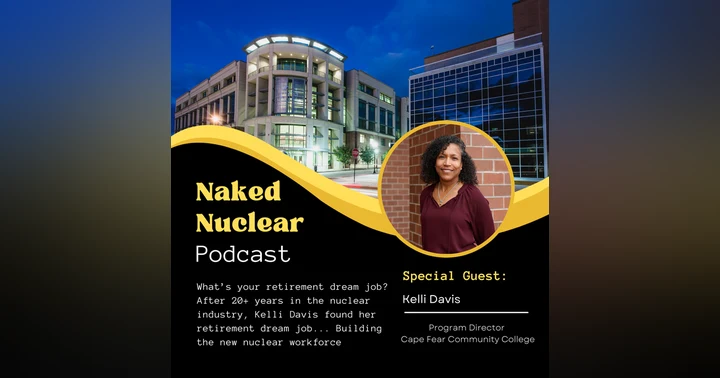
 In this episode of Naked Nuclear, host Danielle sits down with Kelli Davis, Program Director of the Nuclear Technology Program at Cape Fear Community College. From her start as a nuclear chemist to becoming an advocate for building the next generation of nuclear workers, Kelli shares her inspiring career path, insights into nuclear maintenance training, and why this career is more than just a job—it's a lifestyle.
💡 What You'll Learn:
-
The unique journey Kelli took from chemistry to nuclear education
-
What Cape Fear's Nuclear Maintenance Technician program includes
-
Why behaviors and coachability matter more than technical background
-
How the industry is evolving with small modular reactors and a growing need for workforce development
-
Real talk about union vs. non-union plants, upward mobility, and career satisfaction in nuclear
👩🏫 Who This Is For:
-
High school grads and career changers interested in hands-on work
-
Curious minds exploring pathways into the nuclear industry
-
Families, advisors, and educators helping students find purposeful careers
🛠️ Classes Offered at Cape Fear:
-
Welding, reactor theory, hydraulics & pneumatics, non-destructive testing, primary systems, and more
🌍 Kelli's Big Message: "You don't need to grow up wanting to be a nuclear worker to become one. You just need the right mindset, a little mechanical aptitude, and a willingness to learn."
📬 Connect with Kelli:
Learn more at Cape Fear Community College
Email: kndavis245@mail.cfcc.edu
💬 Have a question or want to suggest a topic?
Email Danielle at danielle@nakednuclear.com
🎧 Subscribe, rate, and stay curious.
Season 2 of Naked Nuclear is your inside look at nuclear education—from trade schools to industry. Whether you're thinking about your future or helping someone else shape theirs, we've got you covered.
**Naked Nuclear** strips down nuclear energy so it actually makes sense. New episodes weekly. 🎙️ [Listen on Apple Podcasts](https://podcasts.apple.com/us/podcast/id1781924674) · [Watch on YouTube](https://www.youtube.com/@TheNakedNuclearPodcast) 💡 Curious about nuclear careers? Visit [nakednuclear.com](https://www.nakednuclear.com) for episodes, resources, and guest spotlights.
Full Transcript
[00:00:00] Danielle Allen: If you wanna be a medical doctor, you go to medical school. If you wanna be a lawyer, you go to law school. If you wanna be a lunar base commander who works on nuclear reactors, you go to, well, I don't know exactly what school you go to for that, however, season two of Naked Nuclear is trying to find that out.
We're looking at all the realms of nuclear education from two years trade schools, four year universities, and even up into industry. Those that contain scholarships, internships, academic resources, and all the like. So I hope you enjoy it. Today we are featuring Cape Fear Community College. Cape Fear is located down in Wilmington, North Carolina, and we got to talk with their program director, Kelli Davis.
[00:00:45] Kelli: People go to nursing 'cause they know they wanna be a nurse. People go to engineering 'cause they know they wanna be an engineer. They already know about these programs. People don't really grow up saying I wanna be a nuclear worker.
[00:00:55] Danielle Allen: With Kelli at the helm, she wants that to change. She wants to raise awareness about what it means to be a nuclear worker and some of the expectations about joining the industry. Today. We're walking through her background and how she got here, but also what the program at Cape Fear Community College is like. What does it mean to be a nuclear maintenance technician? And what can you expect from the industry? So first, let's start off with Kelli.
[00:01:22] Kelli: I got my undergraduate degree from Southern Illinois University in Carbondale. 'cause I'm from Chicago and, I've specialized in forensics. When I graduated I started trying to get into the industry and was having, a little bit of a difficult time. I ended up in California and my first job where I got hired full time was as a nuclear chemist. We made radioactive standards for industry. We did some medical standards for instrumentation, like MRI machines I made ones that we pretty much used for friskers, source checks and calibration standards. When I left to move back to Chicago after I got married and started a family, I was looking for a nuclear chemist position. And, lo and behold was looking for a job on monster.com and found a nuclear chemist position. So I applied three months later 'cause nothing happens quickly in nuclear. They had reached out to me to take the exam and interview, back then you didn't have like GPS on phone. So I had to print out the directions on MapQuest. I'm following these directions and I'm going all through these corn fields way off outside of Chicago DeKalb County. Finally pulled up to the Guardhouse and the person had a rifle around him and I'm just like, oh my goodness, I hope I'm in the right place. I interviewed and I got the job offer, and I've just been in nuclear power ever since.
[00:02:40] Kelli: Matter of fact. I'm Facebook friends with the man who hired me, who gave me my first job in nuclear power. Cape Fear just did a spotlight on me I said, I owe it all to you, you started my nuclear power career. Thank you so much.
[00:02:55] Kelli: I got that job in 2002 and then I just left in 2024. It was just time for me to segue and do something else. I have four children. Three grown and gone. And my youngest was home alone homeschooling. I started my own business and was sitting at home working my business. He transitioned into high school, wanted to go to brick and mortar, I'm just sitting at home working and I happen to come across a job post. The irony of it was that it was something I always wanted to pitch to the school. 'cause I didn't know the program was there. I said I need to figure out who I can contact. I knew what the industry needed. We've been struggling with Pipeline forever, and when I was in my last role I did hiring and it was a struggle trying to find qualified candidates. And so I felt like we were missing the opportunity to get people when they were in school and groom them for the industry. That's when I just applied for it. 'cause this was like my retirement dream job.
[00:03:57] Danielle Allen: So what is Kelli's official title?
[00:03:59] Kelli: So I'm currently the nuclear technology program director and so I'm over the program, but I also teach. Right now the program that we have is a nuclear maintenance program. It was birthed out of a need that GE Hitachi had, at the time that I had applied for the position I saw I was a nuclear technology program. I didn't realize it was a nuclear maintenance tech program. Now that I'm in the role and I've dissected the curriculum. The biggest thing that I need my current students to take away is making sure that they're prepared to transition into industry. Right now, we require work-based learning opportunity. In the spring, the springtime is the outage time, so that's when the reactors get shut down for refueling. And while they're offline being refueled, we try to get as much maintenance done as we can. It takes a lot of workers to make that happen. So they get a lot of contractors on site in order to do their work, and the contractors go from outage to outage, and they pretty much just live their life on the road supporting the refueling outages. I need to make sure my students are understanding that that is what is next for them and that they're prepared for what that looks like. The biggest thing is that I wanna make sure people when they come into the program understand this. This is not a job. This is a career, and it's going to change. If done correctly, it will change your lifestyle, right? Because nuclear is so structured and it requires you to alter the way that you view safety. The best thing you can do for yourself is practice like you play to be safe in all the things you do, and then that way when you at work it translates, right? Because there's certain things, like when you're on a nuclear power plant site, different plants have different requirements, but for the most part across the board, you can't look at your phone and walk, that is like a huge no-no. A lot of plants make you walk through crosswalks. There's no cutting across the parking lot however you see fit. So that's why I said it becomes ingrained in you now that I'm not even on nuclear power plant sites anymore, a lot of times I look at my phone, I'll stop. Stop and look at my phone. If I'm at the grocery store going across the street, I'm going to go through the crosswalk. It just becomes ingrained in you. And so that's the biggest takeaway because some people are gonna struggle with that. 'cause in their mind they're gonna be like, this is stupid. It doesn't matter if it's stupid or not. In your mind, this is how the industry operates and you either align yourself or you won't. It won't work for you. Right. Same with coaching. You have to be very receptive to coaching in nuclear. So if you can't align yourself with that, if you're gonna be somebody who's in your ego, as soon as somebody tries to give you some coaching because they perceive that you're doing something that's unsafe, you're gonna be combative and it's not gonna work out. So the behaviors, the behaviors when it comes to a nuclear career are huge. Everything else we can teach you. You either align or you don't.
[00:06:56] Danielle Allen: Let's pause. Behaviors when it comes to nuclear careers are huge. So what does that look like? If you are listening and you are in high school or even early college, chances are you are a teenager, 18, 19, 20, and no offense, but your age group isn't known for their best and brightest decision making. If you're not expecting to be directed on looking at your phone and walking or using the crosswalk, then it might seem that every little thing is being nitpicked, but this is the industry. It's safety focus. And so when it comes to evaluating whether or not a nuclear career might be something you are interested in pursuing. You have to evaluate, are you coachable? Do you have behaviors that can be changed or improved? And do you find that purpose fulfilling? With all that in mind, what classes can you be expected to take?
[00:07:54] Kelli: Because it's a maintenance program we have welding classes. You have electrical engineering classes, like engineering technology. Right now I'm teaching power fluid, so that's hydraulics and pneumatics. Some of the nuclear classes we teach are primary systems where we're talking about the reactor and all the systems that touch it, like the safety systems. Then we also teach reactor theory that teaches you how the fission process happens and what all is happening inside the vessel with the fuel. And then we teach non-destructive examination, which is how a lot of the testing happens with the vessel and the other metal parts that go along with it. You can't just disassemble it and inspect it. You have to have other ways of inspecting, like buried piping and different components. So you'll have those kind of type classes. 'cause again, it's to support the outage industry. That's pretty much the curriculum. But what I am also bringing into it, 'cause some of the feedback that I'm getting is letting me know that we have to do a little better with working with students on their mechanical aptitude. I need to make sure that my students' minds work the way we need their mind to work for you to be successful in that industry, right? Because there's certain exams that you have to take in nuclear to qualify. So one, like if you wanna be an operator, there's the POSS exams, and so a lot of that is how well you can accurately answer questions under duress, right? How accurate can you be in the heat of the moment? You have this ridiculous number of questions that you have to answer, that most people don't finish in a very short period of time. And you have to answer a minimum number. You have to answer the number you answered. So much has to be correct. So they wanna make sure that, 'cause as an operator, if you have to shut down the reactor in an emergent situation, you have to be accurate and you have to be fast. So they wanna make sure that they have people that before they even bring them in, they can work. You just have to have a certain aptitude just to work in the industry. And then, same with maintenance. They have the MASS exam, so there's certain exams, selection exams that you have to pass. And so my thing is to work with my students to make sure that they can pass those tests. Because if I don't prepare them while they're in the program, then when they show up to the plant site, it is gonna be shocking for them when the first time somebody yells at them like in a respectful way. But somebody might stop 'em, say, Hey, please hold the handrail. And they'll be like, are you serious right now? They're very serious. You don't go up and down the stairs without holding the handrail at a nuclear power plant. The biggest reason is if somebody twists their ankle at Walmart, it doesn't make the news. But if somebody twists their ankle in the parking lot, a nuclear power plant, it can make the news. And so our focus on safety is something I can't even vocalize, but I'll just do. The best way that I can explain to people is as someone with a chemistry degree and background. I could not see myself working in any other industry because no other industry has the same layers of safety that nuclear does. So that's how serious safety is in a nuclear power plant. It's really real. It's almost shocking, but it's there to keep you safe. We all wanna make sure that everybody goes home in the same condition, if not better, then they came to work again.
[00:11:12] Danielle Allen: Welding, electrical engineering, power, fluids, hydraulics, non-destructive examination. What if you don't have any mechanical aptitude or background? What if you never grew up learning any of this stuff? Can this program still be for you?
[00:11:29] Kelli: Oh, absolutely. I had no background in that, so I was a tinker. I liked to play around with things and I was good at assembling. If you gave me furniture in a box, I could assemble it, I could look at the picture and I could put it together. That's more or less like the mechanical aptitude portion. But yeah, when I got hired at the Brunswick plant down here in North Carolina, I got hired to be an operator. I had never operated in my life. I was, like I said, I was a chemist. And so when they hired me to be an operator, they sent me to take the test and I test well, like I said, I just have that kind of mind. So I did well on the exam. And then I interviewed and they hired me for the position. Pretty much everybody in class was either a former mechanic or a former Navy nuclear. Right? So I was well behind and I didn't know what a pump curve was. I didn't know anything about different valves. I didn't know anything about throttling character, like nothing. This was all terminology I'd never heard before, right? I'd worked in nuclear. But I had never been an operator. And so when I worked in nuclear as a chemist, when I would ask questions, what is that? How does this work? Oh, you don't need to know that. As far as how the whole plant worked, we got a basic systems class that was like two weeks. That's not nearly long enough to learn how an entire nuclear power plant works. Right. If you have the willingness to learn, the tests are there to make sure that you have the basic aptitude, but with the aptitude and the willingness, anybody can work in nuclear power. And the other misconception is that, it's amazing how many people I encountered. I think you have to go to school for it. These programs, as far as nuclear are new, right? Most people that have been, that are operators in nuclear power plants come from the Navy where the Navy gave them the training and that was all based off their aptitude test, right? They took the test to get into the Navy based off their score. They're like, Hey, we can use this person in nuclear. And so they would recruit them for that. But as far as the commercial plants, a lot of people started off sweeping and mopping the floors and work their way up. Now we hire people with degrees, but like in chemistry, a lot of times we'll hire somebody with a chemistry degree with no nuclear experience, we teach them that part. Nuclear power plants have everything. We have project managers, there's a lot of construction that happens. So there's like a lot of construction workers at nuclear power plants. The biggest thing though, the transition is the level of safety. I just can't express that enough. The things that you do in the regular world are just not gonna translate to a nuclear power plant. The compensation is so worth you aligning yourself. Plumbers, nurses, we have a doctor that comes in periodically 'cause the operators have to pass certain fit tests. It is a small city within the city, so they employ all kinds, admins. Us as operators, we're fire brigade 'cause we're first responders. Whatever you think of in a small city, you have it at a nuclear power plant and you don't have to have a nuclear technology degree to work there.
[00:14:31] Danielle Allen: So, no, you don't need a background in mechanical aptitude or to be a mechanic, but the industry is changing and that's why we're seeing a lot of different community college programs pop up all across the country to provide specialized skills in these programs to industry. So how long does this program last and what are the working expectations after you finish?
[00:14:56] Kelli: So right now the program's designed to be two years. The second spring. That's when we do the work-based learning. I'm working on potentially some curriculum changes so that it is not just a nuclear maintenance program. We're gonna try to tailor it so we can bring some radiation protection personnel through there. And people wanna do other things besides just being maintenance tech. Right now the way that it's laid out is you go do your work based learning the following spring, after your first year. And then from there you should be able to come back and finish out whatever couple classes you have left in that summer and graduate. My goal is to move it so that when they go to do that work-based learning in the spring, if they get a job offer, they can stay and they don't have any more classes to continue. But right now, the way the curriculum is essentially laid out, I have not done my first advising session yet with my students. So I have to get a feel for when the classes are offered and how much I can reconfigure what the school has laid out as the map. Right now it's pretty much two years and you're done. We have a partnership with Sonic Systems. Sonic Systems does a lot of vessel work, reactor vessel work for GE. And so when wherever GE is supporting outages, Sonic Systems goes and does like incor inspections, they change like, do maintenance on the control rod drive mechanisms. My students will travel with Sonic Systems to whatever outages they have planned for that spring and do whatever level of work that, and Sonic Systems will then take 'em with GE and assess what their aptitude is and kind of utilize them wherever they see fit. Because the thing about nuclear power plants too, is you can only perform the work you're qualified to do. So by them being students never worked in a nuclear power plant before. They're gonna be limited in scope as far as what work they can do, unescorted, they can't just go out and start doing stuff. They gotta work under somebody. And as they're working under people, they'll start getting hours, which will then translate into training certifications and it'll start beefing up their resume for 'em.
[00:17:08] Danielle Allen: If you're listening right now and think, oh, this could be for me, or this could be for my really hands-on nephew, or I have a cousin and she's really good at tinkering. Just know, that students who attend Cape Fear Community College have a wide range of backgrounds, some of them straight out of high school and others, non-traditional students. Something we wanted to bring to this season was expectations. So it's a lot easier to do work-based learning and work-based studying if you are a high school student without a family. However, if you do have a family, sometimes outage work is a little bit more tricky in terms of scheduling travel and making plans, you have to figure out who's watching the kids. So I asked Kelli, who are some of the students that she has in her program?
[00:17:52] Kelli: So with the students that I've interacted with thus far most are straight outta high school. I have a couple that are non-traditional students. They're the hardest ones right now for me to work with as far as the work-based learning. Because I don't know where these outages are gonna be located, so I don't know where the person is gonna end up having to travel to. And so if you have a family at home, children, people can't just necessarily pack up so I'm looking to expand the current work-based learning, so I can be more supportive of my non-traditional students. I got a couple students that are in high school still 'cause they're doing the dual enrollment. They're more so looking at getting like the nuclear certificate. Majority of my students are straight outta high school.
[00:18:38] Danielle Allen: And what about the admissions process?
[00:18:40] Kelli: Cape Fear Community College I've never seen anything like it, and I come from Chicago has a whole city college network, all the city colleges are kind of linked together and the programs that this school offers between the truck driving, cosmetology, interior design is in the same building that we're in. The hands on programs that this school has are absolutely amazing. I was trying to encourage my kids to go the community college route, because when I saw the school, I've been so impressed with all the different programs and the level of hands-on opportunities there. If you're in the state of North Carolina, you can go to the community college, but the admissions process go to the school webpage admissions put an application and it goes from there. GE has been instrumental in providing funds for scholarships for the nuclear technology program. So there is money there. Yeah. If that's an issue and students need assistance with affordability. Nuclear's really taken off and I suspect it's only going to become more vast. UNCW and NC State have this two plus two program that they're working hand in hand with as far as nuclear trying to help feed the nuclear industry. There's consortiums that are fine. Because we are expanding right now, 'cause to build a nuclear power plant is extremely expensive. Takes a lot to get licenses from the NRC. As a result of us expanding and building new nuclear, trying to capitalize on the low carbon footprint, the amount of megawatts that nuclear can put out we're doing the small modular reactors. NC State just announced they got the simulator for the new BWRs that are coming out for the small modular reactors they have partnership with EPRI. They just got some funding to figure out what workforce development is gonna look like for that new nuclear. So there's a lot happening, a lot expanding, and there's a lot of working together to try to create this pipeline of future nuclear workers to essentially replace those that are retiring. 'cause it is just, the replacement rate is just not there.
[00:20:52] Danielle Allen: So with new nuclear and all this expansion and money, if I become a nuclear maintenance technician, do I have to be one my entire life? Is there room for upward mobility? Can I make more money in the industry?
[00:21:07] Kelli: My first plant I worked at was a union plant. When I was hired into the role, I was hired with the anticipation that I was gonna have upward mobility. I didn't realize, I didn't know the difference when I hired into a union plant. It takes a lot to go from the union side to the non-union side. And during the time that I was there, I actually saw one of my coworkers, he promoted up to the lab supervisor, but he had been there 18 years. He didn't have a college degree, but he had been there 18 years. I'm six years in and I'm being told, be patient, be patient. At that age, I was just a little too young. I didn't understand. That's why I really wanna help people find nuclear on purpose because I found it on accident and I didn't know what I was walking into. You walk in as a 26, 27 year-old to a job that's paying you more money you ever thought you were gonna make in that industry, right? Chemistry does not pay 30, $40 an hour with a bachelor's degree, but nuclear does. It pays even more now. For me, it was hard for somebody to tell me how much money I was gonna make for the rest of my life if I worked in that industry for the next 30 years because we got a union contract. That says you get a dollar raise every year at this time and if you forward project that you can essentially know how much money you're gonna make for the rest of your life. I was more ambitious than that, right? So I ended up leaving and as a result, then I ended up hiring as an operator, even with no operations experience. Because of my background at the time that I hired in as an operator, I was working on my master's degree in chemistry. They felt like they could send me to class to be a direct senior reactor operator. When I was working at Brunswick, I remember a few people went to other departments. Especially if you're an operator, you can pretty much go do anything else as long as department can support your transition. Which is more so, and it is hard because nuclear doesn't tend to overstaff and that's when your patience really has to come into play. You have to say, okay. I'm interested in doing something different. Might not happen this time, but maybe once you let your supervisors know that transitioning around is what you're interested in, they'll work with you. You might have to wait a couple years but the opportunities eventually will present themselves to you. But it also is dependent on how well your ethics are, what your work ethics are. If you're showing up and you're giving a hundred percent and you're working your butt off and you're showing you're really a go-getter, why wouldn't they wanna work with you and help you go and do some other things? But if you are on a support plan where you're not meeting your minimum requirements, they're not gonna let you move laterally, or promote because you are not cutting it in your current position. So your performance has to be there. They absolutely will work with you. I've seen people go to maintenance. I've seen people go to chemistry. When I was a supervisor in chemistry, I hired a couple security guards because nuclear is a different world and people get excited about the pay, but the pay will only keep you for so long, right? People acclimate a lot faster than they think they will to that new rate of pay, and then it becomes about job satisfaction, whether or not you stay. You gotta love what you're doing. You gotta like who you work for. That's the only way you are gonna be happy and stay in your role. And so rather than bring somebody in with a PhD that I'm like, they don't know what they're getting themselves into. They're going from research and now you're about to come and sample water all day long and do water analysis. That's not gonna be satisfying to them. And they try to assure you it will. And I'm like, I'm telling you, it won't. When you're hiring for these positions, there's so much training involved and the rate of pay is higher than average. We're investing in you. We need to know you're gonna stay. That's where we start getting kind of creative with our hiring. And that was why at the time I was really pushing and advocating to hire the security guards. 'cause they were already on site. They already knew where the bodies were buried, because everywhere you work is gonna have issues. We didn't have to worry about them leaving based off of working at a nuclear power plant. It was just whether or not we could teach them the chemistry part, and we taught 'em the chemistry part. So I've seen people move all around.
[00:25:17] Danielle Allen: Let's say you're still a student and you have no idea how to figure out what you like, and whether it's engineering or research or maintenance, where do you start looking to figure out what you wanna do in life?
[00:25:30] Kelli: I would say if you have any questions, like if you're not sure what discipline you're interested in, some people just love engineering, right? They like creating and solving problems. So it's just a matter of where they're gonna do that, at what industry they're gonna do that in. I was a lab rat, so I didn't care what lab I was in as long as I was doing analysis. If you not sure, you just know you wanna work in the nuclear industry and you're not sure exactly which discipline you wanna fall in, then I would strongly encourage lining yourself with the outage workers. Basically there are companies out there that just support outages and you will get an opportunity to go in and start as a D con, which is basically like housekeeping, but dealing with contamination. You can go in doing dcon. A lot of times people go in as power watches. There's a lot of low level jobs you can just walk in and do with very little training. Once you're in there, you can start meeting people, seeing how the plants operate. See if you wanna be at a pressurized water reactor versus boiling water reactor, because boilers a lot dirtier, right? Maybe interviewing people who do those different disciplines so they can talk a little bit more about what it is they do in their job can shed some light. But other than getting in there and really seeing, talking to people, it is gonna be hard for me to say, "Hey, this is how you would figure out what you wanna do," because it's just not an industry that has historically had a lot of visibility. People go to nursing 'cause they know they wanna be a nurse. People go to engineering 'cause they know they wanna be an engineer. They already know about these programs. They come up as children saying, when I grow up I wanna be an engineer. When I grow up, I wanna be a nurse, a doctor. People don't really grow up saying I wanna be a nuclear worker. Right. So getting out there and letting 'em know the jobs exist. Because it was extremely important to me that my children were proud of what their mom did for a living, it's also extremely important to me having a family that anytime I'm spend away from the family is of value and it's purposeful. And nuclear, we are the stability of society. People don't realize it, but since we've had artificial light, when the lights go out, the chaos starts. They make movies about it. You know, you got this blackout, next thing you know, everybody's running rampant. And so to know that you are essentially providing the stability to society, even during that whole pandemic timeframe. The doctors, they were being inundated, but we were keeping the power on so the doctors could do their jobs. You can't have respirators running, you can't have people on life support. You can't do any of that without a solid source of power. You have to have the stability of the grid and we provide that in this industry. And so, you know, I always felt very proud even when hurricanes and things would roll through and my family would be, you guys are evacuating, right? Well, I'm sending the kids, but I gotta go to work. They didn't understand. The health and safety of the public is my priority. That's what I signed up for. So you can't take all the great benefits that come along with nuclear, without accepting the inherent hazards, the things that are not so great that go along with it as well. You gotta be willing to make that sacrifice. Some people love that 'cause it makes their life feel more purposeful. Some people are like, no, that's too much. I'm not doing that for a job. That's why I say nuclear's not a job. It's a career. It's a lifestyle.
[00:28:50] Danielle Allen: It is important to keep the lights on. As somebody who's worked as a first responder, I've seen just how catastrophic not having power is to an entire community. And so I ask Kelli, what final pieces of advice does she have for students who may be considering nuclear as a career.
[00:29:08] Kelli: So nuclear needs all the things, right? Don't assume that the industry or with the career field that you're interested in, that there's no need for it in nuclear, it absolutely is. The only difference with nuclear is that you're working with radiation. Sometimes the areas are more contaminated than others, depending on if it's a boiling water or a pressurized water reactor. But nuclear has needs for construction workers, project managers, administrators, nurses. If it exists in the regular world, it exists in the nuclear world. For me, not only feeling proud to be able to say, I work in nuclear power. Right? And so it's a little bit of a flex. And when you say I work in nuclear power plant, people just kind of like, whoa. They don't meet that every day. But no matter what industry you are going to work in, no matter what you do, you're going to have things are great about it and things are not so great. You are gonna have difficult people. You don't get to choose the people you work with. Just like you don't get to choose your family, right? These are people that you have to find a way to get along with, but out of all the things nuclear compensates you in a way that most other industries just don't compensate you for. Besides all that, what I would also share with people, you can do it. Like some people, I didn't know nuclear, so it wasn't something I looked at and felt like I wasn't capable of doing because I didn't see anybody who looked like me doing it. I didn't know anything about it. So my thing is I want people to know it exists and I wanna know that you can do it right. There's nothing special about me. Sometimes when people meet me and they find out what I did for a living, they make this assumption, you must be really smart. You must be this, you must be that. I am a regular person, my brain might work a little bit different after spending years in nuclear. I'm not a brilliant person. I've worked with some really intelligent people. I had to work really hard in college to graduate with my degree. I studied my butt off and I studied in groups. So I want to make sure that people who come across this information that are even considering it, don't talk themselves out of the opportunity. Don't answer your own question. That's the worst thing you can do. In Nuclear, we talk. If you have a question, expand the team. If you are considering nuclear, don't automatically think that you would not qualify. You are not capable, you're not able. Let's, let's see. Talk to me, or anybody else in your circle who you might have access to. Let's talk about it. There are tests we can take. Even if we're not cutting it with that, there are ways that we can study. That makes it attainable right? So don't just automatically assume you're not smart enough, you're not good enough, you are. You just gotta be willing to do the work, right? Cs get degrees, as they say, right? If you're willing to study and do the work to close any gaps that you have. You can be successful in this industry.
[00:31:55] Danielle Allen: And where can people learn more about Cape Fear Community College?
[00:31:59] Kelli: They can go on the website, Cape Fear Community College, or they can email me. My email address is KN Davis, that's Kelli Nikita, KN Davis, kndavistwo45@mail.cfcc.edu, which is also on the website. There's so much information out there about nuclear they can dig. If they are interested in the program or interested in learning more, or talking to me about the career path that I have had, there's much easier paths that I wanna help people take, much less expensive paths. Don't need to heavily invest in a college education to get into this industry and there's no point in taking on all that debt unnecessarily. I hope if nothing else, people also take away that nuclear is incredibly safe. This is not something to fear. It's incredibly safe, it's incredibly powerful. I couldn't see myself working in any other industry. The safety, the behaviors are just not there like it is in nuclear. I appreciate this opportunity. Thank you. What you're doing for nuclear, because I've never seen anything like this, this is what we need. We need that visibility.
[00:33:01] Danielle Allen: I wanna thank Kelli for coming onto the show, and secondly, Cape Fear Community College, for not only having this program, but breathing new life into it. Like I said before, season two is all about nuclear education, how to get into the industry, what the job force is looking for right now, and how you or someone you know can get involved. All throughout this season, we are going to be talking to different industries and institutions all the way from two year colleges, trade schools, to fully functioning industries. If there is something that you want to learn more about, if there's a topic that you are interested in and you wanna know how to get into the industry, let us know in the comments or send me an email. We would love if you would rate and subscribe to this podcast, and again, if there's one takeaway from today's podcast episode, it is this. Don't assume how smart you are. You are probably smarter. Stay curious.