Raised by the Reactor: How a 19 year-old Laborer Became a Nuclear Welder


 RSS Feed
 When people talk about building nuclear power plants, the conversation usually centers on policy, engineering, and billion-dollar infrastructure.
But reactors aren’t built in conference rooms.
They’re built by craft workers.
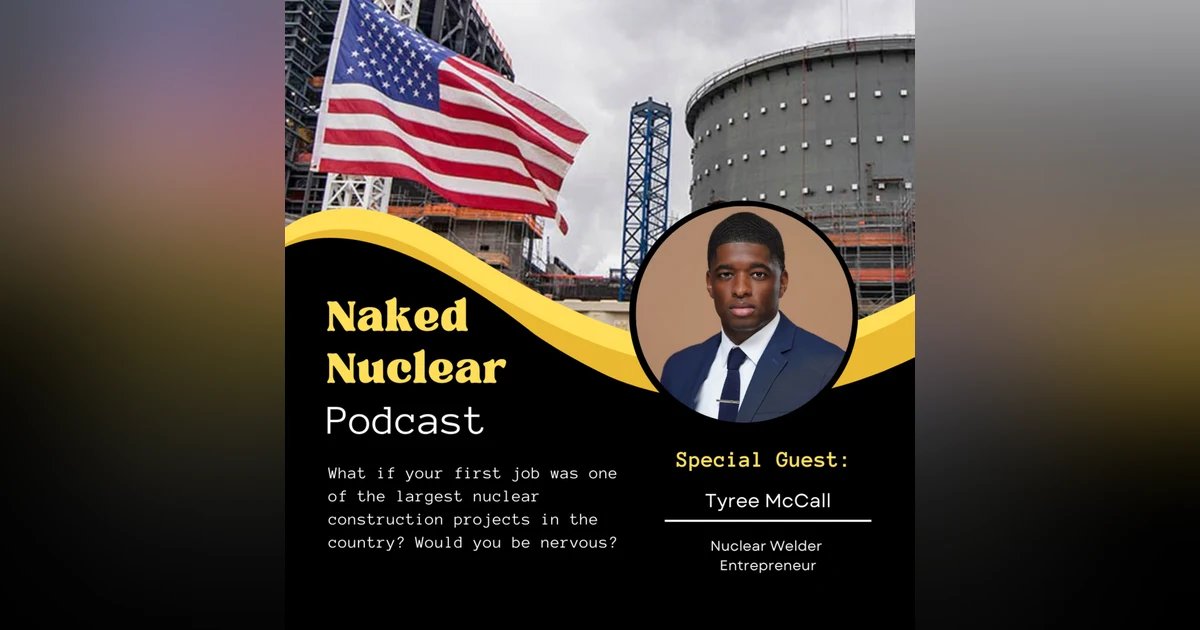
In this episode of Naked Nuclear, Danielle sits down with nuclear welder Tyree McCall, who started his career at Plant Vogtle Units 3 & 4 at just nineteen years old. What began as a labor job quickly turned into a mentorship-driven apprenticeship where experienced workers pushed him to level up his skills and pursue welding.
Working ten-hour days and attending welding school at night, Tyree eventually transitioned into nuclear welding—one of the most technically demanding and responsibility-heavy crafts in the industry.
Together, they explore what it really takes to build nuclear infrastructure: discipline, safety culture, accountability, and the personal growth required to succeed in a high-stakes environment.
This episode pulls back the curtain on the boots-on-the-ground workforce that makes nuclear energy possible.
-
How Tyree landed his first job at Plant Vogtle Units 3 & 4
-
What it feels like to walk onto a nuclear construction site at 19
-
Why the mentors on site “raised him” in the craft
-
The reality of working full-time while attending welding school at night
-
The difference between nuclear welding and other welding careers
-
What nuclear safety culture actually looks like on a job site
-
The intense pressure of passing nuclear welding certification tests
-
How failures and feedback shape skilled trades professionals
-
The lifestyle changes that come with holding a nuclear badge and clearance
-
Advice for students considering trades careers in the nuclear industry
Tyree credits much of his early success to experienced workers on the Vogtle site who encouraged him to pursue higher-skilled trades and pushed him to think long-term about his career.
**Naked Nuclear** strips down nuclear energy so it actually makes sense. New episodes weekly. 🎙️ [Listen on Apple Podcasts](https://podcasts.apple.com/us/podcast/id1781924674) · [Watch on YouTube](https://www.youtube.com/@TheNakedNuclearPodcast) 💡 Curious about nuclear careers? Visit [nakednuclear.com](https://www.nakednuclear.com) for episodes, resources, and guest spotlights.
Raised by the Reactor: How a 19 year-old Laborer Became a Nuclear Welder
Intro
Danielle Allen: Who actually builds the nuclear power plants we're talking about this season? No, I mean not the companies. Not the companies or CEOs, the fancy engineering design teams, but the people on the ground welding pipes, assembling structures, signing their name on work that will last for decades. I wanted to understand this side of nuclear construction, so.
I'm bringing you inside the world of somebody who has lived that reality from the time he was 19 years old. Tyree McCall started his career as a laborer on plant Vogels units three and four, the first major nuclear power plant build in the United States in decades.
From there, he worked his way up, went to welding school while working full-time and built a career inside one of the most demanding construction environments in the world.
Tyree McCall: But nuclear welding is completely different 'cause you're welding on pipes and you're welding on a lot of different structural supports that are gonna be stayed into these nuclear plants for years and years and years to come and your signature is on this stuff. So my mindset shifted
Danielle Allen: This episode is about craft, discipline, responsibility, and the culture that makes nuclear possible. So how did Tyree get involved in nuclear in the first place?
Meet Tyree McCall
Tyree McCall: So a little bit about my background. I'm from a city called Baxley, Georgia. Maybe 40, maybe 50, 60 miles southeast of Savannah, Georgia. We have where the first nuclear plant from Georgia was built, which is named, plant Hatch. So growing up I watched a lot of the community. Where they had nice houses and cars and things and I'm wondering where is this coming from?
And then I heard about, plant Hatch a few times, but I never really knew a lot about it. And so when I graduated it was either you go to college, you go to the military, or essentially you go to the nuclear plant. If you wanted to be successful, my family was very successful, in many different.
You know, career fields, but I'm one of the first in my family or immediate family that chose the, the nuclear career with a craft. And, we talk about, becoming a laborer. I mean, I'm becoming a welder. I'm sorry. So, just a little bit about my background coming, growing up in the, in the nuclear, in the city where nuclear was,
Knowing the success of it, it just kind of how I, like I said, I tried it, military and things or wanted to go and, I took the route of nuclear and, I needed a job at the time, so it was more so just going to work. My grandma, she, she, she, took me to plant Hatch and they weren't hiring at the time.
And then, They said, well, you can go to try playing Vogel. And this was when they were doing the construction or three and four, and she took me there. I started in, November of 2013. I, I graduated in 20 12, 20 13. My first major job ever, fresh outta high school, working at Bogle three and four.
One the big projects ever being, completed and, got my start there. And the rest has just been history as far as my career to where I am today.
Starting Young on Site
Danielle Allen: Tyree grew up in Baxley, Georgia, not far from plant hatch, another nuclear power station. Growing up, he saw something interesting. People in his community who worked at the plant had stable jobs, homes, and opportunities. But like many young people, he didn't necessarily know what those jobs actually were.
Then after high school, an opportunity appeared. Plant Vogel was building units three and four. At 19 years old, Tyree stepped onto one of the biggest nuclear construction projects in the world. So imagine this for a second. You are 19 years old, fresh outta high school, and suddenly you're walking onto a mega construction project.
Are you nervous? Much so I wanted to know what that experience was like for Tyree.
Tyree McCall: At that age, they saw something in me. They saw potential. They knew that I was a young man, but I started as a laborer and they was like, well, it's cool that you start here, but don't stay here.
So going through that, when I first came on site, it was just a different glow. It was a different, like, okay, this young man, he needs to be going places. We don't need to have him just stuck in this same mindset. And I could have settled 'cause I was making, coming outta high school that, that working at a nuclear plant.
Just a starting out salary is great, but like you said, they were around me. So the culture there for me being a young person was like, we're surprised that you're here, but we're gonna push you while you're here. So when you asked what that was, every day I ran into people that was pushing me to be great and do things.
And so, that was like learning. It was kind of like an apprenticeship, honestly, without being an apprentice. So that's what it was. The older guys, they taught me, they raised me. I went through life with them. I had my first child at 19, so as soon as I got into the nuclear plant, I start making money.
I had my first, my son was born at 19, so I'm making a lot of money, but I had a responsibility. So as they begin to have conversations with me, they're like, yeah, you're making money, but you gotta have. You know, take care of your, so, but that's what kept me working as well. You get what I'm saying?
And now saying, well, while I'm here I might as well learn this culture, this nuclear industry, and this safety and this. So, and it just, I fell in love with nuclear. I really did. I don't see myself working any other career. I did. I fell in love with it.
Learning Nuclear Procedure
Danielle Allen: What are the most powerful things Tyrese shared was that the experienced workers around him became mentors. They pushed him. They told him something simple but important. You can start here, but don't stay here. For Tyree, the job became more than just work. It became an informal apprenticeship. He was learning the culture, the expectations, and the responsibility of nuclear work, while also navigating adulthood, including becoming a father.
Now, if you've never worked in nuclear construction before, you might be wondering something basic. How do you actually learn the job? How do you go from knowing nothing about tools, procedures, or nuclear work, to being someone who can operate inside that environment every day? Tyree explains what that learning curve looked like for him when he first started.
Tyree McCall: Listening, learning, just listening, sitting back. At first I was kind of hot and, you know, young, hot on fire, but I learned that, I've worked construction at the house, before. So it's different. You're not be. In Walmart, it's not like a regular, so it's so many different procedures, right?
When you're dealing with nuclear because of the safety of the environment. Dealing with just nuclear culture as a whole. So I had to learn to be patient. I learned a lot of, you know, coming outta high school on fire, just ready to run, but I literally had to slow down and learn the procedures, the processes, the work packages, calling, engineering and calling q QC for different steps and processes.
You can't just. Put something together and sign off on it. Like with nuclear, signing material and things and signing off on stuff is a very big deal. So those different types of procedures and that thing, what you don't know you, that's kind of something I had to learn.
Danielle Allen: One of the biggest shifts Tyree experienced was learning how different nuclear work is compared to ordinary construction. In nuclear, you don't just build something and move on. Every step is documented, every material tracked, every signature matters because when you sign off of something in a nuclear plant, you are accountable, legally and professionally.
So one thing you'll hear over and over in this episode and this season is safety culture. Every process, documentation and signature carries responsibility. And if you're wondering actually what that means on a job site, we'll get to that.
Tyree McCall: And then also understanding, Being around the people that you're working with. It's like a family. You're around them more than you are in your home and your own family. So that's something I did have to learn as well to, you know, on certain job it's like, I don't like you, I can quit or leave.
But making that kind of money, it is like, you gotta learn to deal with people so you don't wanna give up. I mean, running from one job to another and another and another, and just with the integrity that it takes to have a nuclear clearance, to have a nuclear badge to even get in the plant to begin with is something you should carry with honor and integrity.
So I thought about welding only for the money. Fast forward timeline. I had my first son in 19 as a laborer, and then I had another, my daughter at 21, and then this was two years passed by. I was in a labor craft at this time. I had already built my realm, you know, built, kind of got my foot, feet wet in the, in the career.
I've become a little accustomed to the culture. So I'm two years in, I'm like, yeah, it is time to make a shift. I thought about welding only for the money. People around me were like, Hey, you know, they used to call me Young Buck. You've been here for two years. It's time to, do something.
What are you gonna do? Like I said, for the money was, it was just something that I wanted to do as far as a trade. I knew I wanted a trade. And honestly, to be real welding was the highest paying craft out there that I knew. When I asked around outside of, I think crane operators, welding was just what it was,
I wanted to be successful, so I took that route. And that transition was tough. I had, by this time I had two children and then I also, was going to school at night and working in a day. So I was working as a laborer, still at playing Vogel unit three and four, 10 hours a day.
And then I would get off. Go to night school at weld welding night school, and I'd probably go from like 5:00 PM to like 9 30, 10 o'clock at night every night, Monday through Friday. So for two years to get my, welding, and engineering kinda degree. So, but that process was very tough, but I knew I didn't wanna settle.
And then I think what made me want to get involved was that as a laborer, working around those craftsmen, It's a different respect. I respect the labor craft, but I think it's important that you get in and use it as a foot st through. So what I'm saying is that, they kind of just don't have a lot of respect, you know, because they don't have a skill, you know?
I mean, some do, some don't. But like when you actually go through an apprenticeship or go to school and actually get some knowledge on it. You are respected more 'cause you took the time out to do it. So, that was another reason that I went and like I said, it paid off, but it was hard. It was tough.
That was one of the toughest journeys of my career.
Danielle Allen: After two years as a laborer, Tyree started looking ahead. He had two kids, had responsibilities. And he had realized something important. The nuclear industry rewards skill. So he made a decision. He worked 10 hour shifts during the day at Plant Fogel, then went to welding school at night, five days a week for two years.
So I wanted to know what makes someone decide to go all in on a craft like welding, and what does that path actually require?
Tyree McCall: I'm glad you asked, and I think this will give a perspective to a lot of viewers listening. So by me taking the labor route was good, and I'll advise that if anyone is, if you don't go through an apprenticeship, you can can take the labor route. But what that does is expose you. So, 'cause when I went to welding school, there were a lot of people that never knew, they didn't know about welding or they didn't know about the opportunities for welding.
When it pertains to nuclear, they were like, you know, mom and pop, fab shops, local fab shops, car shops that you can weld on. That's the reason why they wanted to go to welding school. So, to my advantage, being at Plant Vogel at the time, working as a laborer, I was around the craft end day in the daytime at work.
And then I would get off of my job, go to school, and then learn at school, and then take what I learned from school and go back to work the next day in the nuclear culture. And kinda real time like on the job training and school. And it played to my benefit because a lot of the kids that were in welding school, they were either like working at McDonald's, you know, and things like that.
So they didn't really know the culture or they didn't really know the money. A lot of people were just thought of, like you said earlier, they were kind of intimidated, like when you hear the word nuclear and welding and just people don't really have the confidence to, to, you know what I'm saying?
But I think, like I said, by me being there already. And just building and working myself up, not being content with where I was, was what gave, kind of gave me that additional spark to want to continue on.
Danielle Allen: One thing Tyree explained really clearly is that exposure matters because he was already working at a nuclear plant, he could see the opportunities in front of him. Many of his welding classmates were training for local fabrication jobs. Tyree already knew nuclear welding existed and that it offered an entirely different level of opportunity.
Welding exists in a lot of industries, construction, automotive, manufacturing,
But listen to what Tyree says about what makes nuclear welding different.
Safety Culture Explained
Tyree McCall: Yeah. So funny enough, I've worked. Both what we call hard dollar jobs or hard money jobs where, it's outside of nuclear, which means like, you know, it's soon as the whistle blows, but with nuclear safety culture, because of the, the, what we're working on, we're building a nuclear plant, right?
Or we're working in doing maintenance on nuclear plants that are already running. You gotta think about the environment and the, the safety culture is more so. If I check a procedure and I like it and sign off on it, there's probably about. Five, five to six different additional signatures go behind me to check and verify, right?
So with that, you have, just by default, different eyes looking at it. And if one person finds something, we stop. We don't go forward. We stop. We, try to find ways to rectify the situation. We have meetings and we discuss, and so with nuclear safety culture, it's slow because of the integrity of the work and protecting the environment and, you know, it's very serious.
I think the difference in what I will say about nuclear safety and to explain it more is if you're out. Side of like building, you know, a house or something, you can kind of get away with not wearing safety glasses or not wearing, you know, if you're a handyman on the, outside you're doing stuff, just without gloves, you know, back in the old days, you know, you could just get away with a lot of things at home, you know.
But with the safety culture, it is a complete different, They are watching for, safety glasses, earplugs, your PPE boots, hard hat. It's almost like a constant everyday thing. I think the culture there is completely different and it's slower and it's very important though.
So, yeah, that, I think that's something I like about the culture
Yeah, we see that often, even with nuclear safety culture, when you talk about, people coming from the outside in, they want to come in and just like get it, you know what I'm saying? Like, I want to go straight to work, work, work, work, work. And sometimes the process of them having to slow down, it just, they, it doesn't sit well with them.
They leave or they can't work it because they're so used to, you know, taking a Red Bull or taking an energy, drinking just. Go get straight to work and then, or they're used to working at home, like you said, building things at home in their garage and things, and they're just go, go, go, go, go with this.
And they do not tolerate it at all. It's a very low tolerance for it. I mean, every day you're liable to get. You know, it's terminal offenses for PPE and things like that. So it's very serious. Only for your safety.
It's, it's important that you stay safe. So they, they, they put a heavy emphasis, emphasis on that. And yeah, you do have people that cannot deal with it plenty enough. It's, it's mental, right? And so it does look like micromanaging, but it's very mental. It's very mental.
And it's for your safety. But yeah, everyone can't deal with it. It can be a lot, but you become accustomed to the culture.
Nuclear vs Non-Nuclear
Danielle Allen: Again, it comes back to safety culture. If you've never worked in the industry, it's hard to understand what that actually means. In nuclear construction, safety culture is everything. Multiple sign-offs, procedure verification, stopping work when something isn't right, and even the smallest details like wearing PPE or walking while using your cell phone are taken seriously.
It might seem like an abstract idea, but we wanted to get into what that actually looks like in the day to day and why safety is non-negotiable.
Tyree McCall: I think with nuclear, non-nuclear. So non-nuclear is more so a schedule and budget. They don't have the funds. They don't have the resources. Most time it's independent contractors, subcontractors, small contractors that are trying to save more. And profit more, right. But with nuclear, I mean, it's a enormous budget, you know what I'm saying?
It's huge. It's kinda more so of we care about you doing it right. We don't care about how long it takes. There's projects we worked on that are supposed to take us a week that can take three months but then there's sometimes that a project can take or supposed to take three months and last a year or things like that.
So I think the difference is, yeah, budget and schedule on non-nuclear, it's like you gotta go. You can't be standing around even if you don't have nothing to do. You gotta find something to do. Right? It's crazy. But with nuclear, it's, do it right and if it takes however long, it's no time pressure, basically.
It's no time pressure. Okay.
Danielle Allen: Tyree has worked both nuclear and non-nuclear jobs, and one difference stood out immediately. In non-nuclear construction, the pressure is usually scheduling and budget. In nuclear construction, the priority is different.
You have to do it right, you have to do it safely.
So what actually changes when the project you're working on is in a nuclear power plant? What's different about the culture and expectations and pace of work?
Tyree McCall: So with me as a laborer, when I first started, like I said, 19, the biggest thing for me when I did start was making that kind of money outta high school was just cultural shocking. I was making adult money at 19, like we talking, we 60, almost 70,019. A year, and this was back in 2013 when everything wasn't as high.
So I say that and I'm transparent enough to speak on that because I spent a lot of time in the mall. I.when I graduated in my hometown, we didn't have a mall. I got exposed to our largest city from my hometown to when I moved to Plant Vogel, and the economy was building around Vogel because of the money that they were paying.
But also, the businesses, it created opportunities for a lot of businesses and things around. Plant Vogel. A lot of businesses start coming in and things, so I spent a lot of money and, I start noticing and I didn't have anything to show for it after a while. Kind of like having fun at first, kind of just buying clothes and every week I was.
Buying clothes and shoes. But as I continued to grow and my responsibilities shifted, I think what kept me grounded often a lot was my children. And I talk about them a lot because they carried me through this career. And the reason I know they have, because I don't get to take them with me, but I take them with me.
I show them pictures, I send them pictures of what I'm doing often, every city I travel to around the country. And so they're aware of the nuclear culture And now currently implant impacts to where plant Hatch is. So we, I take 'em out there sometimes and ride 'em through and see,
From then, it's been an evolution, like I said, of just growing up as an individual. Even the safety culture trans transmute into my lifestyle because of being safe. For example, we can't walk on the phone and talk at work like we have to stop. And text or whatever we're doing. We can't continue to walk.
But even when I'm away from work, it carries with me. So like, if I'm in Chicago or New York or whatever, walking, I stop and I look at my phone and I text, you know, I text and then I start back walking. But yeah, I learned a lot. Like I said, from being a laborer, Now, like you said, the responsibility.
So when you become a welder, your lifestyle shifts just naturally because of the income, the responsibility that it comes with, the integrity of your work. Your name is signed off on this stuff, whereas when I was a laborer. You didn't have much responsibility. You would, you know, sweep, you know, clean up this and that.
But nuclear welding is completely different 'cause you're welding on pipes and you're welding on a lot of different structural supports that are gonna be stayed into these nuclear plants for years and years and years to come and your signature is on this stuff. So my mindset shifted, like I'm signing off on things that I have to have integrity on, which means I have to verify check.
So it was a complete different. Mindset and so yeah, it did shift a lot, and then also my finances and my budget and everything had to shift as well. So that was kind of how that went.
Danielle Allen: Tyree's career has evolved dramatically from a laborer sweeping and supporting crews to a certified welder whose signature is attached to structural components that remain inside nuclear facilities for decades.
That shift doesn't just change your job, it changes your mindset. This is what I love about the evolution of this story, laborer, student welder. Each stage comes with a different level of responsibility. So if you're curious about what an actual day looks like for someone walking inside a nuclear plant,
Tyree explains how that job changes as your career grows.
Welding Work and Testing
Tyree McCall: If I'm speaking to a welder, I would just say it's more so like a glorified, fabricator. Pretty much like same fabrication you do outside. Nuclear, it is the same like we weld on carbon, steel, just kinda like, unis struts and, do a lot of electrical support. I'm a structural welder, so we do a lot of different structural welds, but, it's the same.
I think that the intimidation comes from the test. You have to take a test to get your certs when you first. Qualify, for nuclear welder. So, you take a plate test or a pipe test depending on the location, but to pass, to get your search, you have to pass that test and that test can be very challenging.
I felt it once and I haven't felt it ever, again after that. But that first time I felt it, it crushed me. But I learned from it. But that test is very challenging. It can be very challenging. But yeah, when you pass it, Then you start to learn, they go in more detail as far as your procedures.
We work outta work packages depending on what the work is. But like I said, if I had to explain it, it's not hard. 'cause your supervisors, they guide you through and then like I said, if you're unsure, you have to stop and it's okay to stop. And they want you to stop.
Like I said, if I'm talking to a welder from outside, I would definitely tell them, it's not as. Bad or hard as they make it, but it can be intimidating. I know my first time welding at a nuclear plant, I was shaken. I actually messed up, you know what I'm saying? When I first got my certs, I got inside of the plant and you have that kind of like, I want to show that I'm a welder your ego.
And so you knew, you knew you, knew you out on the job. I messed up bad on my first couple welds. But my supervisor sat me down, you know, and they, they, they, they walked me through the steps and processes and then over time you just keep getting better and better and better.
But, it's really nothing like too technical. You have specialty welders that do different, like specialty work that like underwater welding and all this kind of stuff at the nuclear plants and stuff, but we don't really get into that kind of detail.
Danielle Allen: One of the biggest barriers to becoming a nuclear welder isn't the work itself, it's the test to work as a nuclear welder, you must pass a certification weld test to prove you can meet extremely high standards. Failed the test, and sometimes that opportunity disappears.
So you can't just show up and start working. You have to earn the certificate, and those tests can be intense.
So Tyree will explain why they matter so much.
Tyree McCall: So often, back in the day, the culture has shifted a lot, but back in the day, a lot of welders tell me, I listen to a lot of older guys when I'm at work.. I just do,
High Stakes Weld Tests
Tyree McCall: I glean, I run straight to them and they talk about the culture, how it was to, to where it is today.
But, You used to, would have to do what they call a make or break. And I think some jobs do, but it don't matter where you're coming from. Like if I'm in Georgia and I'm going to Texas or Louisiana or whatever to take a whale test, you get one opportunity and you fail it. You go home and you don't get paid like you travel out there.
'cause oftentimes 'cause we're driving, 'cause we have to have our car for work or vehicle for work. So we're driving out and you can drive miles and miles and you take your wheel test if you fail it. It's over. Like if you fail it, you gotta go home. You don't get paid, this kind of thing. So the pressure of going into a well test alone is hard.
You know what I'm saying? But then when you fail it, you're crushed. 'cause you gotta go back to your family and tell them you didn't get the job because, and you don't have no money because you, you failed a welders. And that, that pressure is, I don't wish that fell on nobody.
Failing Forward on the Job
Tyree McCall: I've seen a lot of people, now today it looks kind of different.
Whereas if you fail, if you come as a welder, you fail it, they'll keep you a job, of course you won't get the same pay scale. You'll probably get like a helper pay scale, We have fab shops at our job, at the nuclear plants, like little fab shops.
You can go and practice and then if you feel comfortable, maybe six months later, the supervisor, he trusts you, he'll let you go back and take it. But, it's a very crushing feeling, to fail a well test when you don't have a job either. Like you don't have a job and you're going to get a job and still don't get the job.
I felt that one time and I told myself I never want to feel that ever again. At the time I was in the union and, you can go back to the local and practice, but you gotta put the work in. I think that was the feeling when you fail. Don't just stay a failure.
Learn from it and then improve.
Danielle Allen: Failure is a part of every craft. Tyree talked openly about failing his first welding test and the pressure that comes with it when your career depends on passing a single exam. The stakes feel incredibly high, but the key lesson he learned was simple. Failure isn't the end.
It's feedback
Because failure happens in every craft. So how do you move forward?
Taking Feedback Like a Pro
Tyree McCall: I studied a lot. My teachers at school were great. But then you build colleagues, you build friends. A lot of the people came outta welder school my age. I Had a couple guys that were my age, and then the guys that you worked with on your crew. You just ask questions. For the first couple, you shadow your, you have someone that'll be over you, so you shadow who you're working with and that's when you ask questions.
But like I said, I went to wellness school, so I had a little knowledge. It was just a safety culture. But yeah, you have to, take it with a grain of salt. Don't take nothing personal. It's only for your good. They're only trying to, help you now. The delivery might not be the best.
'cause with construction delivery is, rough. It is better than what it used to be back in the day. But, you gotta have thick skiing out there. You do. So I think, once I learned that, 'cause at first I took everything personal. But you can't take it personally and just receive it, you know, just receive it.
They're only trying to help you. But yeah, that's how you have to take it.
A lot of times you have to swallow your tongue. You could be right and still be wrong. Similar, you know what I'm saying?
Pay Scale and Responsibility
Tyree McCall: And then you thinking about the responsibilities. 'cause like I said, when you work in nuclear, you get a different pay scale just because of working in nuclear.
The income increase comes with a increase in responsibility. So when I say that, I mean, and oftentimes people build their lives off these incomes. Right. So you thinking about that the whole time, like, is it worth me going back and forth with this individual because of what they're paying me and you know, just, you get what I'm saying?
You have to have those, you know, inner, inner, you have to do the inner work too. And it's a lot balancing that and work and home and it's a lot.
Danielle Allen: Different pay scales come with different sets of responsibility and Tyree shared how he grew his financial understanding over time. But what happens when you rely on a certain income level or paycheck and it's not there? Tyree walks us through what it was like getting laid off during COVID and how to leverage entrepreneurship as a backup plan.
Entrepreneurship as a Backup Plan
Tyree McCall: To the entrepreneurship, role and everything, just having that. So back in the day, like I said, I speak on that a lot 'cause I'm, I, I sit around a lot of older people and they talk about the culture. But the time, the, the, the whole nuclear culture has shifted from the way it used to be.
And, the reason I bring that up is because now we have a little more freedom to, and the, it used to be frowned upon, like to have something going on inside and it kind of still is, it's not a bad thing, it's just like. We, you work here, we need you here. 'cause a lot of people would try to be in two places at one time.
Their mind is not focused and that's how you get accidents and things like that. But, I think when the pandemic, I was working at Plant Bogar from 2013 to 2020 and the pandemic came and stopped me from working I had responsibility to take care of. So it was kind of like, what am I going to do?
And I started my business and just kind of working that on the side. And then, fast forward, just always having that trade under my belt. I knew I was going back to work. But, I think 2022, I went back and, I learned how to have that balance.
But oftentimes. We work a lot of shutdowns sometimes, so, oh, I work shutdowns too, so they only last, you know, 2, 3, 4 months. We do maintenance and do shutdowns, and they last two, three months and then you'll get laid off. And that looks kind of hard sometimes when you have a family and responsibilities and bills because you don't have no income.
Sometimes you get unemployment, sometimes you don't. It's always good to have, and it's for any career, anyone listening, like I think it's always good to have something to fall back on. But yeah, that's how my career in my, in my, creative, entrepreneurial journey started just by, having that balance and diversity or just that balance in wanting to, know that if I get laid off today or when I get laid off, 'cause oftentimes that's what it comes to, you know, what can I fall back on?
Advice for New Nuclear Welders
Danielle Allen: As the nuclear industry prepares for new builds, one of the biggest questions is where will the workforce come from? Tyree's advice is clear. Ask questions, find mentors. Join apprenticeships and understand the responsibility that comes with the work, so if you're a student or someone thinking about the trades, you might be wondering, how do you actually get started in nuclear?
Where do you begin and what should you know before stepping into the industry?
Tyree McCall: Learn as much as you can if you're in school already. But if I had to advise anyone coming fresh outta high school or just wanting to get begin, I would say join an apprenticeship. I'm union, but, you know, I just advocate for either joining an apprenticeship or also, getting under someone's tutelage and kind of being guided.
I think that's very important because. Oftentimes you have people just being honest. A lot of people that their grandparents and parents work in nuclear culture and sometimes you get where they can pull people through the cracks or just a lot of different things that go on and it's nothing wrong with it.
I just think that, You need to know what you're doing, dealing with this kinda stuff. And I say just learn as much as you can. Always ask questions. Don't be afraid. No questions, a dumb question. They tell us that every day at work, literally. But yeah, you can't be afraid to ask questions.
You can't be afraid to fail either. But yeah, that, that my advice to a young person coming up and wanting get in nuclear. You know, ask questions like I said.
Clearance Rules and Losing Friends
Tyree McCall: It is a very, very strategic, it's very, calculated career. Like you really have to be on top of it, and it transients into your lifestyle, certain things and certain people that you hang around with.
You can't hang around with working and carrying a nuclear badge. You have a nuclear clearance that is rare, you know, so, some of the decisions that you make, affect your job, things that happen off the job, get back to the job and you can lose your clearance. So, it's a lot that go on with, advice I could give to someone wanting to learn and get inside the nuclear career.
I'm just gonna add a little tidbit about that. And you lose friends. You lose people. The people, the kids that you grew up at with in high school and stuff, that's another main thing. The friends that you hang around with, you are going to lose 'em. You're in a different, whole different tax record.
You're in a whole different ecosystem. Right. So, yeah, I lost a lot of friends. I, I left my hometown in 2013, and I've never lived in my hometown since. You know, just, just being away on the road, working and moving away and working with this kind of career. So yeah, I, I, that, that's a very big, point in this, in this career.
Yeah. Oftentimes. If you listen long enough, sometimes the question that you do have, they do answer. And if most of the time if I have a question, it's like. Coming from a subject that they're discussing, right? But I mean, if someone's making, if they're having a public discussion or if we're having a group meeting and discussion, they ask, does anyone have any questions, comments, concerns?
You might think about it, but as you listen and hear and just kind of feel, you have to be very present. But, I really don't really have a lot of questions. Just for now, because I've been in, this is year 13. What, see 2013. So this is 2026. This is year, what? Wait, I started in 2013 and this is 2026.
This year. 13, yeah. 13. So now I don't have a lot of questions. It depend on like if we're working on a specific task, It gets embedded in you. I'm saying it becomes a lifestyle, so not too many crazy questions unless it's a certain procedure you're working on or certain task you're working on.
You just have questions.
Danielle Allen: One point Tyree emphasize is something many people don't talk about. Working in nuclear changes your life. Outside of work. You hold a clearance, your actions off the job site can affect your career, and sometimes your path takes you away from your hometown, your friends, and your comfort zone. But for many workers, that trade off creates opportunity.
Tyree McCall: I still kinda sometimes regret that I didn't, just because I didn't have the knowledge of it. No one in my family worked, union or worked more of, just tradesmen. Most of the guys I knew that worked at the power plant were either security or laborers and if they did work craft, they worked on the road.
They didn't work in my hometown, so we would never see them. But we would kind of ask what they do and they'd say welding and they would be present at the nuclear plant in Baxley, like at hatch. So, yeah, you need to have that knowledge going into, and then you get that knowledge.
But what I'm saying, the reason why I speak on apprenticeship is because I probably could join, a trade fresh outta high school versus like, I could have joined in the welding trade immediately, or a iron worker or boiler maker.
More Than Just Welding
Tyree McCall: So welding, and I'll add to this, like welding is a part of a craft, which would either be maybe a pipe fitter, boiler maker, ironwork, and that's just a tool that they use.
Most times the the craftsmen frown upon if you just come in and say, I'm a welder. And the reason why is because you need to be more complete all around just because you can weld. You need to know how to be able to lay out, read blueprints, right? Because often guys, you get guys that just come in and stand around.
I'm not doing anything but just welding. Well, what about if we need you to help rig, or what if we need you to help? You know what I'm saying? Moving beams. Different things and you just get stuck in this mindset that I'm just a welder and it limits you from one, but then it just, no one wants to work around those people sometimes because they just feel like that's all they come to do.
And you get that oftentimes on those jobs. And that's why I say it. I know how to weld, but there are some things that I'm still learning in the craft as far as rigging and, reading blueprints. I'm pretty proficient, but there is so much to learn in this culture and this craft that that's why I heavily, strongly, advocate for, apprenticeship.
Danielle Allen: And now it's time for our rapid fire questions.
Rapid Fire Round
Danielle Allen: The last segment that we have is our rapid fire questions. These I will just keep on going 'em question back to back to back. You answer as fast as you can. So first. If you go to an ice cream shop, what flavor are you and your kids getting
Tyree McCall: Vanilla. I'm getting vanilla or you the, kicks and cream.
Danielle Allen: Kids too.
Tyree McCall: They getting rainbows and sprinkles and gummy worms and all this kind of junk. They getting everything they want. One of everything on the bar.
Danielle Allen: Nice. Is there a place that you would like to travel to with your whole family? I.
Tyree McCall: Yeah, probably, in the States, maybe California. I don't wanna take my family to California
Danielle Allen: Outside of the states.
Tyree McCall: Any island. Water islands. Yeah. Yeah,
Danielle Allen: And coconuts.
Tyree McCall: Yeah, yeah.
Danielle Allen: Very nice. If you had to give a Ted talk on any topic, what do you think you would, talk about?
Tyree McCall: Self-development, personal development, motivation, growth, resilience, structure, discipline, character, character building, integrity, all of that easy, that flow. This, that's just easy.
Danielle Allen: Off the head.
Tyree McCall: Yeah. Yeah, that's easy.
Danielle Allen: Very nice. Favorite meal when you're out on the road?
Tyree McCall: I like seafood, but outside of that I'll probably have, I like a good burger. I like a good hamburger with, egg eggs on it. Fried kind of like fried egg kind of running egg and
Danielle Allen: Mm-hmm.
Tyree McCall: Fries. Yeah.
Danielle Allen: Nice,
Tyree McCall: Go-to.
Danielle Allen: And last question, if you had to be the builder, the developer for the city of the future, the city that your grandkids are gonna live in, what would you want to see in it?
Tyree McCall: Strong leadership. People who are bold, who are not afraid to raise concern and who are aware of themselves and who are selfless, who puts the people community first and just carry itself with integrity like it has to be. Today's society is just so fast with microwave mentality and just everything growing so fast and, but yeah, good people basically.
Danielle Allen: That is the first time we've got that answer for that question, so I'm like Very nice.
Tyree McCall: Yeah. Thank you for having me. I enjoyed it. Thank you.
Danielle Allen: First we wanted to thank Tyree so much for joining us on this episode of Naked Nuclear. His story highlights something that often gets overlooked in conversations about the future of nuclear energy. Power plants aren't just design, they're built by people.
By craft workers, by laborers, by welders, individuals who take pride in signing their name to work, that will stand for generations. And as the nuclear industry grows, sharing these stories matter more than ever. Like Tyree said, working in the industry changes your mindset, changes the people you
Changes your network. The people you hang out around,
There's a subtle transformation that happens working in the nuclear industry, and it all leads back to safety culture.
Thank you so much for listening to this episode of Naked Nuclear. We wanna share more stories like this with boots on the ground, welders, pipe, fitters, INC techs, anyone who wants to share their story and thinks they have a good bit of advice and things, have good advice for the next generation of the workforce. Thank you for listening to this episode of Naked Nuclear.
Until next time, stay curious. I.