Nuclear 101: How this Sold Out Course was Built for Beginners


 RSS Feed
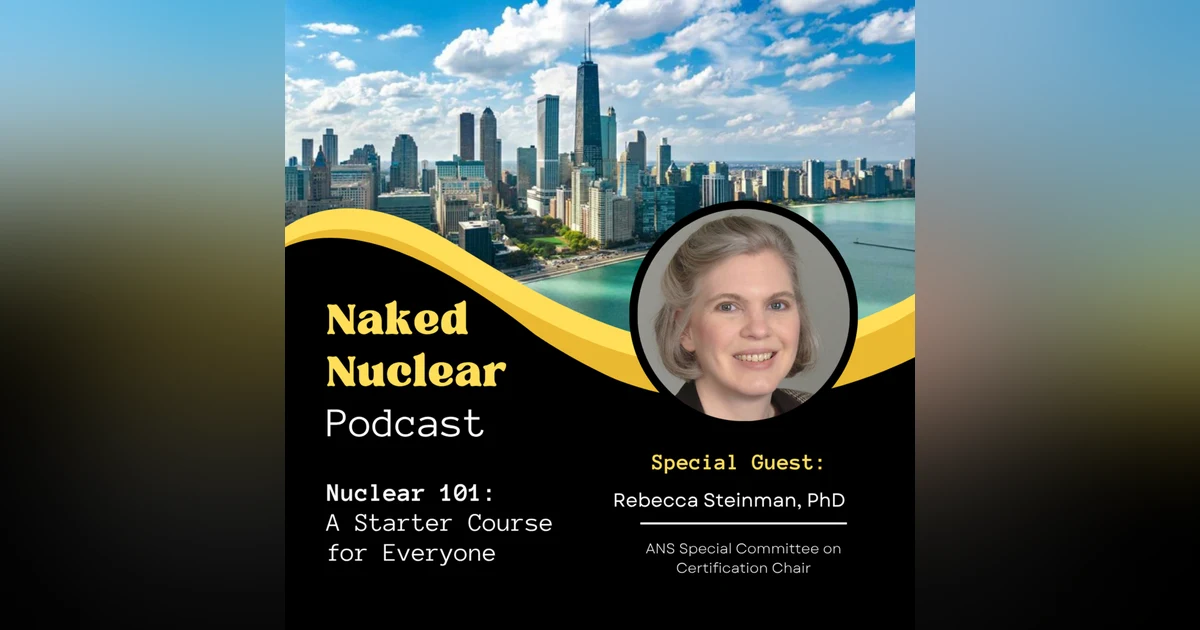
 In this episode of Naked Nuclear, Danielle sits down with Dr. Rebecca Steinman, PhD and the American Nuclear Society (ANS) to explore Nuclear 101—a hands-on, introductory course designed not just for engineers, but for anyone curious about the nuclear energy industry.
Whether you're a welder, museum curator, communicator, or career changer, this episode reveals why now is the perfect time to step into nuclear. We also explore ANS's broader efforts in workforce development, including the Certified Nuclear Professional (CNP) certificate.
-
The Nuclear 101 course was created to make the industry more accessible and train newcomers beyond traditional four-year degrees.
-
Course attendees have included museum staff, communicators, welders, and logistics professionals—proving the nuclear workforce is broader than you might expect.
-
ANS is building out online versions of Nuclear 101 and future offerings like "Nuclear 102" and "Radiation Protection Basics."
-
The Certified Nuclear Professional (CNP) certificate is a new credential for professionals without nuclear degrees to showcase their understanding of the field.
-
All of these programs were developed by volunteers across the industry—from utility experts to regulatory professionals and early-career engineers.
-
Helpful links:
-
🔗 Nuclear 101 Course Info & Registration
https://www.ans.org/nuclear101/ -
🔗 Certified Nuclear Professional (CNP) Certificate Program
https://www.ans.org/credentialing/cnp/ -
🔗 ANS Education & Training Portal
https://www.ans.org/education/ -
🔗 ANS Annual Conference (Chicago, June 15–19, 2025)
https://www.ans.org/meetings/ -
Loved the episode? ❤️
Rate the show, leave a review, subscribe to Naked Nuclear, and share this episode with someone curious about the nuclear field.
👀 Follow us @NakedNuclear for upcoming episode drops and behind-the-scenes content.
**Naked Nuclear** strips down nuclear energy so it actually makes sense. New episodes weekly. 🎙️ [Listen on Apple Podcasts](https://podcasts.apple.com/us/podcast/id1781924674) · [Watch on YouTube](https://www.youtube.com/@TheNakedNuclearPodcast) 💡 Curious about nuclear careers? Visit [nakednuclear.com](https://www.nakednuclear.com) for episodes, resources, and guest spotlights.
Full Transcript
[00:00:00] Danielle Allen: What classes do you remember taking your freshman year of college? Economics 1 0 1, writing, 1 0 1, nuclear 1 0 1? I'd even wager to say that the people taking nuclear 1 0 1 were looking to go into nuclear based careers, but did you know the American Nuclear Society just created a course called Nuclear 1 0 1?
And it might not be for who you think.
[00:00:26] Rebecca Steinman: We had somebody come from a museum to our first course, and she's like, "I work on some of the nuclear history stuff at the Oak Ridge National Lab Museum. I just wanted to understand how it fit into the bigger picture of things."
[00:00:37] Danielle Allen: That's Dr. Rebecca Steinman. She is a nuclear industry veteran with over 23 years of experience spanning from licensing to design analysis, corrective action, and operational support. Just reading through her background and resume is far beyond impressive.
Not to mention one of the creators of the Nuclear 1 0 1 Course.
The nuclear industry has undergone a major shift. In just a few years. We've gone from trying to keep plants from shutting down, to restarting old reactors, to breaking ground on brand new advanced technologies. And with the recent partnerships between nuclear companies and major players like Google, Meta, and Microsoft, more and more people are asking, "How do I get involved?"
It is not just engineers or operators looking to make the leap. Career changers from completely different fields like me are stepping into nuclear with fresh perspectives, and beyond the core technical roles there's a growing demand for people in auxiliary positions, museum curators preserving the history of nuclear science, welders fabricating key components, communications telling the public story, or logistics experts transporting radioactive waste safely. Whether you're already nuclear adjacent or just nuclear curious. A solid introduction can be the spark that lights a whole new path.
That's where courses like Nuclear 1 0 1 come in.
On today's episode of Naked Nuclear, we're gonna be diving into some of the American Nuclear Society's educational courses spanning from Nuclear 1 0 1 to their certificate program.
But first off, I wanted to ask Rebecca. Why have a nuclear 1 0 1 course?
I chatted briefly with Rebecca before recording this episode, and she mentioned she did not realize how popular the course would be. It actually sold out, so now they're looking to refine it and expand it for a larger audience.
[00:02:34] Rebecca Steinman: Obviously nuclear in general is a highly technical area as far as a sector goes. Although not everybody has a PhD in nuclear. I mean, a lot of people think, "Oh my gosh, nuclear, you're a rocket science, you're this, you're that, and you must have a zillion degrees." Some people do, but certainly not everybody in industry does.
There are a lot of people who work in our industry who have nothing more than a high school degree and a lot of extra training. And so as nuclears, hopefully many of your podcast listeners have noticed has been in the news recently. There's a lot of exciting things happening. You know, there's government programs that are happening.
There's new builds. There's the whole AI support. There's just a lot of different things that are new and exciting and we expect to see a very large need for an increase in the workforce in the nuclear field. ANS's programs recognize that if we're trying to hire a bunch of people into this workforce, how do we train them all up?
They can't all go to a four year college and get a nuclear engineering degree. What are other avenues to provide education for those folks? And that's the gap we're trying to fill.
[00:03:32] Danielle Allen: If you're familiar with the nuclear space or you've been listening to the show, you're maybe familiar with ANS or the American Nuclear Society, but my apologies, I've never truly explained what the American Nuclear Society is or does and why they care to build a Nuclear 1 0 1 course. So I asked Rebecca, "What is the American Nuclear Society and how are they helping?"
[00:03:58] Rebecca Steinman: So the American Nuclear Society is a professional organization for people who work in the nuclear industry, and it's not just the nuclear power industry, it's government aspects of the nuclear industry as well as industrial aspects. We do have some people who work in the medical field that are a part of this society and we're a professional society, so we're a place for people to get together and share research ideas, or topics or best practices. The society also publishes technical journals in a couple of different areas, both in the nuclear engineering kind of traditional engineering aspects as well as fusion and other topics. So that's in general what the society itself it is, and we have several initiatives to promote our industry. We have people who are on Capitol Hill who are trying to promote certain aspects of our industry. We have people who are focused on K through 12 education and
STEM and trying to get nuclear into basic science programs, something beyond just what's radioactive decay, but, you know, energy, we're studying energy. What's different about nuclear compared to other energies? And so we have a lot of different programs that focus on those areas.
But again, it's just a group of professionals who are in love with nuclear technology and like to do a lot of stuff with it.
[00:05:05] Danielle Allen: Nuclear is an industry that loves to educate and I found out the majority of the people creating the curriculum for Nuclear 1 0 1 volunteers. And so I wanted to kind of dig deeper. How did Nuclear 1 0 1 come to be?
[00:05:19] Rebecca Steinman: I'll say that the nuclear 1 0 1 curriculum actually fell out of the certified nuclear professional activity. We did a survey for the certified nuclear professional of our entire industry and it asks people questions about certain knowledge and skill sets. You know, what's head knowledge you use every day versus what stuff you just need to know that exists and how to look it up, and you might do it a couple of times a year. So, zillion topics, those two kind of focus areas, everybody ranks them all, and then we conglomerate all that information together and that determined what the key knowledge and skill sets were for the CNP. We originally developed nuclear 1 0 1 specifically to feed into or to be a preparatory course for the CNP.
[00:06:03] Danielle Allen: but when this course was created, it wasn't just popular. It was really popular. So what's all the buzz?
[00:06:12] Rebecca Steinman: I'd like to say because it's the most awesome course out there, but it fills a unique gap. So right now there are a lot of things that are available. Like if you are already working in the commercial nuclear power industry, there are a lot of opportunities for different types of training. We have specific organizations like INPO and WANO that focus on certain types of training, but there's really not anything that covers like the real, like basic nuclear science aspects of things.
So most people who come into our industry either learn that on the job, or they come from an educational background that is specific to nuclear. We saw a need for people especially, even members of the public or people who don't necessarily work in nuclear, but tangentially, people who work in media. Oddly enough, we had somebody come from a museum to our first, to our first course, and she's like, well, I work on some of the nuclear history stuff at the Oak Ridge National Lab Museum. And she's like, I just wanted to understand what some of the stuff that I was curating and writing about, like how it fit into the bigger picture of things.
So we hit a really broad audience because we're offering a unique product.
[00:07:17] Danielle Allen: Nuclear is gaining in popularity across the country. People are seeing more and more positive correlations between nuclear energy and the sentiments of the general public. However, because nuclear power generation has never really been taught in a K through 12 settings, not many people have a solid understanding and grasp of the science behind it. If you were to ask 100 people to visualize a nuclear reactor, I'm sure you might get a hundred different pictures depending on the group surveyed. So if you're interested in taking the nuclear 1 0 1 course, how do you sign up?
[00:07:53] Rebecca Steinman: So the Nuclear 1 0 1 course is currently offered only as an in-person course and in groups of 40 people, mostly because we wanna have a very high instructor to student ratio. So we limit it to 40 seats. We offer two courses kind of at the same time. 20 people each and the instructors move back and forth between them. There is some pre-reading that we expect people to do ahead of time. It's roughly about eight hours worth of work. And we provide all of those materials ahead of time. One of the lessons learned is we also provide some, a little bit of additional math type information for folks that maybe haven't done certain things since they were in high school, and then it is a four and a half day course of instructor led, and hands-on activities. And we offer those at our national meetings, which are held twice a year in June and November. We have one in June that will run Sunday through Thursday of our national meeting in Chicago.
[00:08:47] Danielle Allen: The nuclear 1 0 1 course is going to be held in Chicago during the ANS annual conference. The five day, 32 hour course, will have hands-on learning and cover a broad range of nuclear science and technology topics.
But since the course sold out the first go around, I wonder if there was any changes being made to the new curriculum.
[00:09:06] Rebecca Steinman: I mentioned earlier that the Nuclear 1 0 1 course was originally intended to be like a feeder directly into the CNP, but what happened when we gave our first course is that we got feedback from a fairly good chunk of people who attended that course. It was like some of the nuclear fundamentals was way too much for what I thought I was getting in this course.
It was a little too far into the weeds. So a bunch of nuclear type people put this together. We thought it was really low level. Turns out it wasn't. We also had some focus in some specific areas where we got feedback that was like, "Well, I thought this was super interesting, and I wish we would've spent more than an hour on this, but this other topic we spent an hour and a half on and I'd have been happy with 20 minutes." We also got feedback that they'd like to have more opportunities to do hands-on activities. So we're gonna try to bring in some detectors and sources, so that people can kind of visualize. We're gonna have a cloud chamber. In Chicago, because it's close to where I work, I'm actually gonna be able to bring a mock fuel assembly in for people to see. So folks that have never seen what a nuclear reactors fuel assembly looks like. We're gonna have a little short version of it that's about four foot tall, that they'll be able to walk around and ask questions of people who help design those. So those are very unique situations for people who attend that class in person.
11 modules are required, and then we have two modules where we have a selection of topics. And so, for each class, when students sign up, they give their top two topics from the selection of choices. And then whichever two, get the highest number of votes, those are the ones that we do for that particular class.
Whenever we go to an online option, people will be able to choose which two modules they wanna do. But we hit, the standard basic topics. We have a nuclear fundamentals class. We have one course that talks about nuclear power aspects, nuclear.
So it talks about industrial applications, medical applications, space applications. We have one section that talks about the history of nuclear and where things come from. We have a course that talks about the licensing and the regulatory codes and standards and technical aspects. One module that just talks about different types of reactors. Some, I don't wanna really say esoteric, but they're more niche type topics that are, those optional, you know, the transportation of radioactive materials, or the decommissioning of, of nuclear power plants. And so we have those four topics that are a little more drilled down that might not be of interest to say the museum curator that comes to our meeting, she might have some other interest. And so we tried to make it flexible to meet the needs of as many people as possible in person is more difficult with those optional modules.
But whenever we go to an online format, those optional modules will actually be really helpful because we have found that some small businesses and other organizations have certain niche needs, but don't have the ability to create a full blown training program for those needs. And this is one area where this program might meet that need for them. So they'd be able to send their 10 or 15 people to the ANS program and choose these elective modules that are specific to their organization, then they won't need to develop that content themselves for those few people.
[00:12:10] Danielle Allen: So let's recap. Nuclear 1 0 1 is a five day, 32 hour course. It covers a wide range of topics, and the creators of that course are volunteers professionals in the nuclear industry.
They've taken the feedback from their last course, the one that sold out and integrated it into this one, making more hands-on stuff, breaking down the math a little bit more, especially for people who maybe haven't taken math in a while.
The Nuclear 1 0 1 course also fills a need and a gap in the industry, bridging the curiosities of the public to real life, tactile science.
But if you can't get hands-on, how do you learn about this material in an online format?
[00:12:52] Rebecca Steinman: Actually, all of our credentialing programs for ANS were intended to originally be online format for a number of reasons. One, it's very expensive to offer in-person courses. The logistics of people traveling and how much it costs for hotel space and food and all of that sometimes makes it very difficult for people to be able to afford the price point.
Our intention has always been to offer an online version of all of our courses. Some of our courses will never have an in-person version just because we don't think that there's a need for that. They're the kind of things that people would rather listen to recorded lectures or to be able to do self-paced study. I think Nuclear 1 0 1 will probably always have both an in-person option, maybe not two or three times a year, but, once a year possibly. And then we'll also have this online version for folks who can't necessarily get off work for that one week, twice a year that they could go. But the vision was really to do as much online as possible.
[00:13:45] Danielle Allen: Earlier in this episode, we discussed how the Nuclear 1 0 1 course actually came out of the Certified Nuclear Professionals Program, and I wanted to know how the certificate program is set up, what do you learn and what is it testing for?
[00:13:59] Rebecca Steinman: In the nuclear field there's only a couple of certificates that are out there, and certificates are becoming a big way to differentiate your professional skills. And in the nuclear field right now, we have certified health physicist, which is a very specific topic, and it's actually a very difficult exam. It's two separate exams that are both eight hour days and then a lot of educational and experience requirements. So it's a very high bar. And we also have the nuclear engineering professional engineer license, which is a state license to practice engineering, also a very high bar. It requires a certain level of education and a certain amount of experience, and then you actually have to apply to each state and pass this exam. There's not really anything that's at a lower level to show that folks that don't have PhDs in nuclear engineering also still have really great skill sets in nuclear. That's where the idea or the concept for certified nuclear professional came from. It's like, where, where is this designation for everyone else in a nuclear industry that is very knowledgeable about nuclear topics and the job they do, but they don't quite meet the bar for sitting for the PE exam?
You must have an engineering degree to sit for the PE exam. Nothing else counts. So if you happen to work in our industry for 25 years, but you don't have an engineering degree, that's not attainable for you. So what can ANS offer to fill that role? We're also looking to help people who don't come from a nuclear background. How do you show employers that I took the initiative to know certain level of your industry. I'm trying to get a job with Constellation or, or some other utility and I don't have nuclear experience. Is there anything I can do to boost my resume that would get me an interview? Well, the CNP might be one way to do that, to be able to say, "Hey, I, I meet the minimum level of understanding of what a nuclear professional is and why nuclear is a unique and different type of industry compared to other industries that I might have worked at previously."
[00:16:01] Danielle Allen: And how does this professional certificate compare to others, like maybe the project manager certificate?
[00:16:08] Rebecca Steinman: I think the PMP is probably just a little bit higher than where the CNP is at, just because they have a certain level of experience that's a little bit higher than what we're focused at. But in terms of how we intend it to be viewed and what it represents, it is very similar to that.
The overall application is something that you would access from the American Nuclear Society's website, then there is a certification section there, and you'd be able to choose which courses or the CNP, if that's what you were interested in. For the CNP, we actually partner with Pearson VUE which is a company that offers testing locations all throughout the United States.
So for the CNP, you would actually log into the ANS system. You would register that you wanted to take this exam, and then you would be able to choose from a website, the nearest Pearson VUE test facility and what times are available to come take that exam. right now we only offer those types of exams in a Pearson VUE, facility. We would like to be able to open the, the CNP up internationally, and so we are trying to explore what options are available to be able to provide a secure test environment that could be done online. There's some interesting logistics associated with that. You know, a lot of people may not really wanna be, you know, videoed of their room and proving that they don't have cheat materials or this or that.
So we haven't totally figured that out, but it's a future vision to be able to find a vendor that can offer those services and to be able to, to allow this exam to happen, not at one of those centers.
[00:17:40] Danielle Allen: and if you're thinking about sitting for the CNP what materials are you gonna be tested on? What topics and knowledge are you required to know?
[00:17:49] Rebecca Steinman: Well, on the ANS website there is the exam spec and it basically goes through all of the topical areas and tells you what percentage of the exam comes from each one of those topical areas. So that would be what you'd need to know in order to prepare for the exam. But the topical areas include things like applied health physics, fuel cycle and waste management, nuclear safety culture. So things that we've learned from events that have happened: industry codes and standards, licensing and regulatory concepts, the non-nuclear applications of radiation and nuclear technology, nuclear fundamentals, which is more of your basic science type concepts. And then a section on nuclear power, which is where you would have more of the reactor based type questions. So those are the general topics that are on that exam.
[00:18:33] Danielle Allen: To me, these programs seem perfect for people who are transitioning from careers that might have a background in a different field like finance or law, and are looking to get into nuclear. And so it allows for those professionals to really get up to speed within the nuclear energy space. And I wanted to know a little bit further, what does ANS have in mind for building the future of the nuclear workforce? What does Nuclear 1 0 1 and the CNP look like 5, 10, 15 years down the road?
[00:19:04] Rebecca Steinman: I think Nuclear 1 0 1 will probably live in a format similar to what it is now for a number of years. Because of the feedback that we received we're actually probably be making some. 1 0 2 or 2 0 1. I don't know what you'd want, A number 'em type courses to fill in some of those more technical concepts for people who wanna sit for the CNP.
Cause the idea originally was, Nuclear 101 would be a direct feeder of the CNP and there wouldn't be a whole lot of additional things that you have to do. What we're really learning is that, there's a little bit of a gap between what people are ready for in Nuclear 1 0 1 and what the CNP is actually going to test in terms of the depth and the knowledge level.
And so I think we're gonna have to develop a couple of other courses that fill that nuclear fundamental science aspect in a little more detail to help prepare people for the CNP.
As far as our other courses go, we just wanna continue to grow the catalog of what's available and to just offer as many courses that aren't covered by other programs and where there's a real need.
So, you know, there's some super nerdy topics that we might down, and then there's some less nerdy topics that we might go down. I think we'll probably ultimately have a course on the very basics of radiation protection and how radiation interacts with the body because I think that's a topical area that people will find interesting.
And we don't necessarily have to go into the nitty gritty details about all aspects of that, but enough for people who work in the industry or are considering whether or not they wanna come into the industry to understand those aspects. So I do see a lot of growth in what we offer as far as new programs in the future. For the CNP, the ultimate goal, I don't think there's, any one job that's gonna say, "You must be a CNP to do this particular job." Instead, we're looking at it as, can employers use the CNP as a desired basic knowledge level for incoming people or, you know, say, oh, you need to have, a background in nuclear science or a technical course, a STEM type course, or if you don't happen to have that, the CNP might be an alternative way to gain entry for this particular type of job skills 'cause in all honesty, most jobs in the nuclear industry, you're gonna get a ton of training specific to the job that you're going to be doing.
We're a very procedure and process driven industry, and so you need to come in with a certain basic level of knowledge, but they're always gonna train you to do your job. So the CNPs, it's like the differentiator between you and somebody else who doesn't necessarily have nuclear on their resume to be able to say, "I have the minimum level of understanding of this industry and what's really unique and different about it." 'Cause that's, that's really what the goal of what we're trying to do is to make it clear to people that the nuclear industry, you know, some people feel that it's very nebulous and difficult to understand.
You can't see radiation, you can't feel it, you can't touch it. Is it a scary topic? And we wanna just say, "Well, here's what's unique and different about nuclear." And really help you understand why we do some of the things that we do. And then we think that that's gonna bridge a gap, hopefully for people in the public as well, to have a better understanding and maybe, hopefully not be as fearful of our industry as some folks are.
Some people are like, great, clean energy, no carbon, climate change. I am on board. And other people are like. I was alive when this event happened. And I'm still really nervous about it. Maybe these programs will allow people who are still on the fence of whether or not I wanna join that 40,000 people that we're gonna need in the next 20 years, for our industry, or whether it makes sense to push their kids into these types of STEM jobs in the future.
So we're really trying to fill some of those gaps.
[00:22:43] Danielle Allen: So who are the individuals? What are their backgrounds? What industries do they come from that created the nuclear 1 0 1 course? If there's so many topics and so many different aspects of the course creation, how did it all come together?
[00:22:57] Rebecca Steinman: This particular program in ANS is unique from other certificate and type programs because we are a total volunteer organization. So everybody who participated did it because they either have a passion for the topic or a passion for teaching and sharing their knowledge with other people.
So for Nuclear 1 0 1, we had about 26 individuals from across the industry. Some are university professors, someone used to work for the Nuclear Regulatory Commission. We had a few people who worked in utilities. We had a couple of people who work in other industries within the nuclear sector.
One was from a vendor that supplies nuclear power plant large components. One was from a vendor that provides valves and smaller components like that. Then some folks who currently work in organizations that are developing new reactors. So very broad base. And actually it wasn't just the industry sector that they come from, it was diversity, you know, in gender and age.
Cause we had some young people that were like, "Well, I'd like to see us teach, this kind of boring topic a different way." And then we had some other people, like, "I've been doing this 40 years. This is the way we do it." And so it was a really awesome way to see this collaboration between such a large group of people. Developing the initial content and all of the information with that large group of people, at some point it gets hard to get consensus in that large group of people. And so ultimately the final tweaking of the Nuclear 1 0 1 content, really came down to the six people who currently teach that course.
So they took all that input from the 26 people cleaned it up formatted it, and they organized it. You teach the content, you like it to look the way you talk and you think, So it got moved around a little bit to meet those people, but the general content stayed very much the same. So that's really how Nuclear 1 0 1 worked.
For the CNP it was a little bit different just because there's a formal process. We actually invited people to provide their credentials, you know, and say, would you like to write items for the CNP test? We don't necessarily teach the CNP. We give you a specification and say, "This is the knowledge that you need to know." Then we have an exam. We had about, close to 50 people total that have been involved in that.
So we had people who prepared items for the exam and then separate people who reviewed them and approved them. They went through a very rigorous process, and then we had a different group of people look at that exam bank and our specification and say, "Yeah, you're covering all the right topics to the right percentage. You've got enough questions in these areas," and we're gonna have another set of volunteers here in May that are going to do what we call a cut score. So they're actually gonna take the test. And make sure that it works the way that we intend it to work. Overall we're probably talking about 150 people who've helped out with just those two programs over the last three years.
[00:25:39] Danielle Allen: 150 people over the last three years developing these courses and certificate programs. Rebecca herself has been on committees since 2003, and I'm finding this to be very common within the nuclear industry. People are not only a part of the industry, but they are also advocates for it.
And so when it comes to workforce development, I wanted to know how these courses play a role in creating a wider workforce.
[00:26:02] Rebecca Steinman: There's a lot of different things that we'd like to see in the workforce development area. And I mean there's some really exciting things going on in this area as well. Cause ANS is not the only organization that's doing this. We're looking to partner with other people, but I think one of the things that is really unique about ANS is that because we're not one specific sector where people from all across our sector that we can offer different things than other organizations can offer.
And one of the things that I would like to see going forward, I previously talked about the hands-on activities. We'd like to be able to offer some experiential activities. So we had a small business who was bringing people in from another industry. Turns out it was the aerospace industry to do some I&C instrumentation and control. It's like you get so used to acronyms, you don't remember what they stand for. Instrumentation and control work, but they've never seen a nuclear reactor before. And so they called the university that had a university reactor and went up and spent three days at that university reactor and, and got a little bit of history of nuclear and the reactor and some of that science. So in addition to the courses that we offer, we'd like to be able to partner with some of the national labs and universities and even other organizations to be able to offer tours or experiential options for people who have an interest in doing that.
Maybe two or three or four times a year we have a tour at say, Idaho National Labs, you can sign up for it, travel up there, and spend the day looking at the hot cells. There's some really exciting stuff at Oak Ridge National Laboratories. Try to be able to coordinate those kind of activities.
So I think that's one of the areas where ANS can be really unique, and I'm looking forward to getting out of some of the course development work right now as my role in the chair today. To being able to work on some of those partnerships that allow us to offer those experiential things in the future.
We're still gonna keep developing coursework. We're still gonna keep, striving to have better ways to deliver information and all of that. But I, I think that's an exciting area for this particular program going forward.
I appreciate you inviting me to talk today. As you can tell, I am excited about the work that we're doing. Otherwise, I wouldn't volunteer my time to do it, and I'm really excited that there is such an interest in nuclear these days. Like when I started my career, whenever I said I was a nuclear engineer working in the industry, people would like look at me and it was kind of, "Eh, what's up with you?"
And today you can be really proud about working in our industry. When you say that's what I do, people are interested and they wanna talk to you, and they wanna ask questions. And I think that's one of the most important things either coming into this industry, or just being a member of the public, of being really inquisitive about what's going on and really wanting to dig in and understand.
And I hope that that's something that people will walk away from the ANS courses, with a better understanding and hopefully more questions and a desire to learn more in the future.
[00:28:53] Danielle Allen: First off, I wanna thank Dr. Rebecca Steinman and Sasha Duckworth
For coordinating the back and forth to make this episode possible, as well as making this course available.
If you are interested in the nuclear 1 0 1 course, registration is now open. The 2025 ANS annual conference is being held in Chicago June 15th through the 19th, and we'll post the link into the show notes so you can sign up. Secondly, the Certified Nuclear Professional Certification, is launching this summer in 2025.
We'll post the link in the show notes as well for that, where you can sign up for updates. I wanna thank the American Nuclear Society for creating these programs and allowing there to be a bridge for career professionals who may be pivoting into the industry or the general public who's just interested in learning more about what nuclear has to offer.
If you enjoyed this episode or think that there's somebody you know who'd be interested in taking these courses, please share it with them. We'd love for you to follow the podcast. Rate the show let us know in the comments what you learned or want to learn more about.
Thank you again for listening to this episode of Naked Nuclear.
We will be back next week with a career spotlight from Dr. Fiona Rayment, who will be sharing with us a little bit about what it's like to build initiatives for the new nuclear workforce. Thanks again for listening to this episode of Naked Nuclear Stay Curious.