It's Not Actually Waste: How CURIO is Tackling the Nuclear Waste Problem with Ed McGinnis


 RSS Feed
 Imagine filling up your car at a gas station in Washington, DC, and heading toward Richmond. Twenty miles down the road, you pull over, call a tow truck, and scrap the car, with 96% of the fuel still in the tank. That's what we do with nuclear fuel in the United States right now.
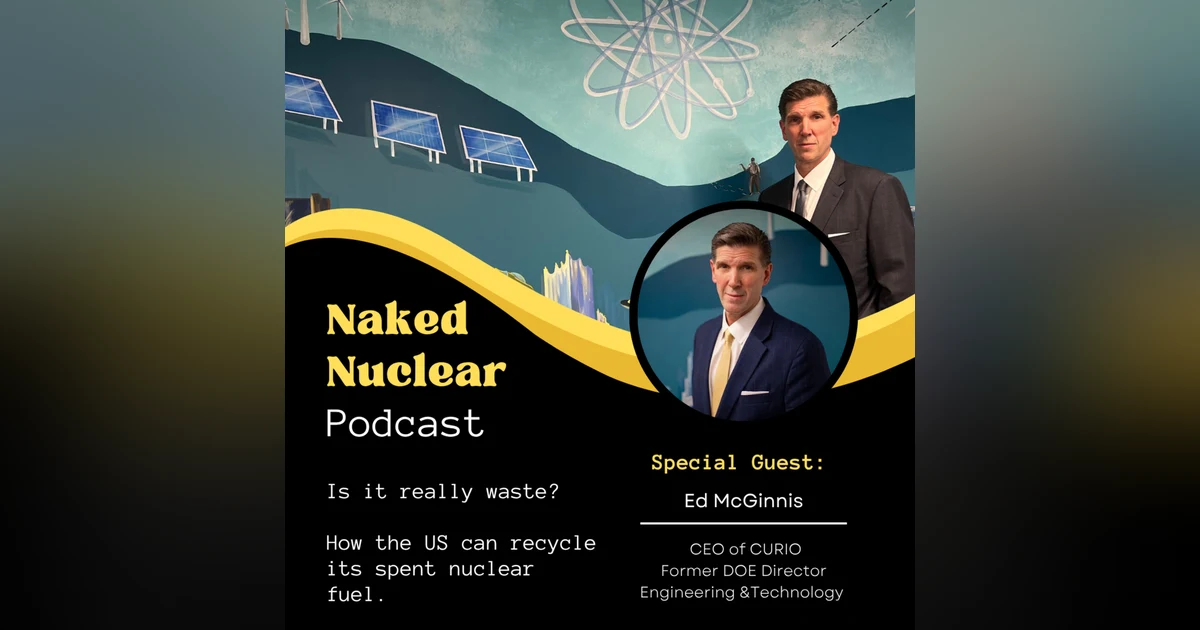
Ed McGinnis is the CEO of Curio and a former senior official at the U.S. Department of Energy. He's spent decades in nuclear policy and energy security, and he's now building something that could change how we think about nuclear waste entirely. Spoiler: he doesn't even call it waste. He calls it "slightly used fuel."
In this episode, Ed breaks down why the U.S. stopped recycling nuclear fuel in the 1970s, what went wrong with the Cold War-era Purex process, and how Curio's NuCycle technology does it differently ... without ever separating pure plutonium. We get into the $50 billion Nuclear Waste Fund that was collected from ratepayers and spent on other things, why the DOE is now paying over a billion dollars a year in court-ordered damages, and how 90,000+ metric tons of used fuel sitting at reactor sites across the country is actually the largest above-ground energy reserve in the world.
Plus: Curio's planned recycling facility, bigger than a football stadium, processing more fuel than every other recycling facility on the planet combined, and the 3,000+ trades-based jobs it would create at around $125K a year for 60+ years.
Topics covered:
- Why only 3-4% of nuclear fuel is actually used — and 96% is still usable energy
- The difference between the Cold War Purex process and Curio's NuCycle technology
- President Carter's ban on fuel recycling and the $13+ billion in lost investments
- How recycling reduces radiotoxicity from 100,000+ years to about 300 years
- Curio's partnership with Oak Ridge National Laboratory since 2019
- The Nuclear Waste Policy Act, the $50 billion fund, and the billion-dollar-a-year lawsuit payouts
- Russia still providing 20%+ of U.S. nuclear fuel — and what that means for energy security
- Curio's planned facility: 4,000 metric tons per year, 3,000+ jobs, mostly trades
- Curio's own SMR and micro-reactor designs (TrueFuel)
Resources:
Learn more about CURIO: curio.energy
Jimmy Carter's Ruling on Reprocessing Spent Nuclear Fuel: https://www.nrc.gov/docs/ml1209/ML120960615.pdf
Unknown Speaker (0:00): Imagine filling your car up at a gas station in Washington DC and driving towards Richmond, Virginia, maybe 20 miles down the road. You pull over, get out of the car, and you call a tow truck to come tow your car and then scrap it because it has 96% of its fuel remaining? That doesn't seem right.
Ed McGinnis (0:23): This is a trillion dollar national resource that has been treated as waste. But the fact is, during the five year period of the fuel operating, when it's pulled out, it's actually slightly used nuclear fuel if considering you've only used about 4% of the energy value.
Unknown Speaker (0:45): That's Ed Viggenes, CEO of Curio, describing what we've been doing with nuclear fuel in this country for decades. Today on Naked Nuclear, why we stopped recycling nuclear fuel, how one company plans to fix it, and what it means for American energy security. Welcome back to Naked Nuclear. We're in the middle of our season on how to build a nuclear power plant. But today, we're zooming in on what happens to the fuel after it's been used in a reactor.
Unknown Speaker (1:13): My guest today is Ed McGinnis. He's the CEO of Curio. And before that, he was the senior official at the US Department of Energy. He's one of the people who's been closest to this problem for decades, and now he's trying to build the solution.
Ed McGinnis (1:28): Well, there are 94 reactors operating in this country. It's still the largest fleet of nuclear reactors in the world. China's hot on our heels, but nonetheless, we still have the largest fleet. Our fleet is what we call light water reactors, and they what we call the gigawatt class reactors, large reactors, and they're fueled by uranium fuel. And this uranium fuel is initially produced by mining the uranium out of the ground and then processing it and converting it where it can be enriched.
Ed McGinnis (2:05): And then after being enriched through gas centrifuge plants, it's then in a gas form, then it's deconverted, as they say, back into fuel pellets that are stacked up in these fuel assemblies and then put in their nuclear reactors around the country. Once it's put in the nuclear reactor comprising of a nuclear core, the fuel, that uranium based fuel, is operated usually for about five years in the reactor, at which point they pull it out of the reactor. And then they put it adjacent within the reactor facility into pools to cool them off. And then after a certain period of time, the fuel assemblies are then pulled out of the wet storage that's in the pool and put in what's called dry cast systems still on the pad next to the reactor because right now there's nowhere for the material to go other than that. And the material then is stored.
Ed McGinnis (3:13): And it's stored in our country at almost 80 locations around the country in almost 40 states. So this material over time has been treated via government policy as what we call a once through fuel cycle, where we, as a nation, decided really initially putting us on this path of only using the material once and then attempting to dispose of it permanently without using any other value in that material, that started all the way back to president Carter where he decided for international security reasons, not based on the technical ability to fully utilize the material, not based on whether there is a lot more remaining energy value and valuable products in it. The decision was made based on international nonproliferation reasons. And so that was the beginning when he put in place a moratorium on reusing, recycling, reprocessing, pretty much all the same thing, that material. And over the years, congress passed legislation setting up a pathway for disposing of that material, including taxing the individuals that receive and purchase the electricity from the nuclear power plants.
Ed McGinnis (4:38): And that that was sort of the nail in the coffin to make this de facto treated as waste. But the fact is it's anything but waste. So the nuclear fuel, when it's running a reactor for about five years, when they pull it out, you've only used about 4% of the energy value. In fact, there's still enough energy value, according to leading scientists at Idaho National Lab, there's enough energy value still resident in that fuel after you pull it out of the reactor after about five years to meet all of The US electricity needs for the next one hundred and fifty years. This is a trillion dollar national resource that has been treated artificially and not based on technical aspects of it as waste.
Ed McGinnis (5:26): It's a product of government policies over the years. But the fact is during the five year period of the fuel operating, when it's pulled out, it's actually slightly used nuclear fuel considering you've only used about 4% of the energy value. Now, not only do you have 96% of that energy value left consisting of a significant amount of uranium that can still be recycled and repurposed for new uranium fuel for our fleet of reactors, but also during that five year fissioning process actually generates a wide plethora of other highly valuable radioisotopes and even nonradioactive precious metals.
Unknown Speaker (6:18): So right off the bat, Ed reframes everything. What most people call nuclear waste is really fuel that's barely been used. Only three to 4% of the energy has been extracted. The rest, 96%, is still usable. Now let's get into what's actually inside that used fuel and why it matters for recycling.
Ed McGinnis (6:41): There's industrial space based radioisotopes that are generated during that process. There's medical, and there are precious metals such as rhodium. Our facility is going to be, and we're building our advanced nuclear recycling facility that will be done in about seven years, six to seven years, our first commercial in about 2032. And in this facility, we will literally be able to supply as much as 10% of the world's rhodium. Rhodium is the most expensive metal in the world.
Ed McGinnis (7:17): It's for medical purposes, imaging, or for detecting leaks and re reactor pressure vessels. So very, very important. And right now, Russia is the main supplier on that. So the beautiful irony is that we're taking what's been treated as waste, and then we are going to mine it for all the highly valuable isotopes and precious metals to fight cancer, to ensure energy security. And in addition to that, the process that we have developed and already validated with the US Department of Energy and four leading national labs.
Ed McGinnis (7:56): Our process actually, at the same time while we're pulling out all of these isotopes, and we've identified about 10, we will actually reduce the original amount of high level waste down to only about 3% to 4%. So we will have reduced 96 or 7% the amount of waste. We will have then fully utilized the remaining valuable radioisotopes and precious metals. And then having that multiple beneficial effect, making nuclear in a position where we're much more environmentally sustainable by reducing that amount of waste down to about 3%, 4%. And then there are many other more palatable and implementable ways to dispose of that three to 4%.
Ed McGinnis (8:46): And the last point on the three to 4% is while the if you don't recycle that material, believe it or not, if you're gonna dispose of it under current regulations and law, it will need to be demonstrated to be securely sequestered from human exposure and contact for a hundred thousand years. And some of the requirements extend out to a million years. That is almost an incomprehensible and almost impossible to demonstrate. Our material, the remaining three to 4% that will have to be permanently, deeply, geologically disposed by law will have to be sequestered only for about three hundred years until it's safe for humans to be around. So that's in a nutshell what we're talking about.
Unknown Speaker (9:35): President Carter banned recycling. President Reagan lifted the ban, but the damage was done. Billions in investments lost, companies walked away, and the political will just wasn't there until now. But to understand why this matters so much, we have to go back to the nineteen eighties when America made the decision that shaped our nuclear industry for the next forty years.
Ed McGinnis (9:58): First of all, I should have mentioned that after president Carter put in place through executive order a moratorium essentially banning recycling and causing those companies that had recycling facilities or were planning to with billions of dollars equivalent, they lost out big time And we removed the incentive for them to really even wanna get back in even to this day to some degree. But president Reagan, when he came on board, he removed that ban for executive order. And so he removed the moratoria on recycling and reprocessing. So that's number one. So that means that it is absolutely possible for a company like ours to enter into an agreement with a utility that is an ownership title of material and recycle it.
Ed McGinnis (10:51): But it's not that easy or simple. Because over the years, there have been legislative action and other policy actions among others that have really had the effect of removing incentives for any of our potential customers' utilities from wanting to have a company like ours recycle. For example, the nuclear waste policy act was passed, I believe, in 1982, '83, and then amended over the years. And that was you know, this is an example of good intentions having negative effects. The good intention was, okay.
Ed McGinnis (11:29): Now that we're not going to recycle the material, we need to figure out where to put that material permanently. So Congress passed a law and said, you, US Department of Energy, are now legally obligated, directed, responsible for taking that nuclear waste. And while technically, it is slightly used nuclear fuel, The fact is if you don't plan to recycle it due to policy and legal issues, then de facto, it is waste. So that material sitting around the country next to all these reactors having nowhere to go, congress said, the Department of Energy, you're required now to take back that material. Come up with a plan and and start taking back that material.
Ed McGinnis (12:23): Take it off the pads of those reactors. Get it out of the communities by 1998, and get it out and then find a place to permanently, deeply, geologically dispose of it. So what happened was the Nuclear Waste Policy Act then directed the Department of Energy to pick up that material by 1998. And here's the kicker. And authorized them and the treasury department to charge each nuclear reactor, each utility that owns a nuclear reactor, a tax on the kilowatt amount of electricity that is sold to residents.
Ed McGinnis (13:05): It's called one mil per kilowatt hour, one tenth of a cent. Well, one tenth of a cent of every kilowatt has now resulted in a nuclear waste fund that's $50,000,000,000. And that $50,000,000,000 was taxed on the utilities who pass it on to the rate payers and had that built into their bill. Well, 1998 happens, and the Department of Energy couldn't get its act together trying to force feed Nevada for Yucca Mountain. It becomes politically intractable and impossible.
Ed McGinnis (13:43): Suddenly, the Department of Energy is nowhere near beginning to send trucks and rail to pick up the used nuclear fuel to take it. But the Department of Energy and the US government continued to tax everybody. So the utilities over time said, wait a minute. This is wrong. You're charging us for a service that you never did.
Ed McGinnis (14:04): And now we're double charging the ratepayers. That's not fair. It took well over ten years. In fact, I believe it was 2018 where a class action suit essentially of many of The US nuclear utilities came together and then filed suit against the government for failing and for damages. And under Obama, they actually prevailed finally after they'd been working through the course over the years.
Ed McGinnis (14:31): Just happened to be under his watch. And so they won. And so what the win entailed was the courts decided that ruled the favor of the utilities and ruled that the administration needs to start paying compensatory damage to the utilities for the costs of continuing to have to maintain all the security and everything else, the material that's sitting on their pads. And secondly, ordered the administration to cease and desist taxing and charging for that service because they failed to do it. We are now paying over $1,000,000,000 a year, our treasury department, to the utilities every year, and it's growing for compensatory damage.
Ed McGinnis (15:19): We also have the $50,000,000,000 that's sitting there and has not been used for disposal. Well, the really unfortunate thing for the taxpayer is that material has already been spent. Congress has already used it for other things. And now that $50,000,000,000 is essentially an IOU. They're still on the hook to pay when there's a repository, but they're gonna have to appropriate new money.
Ed McGinnis (15:46): It's called scoring. So this is another example where the taxpayers it's a double whammy. We're using taxpayer dollars to pay court assessed fines of over $1,000,000,000, the largest amount of what's called the judgment fund after a treasury for any settlements by the United States government. And we have $50,000,000,000 that we spent that was supposed to go for disposal. So that's not a sustainable approach.
Ed McGinnis (16:14): So we wanna absolutely fix this, right the ship. That's one of the reasons why I left my senior position at government because I always felt like you know, I I felt incredibly bad, if not guilty, that if I retired and leaving such a solvable mess called the so called nuclear waste problem that is imminently solvable for future generations to come. So that's why I joined this company. And we we have this unique moment to to right the ship and fix this once and for all and stop the hemorrhaging of money and let the private sector come in just like SpaceX did and once and for all get our our nuclear sector humming and operating in an optimal way.
Unknown Speaker (17:03): So we've got 90,000 metric tons of this material sitting at reactor sites across America. Other countries recycle theirs, France, Russia, China, but they all use the same process, one that dates back to the Manhattan Project. Ed's going to explain why that old process is a problem and what Curio is building to replace it.
Ed McGinnis (17:27): There are a number a handful of countries recycling or reprocessing, if you will. France is the largest. It's in Lahag, in Northern France. And Russia at Mayak, they recycle. China is recycling at a small scale and seeking to build that up.
Ed McGinnis (17:46): Now the process used by every one of those countries that I mentioned is using one process, the same process. It's called Purex. It's a very arcane process. It's a process that was born out of World War two and the Manhattan Project. That process was developed during the existential environment of World War two to try and beat the Nazis from getting the nuclear bomb in our view at that time.
Ed McGinnis (18:16): And so the intent of that process was to take fuel that comes out of a reactor that then during that fissioning process generates plutonium and then extract the plutonium, hence Purex, pure stream of plutonium for weapons purposes. In the fifties, that process was adjusted for civilian purposes to produce and extract uranium for fuel in a recycling process as well. It also could have been adapted, and it has, by certain countries, breakout countries from a plutonium perspective, from a proliferation perspective. But the bottom line is the Purex process is the antithesis of what Curio's process is. We have developed a process that is just a step change, more advanced, and that eliminates or effectively addresses what we think are three of the most problematic aspects of Purex, the way it's being done around the world today.
Ed McGinnis (19:22): And I would argue, which is one of the biggest reasons why you don't see Purex in this country right now. The first is the environmental problem. Like I said, Purex uses a nitric acid process. So literally, you take these 18 foot high fuel assemblies that make up a reactor core in our reactors around the country, and then they chop them up, and then they put them in a bath of nitric acid to dissolve and to get the decladding, dissolve the zirconium cladding that surrounds the fuel pellets, and then to get to the plutonium and the uranium to extract. Well, the irony there is you're creating a lot more high level waste than you even started with.
Ed McGinnis (20:11): So that's a problem. And so we have our process where we eliminated the use of nitric acid. Ours is largely a dry process, a superheated process with electrolysis process as part of that. And so that allows us to extract all the valuable products, and we've identified 10 thus far, and to extract that all the while reducing the amount of high level waste and separating that out from the rest, the low level and others, to get to that 3% to 4%. You can't do that with Purex because you're using that nitric aqueous process.
Ed McGinnis (20:52): The second of the third challenge and what we've addressed is the security issue which led president Carter to ban the reprocessing because the process being used around the world was PRX. And as I said, what was Purex originally used for? Weapons programs. It was used to pull out pure streams of plutonium, which is weapons usable. The process for Purex today, even today, is to pull out a pure stream of plutonium, albeit for civilian fuel called MOX, mixed oxide fuel, primarily.
Ed McGinnis (21:31): And for a facility that is using Purex, they actually have to maintain a large stockpile in the tune of as much as a 100 or more metric tons of plutonium that's weapons usable, albeit it's secure, safe in France, but the process inherently has a Trojan horse. We have eliminated that process. Our process, we never extract plutonium as a pure stream. When we do extract it, we coextract it with other self protecting radioisotopes that make it provides a very strong security barrier. But it doesn't impair the neutronic performance of the plutonium to be used as a fuel in a civilian reactor setting.
Ed McGinnis (22:24): So we are gonna be a uranium fuel supplier from the uranium extract from this process. We're also gonna be a plutonium based fuel supplier for reactors that can be powered by the plutonium, but powered by plutonium that has a nice, strong, robust security layer to it. Right? So that's the second issue with the way it's being done around the world today. The third is the economics.
Ed McGinnis (22:54): Every one of the facilities around the world that's reprocessing today and recycling, They're state owned. They're not set up like a private sector company like ours to have the highest output, strongest return on investment, maximum extraction for marketable products to make it as economically sustainable as possible and not depending on taxpayer money. These are state owned companies. And some of these facilities that are operating today by these state owned companies, they're as large as small cities. And they were not conceived from the beginning and not operated today in a manner that most believe could be economically sustainable without government support.
Ed McGinnis (23:45): We've allowed our fuel cycle and nuclear fuel production and management absolutely deteriorate. We're still at and to this day are almost 100% dependent on foreign suppliers for our nuclear fuel.
Unknown Speaker (24:02): So Curio has a process that's fundamentally different from the Cold War era approach. It never separates a pure stream of plutonium, which means it's proliferation resistant by design. Ed and his team have been working at Oak Ridge National Laboratory since 2019, validating their technology. And the scale they're planning, it's honestly hard to believe until you hear the numbers.
Ed McGinnis (24:27): We have now validated the key aspects of our novel recycling process that is environmental, that's a dry process, gets it down to three to 4%, that is able to pull out multiple products through thermal selectivity and other chemistry processes and doing it in scalable way. So the process that we have put together, we initially put it into patent about four years ago when I took over the company. And we sought opportunities to partner with the US Department of Energy for a number of reasons. One is they have world class platforms, capabilities, facilities, and scientists in our areas, our what we call our flow sheet, our chemistry flow sheet of recycling. Because at the end of the day, recycling of slightly used nuclear fuel is at its heart a chemistry process.
Ed McGinnis (25:25): Right? And so we need would need would have needed to build our own dedicated hot cell facilities, meaning these facilities capable of handling highly radioactive material and extracting it. So we partnered with the US Department of Energy because in our view as a company, it was a more cost effective approach. It was a faster approach, and it was an approach that was more derisked as we demonstrated. So the purpose of the lab scale demonstration was to actually use material, use nuclear fuel and simulated material such as unirradiated uranium, and take our concept and then show it works in laboratory environment at the grand scale.
Ed McGinnis (26:14): So literally saying, for example, our fluorination process, can we take that uranium that is in oxide form and then put it in a gas form? And then can we selectively pull out the different products like the uranium that will be reused for uranium fuel? And in that case, we pull out UF6. And we've already demonstrated we can pull it out in the most pure form that's ever been done to our knowledge from recycling. And that's at ASTM standards, which is very important because that's the standard for fuel that is used by nuclear reactors around the country.
Ed McGinnis (26:57): So fast forward after three years, we won a number of grants and contracts with the Department of Energy competitively based on our technology, including one important one with an organization called ARPA E, really focused on within the Department of Energy, partnering with companies, promising companies or promising technology from tech to market. They selected us competitively, and they have been partnered with us ever since. It was initially a three year lab scale demonstration to show that we can do the key aspects, our Envision technology. And we have done that now. We're shifting now that we have validated the key aspects in our view of the processes.
Ed McGinnis (27:45): We're shifting to now scaling up from hundreds of gram lab scale to now more towards commercial scale, starting with kilogram and then hundreds of kilogram and then thousands of kilograms. So that's where we are now. And we are now we have our line of sight of building one or more of our what we call new cycle facilities in The United States. And when we build our facilities, what I didn't mention is not only have we brought in next generation combination of processes to recycle this in an environmentally responsible way and secure and economic. So what does that mean?
Ed McGinnis (28:31): That means that our facility is going to be one of the smallest, most compact recycling facilities in the world, the size of a large football stadium like Soldier Field in Chicago. Yet it will have the highest throughput of any facility in the world, higher than the facilities that are the size of small cities. In fact, our facility is designed for 4,000 metric tons a year consisting of 10 drive vessel module systems that will be put into this football stadium facility size facility, each one capable of processing about 400 metric tons a year. And four times 10, you've got 4,000 metric tons. That's more than all of the recycling throughput on the planet.
Ed McGinnis (29:23): That's more than if you combine France, Russia, China, Japan. This one facility will be able to recycle more than all of the world's recycling capacity at any given time. That means we have the largest amount of slightly used nuclear fuel over generations being treating it like waste. And so in a way, it's serendipitous because it's been sidelined. And now the material, this national resource is waiting for us to mine.
Ed McGinnis (29:54): We're like a miner. We're gonna be a commodity extractor to the nth degree. So our facilities, once built, is going to overnight be the largest clean fuel supplier on the planet, whatever state has this. And we're very proud of that. This facility will also generate about 3,000 well paid jobs just for the facility, not even including downstream.
Ed McGinnis (30:24): And one thing that I love about this scenario is the majority of the people that are working, they're contrary to the average American who probably thinks, oh, if you're working in a nuclear facility, you must have at least a nuclear engineering degree advanced degree. It's the exact opposite. The vast majority of the people that work at a nuclear reactor or that will work at our facility are trades based. High school diploma, but well trained. Two year associates, highly trained.
Ed McGinnis (30:54): And the average salary, if you look at the NI Nuclear Energy Institute statistics for these trades based type jobs is about 125,000 a year. And our facility is intended to operate for at least sixty years. So these are generational jobs. It's gonna be an anchor to our community. And that's one of the corporate ethoses of our company, and that is to be a win win win stakeholder base, and we want this to be as beneficial to the community as to anyone else.
Unknown Speaker (31:26): A single facility the size of a football stadium that can recycle more fuel than every other country on Earth combined. 3,000 jobs, mostly trade base, paying around a $125,000 a year for at least sixty years. But here's where it gets complicated. Because of decades of policy decisions have created a regulatory and financial mess that still needs to be untangled.
Ed McGinnis (31:52): First, we need to rebuild our nuclear fuel production and use nuclear fuel management in industry. Right? So you see moves happening now by the administration awarding sizable amounts of funds to nuclear companies. A number of them are startup companies for the purpose of enriching the fuel. And that after you get the uranium for the ground and then you convert it and then you enrich it, right?
Ed McGinnis (32:21): And then the second piece of that nuclear fuel cycle is when the fuel is then put in a reactor and comes out, we need to build our national capacity to then recycle the material so we're not throwing it away after 3% to 4% is used and at the highest level of radio toxicity that requires an absurdly long time to demonstrate safe disposal and to build the capability of enrichment much more so. We have one enrichment in the country right now. It's a European company called Eurinko, but that's not enough. Nowhere even near enough. And we have no recycling in The United States, and we aim to be that key leader for that at national scale.
Ed McGinnis (33:08): Now as to your point about reactors and then the recycling, it is very symbiotic because recycling for our facility, we will be able to, at 4,000 metric tons, provide approximately one third of the national uranium feedstock needed for enrichment for fuel. So that is intended to complement the ramp up of uranium mining but doing it in a way where you're not having to open up new mines. We can actually complement the traditional uranium mine to enrichment with our recycled material. And when we pull out our material, it's in a gas form that is the same gas form, UF6, that is used going into an enrichment facility that enriches and produces that fuel for our reactors around the country. So the beauty is that we can become a key strong pillar of fuel production in this country by way of recycling.
Ed McGinnis (34:16): And number two, not only uranium, but remember plutonium. Fact is, plutonium is a superior fuel to uranium unless it's high enriched uranium, which you're not gonna see in the civilian market because of proliferation risks. But with regards to the advanced fuels that we see called HALEU, this is the higher enriched but low enriched uranium up to 20%. The Bill Gates, Terra Powers, and other companies are claiming to use. We will be able to provide substantial amounts of fuel for those reactors and will be a plutonium based fuel reactor that, again, is higher density of power and lower rate ratio than the uranium based fuel in the market today.
Ed McGinnis (35:00): That's why we're not only are we going to be a fuel supplier to virtually every reactor, current large light water and the advanced reactor, we'll be able to recycle virtually all of the slightly used nuclear fuel coming out of both the current reactors and the advanced reactors, even certain types of what we call triso fuels. So we will be not only a major fuel supplier, reactor agnostic, but we also have our own small modular reactor that we custom design to be optimized with the fuel that we're gonna pull out, plutonium with the security blanket wrapped around. We call that fuel true fuel, and our reactor is probably gonna be a third the size of the uranium reactors because of the higher density of power, lower rate weight ratio. We also have a microreactor that will be fueled by our TruePuel. So we are an end to end innovation stack, fully integrated company, and we're gonna be positioned for global too.
Unknown Speaker (36:04): So let me make sure you caught all that. The government collected $50,000,000,000 from ratepayers for nuclear waste disposal. Congress spent that money on other things. The Department of Energy never picked up the waste. The utilities sued and won.
Unknown Speaker (36:23): And now taxpayers are paying over billions. And now taxpayers are paying over $1,000,000,000 a year in court ordered damages. That's where we are today. So the question becomes, what does the actual fix look like? And Ed's answer ties together energy, security, advanced reactors, and American fuel independence.
Ed McGinnis (36:49): Well, first and foremost, energy security, our ability to be able to produce our own fuel, is paramount in preventing us from being, frankly, held hostage by other countries who may now or may not now be our allies. How many people know even to this day, Russia provides over 20% of our nuclear fuel in our country? And under president Biden, he passed legislation banning uranium. But to show you how difficult it is to wean us off of a nuclear fuel supplier because of the technical specs and other long term contracts. It's not easy for utilities to say, oh, I'm just gonna switch suppliers for nuclear fuel.
Ed McGinnis (37:38): It is not that simple. It's a multiyear process. And so it's not until '20, I believe, '28 that the moratorium is gonna go into full effect. During the meantime, we're still getting over 20% of our nuclear fuel or enrichment we call SWU from Russia and the vast majority of our fuel from foreign suppliers. So from an energy security perspective, it's imperative, especially as we now are doing things that's going to make us even more dependent on nuclear.
Ed McGinnis (38:12): Again, whether it's, you know, combating climate change, AI, or just our overall electrification throughout society and our dependence on electricity, it's unacceptable for us to to put ourselves in even more of a dependence on a on an energy sector, in this case, nuclear, where we're so utterly dependent on foreign suppliers because we've allowed it to deteriorate over the years. Now secondly is the environmental issue. Even if we never build another reactor, what are we gonna do with all this so called waste sitting around a country? We're gonna leave it for generations civilization to come. That's unacceptable.
Ed McGinnis (38:54): So that's another thing to deal with our legacy waste or to deal with it by flipping the script and not treating it like waste and reducing it down to three to 4% at most. And thirdly, the economics, the jobs are hugely beneficial. Like I said, generational jobs. We will become a tech core that actually will have very positive economic and workforce impact even beyond any one state. This is how large of a tech corridor it's going to be.
Ed McGinnis (39:26): So I would say those are three of the most noteworthy important aspects of our nuclear sector. Well, first of all, we are available. We have our website at terio.energy. I welcome everybody getting online. We have a portal area for any questions, for contact.
Ed McGinnis (39:48): Our director of external affairs, Liat Gouzi, is available. I welcome engagement. I believe in engaging early and often with the public and to arm everybody with the facts and not just looking in the rearview mirror and taking for granted what's been characterized through different policies over the years for different reasons. And there's a lot out there. I've had the pleasure of speaking and testifying before many state houses, and we have those videos and others on our website available.
Ed McGinnis (40:21): You can even just do a general search for curio.energy or Curio. My name, Ed McGinnis. Nuclear, you should see a lot. We've had some very good media developed and released that should be useful for an average reader. There is also a documentary, I guess you can call it, that was done by the sustainable goat on our company, and it was finished about a year ago.
Ed McGinnis (40:50): But it's on our website, and I encourage people to watch it. We're inspired, and we want to have legacy positive impact. And, hopefully, you'll see that.
Unknown Speaker (41:01): If you want to learn more, head to curio.energy, and we'll link everything in the show notes, including the documentary he mentioned. I called this a master class during the interview, and I meant it. We covered all of the science, history, policy, the economics of nuclear fuel recycling, all in under an hour. If this episode changed how you think about nuclear waste, share it with someone. That's how we grow this conversation.
Unknown Speaker (41:27): I'm Danielle Allen. This is Naked Nuclear. Until next time. Stay curious.