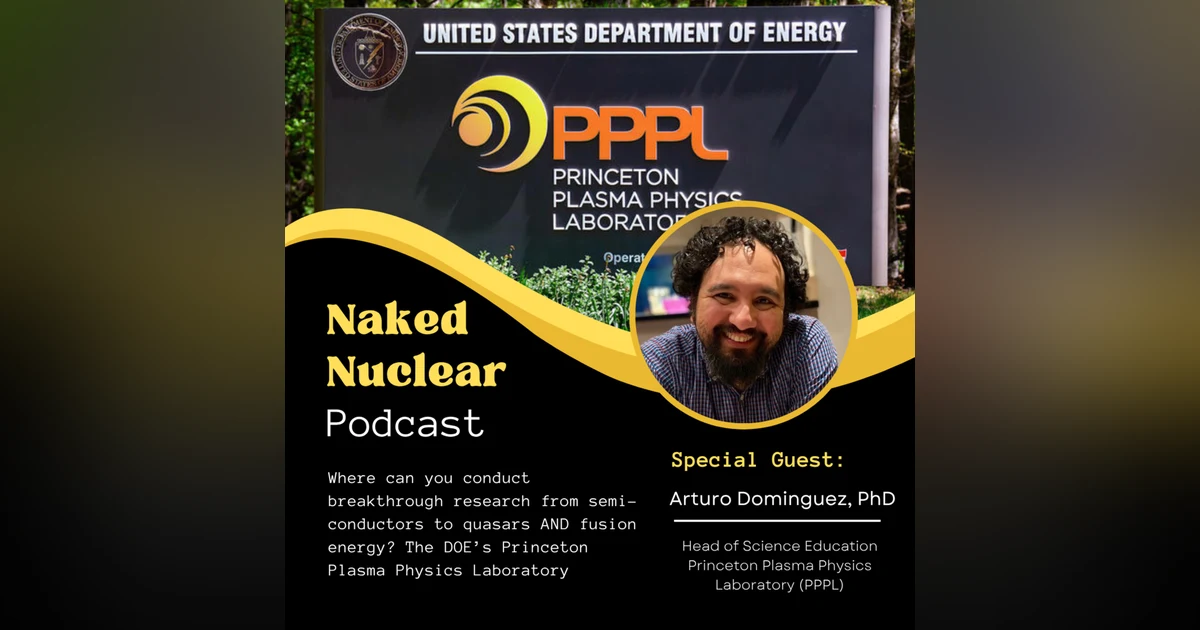
Intro to Fusion Energy with Princeton Plasma Physics Laboratory


 RSS Feed
 What exactly is plasma, and why are some of the world's brightest minds betting on fusion energy to power our future?
In this episode of Naked Nuclear, host Danielle sits down with Dr. Arturo Dominguez — Head of Science Education at the Princeton Plasma Physics Laboratory (PPPL) — to break it all down in plain language.
From his own journey into plasma physics to PPPL's groundbreaking research, Dr. Dominguez shares how fusion works, why it matters, and how students everywhere can get involved.
We dive into PPPL's free Introduction to Fusion and Plasma Physics course — a beginner-friendly, online class designed to make complex science accessible for anyone curious about the future of energy. Whether you're a college student, a career switcher, or just fusion-curious, this episode will give you a clear view into the fascinating world of plasma, research at Princeton, and how fusion could become a key player in the clean energy race.
Check out more Resources:
Intro to Fusion & Plasma Physics Course:
https://www.pppl.gov/events/2023/introduction-fusion-energy-and-plasma-physics-course
Princeton Plasma Physics Lab (PPPL): https://www.pppl.gov More about Dr. Arturo Dominguez: https://www.pppl.gov/people/arturo-dominguez
Full Transcript
[00:00:00] Danielle Allen: My sophomore year in college, I found myself chatting at Tea Time in the Institute for Advanced Study just in the shadow of Princeton University's campus. This facility is where brilliant minds like Albert Einstein, Charles Oppenheimer, and Emily Noder studied. My IQ certainly did not warrant an invitation into the prestigious facility.
However, I did share the same exact name as a brilliant political science researcher there, Danielle S. Allen. How we Met is a story for another time, but what struck me at this tea time for geniuses was the wide array of studies. I listened to the various researchers talk about their backgrounds, and one scientist introduced himself and said he worked at the Princeton Plasma Physics laboratory.
Princeton has a plasma lab. I asked. Well, no, the Department of Energy has a plasma lab. Princeton just manages it, and that's when I learned about the Princeton Plasma Physics Laboratory. A national laboratory owned by the Department of Energy today on Naked Nuclear. We're gonna be talking to Dr. Arturo Dominguez PPPs lead Science Education officer.
We'll be talking about the mysterious history of PPPL. A crash course in what plasma and fusion actually are, and a completely free course that's giving students from around the world a front row seat to fusion energy. So first, is it bad that I had no idea where PPPL was located before this episode, or that it's run by the Department of Energy?
[00:01:50] Arturo Dominguez, PhD: No, we are hidden. We are hidden away. And historically a bit on purpose because we are, if you know the area, we're actually across from route one, so it's, if you're gonna walk it, you better carve it out in your calendar and it's actually pretty tough to get here and crossing to route one if you're walking.
But yeah, we are hidden away, close about three miles away from the main campus. Yes.
[00:02:14] Danielle Allen: So why is there a hidden plasma physics lab three miles away from Princeton's campus?
[00:02:21] Arturo Dominguez, PhD: We, I actually started as a secret project called Project Matterhorn by our founder, professor Lyman Spitzer of the astrophysics department at Princeton University.
And we started right after the Second World War. And this is a good time for people to, to get a sense of what the Department of Energy Labs are because of Oppenheimer. If you've seen the movie Oppenheimer, you know that during World War ii, the government undertook. The plan to construct and build these labs that brought in really smart minds from all over the country to work on big projects.
And for World War ii, it was working in big projects related to the war. But after the war, a lot of labs were founded and became incorporated from the Department of Energy to tackle big science, to tackle the science that really can't be done at a university level. That has to be like very big. Projects.
So for example, at in Oppenheimer they highlight Los Alamos National Lab, which was where, where Oppenheimer was situated, but also Oakridge, which is in Tennessee. And I believe they touch upon Lawrence Livermore with the folks over in, in California. So those are, you know, the biggest labs or some of the biggest labs.
There's actually 17. Department of Energy Labs and we are one of the smallest we are Princeton Plasma Physics Lab. Again, as I was mentioning, we started as a secret project called Project Matterhorn, which was trying to understand and harness the power of fusion. Right, and while there was a dual defense and energy mission of the lab, when it started very quickly, it transitioned towards what is now PPPL, the Prince and plasma physics lab to focus solely in energy.
We became public in the early sixties, so, so we've been the prince of plasma physics lab since the early sixties,
[00:04:19] Danielle Allen: bringing us into today, obviously they do plasma research. But what does that research look like?
[00:04:28] Arturo Dominguez, PhD: As the name suggests, Princeton Plasma Physics Lab. We are all things plasma, right? So, okay, so let me step back a second.
Plasma is, we commonly know it is the fourth state of matter. You have solid, which is the coldest. You heat a solid up, you get liquid, you heat a liquid up, you get gas. If you heat up a gas up enough, you get a plasma. Which is different from a gas because the particles in the plasma, a lot of them are ionized.
A lot of them have separated the electron from the nucleus of the atom, and so as opposed to a gas in which all the particles, or 99.99% of particles are neutral. A plasma, there's enough charged particles that it behaves like an entirely new state of matter. In this case, plasma, more than 99% of the visible universe is plasma.
So, uh. Understanding the universe really requires understanding plasma, and so the big three missions of our lab are to develop the science and technology for fusion energy, which is really what we'll talk about the most today, and really the biggest mission of our lab. A second one is. Utilizing plasmas for microelectronics and electro manufacturing.
So these are what we typically call low temperature plasmas, which is really a misnomer because they're pretty hot, but nonetheless, they're much colder than than fusion relevant plasmas. But these are related to, for example, the processes that you need. To make semiconductors, if you know about Moore's law, right, this law that tells you how quickly the progress in in transistor technology has evolved since the invention of the transistors, and it's an exponential rise from like the eighties.
The processes that have led to Moore's Law, all of them have had to do with plasma, right? Because in order to control the processes that you need to make the nanometer scale details of semiconductors, you can't do it. By having a, a really good pulse, you, you have to do it with, with advanced techniques and plasmas are a really important part of that.
So we have a whole area which has been growing in recent years that really dives into this area of microelectronics and. Closely connected quantum information science, like utilizing plasma techniques for quantum computing, for example. That's a whole realm that has been growing, especially recently. And the third mission of our lab is what I started with understanding the universe.
So the plasma universe. So understanding astrophysical plasma processes, what determines the rate. Of solar flares and coronal mass ejections because the sun is made out of plasma and every once in a while it has these explosive bursts that are plasma phenomena. So one of the big missions that we have is understanding this phenomena and understanding what scales and what parameters dominate these phenomena so we can understand it much better and maybe even help us protect our electrical grid.
Right. So it's to that level. So as I said, understanding the universe requires understanding plasmas, and that's one of the big missions we have.
[00:07:54] Danielle Allen: fascinating part about this type of research is how it scales from the microscopic to macroscopic nanometers to light years. So how did Dr. Dominguez get his start in plasma?
[00:08:09] Arturo Dominguez, PhD: Yes. That's actually one of our pitches. It's understanding the universe from the nano to the astrophysical. All of this has to do with plasmas. Yeah. I started studying physics in my native Bogota, Colombia. I'm actually from Colombia. I was excited about physics in school. I was actually, I got hooked by a brief history of time, right?
This was when you talk to a bunch of physicists, you know that one brief history of time always comes up. I got really excited about physics. There. And so I started studying physics in the National University of Columbia, but then I transferred to the University of Texas at Austin Holcomb Horns I'm contractually obligated to.
So I finished my undergrad in physics at University of Texas at Austin. Just serendipitously I needed a job and I wanted to, you know, work in a lab and there was a professor that I had good chemistry with, professor Congenial at the University of Texas in Austin, and he just. Was a plasma physicist, so I, I worked in his lab.
I barely knew anything about plasmas and I worked on helping construct a reactor, like a, a fusion experimental reactor at the University of Texas at Austin. And when I started learning about it in my last couple of years of undergrad. I got hooked. I mean, the, we'll talk a little bit about Fusion, but, but the mission of Fusion and what can come about once we develop fusion, it's really something that you want to dedicate your life to.
So I got excited about it and did a senior thesis on Fusion and, uh, was able to do my graduate work at MIT where I worked in the. In the plasma science infusion center on a magnetic fusion device that was called Altor, cm OI worked on, um, instrument that detected density in the plasma using something similar to radar.
We would send electromagnetic waves into the machine and once they bounced back, you could analyze them and get to know about what's happening in the machine. It was learning and, you know, got excited about fusion, but. I was also getting excited about outreach. When we're at the PSFC Plasma Science Infusion Center, all grad students were required to give tours and to participate in outreach activities.
And so when I started doing it, I like really saw my calling and I got excited about it. Would give a lot of tours, would participate in outreach activities. When I was about to graduate, there was an opportunity here at the lab to work in this department that I now run the science education department to do a postdoc in science education.
And it was either this or working on instruments on what we call diagnostics for fusion. And yeah, I decided to go in this route and I've, I've never looked back. I gotta say, it kind of connects to one of the big thrusts that I have in our department, which is I want students to, at the end of their undergrad, to be in plasma infusion.
Not because randomly a professor was, they had good cancer with a professor, but because they actually learned about plasmas and fusion and, and like, just, just got hooked because of the science. And this will connect to what we'll talk about of the intro course. I really want students to find out about what we do early because plasma and fusion just isn't really taught even in R one schools and, and schools that are really big at the physics level.
There are very few schools actually dive deep into plasma's infusion. So one of the missions that we have is to try to reach the future workforce and getting them to get excited about plasma infusion early on.
[00:12:00] Danielle Allen: Well, PPPL has a two week introduction to plasma course. Let's see how this offering came together.
[00:12:08] Arturo Dominguez, PhD: I inherited this course or the previous versions to this course from a program that was called a National Undergraduate Fellowship, and this was run out of PBPL since the nineties. And so this was an internship program that would position students all over the country and they would start with a week.
In-person class, of course, taught by different professors in the field to learn the basics of plasma infusion, right? And it was pretty in depth. It was about 30 students would get to attend every year, a one week intensive course. When I joined very early on. The Enough program was stopped and I was connected to a bigger program out of the Office of Science.
The Department of Energy's main funder of this research called Suli Science Undergraduate Laboratory Internship. So if you know about internships, the big one that people know about are reus. These are funded by the National Science Foundation. NSF Suli is kind of the sibling of reus, but coming out of the Department of Energy, that's the main internship that we run.
And so connected to that, we decided. To continue this course enough had already been defunded, so we continued it out of suli. But what I decided to do very early on, so remember this was 2015, uh, very early on, was make it hybrid. I wanted to stream the lectures live and upload them into our website so that we could democratize it.
Some more and get more people to benefit from this. And so we did this, and lo and behold, five years later, this hybrid technology really served us during the pandemic. We revamped the course to make it fully virtual in 2020 and opened to. Everybody, we opened it up, we made it fully virtual. We did it to satisfy both the west coast and east coast.
So we did two weeks of afternoon sessions in the East Co in the East coast, so noon to five Eastern, which you know, was like nine to two Pacific for two weeks and fully remote and. It started building a following. We started getting folks signing up from all over the world and from a typical year where we would have 30 to 40 participants now in, you know, 23, 24, we were having a thousand.
Registrants from all over the world. We upload all the lectures and open the zooms for questions. So it's a really open venue for folks to learn about the work that we do here at the lab and in the fusion and plasma ecosystem of the us. That's a big idea.
[00:15:02] Danielle Allen: One of the unique attributes about this course is the hallway discussions where students can ask questions and make conversation with industry leaders and fusion researchers all across the country. Originally, an in-person course for DOE interns, this evolved into a free online summer course attended by over 1000 students worldwide.
It features 27 guest lectures from across the US fusion ecosystem designed for curious undergrads with STEM interests, even if they haven't studied plasma. But how does Dr. Dominguez and the PPPL team recruit so many top instructors for the class?
But first, a message from our sponsors. How do you become successful in the job market? If you are listening to season two of the podcast, you know that networking is key. Why? Because networking connects you to opportunities you didn't know existed. Here's the truth. In nuclear, a lot of the best jobs get filled before they even hit.
A job board. That's why you need nuclear talent. Scout their recruiters know the companies, the hiring managers, and what it takes to get your resume noticed. When you register, you are putting your name in front of decision makers who are already looking for someone like you. Go to nuclear talent boosto.com and get started today.
Now back to the show.
[00:16:38] Arturo Dominguez, PhD: I will give you even another detail. I try to have, for the most part, a full new roster every year, right? Keep in mind these are like 27 lectures, so I do spend, you know, the majority of the spring just going to people that have either met or that I know from conferences or from, you know, from different venues.
To give these lectures. Right. And so it is, it's literally 20 ish years that I've been in the field learning the people that I've known from them, and then recommendations from past speakers. And so it's great to have like senior scientists and folks that are really well established in the field, but I, I really try.
Get the opportunity to highlight early career folks. And so when you see I, my only rule of thumb is that they should be either early in the industry or or past PhD. So, so postdocs or early career researchers at companies, but that's it, right? And that they. Are passionate about it and, and we'll give pedagogical lectures.
So we have a lot of repetition of topics. Of course, we always have sort of an introduction of plasma and plasma waves and turbulence, so I, everybody knows some of the slides that you're presenting now. You will get from a past speaker and you will be expected to pass on to your next speaker if necessary.
But I do encourage everybody to put their own spin on the talks and to focus on what is really important for them. Right. So it is, there's a lot of. Evergreen topics within the lectures, but there's also, every year I have a couple of completely new topics. It's exciting. It, it really, I try to reflect the evolution of the fusion and plasma ecosystem in the us.
It's not stagnant. It's actually, it's actually growing and evolving continuously. And I really want this course to, and I really put a lot of effort for this course to be, have its finger on the pulse of what's happening in the, in the ecosystem.
[00:18:43] Danielle Allen: So far we've learned that PPPL's Free summer course isn't just a lecture series. It's a full blown ecosystem from foundational plasma physics to real world applications in semiconductors and space weather. The course gives students a rare glimpse into the beating heart of fusion research. It's intentionally designed for accessibility with speakers who know how to teach, and a structure that welcomes students who might not have prior exposure.
One of the coolest innovations is the hallway talks informal zoom breakout rooms. That mimic the kind of side conversations students might have after class. And it's often in those unscripted moments that students start to ask the really big questions. But how do you create a course series that meets the need of numerous students?
[00:19:39] Arturo Dominguez, PhD: That's a really good question, and I think the answer is multifold number one. We have 10 years of lectures uploaded, right? So when in doubt go back to one of, to, to any of the previous ones and take a look at the level of the content. And so I definitely encourage folks if they don't, if they're not sure, just take a look at the lectures, certainly guidance to the speakers to focus on, to gear it towards undergrads that are excited about STEM that maybe have learned some electromagnetism that no.
Calculus, maybe pre-calculus, that kind of, that level and to, to tailor the presentations to that audience. I definitely don't go to a graduate level talk. Right. And in that regard, actually going back to the speakers that I, that I ask for, if you go to senior scientists, unless they're really pedagogical, they will.
Give past presentations. Right. And they will give past presentations that are typically for graduate level, because that's the topics, right? So many times I've had to like, you know. Go back and say, this lecture was very over the top, like, you know, give feedback to the speaker. So, so that's, that actually is some guidance that I give the, the speakers, make sure that it is for that audience for a mid undergrad, maybe somewhat advanced undergrad, excited about stem, but maybe doesn't know everything.
And so when you look at the lectures, the way of kept it broadly is. We start out with a very big, like big picture. What is fusion? Why is it important? Why do we think it's revolutionary? Then we have two days, three days in which we try to go. Slowly, and you know, in quotes from the basics of plasma to a little bit of like waves and turbulence and magnetic confinement.
A little bit more like a physics series of lectures. And then. About a week of talks that are much more specific to the different topics, right? Like different ways that we try to do a fusion. The different approaches for fusion, astrophysical, plasma, low temperature plasma, so somewhat more disconnected, uh, less physics-based.
Definitely more big picture in each one of these topics. If they're basing anything on physics to try to leverage the, the lecture that we're giving at the beginning of the first week of the course.
[00:22:11] Danielle Allen: In our previous student spotlight with Ryan Zerpa, we learned a bit about fusion energy, but let's hear it from the expert. What is fusion energy?
[00:22:22] Arturo Dominguez, PhD: Yes, absolutely. And, and again, this was literally the reason I got into fusion was because as an undergrad, I, I. I got excited about it from the work that I was doing there.
Yes, plasma, as I said, is this fourth state of matter and if you think about the sun right and all the stars in the middle of the stars, you have matter in the state of plasma because it's so hot and so much pressure that all of the electrons have been ripped off the atom. Most of the matter inside a star is, is hydrogen.
And some helium, but very small atoms. The sun and the stars are so hot and under so much pressure that when you think about heat, it's at a microscopic level. It's really particles moving very quickly in all random directions, right? So. Every once in a while, the two positively charged nuclei of hydrogen, which is really just a couple of protons, one proton, and one proton, they, by chance, are going towards each other, right?
Most of the time, they're just going to deflect because they're both positively charged, right? So they don't want to get together. They'll just deflect. But if the conditions are just right. They're pointing towards each other at the right speed. Then they will get so close that another force takes over.
So the repulsion is electric repulsion. When you get really close, you get dominated by the nuclear strong force, right, which only acts at very small scales and is always attractive. Right. So if the conditions are right, the nuclear strong force takes over and that releases energy. Once you combine the nuclei of these two hydrogens, you release energy and that release of energy is fusion energy, right?
And the release of energy. You know, there's a whole process in the stars where it's got a bunch of different interactions, but ultimately the releases and kinetic energy of the byproducts, right? And by the way. That's the, the reason we have life here on earth is because of fusion happening in the sun.
So the objective of this field, since it started, has been to reproduce that here on earth, we always call it, to have a star on earth or, or a bottle, a magnetic bottle of a star on earth, right? That's the idea, is can we reproduce that process here on earth and harness that energy? That's been the main idea of fusion.
So. It turns out that protons, which is the fuel of the sun, is not energetic enough. It doesn't have enough bang for your buck. So we use isotopes of hydrogen. We use deuterium and tritium, and so it just to remind folks, an isotope is, is a nucleus that has the same number of protons, but different number of neutrons.
Right. So isotope of hydrogen, they all have one proton because it's hydrogen, but they have different number of neutrons. The typical hydrogen from H2O has no neutrons. Deuterium, which is one of the big ones that we use, has one neutron. Tritium, which is the other one that we use, has two neutrons. It's one proton, two neutrons.
So the main fuel that we're trying to use here on Earth, and because it's, it's the one that we can get energy at at more reasonable conditions is deuterium and tritium. I'd love to have a whiteboard right now, but unfortunately your listeners can't see me. If you think of a deter atom that's a nucleus, that's one proton and one neutron, and you think of tritium.
That's one proton and two neutrons. When that reaction, when they combine, if you have the conditions just right and they combine, you have this unstable helium five nucleus because it's the two protons and the three neutrons, but then they rearrange and fly out into. A helium four, that's two protons and two neutrons and a free neutron.
So if you think about it, if you do, if you, if you think about, you know, take out your Play-Doh and, and, and make the, or your marbles and make it, if you think about determined tritium coming in and a helium four and a neutron coming out, it's. The same number of protons and of neutrons. There's nothing.
There's no change there. All we did is rearrange them, but just by rearranging them, it releases a lot of energy. The energy comes out as kinetic energy of our products. That's what we wanna harness. You heat it up enough so that you make the reactions happen, but then it flies out as helium and as neutrons, and the objective is harness that energy, that kinetic energy, and turn that into electricity.
I've described very roughly a, a fusion reactor, right? It's harnessing that energy and turning it into electricity.
[00:27:41] Danielle Allen: It is always a bit tricky without three full whiteboards, eight colored markers, and a strong cup of coffee to explain some of the scientific concepts on a podcast. Many of the images in our head about fusion reactors come from Hollywood Star Trek and the Marvel Universe. So what does the process of creating electricity look like?
Is it the same tea kettle concept from the fission side, or is the build out something completely different?
[00:28:14] Arturo Dominguez, PhD: So yes, this is excellent. So I've described the reaction itself, but I haven't really told you why. It's amazing. I mean that the real amazing part of fusion is that when you think of what I just described, deuterium and tritium, this is hydrogen.
These are the smallest atoms in the world and in the universe, you know, the hydrogen atom, you can get deuterium from the ocean. Deuterium is easy to get. It's a pretty plentiful isotope of H2O. I don't remember. It's like one out of every 50,000 H two Os is actually HDO, so you get it out of there. So it's pretty plentiful.
Tritium is harder. Tritium is short-term, radioactive, and it doesn't exist naturally on earth, but we can get it out of a reaction with lithium, which is pretty plentiful. And so we have enough lithium and sea water. In the world for hundreds of thousands of years of. Fusion energy at, you know, the rate that we have.
And if we can get the lithium from the seawater, which is an active field of research, we can get it for millions of years of energy. So when you see fusion in, you know, in Star Trek or in these things, it's because it is an energy of the future. It is something that that's like a next step in energy production.
So it's very plentiful. It doesn't create any greenhouse gases. The byproduct is helium. It doesn't have any greenhouse gases. Tritium is radioactive, but it's short-term radioactive, and you don't produce that much. So it's qualitatively different than fission, but you still have to learn how to deal with that, with all those advantages and the fact that it's nuclear, the fact that that you can get from very little fuel, a lot of energy, it just makes.
For like an idealized source of energy, so that's why you really, really fusion cells itself when you learn about it. It's such an amazing source of energy, but it's super hard. We need to get fusion reactors in magnetic enzyme fusion, which we haven't really talked about, but in a fusion reactor, it's about.
10 times hotter than the center of the sun. That's the ideal conditions for this and, and we can get to that, we get to that on a regular basis, but getting to those conditions, making them stable enough to harness the energy, and then developing all of the technology that turns to that kinetic byproducts into electricity.
These are still challenges that need to be solved. It's been decades, but it's because it's such an intricate set of challenges. But I think all of us that are in the field are convinced that once we solve these challenges, it'll really be a revolution for energy in the world. I mean, if you think of Iron Man, that little heart that's supposed to be a fusion in Ironman.
[00:31:04] Danielle Allen: But I wanted to understand how do students interact with these concepts and what do they struggle with visualizing?
[00:31:12] Arturo Dominguez, PhD: great question. So the students that I really interact with long-term are the interns that stay in our lab, right? And so they do get a cross section of the different topics that are being seen.
And so I would divide this question into two. One is during the course, when we're having such a broad range of students from all over the world participating, what stands out? I think one thing that stands out is access to this, right? During the week and during the two weeks that we do the course, we get a lot of folks from all over the world saying, you know, this is really exciting.
We wanna get in. How do we get involved? Right. And so one answer for international students for the US is that it is, it isn't trivial to be able to come to the US and do the work. So, so there's a lot of that. There's a lot of, of how do you get access to the forefront of this technology and research. So I think there are.
A lot of international groups that are doing this work, and many of which we collaborate with a lot. That's one way of saying, you know, there's, there's collaborations all over the world, but another thing that ends up being both for the online folks as, as well as the folks that end up working in the, in the lab, is really the intersectionality of topics.
This field has been historically dominated by plasma physicists. I'm a plasma physicist or nuclear engineers. Right. Those are the two that have really been the two fields that are focused on fusion. When you describe what it takes to build a plant, right, it is. Physicists, it's chemists, it's mechanical engineers, nuclear engineers, material scientists, mathematicians, computer scientists, economists, civil engineers.
This is a full industry that we're developing, right? So getting that. Big picture mindset, I think is a challenge. I think a lot of students come in with a very narrow view of what they wanna do, and we get 'em excited about fusion and then say, but by the way, this is a humongous field. Right? So I think that's both a challenge and an opportunity, right?
Because it gives us a chance to go out and talk to broad ranges of audiences and say, you know, this thing that could change the world. We need everybody for this. We need many types of students and many types of workers for it, so you can be a part of this. That's sort of the other side of the coin is we need folks from all over the academic spectrum to join us.
Yeah. And I gotta say, in recent years, there have been some courses, some folks that are in the pedagogy space that have spent the whole semester with a group of students literally developing a concept, a fusion concept from the basic plasma physics materials, neutronics, turning the neutrons into electricity, all of that.
I think it's such a valuable experience to have the students get this holistic view of what it takes to develop a plant. And so yeah, I totally agree. It's this, it's this holistic vision of these challenges. Yeah, especially in the magnetic side. I haven't really gotten into different approaches, but when you think of what I described of the fusion reactions, creating hot or energetic.
Neutrons are energetic helium. That really is your kettle, right? And so everything else is how do we turn that random kinetic energy into electricity? That's a huge challenge, right? It's both sides. It's how do we make a kettle that works well, and then how do we get that very specific type of energy that comes out?
Into electricity. Right. And so there are things that we can borrow from the established electrical sectors, right? Especially from fission. How to, you know, how to get the electricity into the grid, the turbines, all of that, right? But there's a lot of challenges that are very specific to fusion, right? We have this flux of.
Energetic neutrons at 14 MEV, you know, a very specific range of, of energies that has never been available, that we've never made. We've never had any experiment that makes that amount of energetic neutrons available. So we need to learn a lot. About the materials, about what's gonna happen to these components before we can actually build a final product.
So yes, so it's long way of saying it's a lot of challenges. It is a, an expensive ski kettle, but it's, it's a very complex one
[00:35:47] Danielle Allen: for students looking to knock at the opportunity of fusion breakthroughs. Where's the door? How do you get involved in fusion
[00:35:55] Arturo Dominguez, PhD: research? So thank you. Yes. So we at PPPL do run these workshops and, and summer schools and all that, that we try to make them as accessible as possible.
So really your best friend is Google. Google US, and look for summer schools or summer courses. If you can pause and rewind your podcast. Our main site for this, for the course that we are describing right now, the two week course at the beginning of the summer is. Suli, SUL i.ppp.gov. Remember, it's three Ps and it's dot gov, so suli.ppp.gov.
And then when you go in, you can see the latest course, but then you can go and, and browse many years of courses. But yeah, take a look at at at some of the resources that we have. I just finished, for example, hosting a graduate summer school, so this is a little bit more advanced. But we are gonna be posting the videos and the slides of many of the talks up, and this was on microelectronics and quantum information.
Remember we were talking about the second mission of our lab? So that was this focus. So one thing that we're, you know, I've already mentioned it, but that we're super proud of is the fact that, that, especially for the intro course, we put. Almost every lecture, both the slides and the video available in perpetuity.
So if you go back, you can see the whole thing, look at the slides, and be able to participate. Now, it doesn't replace participating live because when you're live, we also have something like the hallway discussion. We did this during the pandemic and we just kept it. We give everybody a 30 minute break between lectures, but.
At the end of the lecture, we close the official one, but we go to a private zoom for anybody that just wants to keep engaging with the lecture, kind of like a hallway discussion after the lecture. That ended up being one of the, the most popular parts of it because you as a participant aren't gonna be interested in all the talks, but there are some that you're particularly interested in.
So this is an opportunity for having a, a more intimate setting with the speaker and, and it's been very popular. So anyway. Just a pitch to go visit our site, but enroll in next years. And the speakers are always so keen on doing it. They, they love it as well because it's where you get really the excited ones, right?
This is super selfish on our part. We need workforce. Like we can't, we are envisioning a future in which there will be a lot of fusion plans that require a lot of experts. So this is really like us trying to. Bring people into our field. So certainly, certainly that's part of it. And any further advice for students?
I would say I didn't have any of these resources when I was growing up. There is so much out there if you want to find it. There's so many resources available online for whatever field you wanna get into, so definitely look into it. And get excited about it. Feel free to send emails to folks. Many people will ignore you, but some won't.
And, and it'll be a, a way to, to get in and really start getting into this, into these fields that really need a lot of people to get excited about. So thank you so much, Danielle, for reaching out and yes, excited about sharing this with everybody. I'm very easy to find. If you can find me and send me an email, I, I might respond.
[00:39:24] Danielle Allen: Fusion may be the ultimate clean energy dream, but it's also an enormous human capital challenge. Dr. Dominguez reminds us that while most people associate fusion with plasma physicists and nuclear engineers, the future of fusion will rely just as much on data scientists, material experts, mechanical engineers, welders, and even economists.
That broad ecosystem means there's a role for almost every discipline, but only if students know these pathways exist in the first place. That's why early exposure matters. It's about showing students that fusion isn't science fiction. It's a career they can step into. So how do you get started if you're hearing about this for the first time?
What if you're a student in high school or college? Or even someone mid-career looking to pivot into our future facing field. What resources are out there and how can you plug into the Fusion community no matter where you live? Let's break down the entry points to get involved, whether it's through PPPL's Introduction to Fusion course.
The Department of Energy's SULI internship or summer schools like Fusion Week. The doors are open and they're more accessible than ever. In fact, Dr. Dominguez emphasizes that much of the course's success has come from its open access approach. All lectures are archived. Speakers stay after to chat, and students can explore the material at their own pace.
What's more, it's not just a US-centric program, it's reaching students globally who might not otherwise get exposure to this field. And that accessibility is critical if fusion is going to become not just a technology, but a truly global industry. So whether you're a student, a teacher, or someone who just finds this stuff fascinating, you now have a clear on-ramp into one of the most exciting areas of science and technology, and all it takes is a little curiosity and click on the correct websites.
We're not just teaching fusion because it's cool. We're teaching it because we need you to build it. If you've ever dreamed of helping build a star on earth or you're just fusion curious, definitely check out the course. It's free, it's global, and it might just change your career. If you enjoyed this episode, share it with a student, a professor, or someone who thinks nuclear is the bee's knees.
Until next time, stay curious.
**Naked Nuclear** strips down nuclear energy so it actually makes sense. New episodes weekly. 🎙️ [Listen on Apple Podcasts](https://podcasts.apple.com/us/podcast/id1781924674) · [Watch on YouTube](https://www.youtube.com/@TheNakedNuclearPodcast) 💡 Curious about nuclear careers? Visit [nakednuclear.com](https://www.nakednuclear.com) for episodes, resources, and guest spotlights.Full Transcript
[00:00:00] Danielle Allen: My sophomore year in college, I found myself chatting at Tea Time in the Institute for Advanced Study just in the shadow of Princeton University's campus. This facility is where brilliant minds like Albert Einstein, Charles Oppenheimer, and Emily Noder studied. My IQ certainly did not warrant an invitation into the prestigious facility.
However, I did share the same exact name as a brilliant political science researcher there, Danielle S. Allen. How we Met is a story for another time, but what struck me at this tea time for geniuses was the wide array of studies. I listened to the various researchers talk about their backgrounds, and one scientist introduced himself and said he worked at the Princeton Plasma Physics laboratory.
Princeton has a plasma lab. I asked. Well, no, the Department of Energy has a plasma lab. Princeton just manages it, and that's when I learned about the Princeton Plasma Physics Laboratory. A national laboratory owned by the Department of Energy today on Naked Nuclear. We're gonna be talking to Dr. Arturo Dominguez PPPs lead Science Education officer.
We'll be talking about the mysterious history of PPPL. A crash course in what plasma and fusion actually are, and a completely free course that's giving students from around the world a front row seat to fusion energy. So first, is it bad that I had no idea where PPPL was located before this episode, or that it's run by the Department of Energy?
[00:01:50] Arturo Dominguez, PhD: No, we are hidden. We are hidden away. And historically a bit on purpose because we are, if you know the area, we're actually across from route one, so it's, if you're gonna walk it, you better carve it out in your calendar and it's actually pretty tough to get here and crossing to route one if you're walking.
But yeah, we are hidden away, close about three miles away from the main campus. Yes.
[00:02:14] Danielle Allen: So why is there a hidden plasma physics lab three miles away from Princeton's campus?
[00:02:21] Arturo Dominguez, PhD: We, I actually started as a secret project called Project Matterhorn by our founder, professor Lyman Spitzer of the astrophysics department at Princeton University.
And we started right after the Second World War. And this is a good time for people to, to get a sense of what the Department of Energy Labs are because of Oppenheimer. If you've seen the movie Oppenheimer, you know that during World War ii, the government undertook. The plan to construct and build these labs that brought in really smart minds from all over the country to work on big projects.
And for World War ii, it was working in big projects related to the war. But after the war, a lot of labs were founded and became incorporated from the Department of Energy to tackle big science, to tackle the science that really can't be done at a university level. That has to be like very big. Projects.
So for example, at in Oppenheimer they highlight Los Alamos National Lab, which was where, where Oppenheimer was situated, but also Oakridge, which is in Tennessee. And I believe they touch upon Lawrence Livermore with the folks over in, in California. So those are, you know, the biggest labs or some of the biggest labs.
There's actually 17. Department of Energy Labs and we are one of the smallest we are Princeton Plasma Physics Lab. Again, as I was mentioning, we started as a secret project called Project Matterhorn, which was trying to understand and harness the power of fusion. Right, and while there was a dual defense and energy mission of the lab, when it started very quickly, it transitioned towards what is now PPPL, the Prince and plasma physics lab to focus solely in energy.
We became public in the early sixties, so, so we've been the prince of plasma physics lab since the early sixties,
[00:04:19] Danielle Allen: bringing us into today, obviously they do plasma research. But what does that research look like?
[00:04:28] Arturo Dominguez, PhD: As the name suggests, Princeton Plasma Physics Lab. We are all things plasma, right? So, okay, so let me step back a second.
Plasma is, we commonly know it is the fourth state of matter. You have solid, which is the coldest. You heat a solid up, you get liquid, you heat a liquid up, you get gas. If you heat up a gas up enough, you get a plasma. Which is different from a gas because the particles in the plasma, a lot of them are ionized.
A lot of them have separated the electron from the nucleus of the atom, and so as opposed to a gas in which all the particles, or 99.99% of particles are neutral. A plasma, there's enough charged particles that it behaves like an entirely new state of matter. In this case, plasma, more than 99% of the visible universe is plasma.
So, uh. Understanding the universe really requires understanding plasma, and so the big three missions of our lab are to develop the science and technology for fusion energy, which is really what we'll talk about the most today, and really the biggest mission of our lab. A second one is. Utilizing plasmas for microelectronics and electro manufacturing.
So these are what we typically call low temperature plasmas, which is really a misnomer because they're pretty hot, but nonetheless, they're much colder than than fusion relevant plasmas. But these are related to, for example, the processes that you need. To make semiconductors, if you know about Moore's law, right, this law that tells you how quickly the progress in in transistor technology has evolved since the invention of the transistors, and it's an exponential rise from like the eighties.
The processes that have led to Moore's Law, all of them have had to do with plasma, right? Because in order to control the processes that you need to make the nanometer scale details of semiconductors, you can't do it. By having a, a really good pulse, you, you have to do it with, with advanced techniques and plasmas are a really important part of that.
So we have a whole area which has been growing in recent years that really dives into this area of microelectronics and. Closely connected quantum information science, like utilizing plasma techniques for quantum computing, for example. That's a whole realm that has been growing, especially recently. And the third mission of our lab is what I started with understanding the universe.
So the plasma universe. So understanding astrophysical plasma processes, what determines the rate. Of solar flares and coronal mass ejections because the sun is made out of plasma and every once in a while it has these explosive bursts that are plasma phenomena. So one of the big missions that we have is understanding this phenomena and understanding what scales and what parameters dominate these phenomena so we can understand it much better and maybe even help us protect our electrical grid.
Right. So it's to that level. So as I said, understanding the universe requires understanding plasmas, and that's one of the big missions we have.
[00:07:54] Danielle Allen: fascinating part about this type of research is how it scales from the microscopic to macroscopic nanometers to light years. So how did Dr. Dominguez get his start in plasma?
[00:08:09] Arturo Dominguez, PhD: Yes. That's actually one of our pitches. It's understanding the universe from the nano to the astrophysical. All of this has to do with plasmas. Yeah. I started studying physics in my native Bogota, Colombia. I'm actually from Colombia. I was excited about physics in school. I was actually, I got hooked by a brief history of time, right?
This was when you talk to a bunch of physicists, you know that one brief history of time always comes up. I got really excited about physics. There. And so I started studying physics in the National University of Columbia, but then I transferred to the University of Texas at Austin Holcomb Horns I'm contractually obligated to.
So I finished my undergrad in physics at University of Texas at Austin. Just serendipitously I needed a job and I wanted to, you know, work in a lab and there was a professor that I had good chemistry with, professor Congenial at the University of Texas in Austin, and he just. Was a plasma physicist, so I, I worked in his lab.
I barely knew anything about plasmas and I worked on helping construct a reactor, like a, a fusion experimental reactor at the University of Texas at Austin. And when I started learning about it in my last couple of years of undergrad. I got hooked. I mean, the, we'll talk a little bit about Fusion, but, but the mission of Fusion and what can come about once we develop fusion, it's really something that you want to dedicate your life to.
So I got excited about it and did a senior thesis on Fusion and, uh, was able to do my graduate work at MIT where I worked in the. In the plasma science infusion center on a magnetic fusion device that was called Altor, cm OI worked on, um, instrument that detected density in the plasma using something similar to radar.
We would send electromagnetic waves into the machine and once they bounced back, you could analyze them and get to know about what's happening in the machine. It was learning and, you know, got excited about fusion, but. I was also getting excited about outreach. When we're at the PSFC Plasma Science Infusion Center, all grad students were required to give tours and to participate in outreach activities.
And so when I started doing it, I like really saw my calling and I got excited about it. Would give a lot of tours, would participate in outreach activities. When I was about to graduate, there was an opportunity here at the lab to work in this department that I now run the science education department to do a postdoc in science education.
And it was either this or working on instruments on what we call diagnostics for fusion. And yeah, I decided to go in this route and I've, I've never looked back. I gotta say, it kind of connects to one of the big thrusts that I have in our department, which is I want students to, at the end of their undergrad, to be in plasma infusion.
Not because randomly a professor was, they had good cancer with a professor, but because they actually learned about plasmas and fusion and, and like, just, just got hooked because of the science. And this will connect to what we'll talk about of the intro course. I really want students to find out about what we do early because plasma and fusion just isn't really taught even in R one schools and, and schools that are really big at the physics level.
There are very few schools actually dive deep into plasma's infusion. So one of the missions that we have is to try to reach the future workforce and getting them to get excited about plasma infusion early on.
[00:12:00] Danielle Allen: Well, PPPL has a two week introduction to plasma course. Let's see how this offering came together.
[00:12:08] Arturo Dominguez, PhD: I inherited this course or the previous versions to this course from a program that was called a National Undergraduate Fellowship, and this was run out of PBPL since the nineties. And so this was an internship program that would position students all over the country and they would start with a week.
In-person class, of course, taught by different professors in the field to learn the basics of plasma infusion, right? And it was pretty in depth. It was about 30 students would get to attend every year, a one week intensive course. When I joined very early on. The Enough program was stopped and I was connected to a bigger program out of the Office of Science.
The Department of Energy's main funder of this research called Suli Science Undergraduate Laboratory Internship. So if you know about internships, the big one that people know about are reus. These are funded by the National Science Foundation. NSF Suli is kind of the sibling of reus, but coming out of the Department of Energy, that's the main internship that we run.
And so connected to that, we decided. To continue this course enough had already been defunded, so we continued it out of suli. But what I decided to do very early on, so remember this was 2015, uh, very early on, was make it hybrid. I wanted to stream the lectures live and upload them into our website so that we could democratize it.
Some more and get more people to benefit from this. And so we did this, and lo and behold, five years later, this hybrid technology really served us during the pandemic. We revamped the course to make it fully virtual in 2020 and opened to. Everybody, we opened it up, we made it fully virtual. We did it to satisfy both the west coast and east coast.
So we did two weeks of afternoon sessions in the East Co in the East coast, so noon to five Eastern, which you know, was like nine to two Pacific for two weeks and fully remote and. It started building a following. We started getting folks signing up from all over the world and from a typical year where we would have 30 to 40 participants now in, you know, 23, 24, we were having a thousand.
Registrants from all over the world. We upload all the lectures and open the zooms for questions. So it's a really open venue for folks to learn about the work that we do here at the lab and in the fusion and plasma ecosystem of the us. That's a big idea.
[00:15:02] Danielle Allen: One of the unique attributes about this course is the hallway discussions where students can ask questions and make conversation with industry leaders and fusion researchers all across the country. Originally, an in-person course for DOE interns, this evolved into a free online summer course attended by over 1000 students worldwide.
It features 27 guest lectures from across the US fusion ecosystem designed for curious undergrads with STEM interests, even if they haven't studied plasma. But how does Dr. Dominguez and the PPPL team recruit so many top instructors for the class?
But first, a message from our sponsors. How do you become successful in the job market? If you are listening to season two of the podcast, you know that networking is key. Why? Because networking connects you to opportunities you didn't know existed. Here's the truth. In nuclear, a lot of the best jobs get filled before they even hit.
A job board. That's why you need nuclear talent. Scout their recruiters know the companies, the hiring managers, and what it takes to get your resume noticed. When you register, you are putting your name in front of decision makers who are already looking for someone like you. Go to nuclear talent boosto.com and get started today.
Now back to the show.
[00:16:38] Arturo Dominguez, PhD: I will give you even another detail. I try to have, for the most part, a full new roster every year, right? Keep in mind these are like 27 lectures, so I do spend, you know, the majority of the spring just going to people that have either met or that I know from conferences or from, you know, from different venues.
To give these lectures. Right. And so it is, it's literally 20 ish years that I've been in the field learning the people that I've known from them, and then recommendations from past speakers. And so it's great to have like senior scientists and folks that are really well established in the field, but I, I really try.
Get the opportunity to highlight early career folks. And so when you see I, my only rule of thumb is that they should be either early in the industry or or past PhD. So, so postdocs or early career researchers at companies, but that's it, right? And that they. Are passionate about it and, and we'll give pedagogical lectures.
So we have a lot of repetition of topics. Of course, we always have sort of an introduction of plasma and plasma waves and turbulence, so I, everybody knows some of the slides that you're presenting now. You will get from a past speaker and you will be expected to pass on to your next speaker if necessary.
But I do encourage everybody to put their own spin on the talks and to focus on what is really important for them. Right. So it is, there's a lot of. Evergreen topics within the lectures, but there's also, every year I have a couple of completely new topics. It's exciting. It, it really, I try to reflect the evolution of the fusion and plasma ecosystem in the us.
It's not stagnant. It's actually, it's actually growing and evolving continuously. And I really want this course to, and I really put a lot of effort for this course to be, have its finger on the pulse of what's happening in the, in the ecosystem.
[00:18:43] Danielle Allen: So far we've learned that PPPL's Free summer course isn't just a lecture series. It's a full blown ecosystem from foundational plasma physics to real world applications in semiconductors and space weather. The course gives students a rare glimpse into the beating heart of fusion research. It's intentionally designed for accessibility with speakers who know how to teach, and a structure that welcomes students who might not have prior exposure.
One of the coolest innovations is the hallway talks informal zoom breakout rooms. That mimic the kind of side conversations students might have after class. And it's often in those unscripted moments that students start to ask the really big questions. But how do you create a course series that meets the need of numerous students?
[00:19:39] Arturo Dominguez, PhD: That's a really good question, and I think the answer is multifold number one. We have 10 years of lectures uploaded, right? So when in doubt go back to one of, to, to any of the previous ones and take a look at the level of the content. And so I definitely encourage folks if they don't, if they're not sure, just take a look at the lectures, certainly guidance to the speakers to focus on, to gear it towards undergrads that are excited about STEM that maybe have learned some electromagnetism that no.
Calculus, maybe pre-calculus, that kind of, that level and to, to tailor the presentations to that audience. I definitely don't go to a graduate level talk. Right. And in that regard, actually going back to the speakers that I, that I ask for, if you go to senior scientists, unless they're really pedagogical, they will.
Give past presentations. Right. And they will give past presentations that are typically for graduate level, because that's the topics, right? So many times I've had to like, you know. Go back and say, this lecture was very over the top, like, you know, give feedback to the speaker. So, so that's, that actually is some guidance that I give the, the speakers, make sure that it is for that audience for a mid undergrad, maybe somewhat advanced undergrad, excited about stem, but maybe doesn't know everything.
And so when you look at the lectures, the way of kept it broadly is. We start out with a very big, like big picture. What is fusion? Why is it important? Why do we think it's revolutionary? Then we have two days, three days in which we try to go. Slowly, and you know, in quotes from the basics of plasma to a little bit of like waves and turbulence and magnetic confinement.
A little bit more like a physics series of lectures. And then. About a week of talks that are much more specific to the different topics, right? Like different ways that we try to do a fusion. The different approaches for fusion, astrophysical, plasma, low temperature plasma, so somewhat more disconnected, uh, less physics-based.
Definitely more big picture in each one of these topics. If they're basing anything on physics to try to leverage the, the lecture that we're giving at the beginning of the first week of the course.
[00:22:11] Danielle Allen: In our previous student spotlight with Ryan Zerpa, we learned a bit about fusion energy, but let's hear it from the expert. What is fusion energy?
[00:22:22] Arturo Dominguez, PhD: Yes, absolutely. And, and again, this was literally the reason I got into fusion was because as an undergrad, I, I. I got excited about it from the work that I was doing there.
Yes, plasma, as I said, is this fourth state of matter and if you think about the sun right and all the stars in the middle of the stars, you have matter in the state of plasma because it's so hot and so much pressure that all of the electrons have been ripped off the atom. Most of the matter inside a star is, is hydrogen.
And some helium, but very small atoms. The sun and the stars are so hot and under so much pressure that when you think about heat, it's at a microscopic level. It's really particles moving very quickly in all random directions, right? So. Every once in a while, the two positively charged nuclei of hydrogen, which is really just a couple of protons, one proton, and one proton, they, by chance, are going towards each other, right?
Most of the time, they're just going to deflect because they're both positively charged, right? So they don't want to get together. They'll just deflect. But if the conditions are just right. They're pointing towards each other at the right speed. Then they will get so close that another force takes over.
So the repulsion is electric repulsion. When you get really close, you get dominated by the nuclear strong force, right, which only acts at very small scales and is always attractive. Right. So if the conditions are right, the nuclear strong force takes over and that releases energy. Once you combine the nuclei of these two hydrogens, you release energy and that release of energy is fusion energy, right?
And the release of energy. You know, there's a whole process in the stars where it's got a bunch of different interactions, but ultimately the releases and kinetic energy of the byproducts, right? And by the way. That's the, the reason we have life here on earth is because of fusion happening in the sun.
So the objective of this field, since it started, has been to reproduce that here on earth, we always call it, to have a star on earth or, or a bottle, a magnetic bottle of a star on earth, right? That's the idea, is can we reproduce that process here on earth and harness that energy? That's been the main idea of fusion.
So. It turns out that protons, which is the fuel of the sun, is not energetic enough. It doesn't have enough bang for your buck. So we use isotopes of hydrogen. We use deuterium and tritium, and so it just to remind folks, an isotope is, is a nucleus that has the same number of protons, but different number of neutrons.
Right. So isotope of hydrogen, they all have one proton because it's hydrogen, but they have different number of neutrons. The typical hydrogen from H2O has no neutrons. Deuterium, which is one of the big ones that we use, has one neutron. Tritium, which is the other one that we use, has two neutrons. It's one proton, two neutrons.
So the main fuel that we're trying to use here on Earth, and because it's, it's the one that we can get energy at at more reasonable conditions is deuterium and tritium. I'd love to have a whiteboard right now, but unfortunately your listeners can't see me. If you think of a deter atom that's a nucleus, that's one proton and one neutron, and you think of tritium.
That's one proton and two neutrons. When that reaction, when they combine, if you have the conditions just right and they combine, you have this unstable helium five nucleus because it's the two protons and the three neutrons, but then they rearrange and fly out into. A helium four, that's two protons and two neutrons and a free neutron.
So if you think about it, if you do, if you, if you think about, you know, take out your Play-Doh and, and, and make the, or your marbles and make it, if you think about determined tritium coming in and a helium four and a neutron coming out, it's. The same number of protons and of neutrons. There's nothing.
There's no change there. All we did is rearrange them, but just by rearranging them, it releases a lot of energy. The energy comes out as kinetic energy of our products. That's what we wanna harness. You heat it up enough so that you make the reactions happen, but then it flies out as helium and as neutrons, and the objective is harness that energy, that kinetic energy, and turn that into electricity.
I've described very roughly a, a fusion reactor, right? It's harnessing that energy and turning it into electricity.
[00:27:41] Danielle Allen: It is always a bit tricky without three full whiteboards, eight colored markers, and a strong cup of coffee to explain some of the scientific concepts on a podcast. Many of the images in our head about fusion reactors come from Hollywood Star Trek and the Marvel Universe. So what does the process of creating electricity look like?
Is it the same tea kettle concept from the fission side, or is the build out something completely different?
[00:28:14] Arturo Dominguez, PhD: So yes, this is excellent. So I've described the reaction itself, but I haven't really told you why. It's amazing. I mean that the real amazing part of fusion is that when you think of what I just described, deuterium and tritium, this is hydrogen.
These are the smallest atoms in the world and in the universe, you know, the hydrogen atom, you can get deuterium from the ocean. Deuterium is easy to get. It's a pretty plentiful isotope of H2O. I don't remember. It's like one out of every 50,000 H two Os is actually HDO, so you get it out of there. So it's pretty plentiful.
Tritium is harder. Tritium is short-term, radioactive, and it doesn't exist naturally on earth, but we can get it out of a reaction with lithium, which is pretty plentiful. And so we have enough lithium and sea water. In the world for hundreds of thousands of years of. Fusion energy at, you know, the rate that we have.
And if we can get the lithium from the seawater, which is an active field of research, we can get it for millions of years of energy. So when you see fusion in, you know, in Star Trek or in these things, it's because it is an energy of the future. It is something that that's like a next step in energy production.
So it's very plentiful. It doesn't create any greenhouse gases. The byproduct is helium. It doesn't have any greenhouse gases. Tritium is radioactive, but it's short-term radioactive, and you don't produce that much. So it's qualitatively different than fission, but you still have to learn how to deal with that, with all those advantages and the fact that it's nuclear, the fact that that you can get from very little fuel, a lot of energy, it just makes.
For like an idealized source of energy, so that's why you really, really fusion cells itself when you learn about it. It's such an amazing source of energy, but it's super hard. We need to get fusion reactors in magnetic enzyme fusion, which we haven't really talked about, but in a fusion reactor, it's about.
10 times hotter than the center of the sun. That's the ideal conditions for this and, and we can get to that, we get to that on a regular basis, but getting to those conditions, making them stable enough to harness the energy, and then developing all of the technology that turns to that kinetic byproducts into electricity.
These are still challenges that need to be solved. It's been decades, but it's because it's such an intricate set of challenges. But I think all of us that are in the field are convinced that once we solve these challenges, it'll really be a revolution for energy in the world. I mean, if you think of Iron Man, that little heart that's supposed to be a fusion in Ironman.
[00:31:04] Danielle Allen: But I wanted to understand how do students interact with these concepts and what do they struggle with visualizing?
[00:31:12] Arturo Dominguez, PhD: great question. So the students that I really interact with long-term are the interns that stay in our lab, right? And so they do get a cross section of the different topics that are being seen.
And so I would divide this question into two. One is during the course, when we're having such a broad range of students from all over the world participating, what stands out? I think one thing that stands out is access to this, right? During the week and during the two weeks that we do the course, we get a lot of folks from all over the world saying, you know, this is really exciting.
We wanna get in. How do we get involved? Right. And so one answer for international students for the US is that it is, it isn't trivial to be able to come to the US and do the work. So, so there's a lot of that. There's a lot of, of how do you get access to the forefront of this technology and research. So I think there are.
A lot of international groups that are doing this work, and many of which we collaborate with a lot. That's one way of saying, you know, there's, there's collaborations all over the world, but another thing that ends up being both for the online folks as, as well as the folks that end up working in the, in the lab, is really the intersectionality of topics.
This field has been historically dominated by plasma physicists. I'm a plasma physicist or nuclear engineers. Right. Those are the two that have really been the two fields that are focused on fusion. When you describe what it takes to build a plant, right, it is. Physicists, it's chemists, it's mechanical engineers, nuclear engineers, material scientists, mathematicians, computer scientists, economists, civil engineers.
This is a full industry that we're developing, right? So getting that. Big picture mindset, I think is a challenge. I think a lot of students come in with a very narrow view of what they wanna do, and we get 'em excited about fusion and then say, but by the way, this is a humongous field. Right? So I think that's both a challenge and an opportunity, right?
Because it gives us a chance to go out and talk to broad ranges of audiences and say, you know, this thing that could change the world. We need everybody for this. We need many types of students and many types of workers for it, so you can be a part of this. That's sort of the other side of the coin is we need folks from all over the academic spectrum to join us.
Yeah. And I gotta say, in recent years, there have been some courses, some folks that are in the pedagogy space that have spent the whole semester with a group of students literally developing a concept, a fusion concept from the basic plasma physics materials, neutronics, turning the neutrons into electricity, all of that.
I think it's such a valuable experience to have the students get this holistic view of what it takes to develop a plant. And so yeah, I totally agree. It's this, it's this holistic vision of these challenges. Yeah, especially in the magnetic side. I haven't really gotten into different approaches, but when you think of what I described of the fusion reactions, creating hot or energetic.
Neutrons are energetic helium. That really is your kettle, right? And so everything else is how do we turn that random kinetic energy into electricity? That's a huge challenge, right? It's both sides. It's how do we make a kettle that works well, and then how do we get that very specific type of energy that comes out?
Into electricity. Right. And so there are things that we can borrow from the established electrical sectors, right? Especially from fission. How to, you know, how to get the electricity into the grid, the turbines, all of that, right? But there's a lot of challenges that are very specific to fusion, right? We have this flux of.
Energetic neutrons at 14 MEV, you know, a very specific range of, of energies that has never been available, that we've never made. We've never had any experiment that makes that amount of energetic neutrons available. So we need to learn a lot. About the materials, about what's gonna happen to these components before we can actually build a final product.
So yes, so it's long way of saying it's a lot of challenges. It is a, an expensive ski kettle, but it's, it's a very complex one
[00:35:47] Danielle Allen: for students looking to knock at the opportunity of fusion breakthroughs. Where's the door? How do you get involved in fusion
[00:35:55] Arturo Dominguez, PhD: research? So thank you. Yes. So we at PPPL do run these workshops and, and summer schools and all that, that we try to make them as accessible as possible.
So really your best friend is Google. Google US, and look for summer schools or summer courses. If you can pause and rewind your podcast. Our main site for this, for the course that we are describing right now, the two week course at the beginning of the summer is. Suli, SUL i.ppp.gov. Remember, it's three Ps and it's dot gov, so suli.ppp.gov.
And then when you go in, you can see the latest course, but then you can go and, and browse many years of courses. But yeah, take a look at at at some of the resources that we have. I just finished, for example, hosting a graduate summer school, so this is a little bit more advanced. But we are gonna be posting the videos and the slides of many of the talks up, and this was on microelectronics and quantum information.
Remember we were talking about the second mission of our lab? So that was this focus. So one thing that we're, you know, I've already mentioned it, but that we're super proud of is the fact that, that, especially for the intro course, we put. Almost every lecture, both the slides and the video available in perpetuity.
So if you go back, you can see the whole thing, look at the slides, and be able to participate. Now, it doesn't replace participating live because when you're live, we also have something like the hallway discussion. We did this during the pandemic and we just kept it. We give everybody a 30 minute break between lectures, but.
At the end of the lecture, we close the official one, but we go to a private zoom for anybody that just wants to keep engaging with the lecture, kind of like a hallway discussion after the lecture. That ended up being one of the, the most popular parts of it because you as a participant aren't gonna be interested in all the talks, but there are some that you're particularly interested in.
So this is an opportunity for having a, a more intimate setting with the speaker and, and it's been very popular. So anyway. Just a pitch to go visit our site, but enroll in next years. And the speakers are always so keen on doing it. They, they love it as well because it's where you get really the excited ones, right?
This is super selfish on our part. We need workforce. Like we can't, we are envisioning a future in which there will be a lot of fusion plans that require a lot of experts. So this is really like us trying to. Bring people into our field. So certainly, certainly that's part of it. And any further advice for students?
I would say I didn't have any of these resources when I was growing up. There is so much out there if you want to find it. There's so many resources available online for whatever field you wanna get into, so definitely look into it. And get excited about it. Feel free to send emails to folks. Many people will ignore you, but some won't.
And, and it'll be a, a way to, to get in and really start getting into this, into these fields that really need a lot of people to get excited about. So thank you so much, Danielle, for reaching out and yes, excited about sharing this with everybody. I'm very easy to find. If you can find me and send me an email, I, I might respond.
[00:39:24] Danielle Allen: Fusion may be the ultimate clean energy dream, but it's also an enormous human capital challenge. Dr. Dominguez reminds us that while most people associate fusion with plasma physicists and nuclear engineers, the future of fusion will rely just as much on data scientists, material experts, mechanical engineers, welders, and even economists.
That broad ecosystem means there's a role for almost every discipline, but only if students know these pathways exist in the first place. That's why early exposure matters. It's about showing students that fusion isn't science fiction. It's a career they can step into. So how do you get started if you're hearing about this for the first time?
What if you're a student in high school or college? Or even someone mid-career looking to pivot into our future facing field. What resources are out there and how can you plug into the Fusion community no matter where you live? Let's break down the entry points to get involved, whether it's through PPPL's Introduction to Fusion course.
The Department of Energy's SULI internship or summer schools like Fusion Week. The doors are open and they're more accessible than ever. In fact, Dr. Dominguez emphasizes that much of the course's success has come from its open access approach. All lectures are archived. Speakers stay after to chat, and students can explore the material at their own pace.
What's more, it's not just a US-centric program, it's reaching students globally who might not otherwise get exposure to this field. And that accessibility is critical if fusion is going to become not just a technology, but a truly global industry. So whether you're a student, a teacher, or someone who just finds this stuff fascinating, you now have a clear on-ramp into one of the most exciting areas of science and technology, and all it takes is a little curiosity and click on the correct websites.
We're not just teaching fusion because it's cool. We're teaching it because we need you to build it. If you've ever dreamed of helping build a star on earth or you're just fusion curious, definitely check out the course. It's free, it's global, and it might just change your career. If you enjoyed this episode, share it with a student, a professor, or someone who thinks nuclear is the bee's knees.
Until next time, stay curious.