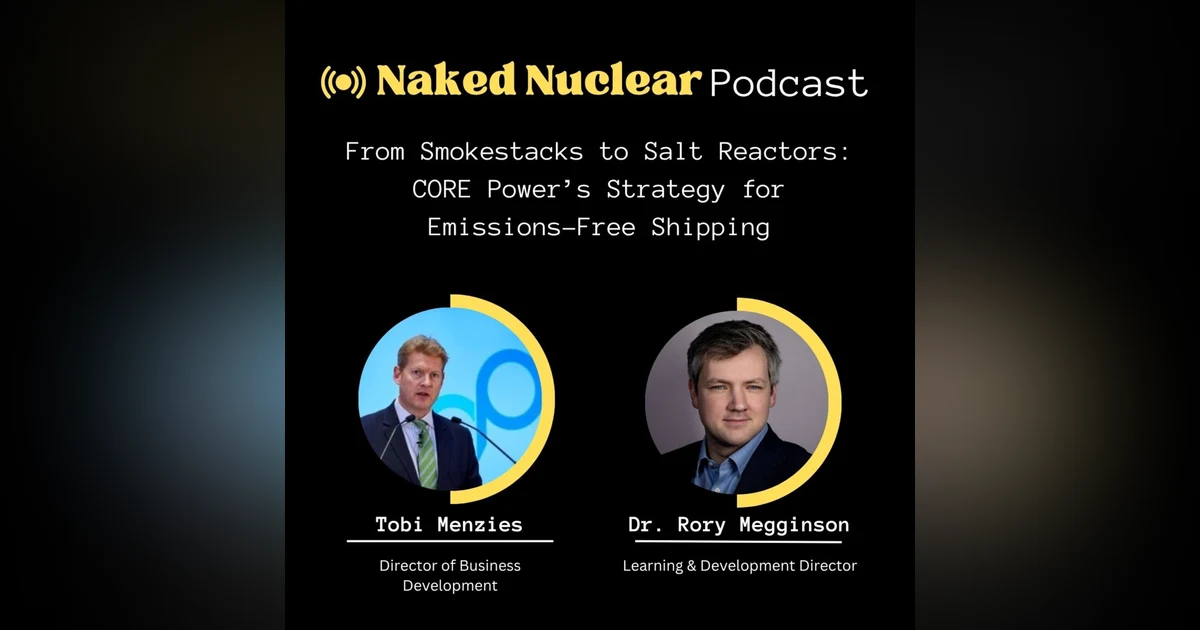
From Smokestacks to Salt Reactors: CORE Power’s Strategy for Emissions-Free Shipping


 RSS Feed
 Nuclear-powered cargo ships might sound like science fiction—but CORE Power is making them a science reality. In this episode of Naked Nuclear, Danielle sits down with Tobi Menzies and Dr. Rory Megginson from CORE Power to explore how molten chloride fast reactors (MCFRs) and floating nuclear power plants (FNPPs) could transform global shipping.
We dive into the engineering, the policy, the people—and the programs—needed to build a clean maritime future. From international emissions policy to student research programs to training industry professionals, CORE Power isn't just designing reactors. They're designing the entire ecosystem.
00:00 – Introduction: From Steam to Salt Reactors
03:10 – Why Nuclear Shipping? Global Trade and Climate Math
08:30 – What Is a Molten Chloride Fast Reactor (MCFR)?
15:00 – Floating Nuclear Power Plants (FNPPs) Explained
18:20 – Lava Lamps and Fast Neutrons: MCFR Recap
19:30 – Why Shipping Needs a Nuclear Upgrade
23:00 – The Academic Resource Program: Supporting Student Research
26:10 – Internships and Entry Paths into Nuclear Maritime Careers
28:20 – The Convoy Program: Training the Industry Itself
34:30 – From Shipowners to Port Authorities: Who Needs to Learn?
39:00 – CORE Power's Vision for 2040 and Beyond
42:00 – How to Get Involved with CORE Power
CORE Power website: https://www.corepower.energy
Academic Resource Program info: https://www.corepower.energy/academic-resources
Convoy Corporate Training Program: https://www.corepower.energy/convoy
Nuclear Shipping & FNPP Overview: https://www.corepower.energy/maritime-applications/nuclear-propulsion
📬 Sign up for CORE Power's newsletter: https://www.corepower.energy/contact
🔗 Resources & Links:
IMO 2023 Strategy on Greenhouse Gas Reductions: https://www.imo.org/en/OurWork/Environment/Pages/2023-IMO-Strategy-on-Reduction-of-GHG-Emissions-from-Ships.aspx
NEMO Website: https://www.nemo.ngo/mission
Some Light Reading on Nuclear Powered Ships: https://world-nuclear.org/information-library/non-power-nuclear-applications/transport/nuclear-powered-ships
**Naked Nuclear** strips down nuclear energy so it actually makes sense. New episodes weekly. 🎙️ [Listen on Apple Podcasts](https://podcasts.apple.com/us/podcast/id1781924674) · [Watch on YouTube](https://www.youtube.com/@TheNakedNuclearPodcast) 💡 Curious about nuclear careers? Visit [nakednuclear.com](https://www.nakednuclear.com) for episodes, resources, and guest spotlights.
Full Transcript
[00:00:00] Danielle Allen: Can you picture a train from the 1800s thundering down the tracks, blasting that signature whistle and a trailing plume of black smoke behind it. Now picture a train today. High speed aerodynamic whisper quiet, no smoke. Just clean, efficient power cutting through the landscape. We've transformed the way we move across land with electric cars, bullet trains, and low emission buses. But there's still one form of transportation stuck in the smokestack era: shipping. And that's a problem.
[00:00:35] Tobi Menzies: If shipping was actually a country, it would be an emitter about the same size as Germany. So there really is a significant pressure to cut those emissions.
[00:00:44] Danielle Allen: That's Tobi Menzies, director of Business Development at CORE Power. Today on Naked Nuclear we sat down with Tobi and Dr. Rory Megginson, Director of Learning Development about why the commercial shipping industry needs a massive climate makeover and how nuclear energy just might be the key to pulling that off. In this episode we'll break down how molten chloride fast reactors MCFRs, and floating nuclear power plants FNPPs could revolutionize ocean transport. How CORE Power's education and training programs are helping build an entirely new maritime workforce.
[00:01:21] Rory Megginson: This is a brand new industry. It needs hundreds and eventually probably thousands of young nuclear and maritime engineers to get involved and we've gotta make sure that we're doing our bit to support them coming through.
[00:01:34] Danielle Allen: And why rethinking how we power ships could reshape global emissions policy. Let's start with the basics. What is CORE Power and why nuclear powered ships anyway?
[00:01:46] Tobi Menzies: In simple terms, CORE Power is building the world's first complete maritime civil nuclear program, and it's anchored in the United States. Our vision really is to deliver nuclear power on time and within budget, directly to both industrial customers on the coast and those involved in ocean transportation. That's by combining advanced new nuclear technologies with maritime manufacturing and shipyard construction to build essentially two things. Firstly, floating nuclear power plants or FNPPs. And then later on, maritime civil nuclear propulsion, effectively nuclear propelled commercial ships. It's worth trying to dig into bits of what CORE Power's role is in advancing nuclear for maritime. I think the simplest thing to say is that we're taking a holistic approach. We're not just the reactor technology itself, but also the entire ecosystem around it that's required for successful deployment. This includes some of the design work, the financing, construction, insurance operations maintenance, and actually eventual decommissioning as well. That's so important to factor in from the start. Right? We basically don't think it would work if we just developed the tech, handed it over the fence one day and said to industry, okay, it's yours now. You figure out how you need to integrate it. You figure out how to get license to operate it, how to insure it, et cetera. I think the shipping industry is gonna need a lot of help figuring all that out. All of that is encompassed in the program. In its entirety, it's been called Liberty. It's a partial nod to the Liberty Ships actually, which was so crucial to the allied supply chain during Second World War. The Liberty Ship program was an American emergency ship building initiative during World War II. I think it produced nearly 3000 cargo ships to support Allied logistics. They were built using modular mass production techniques and they were crucial for transporting troops and supplies and equipment helping to sustain that war effort. So it's partly named after that. But I think it's partly named after liberty also symbolizing freedom from some of the constraints of the energy transition, and it's that release or unleashing of this new energy system certain advanced nuclear technology can deliver. We think it's pretty exciting. At the heart of the program is the molten chloride fast reactor. We're calling that the MCFR at the moment. It will get a catchier moniker later on. And that's an advanced reactor that's really uniquely positioned for marine use because a liquid fuel, which is actually a very hot chloride fuel salt, acts as both the fuel and the coolant. Means you can almost completely eliminate the possibility for a loss of coolant accident. It's a reactor that operates at near atmospheric pressure, which allows for a greatly reduced emergency planning zone around that reactor, but it's kind of a crucial factor really for the insurability of future nuclear ships in ports around the world. There's a couple of other features as well that make the MCFR quite unique. It's extremely thermally efficient, it's fuel agnostic. It can also be refueled while it's operating at full power, which is very useful for shipping applications. You don't have to stop the machine at regular intervals like you would a light water reactor and have it offline for some time. Because it operates in the fast spectrum, it can actually fission a lot of its own actinides therefore dramatically reduces the final waste footprint. We're envisioning really two primary applications for this. The first is these floating nuclear power plants, likely to be the first application. Then probably as a second stage we have these nuclear electric ships that are coming. The FNPPs, the nuclear power plants, are actually small modular power plants deployed in ports and terminals or near shore environments. They could go off fully offshore as well. And very good at providing sort of reliable and secure electricity directly to those consumers that need them. They can also be mass produced in shipyards, and then they can be towed or delivered by a heavy lift vessel as a project cargo to those customer locations. And it's very easy for them to be removed at the end of life for decommissioning as well. And that would happen in the same yard facility that built them. And then the second stage, as I mentioned, features nuclear electric propulsion for merchant ships, which is potentially a game changer. It will enable these very large vessels to become fully electric and to sail for years without refueling. They can do it at higher speeds and with zero greenhouse gas emissions.
[00:06:21] Danielle Allen: Every year, the Global Cargo Fleet hauls over 11 billion tons across our ocean. To put it into perspective, every year we ship cargo equivalent to the weight of 73 million blue whales. That's more than double what you'd get if you line them up nose to tail from the earth to the moon and back. And this isn't the world's first go around with nuclear shipping. So why now?
[00:06:47] Tobi Menzies: There were some experimental ships in the sixties, seventies. They didn't really catch on. I think what we'd say to that is that the maritime industry is a trillion dollar plus powerhouse. It's responsible for transporting over 80% of all goods globally. It faces quite a significant pressure to decarbonize. Now that pressure wasn't always there, but it certainly ratcheted up in the last few years 'cause the expansion of the global fleet has led to around 3% of global greenhouse gas emissions coming from shipping. That adds up to about a billion tons of CO2 annually. If shipping was actually a country, it would be an emitter about the same size as Germany. So there really is significant pressure to cut those emissions. The overall regulator for shipping, which is the International Maritime Organization, has adopted a strategy to get to net zero emissions by or around 2050. But a lot of the fuels that are being discussed currently, like ammonias and methanols, present their own challenges, mainly in terms of energy density and the ability to scale them. They require greater quantities to be carried on board compared to traditional bunker fuels that shipping currently uses. The production methods for those synthetic fuels are often not particularly low in emissions either. So for these fuels to be sustainable, they have to be green from what the industry calls well to wake, from the point of production to the point of consumption. That necessitates vast amounts of emission free electricity to make the green hydrogen which you need. And that really greatly impacts the economic viability of some of those fuels. We feel that nuclear offers a compelling solution. Really, it boasts the highest capacity factor amongst all the energy sources that we have out there. 90% of the time on average, far exceeds that of wind and solar in that respect. And of course, it has that significantly higher energy density compared to both fossil fuels and alternative fuels, right? So a ton of uranium 235 contains 4 million times more energy than ammonia and methanol. It really is that kind of definitive solution that can offer advantages compared to both traditional fuels and alternative fuels, especially in economies that are gonna be driven by carbon taxation. You have something across here in Europe called the EU Emissions Trading System, ETS, and another mechanism called Fuel EU Maritime, which are gonna be increasing the cost of pollution over the coming years, which makes zero emission nuclear ships an increasingly attractive economic alternative. Nuclear electric ships will generate no air pollution when they're on the berth in ports around the world, which kind of adds to their benefits as well. So you have those coming IMO regulations as well. They're actually under discussion right now in London as we're recording this. That's kind of the stick if you like. That's the impetus, the decarbonization impetus that's pushing from behind. You also have that carrot in front, the potential for the ships to have higher dead weight cargo carrying capacity, sail faster and do it more competitively than their peers. The fact that there's zero emission is actually just a bonus.
[00:09:56] Danielle Allen: This is an idea that echoes something we listen to in season one with our conversation with Dr. Simone Friedrich, a physicist and a philosopher looking at nuclear energy and economic systems. Having the objective to create zero emission systems or industry is all well and good, but if the economics are not there, it really can't scale. If it doesn't make the industry more competitive, better, faster, stronger, then it's most likely not going to work in the long run. Not only is there a big push for the shipping industry to decarbonize shipping, it actually makes shipping more competitive. Ships can go faster, carry more cargo, and spend less time refueling, and the zero emissions is kind of the bonus. If regulators like the IMO, the International Maritime Organization are cracking down on emissions in the upcoming decades, shipping companies are going to want zero emission solutions that make them the most competitive.
[00:10:56] Tobi Menzies: Shipping industry really is at this fork in the road if you like, or a fairly critical juncture. It's gotta meet those stringent environmental standards but it's also gotta maintain its competitive edge. And that's the hard bit. The mandate the IMO has in fact is to cut emissions by 70% by 2040, then to try and reach that net zero on or around 2050. It really presents kind of an insurmountable challenge of scale. But at the same time, you have quite a significant portion of the global fleet, and particularly the sort of 7,000 largest ships responsible for the majority of all global fuel consumption from shipping, are gonna start to need natural replacement by the mid 2030s just due to their age. So it's that kind of timeline that I think aligns quite well with CORE Power's development and deployment plans. We are really anticipating the formation of an initial order book from around 2028 onwards. The scaling up of our technology deployment is expected in the early to mid thirties. Liberty program has sort of three distinct phases. It's really the second phase, which is from 2030, which is the crucial one around building up the fit out yard capacity and starting to industrialize this activity. So it'll be early part of the next decade when we start to see some of these first assets hitting the water. The approach is to leverage modular shipyard construction, a proven method in the maritime industry to achieve that sort of low cost, high productivity, high volume, and high quality construction. Some of the world shipyards are very experienced in delivering quite large and complex vessels and offshore equipment on time and on budget. And that serial production, when you transpose it across to standardized advanced modular reactors and putting those into FNPPs, it's gonna drive down costs and deployment times.
[00:12:49] Danielle Allen: If you're thinking, wow, this all sounds incredible, but who's gonna build it? You're not alone because creating a commercial nuclear maritime sector doesn't just require reactors and shipyards. It requires people, engineers, regulators, welders, economists, naval architects, people who understand both the nuclear and maritime world, and the space in between. That's where Core Power's Academic Resource Program comes in. It's not just about the education, it's about building the brain trust for a brand new industry.
[00:13:26] Rory Megginson: So the academic resource program came to be because of the interest we were getting from students in the field of maritime nuclear. We kept getting this kind of steady drip of students in their final years or in the earlier years, wanting to do research projects related to maritime nuclear. They were interested in the technology and how it could work and what effects it would have on the shipping market, in some cases how it would work with regulations and all these sorts of questions. What we really wanted to do was make sure we had a way of supporting them because like you said, this is a brand new industry. It needs hundreds and eventually probably thousands of young nuclear and maritime engineers to get involved and to play a big part in that. And we've gotta make sure that we're doing our bit to support them coming through. So that's where the academic resource program came in. So what the academic resource program does is it supports students and academics in research. So essentially what we do is provide access to a library of our resources. We've written all sorts of stuff on nuclear liability, on ship design, on sort of the economic questions, and we make that available to these students. And then we also provide information sessions. We do two throughout the year, so at the start either term, so that students who are involved in our program can come along, they can meet some of our experts and ask questions. And then apart from that, we'll provide support on a kind of ad hoc basis. We'll fill in surveys, make sure we can provide any data to help these researchers with their work. Also one of the things that we have coming up at the end of this year, and it'll be the first time we've run it, is we're gonna run an online conference for all the members of the program. This means they can present their work to the wider nuclear maritime community, trying to get that exposure and make sure we're information sharing. One of the most important bits of the program is that we ask that everyone who signs up provide us a copy of their final research. This means that we can then have that final copy of the research on our portal with all the other resources so that there's a continuance and this research in this topic can grow and people can learn from each other. I think we're really proud of it. We've had 22 students from all across the globe sign up so far. We're hoping to grow that next year, and it provides a great pathway for them to get some experience. If any students are interested in the program, they just need to go to CORE Power's website. There's a form on there to request access to the program. If you fill that in, I will get an email and then you'll get contacted by me to have a quick chat about what your specific project is and what kind of support you need. We can get you onboarded from there.
[00:16:21] Danielle Allen: Supporting research and student interests is a critical first step, but theory only goes so far. At some point, you've gotta get your hands on real problems and work alongside the people shaping this new frontier. That's where the Core Power Internship program comes in. It's a direct bridge between students and the growing world of nuclear maritime technology.
[00:16:44] Rory Megginson: This leads into our internship program, which is another thing that CORE Power are really proud of. This will be our fourth year of our internship program, which isn't bad considering we're only just over six years old. We like to get a lot of interns in, have them work on some of the topics related to the work we're doing. It's been a great way to get new talent in, to help people develop, take that first step into a career in maritime nuclear. We've had a lot of interest initially. I know it's kind of where CORE Power came from is from the maritime side, really interested in nuclear shipping. And that's where we've seen a lot of naval architecture, marine engineers get in contact. But we also have had significant interest in the nuclear side, sort of in the last year or so where there's students who are interested not just in the idea of powering ships with nuclear reactors, which seems really cool, but also on that FNPP side that Tobi was talking about in terms of floating nuclear power plants. They look at that and think of shipyard construction provides a lot of benefits in that case in regards to repeated construction and making sure these infrastructures are affordable.
[00:17:52] Danielle Allen: So we've covered how students are going to get involved. But what about the industry itself? From port authorities and ship builders to insurers and finance teams? There are thousands of professionals who've never worked with nuclear but will soon have to. That's where Core Power's Convoy program enters the picture, a structured way to help industry leaders understand, prepare for, and navigate a nuclear future at sea.
[00:18:21] Tobi Menzies: The Convoy program is designed really to provide a platform for learning and engagement for companies, or individuals nominated by companies who are looking to lean into this concept of maritime and nuclear more and more. Whereas the academic resource program as Rory outlines is for students, this is very much for corporates. It's a program we've developed that tries to ensure that companies in the maritime sector, but not just the maritime sector, are kind of well-informed about the transition to nuclear and how to implement it, how to understand really how it can benefit their operations and to have an early think about how to navigate the nuclear regulatory environment. We're trying to empower those companies really to see the full picture. This is the only program as far as we're aware that kind of looks at the whole picture of the deployment of advanced nuclear technology in the maritime sector and including for those ports coastal industry as well as traditional shipping companies. It's there for organizations who want to advance their knowledge of nuclear energy and maritime. I think there's various organizations in there that could look to a better understanding of some of these technical and regulatory requirements involved in the design of floating nuclear plants, how you integrate nuclear technology into a maritime asset. And for them, I guess this knowledge is important for adapting the products that they're already working on and the services they're already providing, to meet that emerging demand. We're also looking at people from the ship finance community. You've got a set of professionals there that need to learn about potential business models and the financial viability of nuclear powered assets. The old balance of CapEx versus Opex on these assets will shift quite significantly. They will end up probably being cheaper overall, but there is still a balance shift to handle. And they need to be informed to help make their clients make those investment decisions and how to assess the risks and rewards so that they can advise their clients properly. There'll be an important part of how we piece together a leasing structure on some of these future assets because it doesn't feel like nuclear ships will be sold into the marketplace for someone, a conventional player, to operate. I think they'll be controlled by SPVs and operated by specialist personnel. So it'll be on a lease type model of the future. That still needs to be determined in detail, but that picture is starting to emerge. You've also got ship owners. In some ways they're kind of our baseline audience. They're a key group who wants to study the integration of nuclear propulsion by looking at both physical and operational models. They want to grapple with what the cost, operational cost savings could look like, what the environmental benefits could look like, as well as that vital human element as well. What do future crew training requirements look like? How will nuclear assets be operated in the future? Another subset is port authorities. And those types of end users, they will need to gain a better understanding around the sort of infrastructure safety protocols and regulatory frameworks required to accommodate these assets in the future. Ports, we see as an ideal location really for some of the early FNPP projects. They've got quite energy hungry equipment. It's not always easy to electrify that using solar or wind, and they've often got constraints about land availability on shore. And to be fair, they have constraints with berth availability as well. For a small to medium sized FNPP, if it can be accommodated within a port, it can be a really fantastic power source to power that port itself. It could be something that can power the trucks and the battery electric vehicles in the port. It could provide cold iron facilities for ships that call in that port. For the benefit of people not familiar with cold iron, that's where a vessel can turn off its own gen sets and utilize shore power when it's docked, reducing its own emissions in the port. I think one of these assets can also be a power source that allows the port to manufacture a certain guaranteed quantity of synthetic fuels. So that's another sort of deployment pathway. And there's a range of supporting industries that the Convoy program can help. Those who are looking to develop some specialized expertise enabling them to offer tailored services to their clients navigating this landscape. I'd put classification societies, insurance providers, possibly shipping law firms, maybe even ship builders, ship brokers or trading houses who are looking to understand how the concept works really. So potentially quite a broad church of potential members. Because in essence, it's there for any and all industry professionals looking to get a better understanding of it.
[00:22:47] Danielle Allen: So let's recap. What is the Convoy program? At its core, it's an industry first educational initiative designed to help companies and the professionals within them get up to speed on what it really takes to bring nuclear to the maritime sector. Unlike the academic resource program, which supports students and researchers, Convoy is built for corporate teams, ship owners, port authorities, marine engineers, financiers, insurance providers and regulators. Basically anyone who will play a role in designing, funding, building, ensuring, or operating nuclear powered maritime systems. For example, ship finance professionals need to understand how the economics shift with nuclear propulsion, how the CapEx versus Opex balance changes, and what kinds of leasing models might emerge. Port operators need to know how to plan for safety zones, infrastructure and regulatory compliance. And suppliers from welders and shipyards to classification societies need to adapt their products and services to this new class of assets. Whether it's powering port equipment, enabling ships to plug in for clean electricity while docked, or producing synthetic fuels on site, small floating nuclear power plants open up new possibilities. But to realize them, we need an informed and engaged maritime sector. It is not just about floating nuclear power plants or reactor specs. It's about building an ecosystem. Because for nuclear shipping to scale globally, we'll need more than a few early adopters. We'll need a robust supply chain, mariners, cooperative regulators, and a public that understands why this matters. So if you're considering joining the Convoy program, what should you expect? How long is it and what topics will be covered?
[00:24:40] Tobi Menzies: So the 2025 program begins in April 25, and it lasts for nine months, so it's gonna finish at the end of the year in December. The 2026 program will be a full calendar year, so 12 months. We'll announce details on that one later on. But for this year, we've structured it so that we've picked five core topics for 2025 because we feel they're some of the most important ones to grapple with first. Insurance is the first event. It's a key one because the lack of ability to procure commercial insurance is probably the single largest thing that's held nuclear back from the commercial space up until now. It's the insurance landscape for floating nuclear, exploring how and why it's gonna change in the coming years. That sort of includes the criteria for insurability, exploring that link between the emergency planning zone and why ultimately solving this insurance conundrum is gonna be technology led, but what needs to happen on a practical level in the meantime. We're gonna also be looking at the development of a standalone nuclear reinsurance pillar, and a liability regime that can handle some of these business models and assets in the future. This speaks to the crucial role that insurance has in the adoption of nuclear technology in maritime. After insurance, we're gonna look at business models, exploring economic frameworks that will look into ownership and operatorship structures for floating nuclear. They will challenge some of the theoretical business models. This will help our participants understand some of the economic implications of deploying this technology. We also hope to build on that event some feasibility studies and potential future business cases. A word that often comes up around this particular topic is disruption and how disruptive nuclear commercial shipping could be. But how do we handle that shift of moving nuclear from what has been up to this point a state sponsored mega project to shipyard built machines operating in the commercial sector? Looking further ahead, the third event in the program is our European Summit, which is gonna be an in-person event happening in London in July. That's a full day conference and an evening networking event as well, which all Convoy members can attend. After that summer break we'll be looking at aspects of the nuclear fuel cycle, with a focus on how that's gonna differ in the maritime space, demystifying some of the challenges around HALEU supply as well. A lot of the advanced reactors being looked at for maritime will require HALEU. We've got some guest speakers throughout the series who are gonna come and hopefully ameliorate on what CORE Power is saying. But for that event, we'll have someone from Urenco nuclear fuels supplier joining us. Towards the end of the year, we're gonna be covering containment and shielding, as well as the interface between nuclear and maritime on board the asset. Clearly that's key from a safety and regulatory perspective. The final event of the Convoy year is on workforce development. Rory's covered quite a lot of it, but preparing professionals for the future, that's gonna be a major element of the whole Liberty program. Also interesting to note that Maine Maritime Academy have their nuclear engineering minor after a gap of nearly 30 years. That program allows a select number of engineering students to graduate with specialized knowledge in nuclear engineering.
[00:27:57] Danielle Allen: The Convoy program isn't just a workshop series. It's a blueprint for building an industry. With sessions covering everything from insurability to business models, port integration to HALEU supply chains, Convoy brings together shipping professionals, financiers, regulators, and engineers to prepare for a nuclear powered maritime future. This is about building the ecosystem it takes to make nuclear work offshore. Which brings me to our next question. How does a company like CORE Power build the type of team that can not just move one technology but an entire industry?
[00:28:34] Tobi Menzies: I'll start. In terms of the team here, I'm on the business development side for CORE Power. My personal background is from maritime. Like a few of the team here I don't have an official nuclear background, but I come from the shipping and offshore energy side. I spent a long time looking at offshore oil and gas projects and saw the light for nuclear in 2021. And I've been here ever since. It's a great place to work. There's always something new happening. Whilst it feels sometimes that it is still a long time to wait before these machines come out, there is an enormous amount of work to do and we're very excited to get involved in all the different aspects of it.
[00:29:08] Rory Megginson: Yeah, so I joined CORE Power also in 2021, a few years ago now. So I'm a chemist by training. My PhD was in green catalysis, and then I joined CORE Power initially doing a lot of work on using floating nuclear power plants for hydrogen fuel based creation. Then for the last year and a bit, I've been doing more operational stuff, including setting up the academic resource program and overseeing all our interns. It's been a really exciting, almost sort of first job outside of academia to have. And working somewhere that's kind of really dynamic and actually we're getting stuff done, which is always very exciting. So in terms of people trying to get into the industry, we're obviously looking to bring on people with nuclear engineering backgrounds, chemical engineering backgrounds, as well as marine engineers and naval architects. So sort of the whole spread of technical skills to make this work. Hopefully in both London and the US as well.
[00:30:08] Tobi Menzies: Yeah, and I'd also add to that, people with a regulatory background. We've got quite a large focus on the technical development but I would say when we talk to clients and customers, their feeling is that the regulatory path is perhaps as challenging as the technical path. So we're expending a lot of efforts to remove obstacles before they become a problem. On the regulatory side, CORE Power was one of the founding members of NEMO, which is the Nuclear Energy Maritime Organization.
[00:30:35] Danielle Allen: It's the industry association for floating nuclear. That's actually taking on the regulatory work in this space as well and CORE Power is contributing to that. So yeah, we are looking for people with relevant experience or things of that nature to come and assist on the regulatory side. CORE Power is taking the time to build out an entire industry. So what's the timeline? How long will it take until we see a floating nuclear power plant or nuclear electric ships in the water? 2050, 2060?
[00:31:03] Tobi Menzies: Well, I don't think we'll have to wait that long to see some of the early assets. As I said, I think it'll be sort of the early years of next decade when we start to see some prototypes out there. I think one comment we'd make is that there is a view perhaps that some people think that this is gonna happen everywhere, all at once, and there will suddenly be a lot of nuclear vessels flying flags of convenience tramping around the world from any port to any port. And I don't see that as being a viable pathway. I think this will start relatively small. I think we'll see specific trade routes being developed between OECD countries that are really at the forefront of this technology. I think the US is guaranteed to be one of the anchors for one of those trade routes. I could envisage something transatlantic across to the UK or certain EU states and then possibly something transpacific across to Japan. I think it will be a small number of these experimental nuclear corridors, if you like, with some of the first ships that operate. It will then be proven on those routes for propulsion cases and then hopefully grow from there. It's a lot of that's tied into how the licensing will work and the spine that runs through the flag state of the ship and the state that's licensing the reactor. Those two have a strong unbreakable link. So an NRC licensed reactor will need to go on a US flagship. And it will need to trade between two ports, probably to start with on a purely bilateral agreement between two countries that want to experiment with this novel method. It won't be a ballooning concept of nuclear ships trading everywhere on a completely random basis. It will start small and grow. But I would like to think that by the time we get to 2040, where we have that 70% target from the IMO, that there are a meaningful number of large nuclear powered ships out there that are actually taking a chunk out of that emissions quota.
[00:32:55] Danielle Allen: And if you're looking to get involved in CORE Power, where should you look first?
[00:33:00] Rory Megginson: If there's students, I would just go to our website. You'll be able to find all the information about the academic resource program as well as any open internships or graduate level jobs. And do feel free if you are interested in the future at CORE Power to just drop us an email with your CV and we'll always get back to people.
[00:33:18] Tobi Menzies: Yeah, and I think the same goes for anyone who's potentially interested in the Convoy program. The website is kind of the first portal call if you like. And there's forms on there to fill in. My details are on there. You can reach out to me directly and we'll get back to you quickly with a membership pack and the next steps. We're also quite active on LinkedIn. That's a good place to follow us. You can also sign up for our newsletter on our website. And we produce a weekly newsletter that has a growing readership. Basically, website and LinkedIn are two good starting points.
[00:33:45] Danielle Allen: Nuclear shipping may sound like science fiction, but it's quickly becoming science reality. And if we wanna meet our climate goals without sacrificing global trade, it's an idea whose time has come. From floating nuclear power plants to molten chloride fast reactors, from student researchers to industry veterans. What CORE Power is doing isn't just about building ships. It's about building an industry from scratch and inviting the world to help shape it. If you're curious to learn more, check out Core Power's academic research program and Convoy initiative. Whether you're a student engineer, welder, policy expert, or a port operator, there's a role for you in the nuclear maritime future. Thanks again to Tobi Menzies and Dr. Rory Megginson, as well as all the CORE Power staff like Rosie Instrall who made this episode possible. Thank you again for listening to this episode of Naked Nuclear. If you enjoyed it, leave a review, share it with your crew, and subscribe for more conversations at the edge of energy, science and technology. Until next time, stay curious.