From Candlelight to Clean Energy: Finding Your Role in the Nuclear Future with Dr. Fiona Rayment, OBE


 RSS Feed
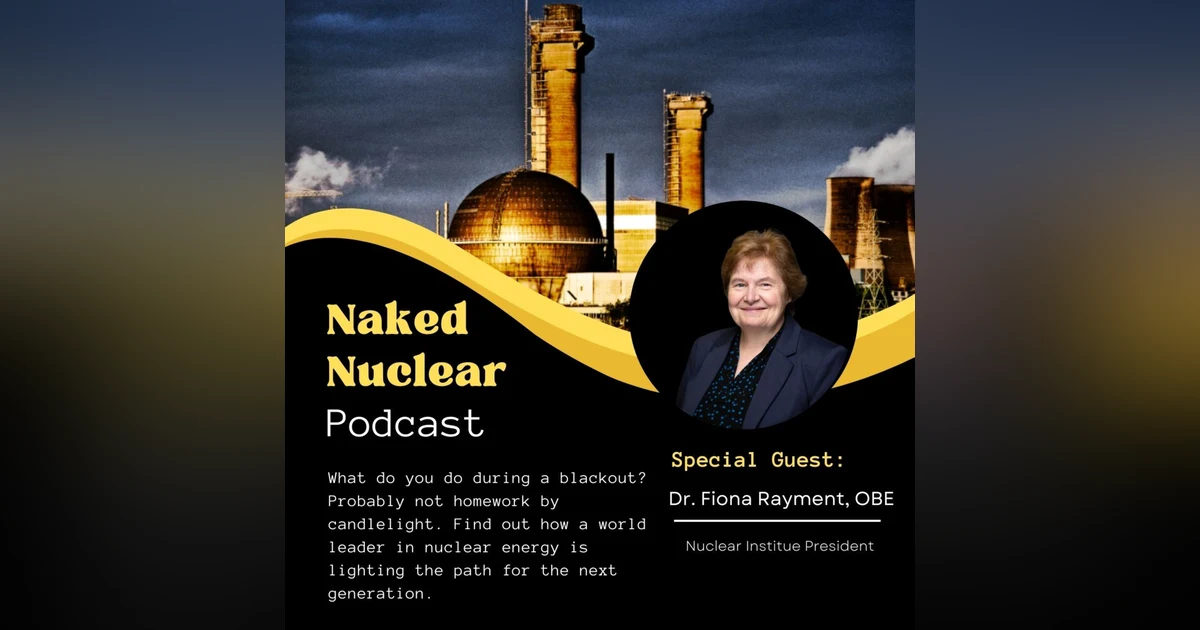
 What do candlelit homework, career pivots, and global nuclear leadership have in common? Dr. Fiona Rayment.
In this episode, Danielle speaks with internationally respected nuclear chemist and engineer Dr. Fiona Rayment about her early experiences with energy insecurity, her path through a diverse and powerful career, and the future of workforce development in the nuclear industry.
Together they explore:
– Why your first role doesn't have to be your forever one
– How to tell when you've lost your spark (and how to get it back)
– The surprising variety of roles across the nuclear sector
– What "Destination Nuclear" is doing to bust old stereotypes
– Why gender diversity isn't just a nice-to-have — it's critical
– Regulatory innovation and how to accelerate new technologies responsibly
This episode is packed with real-world insights for anyone navigating their own career journey, mentoring others, or building tomorrow's energy workforce.
Resources & Links:
🔗 Destination Nuclear → https://www.destinationnuclear.com
🔗 Nuclear Skills Delivery Group (NSDG) → https://nuclearskillsdeliverygroup.com
🔗 Learn more about Dr. Fiona Rayment → https://nuclearinst.com/dr-fiona-rayment-obe
Wanna learn more about historical women in science?
https://obamawhitehouse.archives.gov/women-in-stem
**Naked Nuclear** strips down nuclear energy so it actually makes sense. New episodes weekly. 🎙️ [Listen on Apple Podcasts](https://podcasts.apple.com/us/podcast/id1781924674) · [Watch on YouTube](https://www.youtube.com/@TheNakedNuclearPodcast) 💡 Curious about nuclear careers? Visit [nakednuclear.com](https://www.nakednuclear.com) for episodes, resources, and guest spotlights.
Full Transcript
[00:00:00] Danielle Allen: What would you do if you had to do your homework by candlelight? Not because it was charming or romantic, but because you didn't have electricity. Today's guest grew up during energy shortages that literally sent her home from school and inspired a career that's shaping the future of nuclear energy.
[00:00:21] Fiona Rayment: We used to have what we would've called church candles that we used to keep underneath the staircase, I would be at home with my workbook actually writing my homework in candlelight.
[00:00:31] Danielle Allen: Meet Dr. Fiona Rayment, a globally recognized leader in nuclear energy with over 30 years of experience. She's a chartered chemist, a chartered engineer, a fellow of the Royal Academy of Engineering, the Royal Society of Chemistry, the president of the Nuclear Institute, and a member of the American Nuclear Society. Today on Naked Nuclear, we're diving into Dr. Rayment's remarkable journey, how energy shortages shaped her purpose, her leadership in creating a more diverse nuclear workforce, and what the future holds for innovation, education, and opportunities in nuclear.
[00:01:08] Fiona Rayment: One of the things that I've had a passion about, all of my life is around just enabling a skilled workforce, you know, best athletes. Usually that is a team of people who all bring different things to the table, not just in terms of what they know, but how they actually do things.
[00:01:22] Danielle Allen: So I asked Fiona, how did a simple question based on her experience in grade school shaped the trajectory of her career?
[00:01:30] Fiona Rayment: Yeah, I mean, when I was at school, I guess it would've been secondary school. So I'd probably be around the age of about 14 at that time. And there was a lot of challenges that we had in the UK then in relation to energy. We had previously a series of miner strikes. We had a number of issues with gas shortages and oil shortages. And as a result I found myself being sent home from school on a regular basis. So at secondary school I was in my second year, 14 years old. Basically the people who were in the higher years they had priority because they had exams to sit. Part of the school was actually heated via coal. And part of the school was heated via oil. It was two separate buildings. And so everybody who actually had to sit exams got the priority. So I actually ended up being sent home from school for around a period of four months. I was sent home roughly about two or three days a week. So I ended up having to do some of my schooling at home, which was kind of interesting for me. At that time I kinda like thought to myself, why is this even happening? You know, that I'm being sent home from school when this is actually a developed country. At primary school when I was even younger, we had the minor strikes and we basically had power cuts. We had a lot of coal fire that were actually creating electricity at the time. We had planned outages, planned power cuts that people would know about. So we would actually have power cuts. And so at a time when I was in primary school, around eight years old, I was actually doing my homework in candlelight. These days people wouldn't even know what that is, I don't think anymore. But we used to have what we would've called church candles, long, kinda cream colored candles that we used to keep underneath the staircase, just in case this particular issue cropped up. And so, yeah, I would be at home with my workbook writing my homework in candlelight. That got me really interested in why this was actually happening, you know, in this day and age. I mean, it wasn't that long ago. This got me interested in all of the forms of energy and where you get it from. At that time I started looking at nuclear because in the UK we actually had nuclear power. We were actually powering around one in five homes with nuclear energy. That was my starting point in terms of actually just starting to really get an interest at that point about the role that nuclear could play.
[00:04:01] Danielle Allen: If you told me that I had to study by candlelight, I would probably fail, and I certainly wouldn't go on to get a PhD in chemistry and become a world leading expert in nuclear energy. But this is something we need to talk about in education. Season two is all about nuclear education, and I think there's an important takeaway from Fiona's story surrounding her environment. She was able to ask questions about where she lived. If we are a developed country, why am I studying by candlelight? Why can't I sit through school? And I think many students who went through Covid may have similar questions. If we are the best nation in the world, why was my school year cut short? Why was I learning on Zoom? How does public health affect public education? So I think as scientists, educators, and communicators, it's important to check in with our students. What global problems are students experiencing as an issue in their lives that might not apply to ours, and how do they want to solve it? Right now, when I talk to students, climate change is an important issue that comes up frequently for them. It's currently shaping the way they view the world. But as adults, we might not have the same impact with experience as our students. For example, nowadays it's pretty common to see women who are professors holding tenure at universities teaching very difficult courses. But that didn't always used to be the case, so Fiona shared with me some of the challenges about being the only in the room, what that means to never have any teachers like you growing up.
[00:05:39] Fiona Rayment: So, I mean, all of my life, because I've been working on science subjects and engineering subjects, I've found that in many cases I've been one of a few females in the room who actually have that science background. So at school, when I was in the chemistry and physics classes, I think there was about four of us in a class of 30. Got to university and there was more of us, but in a large class. So probably the similar percentages, maybe slightly bigger. And so it was always a case that we were the minority. I lived throughout my whole educational life being the minority. And then I went on to my working life and went initially got involved in nuclear. My first real job was in nuclear. And basically again, I found myself in various meetings where I was like one of the few women in the room and in many cases, the other women in the room weren't people who had a science or engineering background. There were maybe people who are finance people or HR people. That was fine. But it's kind of interesting because you start to think about this maybe in later life that what would it been like if you didn't keep seeing yourself as the odd one out? I'm trying to kinda like replay that just because I managed to get by and basically muddle through, doesn't mean that everybody else has to do it that way. And so what I'm doing now in terms of a lot of the work that I do in gender balance across the nuclear sector around just trying to get more females into STEM, enabling that going forward. And just kinda like having a bit of a mindset shift. I mean, it's not just about how I feel, it is actually around the role that having a broader male and female combination within STEM can actually help drive different decisions and a broader understanding of the subject. So in terms of studies and when I was a student, all of my teachers were male, at school and at university. All of my professors were male, so I had no female teacher or professor when I was there. And that was just the norm, which these days feels weird. I've worked in industry, in the nuclear sector. I've worked in national lab and now I'm working in academia. Very different now. There are still more male than female people in the academic sector. I find that there's more females now. Especially, it's more difficult when you talk about the hard engineering subjects, electrical, mechanical engineering and the like. It's still kinda difficult to find women in that field. And also in physics. But in some aspects of chemical engineering and chemistry, I think that's become a bit better over the years. But there's still a way to go.
[00:08:25] Danielle Allen: In an article called The Gender Gap in STEM, Still Gapping in 2023, MIT reports that only 28% of the STEM workforce is female. And they give some factors contributing to that gap, including stereotypes, lack of role models, conscious bias and work life balance imbalance. However, about four years ago, I started learning more about women in science. Mainly because I hadn't been taught much about them in school. So I started learning about their research, their goals, their career ambitions. But I found something a little troubling. It wasn't just the passive systems. Oh, women aren't interested in those topics. They'd rather be sewing. Or, oh, there's not any women in engineering. They'd rather be nursing. But there were hostile systems. A large number of the women I read about experienced sexism in the workplace. Not only that, they had their work stolen, repurposed, or taken advantage of, even to the extent of professors and colleagues being awarded with Nobel Prizes while they sat in the background. Mostly forgotten. So when we are considering how do we get more women in STEM, we have to remember where we started from. We started from a place of aggression. We started from a place that said women weren't good at math or science, which is not true, especially when I learned more about Fiona's background in her PhD about boron neutron capture therapy.
[00:09:59] Fiona Rayment: I did a PhD in BNCT, boron neutron capture therapy, for the treatment of cancerous tumors. I did that as my PhD. When I decided to do chemistry, it was quite simple for me. At school I just seemed to be really gifted at science and maths. I didn't have to do as much to pass exams. I really had to really study hard for English, for literature, for languages. Kind of found that really challenging. But chemistry, physics, maths, geography, things like that. Oh, absolutely loved. Seemed to do it well. And so that was when it started. In terms of why chemistry as opposed to physics, like my chemistry teacher, Mr. McCray. I remember him to this day. Can't remember my physics teacher. But anyway, I remember my chemistry teacher, he was brilliant. I had quite a few years studying with that chemistry teacher at secondary school. And therefore I made the decision, I was doing chemistry at university. I think that everybody remembers a good teacher. For me that was it. I liked my chemistry teacher. So I was doing my PhD in something called Boron Neutron Capture Therapy. I was applying chemistry and a bit of engineering to manufacture these boron cage clusters that enabled antibodies to be attached to them, which could then be injected into the patient. And then under kind of epithermal neutron therapy, you could kill malignant tumors, and that was the research. The issue was that getting access to these epithermal neutrons was not easy back then. Because you need a nuclear reactor for that. The number of patients that could go through that treatment were not as high as they could be. There's a bigger discussion about BNCT again in terms of whether that could come back because there's more of an opportunity to access different technology now for that. But that was where I started off in the medical side of things. As I said, I was interested in nuclear energy, so I applied for a number of jobs as I was finishing my PhD. I had a number of interviews, and one of them was with a company at the time called British Nuclear Fuels, BNFL. And BNFL was the fuel manufacturer, the spent fuel treatment and also all of the waste management and decommissioning associated with nuclear reactors both in the UK and internationally. It also had a significant research and development arm as well. And it was based at Sellafield, and Sellafield in Cumbria is roughly a two hour drive from Glasgow, where I was living at the time in Scotland. And so, had an interview. Didn't know whether I'd done very well or not. Had another interview with other chemical organizations and I got a few job offers. One of the job offers was with BNFL. To be quite frank, I looked at the graduate program, and the sort of training I would get, and it looked really good. I also looked at where I would be based and given the fact that I was gonna be moving away from home. And the thing is, in America, you all just move everywhere, right? In the UK we kinda like want to do it a small bit at a time in terms of where we move. So I didn't wanna move too far. I still wanted to maybe have the opportunity to go back home at weekends if that was an option. This opportunity allowed me to go back home at weekends if I wanted to. And I also had access to an excellent three year training program that was all about management training, how to do research in the nuclear sector, how to be a leader, impact skills, negotiation skills, a whole variety of stuff that I just got access to. So I thought, right, I'm gonna do this for two or three years. I'll probably move on elsewhere at that point.
[00:13:33] Danielle Allen: The rest is history. She didn't leave. She stayed with the sector because every single job that she got was better than the last. She just loved what she did. But choosing that first job wasn't just about it being an exciting technology to engage in. It was about the location and the access to the excellent training that she was gonna get in terms of enhancing her education going forward. So let's recap. After finishing her PhD, Fiona joins British Nuclear Fuels BNFL, drawn by a combination of serious training opportunities and a location close to home. What she thought would be a few years commitment turned into a decades long career. It seems like many of our guests have found their home within the nuclear industry. It is not uncommon for a one year internship to turn into a lifetime of leadership. I wanted to understand Fiona's perspective of how she determined where she belonged in the nuclear industry.
[00:14:31] Fiona Rayment: I'm three years in and basically I'm now looking at what am I doing next? It was kind of quite interesting. The only thing I ever knew that I wanted to be was a scientist and an engineer. I've always known that, ever since I was young. I used to play with chemistry sets and I used to look at how oil barges lay in the North Sea. So I've always been interested in that. So I always knew I wanted to be a scientist or engineer. The thing that was challenging was that I didn't know what role I wanted to do. My first role was as a research associate within BNFL. I was leading on various research programs for the company. I just didn't know what I wanted to do next. And so the way that I did it was to test out things. Opportunities would come up and I would go, well, I'm gonna have to take it to see if I like it. An opportunity came up to work in the US in Washington State, at the Hanford site. I took on that opportunity. That was back in the early nineties. It was really good fun, really enjoyed it. And I used my experience in terms of a researcher at that time to underpin various flow sheets for the Hanford site in treating the Hanford tanks. Then moved on to different roles. And so without taking an hour to tell you the whole story, my journey went from being a researcher on one site at Sellafield to another site at Hanford, to then coming back to the UK, getting involved in product development for the company. I then moved into commercial and got involved in procurement. I then got involved in strategic business planning. So I was a business planning manager for BNFL. I then moved from strategic business planning back into R&D and actually being a team manager, a team leader, driving new products and services, leading on fuel services for the company from an R&D perspective. And then kinda like eventually being the chief scientist at the National Nuclear Laboratory, which is now UK National Nuclear Laboratory. And then at one point actually being a strategic advisor to at the time it was her Majesty's government, but now his Majesty's government, on nuclear. And I did that for a few years, to now just having a portfolio of roles where I spend half of my time working and half of my time having fun. So that's kinda like it. But what's really interesting was the bit from being a strategic planning manager actually moving back into R&D. If I just can take a couple of minutes to tell that story. I was in the first Starbucks in the UK, which was in Manchester, quite a few years ago. And a friend said to me, I think you've lost your spark. And I said, what do you mean I've lost my spark? Usually people know me, I'm quite passionate about what I talk about and there's usually a lot of energy coming through. But I was just not like that at all. He explained that to me. I was now in a role, strategic business planning, which I seemed to be doing well. But it didn't actually have anything in it that was getting me out of bed in the morning. It was all about numbers. There was no technology anymore. There was no engineering, there was no science. I was having to report things to the board and manage things through the various executive committees and you couldn't please everybody all at once anyway. It was one of these roles. I take my hat off to people who can do it. But it wasn't for me. And I realized that what was for me was a role that included technology, had to include science, it had to involve people. And that's where I then realized my forte is in science and engineering leadership. That's where I should focus my time and effort. So I started to create my CV looking at what you need in a CV to be a science and engineering leader. Where are the gaps? And let's find opportunities to fill these gaps. That's how I ended up being the chief scientist at the National Nuclear Laboratory.
[00:18:31] Danielle Allen: This career path was anything but linear. Fiona moved across multiple roles and research operations, commercial management, strategy, and leadership, and maybe thought she even lost her spark. That realization pushed her towards roles where science, technology and people intersected, ultimately shaping her into the leader she is today. And this is the philosophy she champions for others too. There's no one correct way into nuclear energy.
[00:18:58] Fiona Rayment: If everybody's all looking for that one right answer that once they've made their decision, that's it for the rest of their life, it doesn't work like that. If you feel as if you'd like to go, give it a go, give it a go. In nuclear there are so many different roles. So you might come in, if you do have a STEM background like me, you might start off as a researcher. But you might end up moving into project management or you might end up moving into business. All of these things actually require people who've got that STEM background. There's a whole variety of roles out there. As a matter of fact, when you actually look at the nuclear sector and you start to think about all the jobs that are available in the economy, I would say that at least 80% of them you'll find in the nuclear sector. It's that broad. So you should think about that because even if you're talking about large infrastructure projects, we do that in nuclear. You wanna be involved in waste management? Yeah, we do that in nuclear. You wanna actually have the ability to basically finance, involved in the financing of projects. That's obviously something we do in nuclear. We need to have really good people who get really good accountancy skills. Then you go on people who've done a geography background who are actually absolutely fantastic now at stakeholder engagement, or are also doing stuff on environmental aspects of nuclear. So honestly, you just keep going on, you just cut across it and there are so many roles out there. So don't think it's just people who do science and engineering who do nuclear. It's far from that. The thing I would say is a single track career might be okay for some people. So if that is what you do and that's what you decide to do, that's fine. For me, it didn't work because I didn't know what I wanted to do until I knew what I didn't want to do. And so I tried other things and even although I could do these other things, they just didn't do it for me. There is something about working that through. The other thing I would say is that actually being able to work in research, operations, commercial and other roles enabled me to think about and see things from other people's point of view. And that's actually really good because all the stuff we do in nuclear requires stakeholder engagement. So actually to actually have that broad aspect of roles that you've actually been involved in is actually helpful from that point of view because you get to see things from a different viewpoint. So the advice is there's no one answer. Single track career is okay. Not knowing what you want to do is okay. The only thing I would say is don't just sit and hope that you'll get to the role if you don't know what you want. Test things out and work out what you don't want. 'cause most people either know what they want or what they don't want, and you just take it from there.
[00:21:42] Danielle Allen: As someone who's worked in various sectors across various industries, I can concur. It is amazing to be able to connect the dots to problems in ways that other people may not be able to. And I think this speaks to the diversity required through nuclear, not just diversity of backgrounds, but diversity of thought. The way in which people see and interact with a problem creates more solutions. So I wanted to learn about the different initiatives and programs that Fiona has been building through the Nuclear Energy Agency and the UK's destination nuclear campaign. What does it mean to be diverse in this workspace, how do we recruit the best talent from a variety of backgrounds?
[00:22:27] Fiona Rayment: So one of the things I've had a passion about all of my life is enabling a skilled workforce. You know, best athletes. To get the job done. A good way of doing that in a team is actually having people together who have the right chemistry to actually drive things forward. Usually that isn't a team of similar people. Usually that is a team of people who all bring different things to the table, not just in terms of what they know, but how they do things. Both types, the what and the how, the behaviors in terms of how things are done. Some people are very direct and drive things through. Other people are much more on the broader and influence side. And so they will bring people along in the journey and it's really important to have that level of impact as well as actually having that level of influence. So the first thing was in the UK I created a group called the Nuclear Skills Strategy Group. And I did that with a number of colleagues. And what we did was we brought together senior leaders from industry, from academia, and from government to actually start to look at what is the workforce strategy that's required for UK nuclear. So we did that. As part of that, we recognized the fact that we needed to sort out gender balance in nuclear, because it wasn't enabling us to get that best athlete because we weren't attracting enough ladies into the sector. And so as part of that, we actually created a roadmap to gender balance in nuclear, in partnership with Women in Nuclear UK. Today and for the last just over three years, I am patron of Women in Nuclear UK. As part of that, I started to have international dialogue in this space. One of my roles is with OECD, Nuclear Energy Agency. I'm one of the vice chairs of the steering committee. I had discussions with the steering committee about enabling gender balance across nuclear nations. We worked on the creation of a policy instrument that was endorsed last year by the OECD on enabling gender balance across nuclear nations. It's a framework that talks about how you attract, how you retain, and how you advance ladies in the nuclear sector. And to do that, how it's all underpinned by data. We also launched the first report that was ever written, which was published last year where different countries were at in terms of gender balance at a variety of organizational levels. And what was clear was that we have an issue in terms of gender balance. It's worse in STEM. It's worse in leadership across various countries. And so we've started to now drive this framework going forward to get us to a situation where we get better gender balance in the future. So we have these platforms: attract, retain, advance. Attract is about how we get more women into the sector. Some of that is about the visibility of the sector, the appeal of the sector, being clear that it's broader than just STEM. Some of it is about role models. If you can't see it, then you can't be it. Right? On retain, a lot of it is about inclusiveness. Understanding where people are coming from and being respectful of others, and actually having an environment that actually takes different people's backgrounds, environments, beliefs and everything into account so that people feel more included as opposed to feeling the odd one out. And in advance, a lot of that links into mentoring. And basically, when I was going through my career, I didn't have an official mentor. But I had a whole variety of different people that I used to have cups of coffee with and ask them advice on things, whether it was on communication skills, on being more confident, on why things are done in a particular way within a nuclear power plant. And it was like a variety of different people. It wasn't just one. So I think that when I look back, I had a number of mentors, and if they were to think about it now, they'd probably agree with me, but we just didn't call it that at the time. So part of that advance is about having people that actually can help you sow the seeds of your journey for you, but actually be a sounding board to actually help you with that journey where you're trying to work out what your next steps are and how you actually plan for that. We're doing that through the auspices of the Nuclear Energy Agency. And that gives us a platform in terms of trying to kind of drive this whole area forward, which I think is really exciting.
[00:27:01] Danielle Allen: So we're tackling gender balance and equality as well as looking at how we attract and retain. But how do we get the message out? How do we reach people in all walks of life? Well, the UK has already started working on that.
[00:27:16] Fiona Rayment: This was really interesting. Google Destination Nuclear, you'll find the webpage. Basically what it's all about is producing a portal for the general public to come in and actually look at what roles are available to you if you were actually to come and work in the nuclear sector. The whole point of it was to mythbust the fact that we only employ scientists and engineers. Now don't get me wrong, we absolutely need scientists and engineers. However, we also need people from a whole variety of other backgrounds. So the whole point of Destination Nuclear was to start to give these opportunities out there. We have a portal, it's a jobs portal, insights in terms of role models and the sorts of people that you might see working in that sector. So this is not me, but this is other colleagues who drove this forward, who are absolutely amazing. So they started actually then looking at where are we gonna promote this? In train stations on freeways, notice boards, and in various places throughout towns and cities, there would be adverts and messages for Destination Nuclear. And it would say things like "the future is in your power." We started in the London tube, so people were going through tube stations and you'd see the soundbite there and go and have a look at that. Then it went on to more social media. We've actually tried it on gaming platforms. I have absolutely no idea about gaming platforms. And so this is why you need a diverse workforce. But anyway, so they were telling me, we need to go and access gaming platforms because you get messages on gaming platforms that people will click on and then they will go and look at that. My goodness, we put Destination Nuclear onto gaming platforms and people are clicking it and looking at it. The number of hits we've had is just unbelievable. It's gone from single thousands to tens of thousands to hundreds of thousands. Now the level of interest just continues to grow. The challenge now is to convert these levels of interest into jobs. But this is great because actually we're out there now and we're actually just letting the general public see that there's actually lots of roles here for nuclear. I think a side thing from this is to help people engage in the discussion on nuclear and how it actually is clean energy and how it will actually enable energy security. I think that's a byproduct of this too, because actually it's engaging with a larger number of stakeholders in comparison to what we ever did before.
[00:29:41] Danielle Allen: Nowadays with the Internet, there are so many different channels and opportunities to reach out to people. One of those methods is the gaming community. Now, I'm not a gamer, but I grew up with lots of gamers, and the gaming community is massive. Recently I came across a video of a man who is building a public library within Minecraft. It was mind blowing. That got me thinking, how do we reach more people in more ways, especially in the K through 12 range? How do we reach kids in grade school?
[00:30:13] Fiona Rayment: I think that's a really good question. In the past, in the UK, we did have energy systems as part of the training pack and that went really well. We used to talk about that quite a lot, but it's not there anymore. So a lot of the discussions that we are having with teachers at the moment is that they would actually really welcome information packs in terms of what role nuclear plays, the energy mix and how that's taken on board. They would welcome more visits from experts from the nuclear sector who can come in and help with that. And I think that's all good. And I think that there's a number of organizations nationally and internationally that are actually looking at how we do that. The key thing is to think about how do we get access to a broader group of people. And I think that comes back to what can we do online? Maybe we have to be doing some more vlogs and the like. These days people take in things in two minute sound bites. It's gotta be short and sweet. A lot of what teachers are saying is that they would really welcome the teach teachers having packs in place that enable that. And I know that the American Nuclear Society, for example, is very heavily involved in this and is doing some fantastic work just in terms of getting out to schools and talking to them about it. I don't know what the answer is there yet, but I'm sure there's a number of younger people there who've got loads of ideas in terms of how we do that. In the past we used to have things like energy cards. I remember at the University of Manchester, maybe about 15 years ago, there was a pack of cards that was actually created that were like top trumps. I don't know if you remember Top Trumps, but you would have a set of cards and you would compare, like Formula One racing cards. So we actually had the Top Trumps that compare different types of energy generation, the energy cards, and nuclear was part of that. And it included renewables, coal, gas and other things. That was kind of quite an interesting game and that's now been put online more as an app now. And I think that sort of thing, the fun aspect of it and getting people to come in and play on it is the sort of thing that grabs people's attention. We probably need to do more of that too.
[00:32:16] Danielle Allen: It sounds like the field is wide open for ideas in how do we recruit and attract new people into the nuclear workforce. But now it's time to learn a little bit more about Dr. Rayment with our rapid fire questions. So the first question, pretty easy one. Do you have any hobbies?
[00:32:35] Fiona Rayment: Oh my goodness. Other than nuclear, I mean, honestly, I just love the fact that I get paid for doing things that I love to do. Other than nuclear, I love swimming. That's my thing. That's something I love to do. Because I'm a chemist I love cooking because I don't actually get to go into the lab anymore, so I like to be able to throw things together and see how they turn out. And I love travel. I've had the opportunity to do that with work and also in terms of vacation time as well. So, I guess that's it.
[00:33:03] Danielle Allen: Do you have a favorite type of food that you like to cook or is it just all experimentation?
[00:33:08] Fiona Rayment: It's all experimentation. I like just mixing things together and seeing how they turn out. I'll even take a recipe and change it because I like the ability to experiment.
[00:33:16] Danielle Allen: If you had a TED Talk and you had to give it in a completely different field of study, what do you think it would be about? Non-nuclear related.
[00:33:25] Fiona Rayment: Oh my goodness. I think I would have to do getting girls into STEM.
[00:33:28] Danielle Allen: If you had to design the city of the future, what features would you wanna put in it? What would it look like?
[00:33:35] Fiona Rayment: Obviously it would have a lot of nuclear, 'cause that city of the future is gonna have a lot of consumption of energy. And so you're gonna have some small reactors. You'd probably have some advanced reactors producing hydrogen and the like, in terms of actually driving that forward. So you'd definitely see that. I think you would basically have all the things that you would expect in a city. You would have green space, the ability to see rivers, crops that are grown locally. I would like to see that. So I would like to see the benefit of local produce. Obviously, it would need to have some industry there because I'd want to make sure that actually it's a great area for development of economic value and high level skills.
[00:34:13] Danielle Allen: What's been a unique place that you have been to or traveled to because of nuclear?
[00:34:19] Fiona Rayment: Oh my goodness, I've got so many, and unique in different regards. I need to just say a few maybe. Through nuclear I got to visit Ghana and dance with the Ghanaian president. I got to see the Sydney Harbor Bridge. I got to visit at least half of the states of the USA. I got to see lots of Europe. I mean, it just goes on and on. My second conference, I was asked if I'd minded going to Disneyland. I mean, what's not to like about being in nuclear? I've been very blessed. I've been to so many places in the world through the work that I've done in nuclear, I don't think I could choose one place.
[00:35:02] Danielle Allen: Any final advice for people who are looking to get into the industry, or specifically women and girls who are interested in STEM?
[00:35:09] Fiona Rayment: If you're interested in getting into the industry, and you know somebody who works there, talk to them about it. If not, there's more information out there than maybe what you would've thought of in the past. So just start to research into it and look at what's actually available out there. Speak to the various institutes. If you're in the US speak to the American Nuclear Society. If you're in the UK, speak to the Nuclear Institute. We'll tell you all about it. In terms of girls wanting to get into the industry, whether you're STEM or whether you're non STEM, honestly, there's roles there for everybody. What I would say is that we are keen to recruit both boys and girls into the sector. So whether you decide to stay for just a couple of years and move on, or whether you actually stay for life, it doesn't really matter. You'll be able to create a great CV. So just try it. I would say in terms of anybody who's actually already in the sector and you need a bit of help, find a few mentors. I mean, I still mentor today. I mentor a lot of people too. Reverse mentoring is fantastic. The things I have learned during mentoring is just amazing. So anybody who is mentoring, remember, reverse mentoring is good too. Nuclear is a highly regulated sector and if you can do something well and efficiently in a highly regulated sector, you can do it anywhere. If you have a CV that you have actually worked in that highly regulated sector, it's sellable. Whether you're talking about science and engineering, project management, finance, legal. I mean, if you've managed to create legal frameworks in terms of how you will do things on a nuclear license site, right? You can probably create legal frameworks anywhere. So there is something about recognizing the fact that nuclear is that accelerator because actually it'll just transform your career. It'll also give you opportunities to work with a large variety of different people. Nuclear is global. The variety of roles that you get to do in nuclear, combined with the fact that you're working in a highly regulated sector means that your CV and your resume is just created for whatever you want to do next.
[00:37:22] Danielle Allen: I am so incredibly grateful for having Dr. Fiona Rayment on this episode of Naked Nuclear, joining us to talk about her experience and how she's building out the next generation of the nuclear workforce. If you enjoy today's conversation, please let us know in the comments or share it with a friend. All this season we're really going to be focusing on nuclear workforce and education. You can find all of the links to the resources Dr. Rayment mentioned in our show notes from the Nuclear Skills Delivery Group to Destination Nuclear. Until next time, stay curious.