Dyscalculia to Calculus: How Veronica Annala is Rebranding Nuclear Advocacy


 RSS Feed
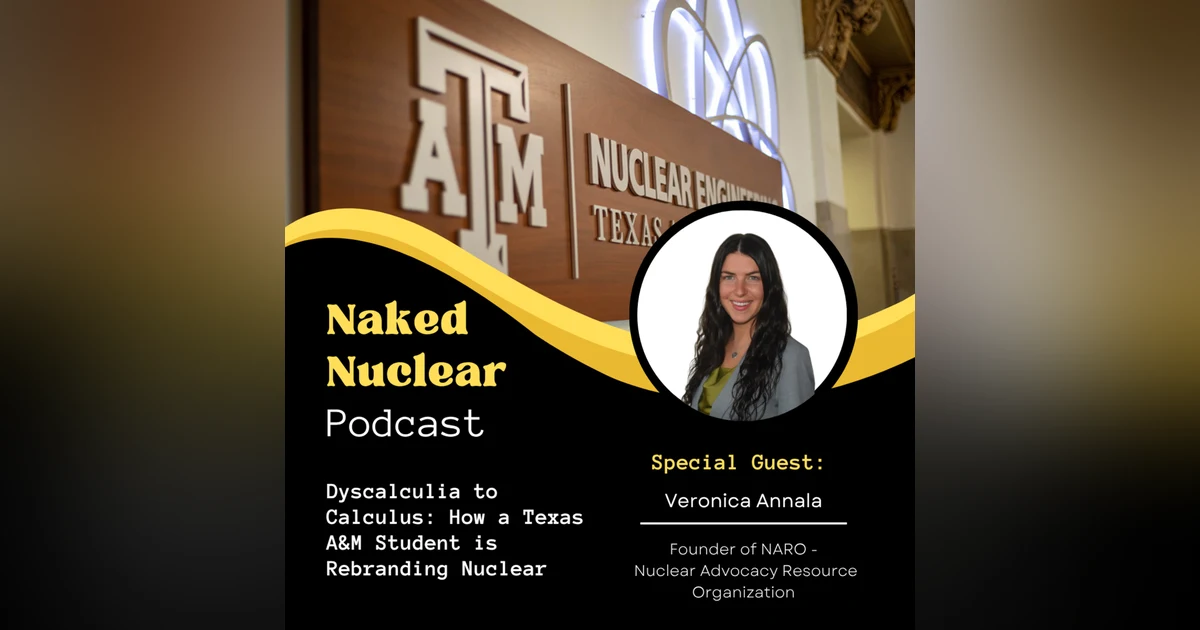
 You don't have to be a math genius to change the world — just ask Veronica Annala. In this inspiring Student Spotlight, Danielle sits down with Veronica, a recent Texas A&M nuclear engineering graduate and founder of the Nuclear Advocacy Resource Organization (NARO).
Diagnosed with dyslexia and dyscalculia, Veronica shares how she built her own study systems, cried through calculus — and still emerged as a leader in the next generation of clean energy advocacy.
They unpack the birth of NARO, how a trip to Antarctica sparked her nuclear "a-ha" moment, and why Veronica is now pursuing an MBA to scale the movement even further. From grassroots posters to national policy, this conversation is about curiosity, audacity, and rewriting the narrative around who belongs in STEM.
-
Overcoming dyslexia and dyscalculia in engineering
-
The impact of great teachers and inclusive classrooms
-
Founding NARO and building student-led nuclear movements
-
Veronica's decision to pursue an MBA for nonprofit leadership
-
Advice for students who feel like they don't "fit the mold"
More Resources:
Website: nuclearadvocacy.org
Instagram: @nuclearadvocacy
LinkedIn: NARO on LinkedIn
**Naked Nuclear** strips down nuclear energy so it actually makes sense. New episodes weekly. 🎙️ [Listen on Apple Podcasts](https://podcasts.apple.com/us/podcast/id1781924674) · [Watch on YouTube](https://www.youtube.com/@TheNakedNuclearPodcast) 💡 Curious about nuclear careers? Visit [nakednuclear.com](https://www.nakednuclear.com) for episodes, resources, and guest spotlights.
Full Transcript
[00:00:00] Danielle Allen: You have to be good at math to be an engineer, you have to be great with numbers. You have to, okay, that's what we've been told. But what if we flip that idea on its head? What if you were bad at math?
[00:00:15] Veronica Annala: I really never thought that I was good at math or science. And definitely did not think I was good enough for STEM.
[00:00:24] Danielle Allen: Like diagnosed with dyscalculia bad? What if you were also dyslexic and the numbers move, the equations tangled, and you cried your way through calculus. Would you still be allowed in the room? Could you still be an engineer? Veronica Annala says yes. In fact, she dared to say yes again and again. A recent graduate of Texas A&M with a BS in nuclear engineering and is the founder of NARO the Nuclear Advocacy Resource Organization, a national nonprofit that started as a student group and is now a movement for rebranding nuclear energy.
[00:01:02] Veronica Annala: It started out as a student group at Texas A&M. I founded it, but really that feels even like kind of weird to say because I got so much support from my peers and my professors. We had about a hundred members, like right off the bat, which is crazy.
[00:01:18] Danielle Allen: In today's student spotlight, we unpack how Veronica built a system to thrive in engineering. How a trip to Antarctica led to a nuclear awakening and how her team pulled off one of the most viral moments in nuclear advocacy with nothing but Sharpies and poster board. From studying hacks and student organizing to rethinking who belongs in STEM. This episode is about what happens when you stop waiting to be perfect and start showing up with audacity.
[00:01:46] Veronica Annala: Hi. I am Veronica. I just graduated from the Department of Nuclear Engineering at Texas A&M University. Whoop. And I'm also the founder and CEO of NARO the Nuclear Advocacy Resource Organization, which is a national nonprofit. So engineering in general, it's funny because I think a lot of people who go into engineering are like, oh, I was a coding prodigy by like two years old. Or like, I've always been just so talented or gifted with math and science, whatever that means. And for me, it definitely was not the case. I really never thought that I was good at math or science. And definitely did not think I was good enough for STEM. It was my sophomore year of high school actually. I had a teacher, the chemistry teacher, he called all of his students chemists. Like, so even if you were good at chemistry, bad at chemistry, he called you a chemist. Like regardless. If you were going in for a homework question, you weren't a student who needed help, you were a chemist. And I think for some reason it's such a small, inconsequential thing, but it switched something in my mind and I started thinking of myself as a scientist, like, maybe I could. No one has ever told me I'm good at science, but maybe I could be. I started doing really well in chemistry and that teacher actually invited me to do student research on solar cells. So I started getting into energy, learning more about energy and was always very interested in the environment and the climate crisis, and started viewing it from more of a scientific view of the fact that we need more energy, not less energy, but it needs to be clean energy. How could we possibly do this? And so just kind of started being a lot more interested in chemistry. That teacher encouraged me to take AP courses, so I took all AP throughout the rest of high school and applied for engineering, which was like very crazy for me. And A&M's kind of different, so we have ETAM which is like entry to major. So your freshman year you don't declare a major. You just are in engineering. And you can take kind of whatever courses you want to like kind of figure out what you wanna do. I thought I would do chemical engineering, so I took a lot of chemistry courses. And the professor was talking about nuclear chemistry, one of the later courses. Like I had taken a lot of chemistry to get to that point. And I was like, wait, what? Like, I've been like searching for this solution. There just already is one. I was amazed by how much energy reactors produce and they do it clean, safe, and reliably. It was kind of like a wow moment for me and then ETAM'd into nuclear and got in first choice. And I think it really just takes one person to have you think of yourself, not as you are, but as you could be. And I think teachers are really heroes in that respect.
[00:04:59] Danielle Allen: Veronica didn't grow up thinking she was destined for STEM. In fact, she grew up believing she wasn't good at math or science at all. But that changed thanks to a chemistry teacher, one who saw everybody as capable. Planting the seeds that she could be a scientist. Fast forward to today. She's a nuclear engineering graduate who tackled AP Science, survived Calc one through DiffEQ and built a student system tailored to her own dyslexia and dyscalculia. So how does someone who once cried through math homework end up starting a nationwide nonprofit in nuclear advocacy?
[00:05:37] Veronica Annala: So yeah, I am profoundly dyslexic. In pretty much every single way you could be dyslexic, I'm extremely dyslexic. And I got the two for one specialist, buy one, get one free. So I also have dyscalculia, which is like the math version of dyslexia. And like I said, never thought I was good at math or science. And really it was dyscalculia was very much hindering me. And it's so funny, I don't know what made me think that I could. My parents at like any family gathering, they love to tell this story about me in like seventh or eighth grade lying on the kitchen floor, doing my math homework and sobbing. You know, numbers moving around, things just not really clicking like they would with all the other kids. And I used to hate that story so much, but now I honestly smile whenever they tell it because I was crying on the kitchen floor, but I was doing my math homework. That's the big part. I was still doing it. I was doing it through tears, but I was still doing it. And I think just, I kept doing it. I never stopped. And sure there have been times in undergrad where I was crying, doing my math homework. Even if you have to cry through Cal one, Cal two, Cal three, DiffEQ, linear algebra, all the way through. Okay, so be it. Just get it done. You can do it. I think that's the mentality that I started building. Like it's hard but do it anyway. I just accepted that my brain is not like the other students and that's okay. And if you're like that too, it's okay. I would have to work twice as hard, four times as long to get half as far, and that's okay. So some things that I figured out was like rewriting every single notes that my profs would give us, like slide decks or whatever, in my own words, and in my own thought process, especially for nuclear, because nuclear is so, like, you can't ever see an atom, right? You have to figure out what that is for you. Lots of colors, lots of highlighters, making your notes really your own. And then again, this sounds so tedious, but doing it not till you get it right, but until you can't get it wrong. In nuclear, that's really important because it's a harsh subject matter, but really just making my notes my own.
[00:08:16] Danielle Allen: The idea for NARO, Veronica's nonprofit, was sparked far from the lecture halls of Texas A&M. While studying abroad, a casual conversation revealed just how misunderstood nuclear energy still is, and that moment lit a fire in Veronica. If one conversation could change someone's mind, what could hundreds do?
[00:08:37] Veronica Annala: I went on a study abroad to Antarctica actually. It was one of the only times in my undergrad that I wasn't around engineers, so it was with a bunch of different people from different disciplines. I was talking to a girl on the trip as we were crossing the Drake passage or whatever, and I was telling her, oh, I'm studying nuclear engineering, and she was like, "Oh, what? You're so nice, like why do you wanna kill people?" And I was just like, that is not what I do. We ended up having like a really long conversation about nuclear energy and just like what I actually do and my actual goals with this degree and why I believe in it so much. By the end she was full on pro-nuclear. So that made me realize it really just takes a conversation. It takes learning what you don't know. A lot of people get their main information about nuclear from the Simpsons or the Chernobyl docuseries or whatever kind of like scary larger than life drama surrounds the idea of nuclear versus the reality, which is that it is safe, clean, and reliable. Texas A&M and I think just college in general is such a good time to just say yes to everything. It was actually with the oceanography department. It was a FIDO NASA project, so we were collecting data for NASA and doing student research, which was super cool. Such a cool opportunity. Doing a lot of oceanography science that I would've never done otherwise. And so I got back from that trip and pretty much immediately started working on NARO or what would be NARO.
[00:10:27] Danielle Allen: So when she got back to campus, what did launching a grassroots student movement actually look like?
[00:10:34] Veronica Annala: It started out as a student group at Texas A&M and I founded it, but really that feels even like kind of weird to say now because I got so much support from my peers and professors. It was such a team effort. So much support initially, and that's kind of really what made me realize that this could be a national nonprofit. So in January we ended up transitioning to a 501c4 nonprofit. And now we have people from all over the country from all different backgrounds involved in NARO. We have five different committees. We have social media, merch, NARO papers, which is bringing like really technical, hard to understand topics and putting them in one pagers that are super easy to understand. And we use those for all different kinds of things. So like making graphics, small videos, whatever. Then we have our general campaigns committee, which is kind of everything else. A lot of listeners have probably seen or heard of the iHeart Nuclear Game Day shenanigans. So that was part of the general campaigns. And then, oh, policy committee. Which is nuclear policy and it's students getting really active in government and talking with lawmakers and advocating for nuclear on the political side of things. Initially we had about a hundred members right off the bat, which is crazy. We're the largest nuclear department, but we're still super small. Everyone kind of hopped on and was super supportive. Gabriel Ivory is the VP of NARO. He's the I ❤️ nuclear guy. So he's incredible. He's super helpful. And just tons of students pretty much dedicating their full day. So initially it was like a few students getting out there, handing out candy on campus with facts about nuclear, and just like really grassroots at A&M. Then professors were incredible. They emailed us every opportunity. They emailed out opportunities, talked about us in really positive ways. So they were incredible. And then we just started continually growing and transitioned to the nonprofit.
[00:12:52] Danielle Allen: NARO began as a student group at Texas A&M, one of the largest nuclear engineering departments in the country, and quickly grew, gathering over a hundred members and expanding to a national nonprofit with five active committees. From meme worthy merchandise to hard hitting policy briefings, Veronica and her team are redefining how young people advocate for clean energy. Even professors and seasoned professionals took notice. But while the movement gained momentum, Veronica was still deep in nuclear coursework. So what kept her going academically and what parts of nuclear engineering captured her imagination most?
[00:13:34] Veronica Annala: You can literally do anything. It's like a choose your own adventure kind of thing. You take your initial courses, like materials. Every math under the sun. I think we do take the most math out of any engineering major. Just a lot of math. Be ready for that if you're looking to join. Then you take your nuclear physics courses, like neutron transport, a lot of coding courses and it's very, like I said, choose your own adventure. So if you're more interested in that side of things, you can go there. If you're more interested in the health physics side of things, there's labs that you can take. There's reactor labs, so you actually get to work in the reactor as an undergrad. You can choose to do that as a job. A lot of students did that as their job on top of undergrad. You can go the reactor route, the health physics route, the nonproliferation side of things, policy advocacy. There is no limit to what you can do with this degree. Our senior design project is a two semester project. My team did hydrogen production, so an SMR producing hydrogen for aviation. And that was really interesting getting to kind of see the full scope of a nuclear project in an academic sense, but just kind of getting to see all the regulations that go into it, the finance side, which I thought was super interesting.
[00:14:58] Danielle Allen: From reactor physics to health physics, neutron transport to capstone projects on hydrogen and SMRs, Veronica explored the wide world of nuclear engineering and loved every part of it. But she also saw a gap. While students were learning the tech, few understood the financial, regulatory, or business sides of nuclear development. That realization pushed her towards her next bold move: an MBA. So how does a future focus nuclear engineer approach business school, and what does she hope to learn that she can implement in NARO and the broader nuclear movement?
[00:15:37] Veronica Annala: I absolutely loved every, like, this is such a cop out answer, but I really did love every single class that I took in undergrad and I love the technical side of things. Now that I have this technical side of things, I'm looking to get better at the business side of things, the more marketing side of things, the finance side of things, not only for NARO but for me and for my future and for whatever else I wanna work on. I think that sometimes we think engineering and business are two separate things, but in the real world, it's necessary to have both. Like financial viability, making these paper projects actually happen in real life, how that can work, and how we can really get reactors built and not just talk about it. I work with a team that understands that I'm really just doing my best. And I get a lot of feedback from them, and that's super important to me. But actually taking a class on it, I think is a completely different thing. So definitely the management leadership side of things. And then the finance side of things that I talked about. In engineering, we don't focus on that. We take one engineering finance course, and I'm super interested in the whole thing to just know what I don't know yet, you know? Everyone has something to bring to the table. Like everyone that you ever meet knows something that you don't. And so I think as a leader, you have to keep that in mind. Especially in nuclear, we can sometimes put such an emphasis on technical experience. We have an English major as one of the leaders of a committee and she's a rock star. She leads the NARO papers committee. Anyone considering joining or getting involved in nuclear in any aspect and you're like, oh, math and science isn't my thing. For sure. You can totally join and have any kind of background. Nuclear needs more than just engineers. That's something that I've learned. We need way more than just engineers here.
[00:17:40] Danielle Allen: Veronica's next chapters include learning about leadership, management and business finance to scale NARO into a marketing engine for nuclear's next generation. But she's also quick to note, not everyone in nuclear needs to be an engineer. From English majors to welders, the industry needs all kinds of people, and NARO is creating the space for them. So how does she connect with non-technical audiences? And what does effective nuclear advocacy actually sound like in real conversation?
[00:18:12] Veronica Annala: I think a lot of people come into these kinds of conversations with the idea that when they hear nuclear, they think of weapons. So first and foremost, just separating those two, you don't even have to get into enrichment or anything like that. You can keep it super, super simple. Let them talk first. What have you seen or heard about nuclear? Get to know them and their side of things a little bit more. If you're talking to a farmer, maybe land is something that's super important to them, and you can talk about how compact nuclear is compared to other clean energy sources. With nuclear, we really understand that land is valuable. And there'd be more land for farming. So getting to know them, letting them do a lot of the talking instead of just giving them a straight up lecture right away.
[00:19:03] Danielle Allen: And now it's time for our rapid fire questions. And the first one is, how would you describe nuclear energy to a third grader?
[00:19:12] Veronica Annala: Okay, so for my third grade birthday, I had a piñata. I imagine if you hit your birthday piñata and it split and released a ton of energy. Also what's inside of a piñata? Candy, right? So what if one of these pieces of candy was going so fast and had so much energy that it hit another piñata, and that one split? There's more candy and it's a chain reaction. More piñatas, more candy. And then we use that to heat up water somehow 'cause piñatas can do that. And then that's nuclear energy. So that's how I would explain fission to a third grader.
[00:20:00] Danielle Allen: Next question is what hobbies do you have?
[00:20:02] Veronica Annala: Hobbies. I love cooking. I like hiking and camping. I'm from Northern Minnesota, so less so in the Texas heat, but grew up doing a lot of hiking and camping. I like reading. I actually like studying, believe it or not. I think eventually you just start to like it. And of course I love advocating for nuclear energy.
[00:20:25] Danielle Allen: What's your favorite dish to cook?
[00:20:27] Veronica Annala: Honestly, this is the college student in me. I like taking whatever I can find in my fridge and pantry and making something completely new. So never using a recipe. Just as it will.
[00:20:39] Danielle Allen: Like the college version of Chopped. If you had to build a futuristic city, what would be in it and how would you design it?
[00:20:46] Veronica Annala: Okay, well obviously it'd be powered by nuclear. We could use desalination. I mean, yeah, that's like, what else do you need besides decay heat to heat buildings? Everything. Nuclear. You need fertilizer. Nuclear. You need this. Nuclear. You need pretty much any answer? Nuclear.
[00:21:06] Danielle Allen: What has been one place that you've traveled for NARO that you have really enjoyed?
[00:21:10] Veronica Annala: NARO as a whole has gotten to travel to New York, DC and Austin. I have to say Austin would be my favorite just because the excitement in Austin for nuclear is unmatched. Right now in Texas, there is so much excitement about the nuclear renaissance. They all have this can-do attitude that makes it really fun.
[00:21:34] Danielle Allen: Amazing. What did you wanna be when you were like five?
[00:21:37] Veronica Annala: I was five, probably like a princess or something. Definitely not a nuclear engineer. I think 5-year-old me would be really impressed with where I'm at. I don't think she would understand much about what I do.
[00:21:50] Danielle Allen: Amazing. So for you and for NARO what is your big vision, like 10 years, 20 years down the line? What do you want for yourself, but also for the organization and then also for nuclear?
[00:22:02] Veronica Annala: Yeah, so NARO first and foremost is a marketing company. It's a rebranding company, and it's a movement. 10 years in the future I would love for NARO to be larger than life and really remarketing nuclear as clean, safe, and reliable. And I say that over and over again because that's really what marketing is. It's like changing this picture that people have in their minds of what nuclear is into something different, in this case, more accurate. And so I think we would just keep growing not only in members, but in this idea, this movement. And for nuclear, I would like us to actually be building. Like, let's get building, let's get actually utilizing this amazing solution that we have. It really is just the solution. And we're severely underutilizing it right now.
[00:23:05] Danielle Allen: From piñatas as reactors to cooking with leftovers, Veronica shares how creativity and curiosity show up in all areas of her life. Whether it's turning a third grader into a fission expert or navigating Antarctica. She says the key is simple. Say yes to things even if you don't feel ready. So what's next for Veronica and what's her advice to students wondering if there's a place for them in the world of nuclear?
[00:23:32] Veronica Annala: You don't have to be a nuclear engineer for you to be involved in nuclear, so go find what you are interested in, whether you like working with your hands and you wanna do welding. Cool. We need welders. Whether you like writing, cool. We need writers. Pretty much anything that you wanna do is something that we can use in nuclear, and it's an incredible industry. It's really taking off again, for like the second time. People are calling this the second renaissance. And I would say learn more, get involved. It doesn't need to be NARO. It probably should be, I mean, pretty cool. But whatever nuclear advocacy organization that catches your eye or in your area, just get learning, get talking about it, and use your skills in this industry.
[00:24:28] Danielle Allen: And where can you get connected with NARO?
[00:24:31] Veronica Annala: All you have to do is look up nuclearadvocacy.org. That's us. You can find us on LinkedIn. You can find us on Instagram, you can reach out to me whenever.
[00:24:41] Danielle Allen: Thank you to Veronica Annala for coming onto the show and sharing a bit about her world and how she created NARO. It is beyond impressive. She's the first person I've met with the same numbers diagnosis as myself. And nonetheless inspiring. If there's one takeaway from today's episode, it's this: have audacity. Veronica didn't wait to be good at math before declaring her major. She didn't wait for someone to invite her to advocate for nuclear. She built the platform herself through learning disabilities and late nights studying MATLAB. She stayed curious and stayed committed. If you're listening and wondering whether nuclear is a space where you can belong, the answer is yes. And if you're wondering where to start, Veronica's already built the bridge. You can learn more at NARO and get involved by visiting nuclearadvocacy.org or follow them on LinkedIn and Instagram. Thank you to the teachers cultivating confidence in students. I hope you get the rest you need to stay golden. Thank you for listening to this episode of Naked Nuclear. Until next time, stay curious.