Connect the Dots: Industry to Advocacy


 RSS Feed
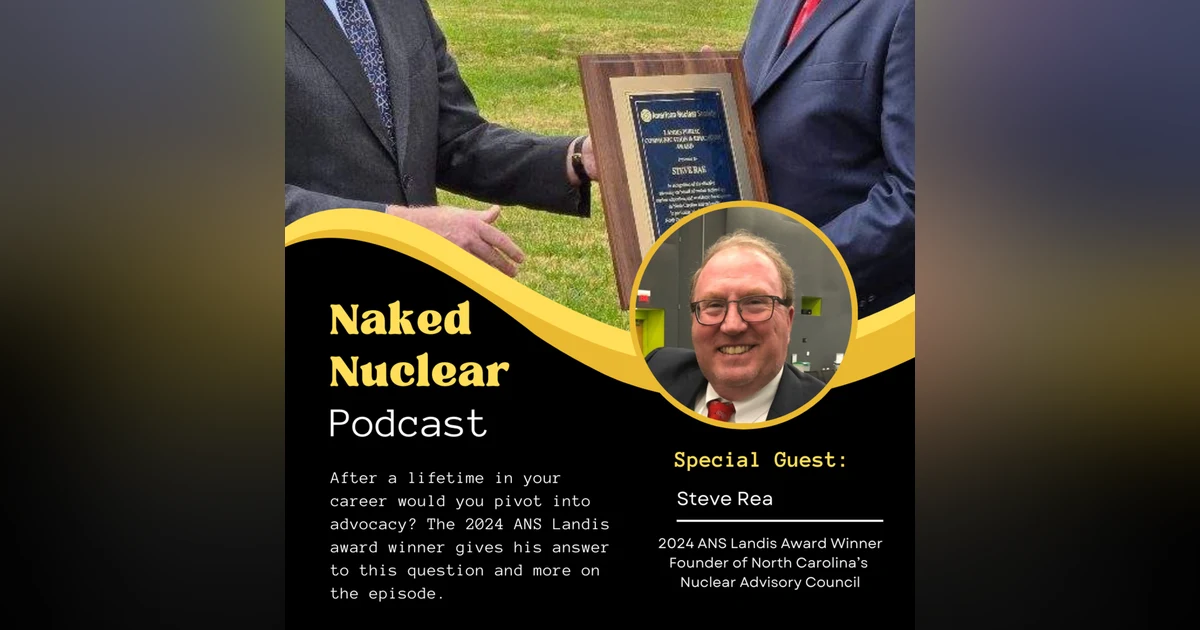
 In this episode of Naked Nuclear, Danielle sits down with Steve Rea, the 2024 recipient of the American Nuclear Society Landis Public Communication and Education Award .
Steve, a 30-year nuclear industry veteran, discusses his transition to public education and nuclear advocacy in North Carolina. From his beginnings in nuclear chemistry in high school to forming the Nuclear Advisory Council, Steve shares insights on the role of diverse energy sources and the importance of communicating nuclear technology's safety and benefits to various stakeholders.
Tune in to learn how Steve connects industry knowledge with public education to shape the future of nuclear energy.
00:00 Connecting the Dots: Introduction to Steve Rea
00:35 Steve Rea's Journey in the Nuclear Industry
01:24 Nuclear Advocacy and Public Education
02:01 Steve's Early Interest in Nuclear Energy
04:59 The Formation of the Nuclear Advisory Council
10:02 Public Perception and Nuclear Technology
14:47 Diverse Energy Sources and Nuclear's Role
18:15 Legislation and Policy in Nuclear Energy
21:08 Workforce Development in Nuclear Energy
26:17 Rapid-Fire Questions with Steve Rea
29:06 Conclusion and Future Episodes
Some of the companies listed in this episode:
NC State Nuclear Engineering Program
Full Transcript
[00:00:00] Danielle Allen: When you were seven years old did you ever finish one of those connect, the dot drawings? Sometimes the dots were close together. So you could easily guess what the picture was. Other times the dots only made sense after the final line was connected. Either way. Seemingly unrelated points came together to form a coherent picture. This is where Steve Rea thrives.
[00:00:25] Steve Rea: I like connecting dots You see the dots out there. We were missing that voice to the public of the whole industry
[00:00:35] Danielle Allen: Steve Rea is the recipient of the 2024 American Nuclear Society Landis Public Communication and Education award. This award recognizes an individual for outstanding efforts dedication and accomplishments in furthering public education and understanding of the peaceful applications of nuclear technology.
He has worked in the nuclear space for well over 30 years. And is now connecting the dots between industry knowledge and nuclear advocacy.
In 2021, Steve became the co-chair of the nuclear advisory council for North Carolina. They're tasked with educating the public about matters of nuclear, energy and technology within the state.
[00:01:15] Steve Rea: We've got to be willing to talk to the people. And so, that was one reason we formed the Nuclear Advisory Council.
[00:01:24] Danielle Allen: On today's episode of naked nuclear, we're going to be diving further into how a veteran of the industry is now pivoting into, public education. within the state of North Carolina. And what that means for private citizens, commercial industries, and even some state legislators.
I sat down with Steve to learn a little bit more about what it means to retire from the nuclear industry. And what happens after that?
[00:01:48] Steve Rea: I want to tell you how much, , I respect what you are, doing with this podcast. I like your idea of trying to make nuclear energy more accessible to the public. We want that as an industry and we especially need it in the phase of nuclear energy's growth right now,
[00:02:09] Danielle Allen: As a 30 year veteran of the industry, I asked Steve, how did he get into nuclear?
[00:02:14] Steve Rea: I Got involved with the nuclear industry when I was 17 years old. My chemistry teacher at Goldsboro High in advanced chemistry introduced us to nuclear energy. This was really in the forefront because Dr. Joseph Michener, this was back in 19 73 okay, I go back a little ways, and he talked to us about nuclear energy, how chemistry interacts with the, , process of, making energy in the reactor.
And I got excited about that because the technology was so neat I ended up making, at least one, presentation to the public in Goldsboro, about, nuclear reactors back at that time I told them about, boiling water reactors, BWRs, pressurized water reactors, PWRs, and the one that really excited me was breeders.
Then was the NC State, segment where I learned more about nuclear. I had a mentor who was really helpful to me.
He said, Steve, if you're going to be in this industry, you need to spend some time working at the plants. So I got the opportunity, at Brunswick, for several years. Then, the company transferred me up to Harris during their last stages of construction and startup about a year away from, full operations.
When I was there, I sort of have this knack for organizing. Okay. Like connecting dots. They gave me the opportunity to put together One of the first cloud based, configuration control programs in the, nuclear industry at that time for managing how maintenance people, engineers, construction folks interacted with the equipment on site.
And that's real important in our industry, because once the NRC says, we approve your design, they don't expect you to mess with it. Because they've approved it, And there's a process which the NRC has given approval to, from a quality standpoint. I got the opportunity to put that together site wide. After that, I went to work for a company called Heyward Incorporated. They are a small company, been around since 1908. They specialize in water, wastewater, and power production, and they were early adopters of nuclear energy.
In, the Carolinas, and I worked there until I retired back in, 2021, and I got the opportunity to advocate for nuclear energy as a result of my relationship with NC State University. They saw what was coming with new nuclear, and they wanted to, encourage, me to pursue that, as a, volunteer, and so that's what I've done.
[00:05:07] Danielle Allen: Let's go back a little. Steve said his interest peaked around 1973. The average age of a nuclear reactor is 42 years old. That goes back to 1983. So. when we're trying to convince people that nuclear energy? is safe, and has been for literal decades, working quietly in the background with little disruption, to our energy supply. And it's one of the safest energies in the world. Why does it need an advocate and what are they supposed to say?
[00:05:37] Steve Rea: Well, it's about people. We've got to be willing to talk to people. That was one reason we formed the Nuclear Advisory Council. We'd like to put folks that have the time to talk to the public who have had experience in nuclear because it is a unique industry it's highly regulated. Like pharmaceutical, and airlines. And so I felt like it was important for us to put, other spokespersons who understood nuclear but could speak to the public in a way that, interests them.
We wanted folks to know that, the nuclear industry in North Carolina, it's not just the utility company, the industry, there's a supply chain associated with that, that builds up around, the utility who operates nuclear plants we wanted to, be able to have diverse resources to address opportunities to talk to the public.
For example , we've had, volunteers from our council speak to the League of Women Voters, to other organizations around the state We've had, volunteers who give presentations to students like at NC State's nuclear engineering department.
We, write articles, we put the articles out, for public consumption. We now have a newsletter that goes to, folks from all different walks of life. We communicate with different government organizations through conversations, through providing information to them. We work with public officials for example, to review legislation. And, Give, input from, different folks around the industry that are on our council.
Whether they're in the industry or they're outside the industry. We want to be able to communicate with them what's going on in the North Carolina nuclear industry.
And again, on our council, everyone is a volunteer. And, we're all focused on advancing, the information base available to the public
[00:07:40] Danielle Allen: To me, the nuclear advisory council sounds like an assembled team of
Marvel Avengers, superheroes of the nuclear industry who have the time to teach people from politicians to kindergartners about nuclear energy. But where did he get the idea to start an advisory council?
[00:08:00] Steve Rea: Where that came from was my experience with Heyward Incorporated over, 33 years. I chaired, the Siemens Water Technology, Council for 10 years, and I saw how that was organized, with Heyward, I worked in the nuclear space Every day, 24 hours a day, if you will,
and I got to know a lot of the companies and people in the, industry. And when I retired, I saw there was this, this gap between the perception that, North Carolinians had of the nuclear industry most of us, including myself for a long time in my early career, perceived Duke Energy.
a fine operator of nuclear plants they have a tremendous safety record as well as a capacity record. What that means is that those reactors are available for power use consistently and reliably. But I realized from my work with Heyward, there's a lot of other companies out there supporting the nuclear, operation.
They needed to give their voice, to the public. And so it's like connecting the dots. You see the dots out there. We were missing that voice to the public of the whole industry. And that's what we wanted to accomplish. I knew these organizations, I was blessed to know people in these organizations.
I worked with Dr. Kostin and Ivanoff at, NC state university closely. He was a co founder of this council. And, we teamed up put the founders together. And then once other organizations heard about this, they want to be part of the council.
[00:09:44] Danielle Allen: 33 years in the business. Steve has many dots, many connections and a wide network of individuals that were able to. make up the nuclear, advisory council. But somewhere in this interconnected web, Steve. was missing something critical. The public. And so I asked him what was the public reaction to bringing nuclear into these conversations to people who might not know much about it?
[00:10:10] Steve Rea: Well, I'll be honest with you. I was pleasantly surprised by the level of curiosity and enthusiasm for nuclear energy being part of North Carolina's all of the above energy strategy, and we support that too. There's a place for each energy technology. Nuclear strength is a small footprint, So when you mix that in with renewables, you've got a complete solution to the energy problem. People wanted to hear more about nuclear and the fact now that we have what we call, small modular reactors.
We have micro reactors, we have advanced reactors, obviously the public's curious, what are all these different technologies and what do they mean to me and my energy needs for the future? So, I found whether they're public officials, people that are just like me, getting through their life, they were curious about nuclear.
So we've received a positive, reception.
[00:11:15] Danielle Allen: Let's say you're relatively new to understanding energy systems. You might know, a little bit about wind.
Wind turns wheel wheel makes electricity.
Solar. Sun hits panel panel makes electricity.
And then there's nuclear. Nuclear has spicy rock. Spicy rock makes hot water. Hot water turns wheel. Wheel make electricity.
But if that's the case, why is there micro reactor, small modular reactor, advanced reactor, boiling water reactor. Pressurized water reactor. It seems a bit much. And within this community, I was wondering, what does the nuclear advisory council advise on all these specific technologies?
[00:12:02] Steve Rea: We are agnostic about the reactor technologies. In North Carolina, we've got a number of, fine companies that, are offering their nuclear reactor technologies, to the public. You've got GE, Hitachi, in Wilmington, part of the old BWR, culture, and they've got a new, reactor.
You've got, Kairos Power. Who has a regulatory and quality, control office in Charlotte. They do an advanced reactor. Advanced reactors use molten salts or high temperature gas instead of water to cool and transfer heat from the reactor. Kairos, they're interested in the advanced, AI, industry.
And then we have, Terrestrial Energy, whose headquarters is here in Charlotte. And they also, offer an advanced reactor, that, Is, available for all different services. They're not just concentrating on the utilities. They are interested in industrial applications. They look at chemical plants that need a lot of electricity and steam. Their reactors can generate both.
So all three of these suppliers are highly thought of, around the country. They, focused on different aspects of the energy need landscape
I also want to mention BWXT. They're corporate offices here in North Carolina. They do microreactors. They are also very supportive of NC State, Nuclear Engineering Department.
Their manufacturing is not here in North Carolina. It's just across the border from us in Lynchburg, Virginia. But we consider them part of our, council because they're here , in Charlotte, North Carolina at their headquarters. They pay taxes. They employ people. All of those things are important to the state of North Carolina.
The other thing that you've alluded to that I want to highlight, why do we have all of these different technologies? Why has the industry gone down the road now of exploring advanced reactors, small modular reactors, micro reactors? The key is, all of these designs advance the safety aspects of nuclear reactors.
They go beyond the safety, designs of, PWRs and BWRs, which have been very safe, here in North Carolina, and they add additional safety features to their designs, which is something that, is in the best interest of the public and the people that operate them.
There's a organization, of Carolina Utilities, and they're consisting of different industries and businesses, and they're very curious they wanted to understand how that worked. Our council, the way we approach things, we contacted somebody at NC State's Nuclear Engineering Department. They volunteered. And went over there to present, and so, we've started reaching out, to, industry, in North Carolina to help them understand the different technologies out there.
[00:14:55] Danielle Allen: I was watching a show on Yellowstone national park. And what I realized is energy sources for animals to make it through the winter, are diverse. And varied. Old bison who can't make it through the winter, provide an abundance of energy for wolves of the park. A small fish frozen underneath the stream, provide energy for otters that are burrowing in ice caves. Buried nuts and seeds provide energy for squirrels and squirrels.
Provide energy for foxes. What I'm saying is energy inherently has to be diverse. And dependent on its type of usage in its environment.
So, let me connect some dots for you.
When we look at engineered cities, like Charlotte, North Carolina, we shouldn't try to fit a monolithic energy source. into powering the whole town. Bison can't feed all of Yellowstone. And wind turbines, camp power, all of Charlotte. Instead, we should look for various energy sources.
So what's an example of an old industry that needs a new diverse energy source?
[00:16:00] Steve Rea: Something significant here has occurred. Nucor Steel in Charlotte, North Carolina. They are a leading provider of various steel products in the U. S., and I think they're number one. And they operate what are called electric arc furnaces. That's a way of making steel very efficiently, but it takes a lot of electricity, don't put this down as exact numbers, but generally speaking.
When running an electric arc furnace, it may pull 350, maybe 450 megawatts on a good day. And we look at small modular reactors, their output is 300 megawatts. So that, which is one third the size of current, BWR and PWR reactors, that's a lot of power and so they also believe in clean energy last year they really spoke up and said that Nucor wants clean energy but they need it to be reliable, firm, that you can count on it because that's the way their business runs.
They are open to nuclear energy as a possible source for their electric arc furnace mills.
Other firm sources are coal and gas. , coal, , we're, , around the country in a lot of places you're seeing that, here in North Carolina included. Those plants are, closing up. For example, Duke Energy last year announced that they want to build a small modular reactor in the Blues Creek area.
They have an existing coal fired boiler operation there to make electricity. And if I understand correctly, the thought process is to eventually close that. And they will, have one or more small modular reactors there generate electricity where the coal fire plant had been doing that.
Then there's, natural gas. My view, my opinion, it's a transition energy source. Between where we are now until, power sources like nuclear energy, which take time to design, approve, and build until they can be deployed here in North Carolina.
[00:18:08] Danielle Allen: This is diverse indeed. Using nuclear energy to power electric arc furnaces for steel. Replacing old coal power plants with nuclear, small modular reactors and having natural gas as a transition source in the meantime.
But all of this probably comes with legislation and policy making. So I asked, is the nuclear advisory council, a political organization or do they just advise.
[00:18:35] Steve Rea: We let them know we're available to support them as advocates, in any way they can think of. That's how we really got our start. Senator Tom Tillis he's very enthusiastic about nuclear energy, very supportive. And, in January of 2021, as we were starting this process of developing the council, I reached out to his office and said, "if you all want to get some input or answer questions about nuclear energy, we'd be glad to help you."
Each state has a different profile of assets, of strengths, of considerations, and so they ought to look at their situation to figure out what's the best energy plan. There's not one answer for every single state in the Union.
I like to point out Canada, for example. Canada is very comfortable and very reliant on nuclear energy. It's very cold up there. They don't have as many good, sunny days as we might have here in North Carolina
We've had a good record with solar and I just say they're meant for each other they're intermittent and then they get some backup from battery sources.
But when we want large amounts of firm power that's there 24 7. Nuclear fits that bill in the clean energy spectrum. And by the way, did you know that, North Carolina General Assembly , they passed a bill that redefined clean energy in North Carolina. Prior to that bill, clean energy was strictly associated with renewables like solar, wind but the bill was passed to add nuclear fission nuclear fusion. And things like upgrades.
So upgrades are like, if you have a car and it has a certain amount of horsepower from the manufacturer, you can add a little additional horsepower to that. Those people who like cars will get that upgrade so they have more horsepower in the car. And the car will run safely, but it will have a little more power in the engine.
Some nuclear plants, you can make modest upgrades to them based on, discussions with the manufacturer, with the utilities experience operating them. So that's an upgrade and it comes on the control side of things. They don't have to put in any mechanical equipment. It's just controlling, the flow rate to the reactor to get more power.
Horsepower out of it, if you will. So that was an important bill back in, fall, 2023.
[00:21:10] Danielle Allen: With improved power plants, policy changes, and industries looking to use nuclear energy. It sounds like North Carolina may need a larger workforce.
[00:21:20] Steve Rea: Absolutely one of my favorite topics workforce development, in the nuclear energy space. That's an area that concerns our industry as it's looking to springboard into greater applications and uses around the country.
And we need mechanical engineers, electrical engineers. The new nuclear plants are going to be much more sophisticated in terms of controls. They're going to be digitally controlled rather than analog so we need, , engineering expertise in those areas. But, I would submit to you we also need individuals who, are in quality control, who are in operating the plant, who are technicians, maintenance You need workers to build them. And they have to have special trades and our industry is really focused right now on trying to, in particular, get young people interested in a nuclear career in those spaces, those job categories.
My experience in the industry has been a very good one. It's an industry where, people are very transparent. They're very conscious about safety. They're very solution oriented and, I've made a whole career out of working there. It's just a good industry
And I can tell you, I'm not the only one. There's been a lot of people that I, have worked with a long time. Some of them I went to school with at NC State. You can build those long term relationships, because everything you do in our industry is safety oriented, we're transparent, because we want the results to turn out well for not only the operation, but for the safety of the public.
I'd like to give a shout out, if I may, to Cape Fear Community College based in Wilmington, North Carolina. They have a year old program of giving young adults the opportunity to enter into the nuclear industry by becoming what we call service technicians. These are folks who, go to existing plants help them with the service and operation of their nuclear equipment. They perform inspections. They, provide that kind of technical support to the licensees.
For example, Duke Energy is a licensee. They have a license to operate each and every one of their nuclear plants. given to them by the NRC. Cape Fear Community College has done a really nice job of giving these opportunities to young adult learners who want to get into the nuclear industry. It's a two year program and there's scholarship money available because of the generosity of GE Hitachi and Sonic, both based down in Wilmington.
[00:24:05] Danielle Allen: This is the perfect time to connect another dot and place a plug for Naked Nuclear. We have future episodes where we're going to be doing a series,
spotlighting community colleges, trade schools, four year programs and certificate programs to understand how you can sign up how much is going to cost, what the curriculum consists of. And what students are saying after they joined those programs. And the job they got later on. So that's the future we have in store for you. But what about Steve?
What does he see as the future for the nuclear advisory council?
[00:24:38] Steve Rea: That's a fair question, the North Carolina Energy Policy Council 2024 Biennial Energy Report, in Section 2. 4, Recommendation Number 5, they give specific recommendations on how to advance the nuclear energy industry for the benefit of the public, in North Carolina.
And they make several recommendations. One is incorporating some nuclear science into K 12 education. They talk about community colleges, embracing, nuclear, energy careers where it makes sense. We've got, I think, 58 community colleges. Some of those are going to be closer to the industry than others geographically.
Do we have nuclear industry in our backyard? And could there be job opportunities for our young adults? But they also stated the state of North Carolina should consider standing up its own version of the Nuclear Advisory Council at the state level.
We see these, starting to pop up, in places you would not expect, Texas, Ohio, Kentucky, of all places, a coal state. And we scratch our head because North Carolina was a very early adopter. Of nuclear power. They went to work in the sixties to get the first ones built so we scratch your head and say, well, why, why don't we here in North Carolina have a council, but you got States like Texas and Ohio and Kentucky, not known traditionally for their nuclear energy footprint.
We're hoping this will lead to a discussion about the topic and see what happens.
And I think ultimately that's where we'd like to see this all volunteer effort end up at some point.
[00:26:25] Danielle Allen: Now it's time for our rapid-fire questions to get to know this industry leader a little bit better.
[00:26:31] Steve Rea: The first one would be, you know, what. unrelated subject, would you give a TED talk about?
Well, I could talk to people about soccer.
Back in my early days, , I played soccer in high school. I went to, NC State and played for the team there. Coached soccer at Cardinal Gibbons High School. I've been a supporter recently of the NC State Men's Soccer Program. Created a scholarship and a leadership award. If I had to give a TED Talk, I would talk about soccer.
[00:27:02] Danielle Allen: Aside from soccer, are there any other sports that you either enjoy playing or watching?
[00:27:07] Steve Rea: I enjoy watching hockey because I see it as a faster version of soccer. I am a Canes fan. They're, they're number two in my list of favorite teams.
Boston, because that's where I was born. Those family ties run deep.
[00:27:21] Danielle Allen: Another question is what did you want to be when you grew up?
[00:27:25] Steve Rea: professional soccer player.
[00:27:27] Danielle Allen: you have a team in mind that you wanted to play for?
[00:27:29] Steve Rea: Back then the professional league, NASL there, there wasn't a lot of visibility, the only one folks really knew was the Cosmos because Pele played for them.
[00:27:38] Danielle Allen: Who else, um, what other people in the industry would you like to hear from? Whether you know them or, you know, you just think the topic is fascinating.
[00:27:46] Steve Rea: Well, through our council, I get the opportunity every quarter to hear from all different aspects of the industry presentations from reactor vendors . Presentations from the companies that are in the supply chain for services or parts or components for, the nuclear industry.
I hear from the academics. For example, NC State's got a nuclear engineering department. It's, , graduate program ranked, third, in the country. It's the largest nuclear program in the country, and they have a PulseStar one megawatt, water cooled, light water cooled reactor on site.
And they do tours, by the way.
It's a very diverse council there. I'm kind of in a good spot there.
[00:28:32] Danielle Allen: What's your personal philosophy. And can you describe it in five? Five words.
[00:28:36] Steve Rea: There's a number of underlying philosophies that help me get through life, and I'm sure that's true for many people. But for this, discussion, The one I would share is , try to connect the dots because if you connect the dots, you get the answer to the, the core question, why?
I use that at a practical level throughout my day, try to connect the dots so I can understand why.
You've got to be able to, um, dig deeper and understand things like root causes and, what call design basis. So that's the question you got to keep asking. Why, why, why?
[00:29:15] Danielle Allen: I reached out to Steve after I saw on LinkedIn that he had won the Landis Public Communicator award from the ANS, and he was gracious enough to respond.
We both realize that we're in North Carolina and wanted to share a little bit more about how to inform and educate the public around nuclear energy and specifically how to build bridges so people understand more about the industry.
Thank you so much for listening to this episode of naked nuclear. and thanks again to Steve for helping connect the dots between public interest. and nuclear energy.
I hope you stay around for the after pop where we're going to be breaking down some of the reactor types that we talked about during this episode to make it a little more accessible.
Keep an eye out for our upcoming series on academics and education and how you can get into nuclear energy via community colleges, four year colleges trade schools or work learner programs.
I'm your host, Danielle, stay curious.
**Naked Nuclear** strips down nuclear energy so it actually makes sense. New episodes weekly. 🎙️ [Listen on Apple Podcasts](https://podcasts.apple.com/us/podcast/id1781924674) · [Watch on YouTube](https://www.youtube.com/@TheNakedNuclearPodcast) 💡 Curious about nuclear careers? Visit [nakednuclear.com](https://www.nakednuclear.com) for episodes, resources, and guest spotlights.