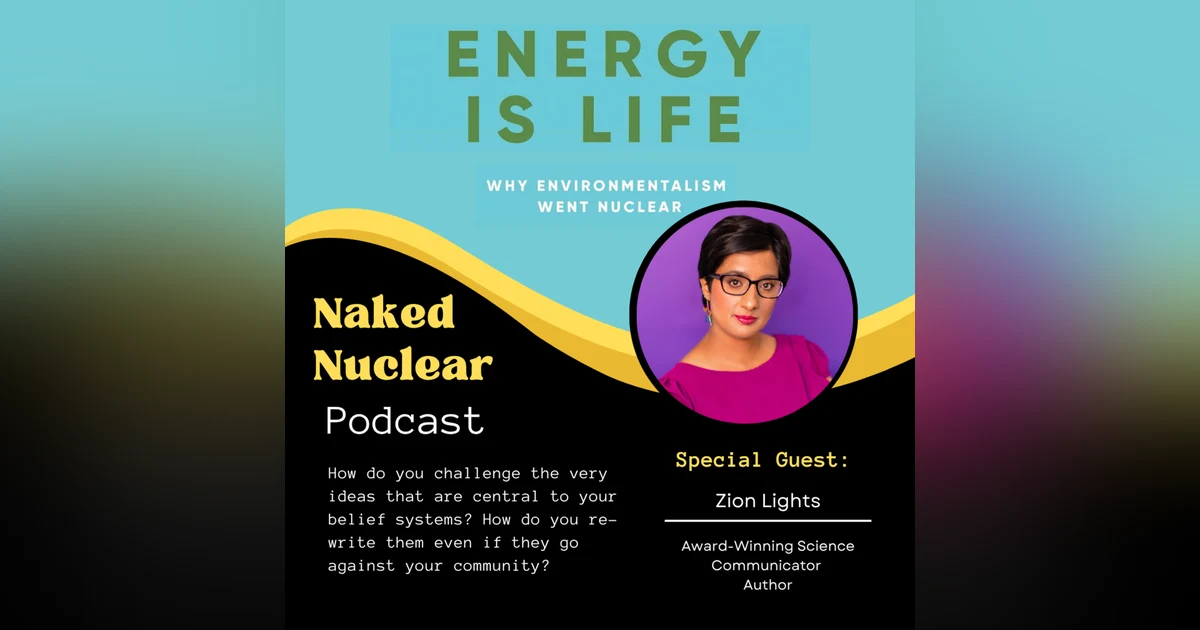
Change Your Mind on Climate Change: Why Energy is Life with Zion Lights


 RSS Feed
 What happens when an environmentalist changes their mind about nuclear energy?
In this episode of Naked Nuclear, Danielle sits down with Zion Lights, environmental advocate, award-winning science communicator, and author of Energy Is Life to unpack one of the most important (and uncomfortable) shifts happening in climate conversations today.
Zion shares her journey from anti-nuclear activism to becoming one of the most prominent voices advocating for nuclear as a critical solution to climate change. This isn’t just a story about energy — it’s about intellectual honesty, changing your mind in public, and what it really means to support life on this planet.
Together, we explore:
- Why energy abundance is essential for human and environmental well-being
- Where parts of the environmental movement have gone wrong on nuclear
- The role of fear, narratives, and misinformation in shaping public opinion
- Why nuclear energy is uniquely positioned to support deep decarbonization
- How to communicate complex, controversial ideas without losing people
This episode challenges assumptions, reframes the climate conversation, and asks a bigger question:
What if being pro-environment also means being pro-nuclear?
Get the Book
Zion’s new book, Energy Is Life, is available now on Amazon.
https://www.amazon.com/Energy-Life-Environmentalism-Went-Nuclear/dp/1917458452
If you want to go deeper into the ideas discussed in this episode, this is the place to start.
Follow Zion Lights
Stay up to date with Zion’s work and insights across platforms:
- Instagram: https://www.instagram.com/zion.lights/
- LinkedIn: https://www.linkedin.com/in/zionlights/
- TikTok: https://www.tiktok.com/@zilovesscience
- X: ziontree
If you’re a qualified nuclear professional looking to get personalized job alerts in the industry, sign up with Nuclear Talent Scout.
**Naked Nuclear** strips down nuclear energy so it actually makes sense. New episodes weekly. 🎙️ [Listen on Apple Podcasts](https://podcasts.apple.com/us/podcast/id1781924674) · [Watch on YouTube](https://www.youtube.com/@TheNakedNuclearPodcast) 💡 Curious about nuclear careers? Visit [nakednuclear.com](https://www.nakednuclear.com) for episodes, resources, and guest spotlights.Change Your Mind on Climate Change: Why Energy is Life with Zion Lights
Danielle Allen: Hello everyone and welcome to Naked Nuclear and welcome to our new series Follow Them Friday, where I highlight the people doing amazing work in the nuclear space, helping to educate the public through social media, newsletters, blogs, books, and of course podcasts.
Our first guest in this series is Zion Lights. Zion is an environmental advocate, science communicator, and the author of "Energy is Life: Why environmentalism went nuclear?" A book that really asks the hard question, what happens when fear-based climate narratives block the very technologies that allow humans and ecosystems to thrive. In this episode of Follow Them Friday, we talk about changing your mind in public why nuclear energy is essential to environmental justice.
And how honest energy conversations and storytelling might be the most radical climate change action we have.
Saucepan excerpt
Danielle Allen: I knew this was more than your average energy book when I read through the introduction, here's an excerpt. Zion writes:
At 10 years old. Wrapped up in my own small dramas and concerns. I didn't pay much attention to what my parents did for work, but I do have a vivid memory of my mother bringing home a stainless steel sauce pan and our family gathering around as if it were a rare and precious jewel.
I remember clearly the smell of the freshly unwrapped pan mom lifting it carefully from its nest of paper in a large box. For all to admire in our small kitchen. I didn't quite know what I felt at the time, only that we were looking at more than just a sauce pan.
I really hope that you enjoy today's episode with Zion Lights because she is an excellent storyteller and environmental advocate.
Thank you so much for joining me and being able to have this conversation.
Zion Lights: Well, thank you for welcoming me.
Danielle Allen: And so, yeah, it is funny, we were just talking about this earlier.
We had some technical difficulties in the first time. This is the second time we're having this conversation, but I think it's, it's great
Zion Lights: Yeah, and then you said welcoming me again, and then I had to stop myself.
Danielle Allen: The first conversation was great, and I learned, so much about you and your background.
Energy poverty roots
Danielle Allen: We talked about everything, from, what it means to, you know, grow up in a rural community that does not have access to energy. What are all the downstream effects? What do people have to become when they don't have that energy access? And I think that was really something that, changed my frame of thinking, after that conversation of like, yeah, what would my life look like if I didn't have access to like Zoom and, running water and energy and like, I don't even think twice about it. And so, I just wanted to talk from that perspective, with your new book, energy Is Life. Your perspective, takes us from this journey out of rural India, your parents' journey into the uk. And so can you talk about a little bit about that story, and how it kind of shaped your idea of environmentalism?
Zion Lights: So my parents grew up in the rural world, Punjab in very, I don't wanna say it was, it was not extreme poverty, so it was not at the worst end, even, of what I saw when I traveled around India. But they grew up in poverty. And you know, obviously we have poverty here as well, but I think that's our measure.
Like our scale is very different to what millions of other people experience. They took me when I was a kid, I have no memory of that journey. And then they took me again when I was a teenager and that's the one that really struck me. And we went for three weeks. 'cause I, I didn't know what I was getting into.
Like, they didn't talk about poverty. They would talk about experiences, which now I kind of connect to that. For example, I remember my dad saying, you get chased home by wild dogs sometimes. But I kind of, you know, I filed it away. I didn't really understand, like, it's not something I could relate to.
I was just a kid. But then I saw what that actually meant, which is that, they do have this huge issue of wild dogs. The government has tried to deal with it, but they just breed. And the problem is that they do bite people and then you get rabies. And then the other problem is that then you get rabies and it can be treated, but you can't get that treatment because you can't get access to it because you're in the rural area.
And it's like, so the area we went to is four hours, from the airport. That's how close you are to, anything resembling civilization to get to a hospital is similar. So you're really on your own out there. And, you know, it's interesting, your question was, how did this fit into my environmentalism?
But this was actually at odds with my environmentalism because at the same time I was surrounded by people here who have grown up with immense abundance. Right? We've grown up, we don't know scarcity. Not really, especially not on that level. And there are some support systems if you do get into that situation.
But we have, we generally have good access, right? We have good access to electricity, healthcare, medication, education, all of those things, which we take for granted. And so I would spend time in these groups. We'd do letter writing, we go to protests. As I got older, I got more and more involved in these groups.
It's doing a lot for them. And their idea of like where development went wrong and why modernity is wrong and the way we live is wrong, was that we need to go back to living in rural areas on the land, and we don't need all of these things. Yeah, we don't need all of these things. We don't need TVs and technologies.
We don't need all of that. But it was very hard to, I had to kind of compartmentalize what I'd seen and felt and understood. It took me a long time really to process that. And part of that. Is because people at that time were not talking about it. There was no one to have a discussion with about that.
Like, yeah, I can talk to my parents, but they're also thinking, well, we just escaped that. Aren't we glad? You know, they're not thinking about the the challenges that they faced. They didn't like talking about that because it made them feel bad and then they'd feel sad as well because they left all their family members behind who still live in poverty.
Commune reality check
Zion Lights: So it was many years before I started to push back on that kind of, living on the land naturalistic policy, but I just get told I was wrong.
Oh, you don't know what you mean. We should all live in a commune. I even went and lived in, in sort of like a hippie commune to see, you know, maybe I'm wrong. And on this commune They did grow some of their own food. They did have some hens, you know, they were getting eggs from hens. There were families there.
They would, they would cook communally. There was only one cooking space. But, every week one of their parents would come and pick up their washing and take it to the la Yeah, really take it to the lat wash and dry it all and bring it back, because let's be honest, they don't, people that did not wanna spend hours, hand washing clothes, trying to dry them in our climate where we get a lot of rain here.
You know, if you don't have a dryer, you don't have access to anything like that. So they were off grid as much as you could be, I think. But it was a facade and that was, it was around then that I really started to think, and I, and I questioned them on it, right? And they said, oh, we're in transition. We'll get there.
But then I would think about like what I saw in these villages. This is where I started to connect it, where I was kind of thinking, well, in those villages, these women, it's always women. Spending hours, washing clothes with river water in these like little buckets, beating the clothes. You know, no one wants to live like that.
Let's be, let's just be honest. And if you are picking and choosing what you can and can't have, so you find you, you've got a nice little place on the land in the countryside, you're picking and choosing. That's not really living the way that we did for a long time. That humans did for a long time.
Danielle Allen: Oh yeah. Yeah. And I think that's super helpful 'cause it brings up this idea of, labor and gender of who's doing what work, how much time, women are spending, bridging the energy gap. 'cause that's usually what it is. We're bridging the energy and labor gap, what as it relates to like water or washing or, or
Zion Lights: Yeah. Collecting fuel for cooking.
Danielle Allen: All of those things, women are doing it and they're not able to get access to like, you know, an education. And I think that's, something that's really interesting that I found fascinating within your own story of when you came to this crossroads and be like, I actually don't agree. Not just going along and being like, okay, we'll just kind of put that in the background and keep going because that was also your experience around nuclear energy.
Zion Lights: Yeah, yeah,
Danielle Allen: Where you're like, well, wait a minute. There are some questions that I have and things aren't fitting the way I thought into this box.
And so, yeah, I, I wanted to, to kind of get your perspective on, how that was coming into, contradiction with how we should be living.
Zion Lights: Yeah.
Changing minds on nuclear
Zion Lights: I mean it, and it was a hard thing to do, you know, I do appreciate why it's hard for people to change their minds, because even if you have it in the back of your mind, and even if you really know. It's a huge step because you have to challenge your community. They don't wanna be challenged on that.
It's one of their core belief systems. So you already know that you've gotta be combatative, you've gotta be willing to potentially lose your community, which I did. If it's a really core belief, it's something that you believe for a long time. So I believe those nuclear myths since I was a teenager, because I was involved in groups like Green Peace and Friends of Year, I went to their events.
It was always the same messaging, the same myths over and over again, reinforced by pop culture, reinforced by people around me who weren't necessarily antinuclear, but they just kind of, you know, it was just a general Yeah, it's bad, isn't it? You know, even if they didn't really think about why to go against all of that is, you know, it did take, me a while, it took me a while and it wasn't like an overnight thing.
I don't think these things ever are. It was a chipping away of kind of questioning and it did fit into the previous example I've given of challenging, the idea that living in poverty is good, right? I was frustrated then that I couldn't have those conversations. And as I say, at that time there was nothing, like, you've got lots of good books by intellectuals now that are talking about these ideas.
But back then there was absolutely nothing. And if I went and I tried to read something, even in the media, they were perpetuating this idea that, the way we live is bad. The way we live is damaging, look what we've done to the planet. And it was kind of reinforcing this idea that we went wrong somewhere and so yeah, it took me a while and I started to push back and push back.
And it was really just at the point of I was at a Green Party event. I, I was a member and they wanted me to run as a counselor and I was considering it. So I was very involved and I tried to ask a question about nuclear, and I just was basically told we don't discuss that. And it was that simple.
But then it wa you know, I don't think even that would've made me leave, leave the party altogether. It was the fact that. The leader of the local party. Then after the event came over to me, she put her hand on my shoulder and she said, you're not pregnant, Claire, are you who got to? And it was just that moment.
Now this woman really lovely, like I've been to her house for dinner. She's extremely supportive. She's a nice person. So it's hard again to kind of go wait. No, but it was that moment where I just, what I realized was we're on different planets, I'm never gonna get through to we, if we can't have a conversation about this, we are never gonna get past this.
So either I go back to just, I don't question and I go along with stuff, but there was a little bit niggling in the back of my mind with nuclear, with the living on the land fallacy. I kind of thought, well then we're not gonna achieve that. So I could kind of live with it. It was just a fantasy, right? But with nuclear, it was kind of more sort of what if, what if we're wrong and it's actually damaging the planet, which we all know that, you know, there's plenty of data to back that up.
But I was just questioning, and again, there weren't a lot of places to go to get answers on that. But that was the moment when I quit the party that same day, and I said in my email to the membership, you know, you've got to allow these conversations. Even if you are gonna keep your anal policy and still disagree, you've got to allow the conversations because otherwise that's dangerous.
And that's, what happened there is rubbed up against a core personal belief that was more integral to me, more innate than the anti-nuclear was. Whereas for the other people there, a lot of the people there, the anti-nuclear was more core. And so that's really where we, there was a friction and I stepped away.
As I say, it was not an overnight process. And the reason I say that is because I was speaking to someone recently, nuclear advocate who basically said, you know, oh, we just need to get rid of these people. It was a bit bleak, but he basically said, these people, they'll never change their minds.
And I said, well, hold on. I did. And I think actually that's part of the problem. If you are not building the bridges. There was nowhere for me to go for good information. There was no one to reach out to. Industry had very little visibility. I didn't even know anyone. I didn't know how to contact anyone in the industry.
Like I just, it wasn't even on my radar. There was no one to go to. I would've changed my mind a lot sooner had the information been out there.
Why she wrote the book
Zion Lights: And the reason I wrote this book is because this is the book I needed to read. That would've changed my mind as a kid.
I would've read this book and gone okay. And I would not have gone down the path that I went down wasting frankly, years, in a movement that I feel actually was quite destructive.
Danielle Allen: Yeah, I think it's really fascinating just the way in which, we as humans, every now and again, we get a little bit tribal in our thinking of like, okay, like this is our core belief and it can't change. And I think it's interesting because. Beliefs are kind of, you know, now and again, they do have to change.
And using that intellectual process, using like curiosity to enable us to kind of be like, Hey, this is not what I thought it was. I have to change my mind. And so, yeah. I wanted to get a little bit more into like, the core thesis of energy is life. You mentioned it was the book that you needed to read.
And as I've read it, I'm like, yeah, I can see that. Like, I could see my 13-year-old self, taking it on a crusade to be like, listen, everybody. But yeah. What is that for you?
Zion Lights:
Storytelling over textbooks
Zion Lights: I pitched this book to a number of publishers, right? And I've been writing for at least 10 years. I have many years under my belt as a writer, as a communicator. So I thought it would be an easy pitch because everybody's talking about nuclear. But even so, a lot of the publishers are still in this old mindset that it's controversial, you know?
And, a couple came back and said, well, if you change your pitch and you make it just scientific, that could work. And one of them did actually then go publish someone's book here that. A man that's just pure, like pure science. And I was trying to argue for something different, which as you know, from reading it, I mean it's narrative nonfiction.
So it's blending storytelling with data. I mean, this is what all the research and science communication says is, is the best way to reach people. Because if you make a really technical scientific book, good, we should have those two. But the people that are reading that already have the foundational knowledge and they're coming to that book because they, they don't need convincing
They have that information. And you know, to me one of the biggest issues is that if you look at polls like across the world, it's women that don't support nuclear and men do like overwhelmingly so. And I think that came from a movement that demonized nuclear technology as like masculine. There's literally, you know, Helen and other environmental activists who very.
Popular before I was born. Even, giving speeches saying it's male energy, it's masculine, it's dangerous, that's why it's linked to weapons. And I think that kind of did get into the psyche of a lot of women, and I think that's really damaging. So I wanted to write something that like, yeah, my female friends, who would not read a scientific book or a textbook about nuclear, absolutely not would read.
Not because I wrote it, but because it's telling a story. And obviously for them, obviously it adds more of an element because they know me as well. But from the feedback I've got, you know, it's similar to what you said, like it's making people think about things that we just haven't quite kind of thought about from this angle before.
What I found really interesting with that, I always thought it was a little bit of a failure of like, why isn't industry doing this? Why aren't more people doing this? But actually there are roadblocks the whole way because like I said, the publishers themselves didn't see the value. And I think part of that was.
Because they still see nuclear as controversial. They would rather just have a scientific book because that's easy to defend. If you put opinion in there, then they don't know. They're not experts. They don't know if they should back that or not. And so it's safer not to, and that again, can be quite dangerous.
'cause you've got, you've only really got the Big five publishers and then you've got everybody else. I went with an independent publisher and it's really hard actually to compete with the bigger titles because, you know, even just, I tried to do a, there was a lady on X who tweeted me and said, I came in to buy your book and it was on the third floor.
Waterstones said, why is it on the third floor when you live here and it should be blah, blah. And I said, look, I've contacted Waterstones. And they don't wanna have a local author in the store doing book signings. Like I'll try, I can try again. But if you're not part of the big five, and she said, but couldn't they put it on one of the store?
You know where you walk in and there's like books everywhere. And I said, no, you have to pay loads of money. Loads of money. I'm talking tens of thousands of pounds to be on there. Small publishers can't compete anyway. But I think it was a shame because I feel like there's a bigger story here that needs to be told, whether it's me or someone else telling it.
And I feel like those stories probably people have tried before and they're just not breaking through even now because you know, a lot of people still aren't really up to date with like the nuclear conversation. So they're still thinking, oh no, this is still kind of, we don't touch this unless it's just purely science.
I think we almost have too much of the purely science, right? I think we've had so much emphasis on science and technology. We've forgotten the role of the humanities We process everything with our feelings. Even if we learn to be rational, we learn to spot cognitive biases, and we learn to overcome fears and tribal thinking and all of that.
We still, first of all, process things emotionally, and that's probably never gonna change. So I think really we desperately need more of the storytelling, but it's tough out there.
Danielle Allen: It sure is. And that's been one of the things that I've been kind of like, you know, preaching from the roof props of, of,
Zion Lights: Yeah.
Danielle Allen: Nuclear, I'm like, you, we need to spend more money on the storytelling. And, and, you know, it's, it's slow going because it is kind of uncomfortable and unfamiliar for, for industry. And I think from, from this book, is there a story that you feel like, you know, maybe it's not your favorite, but like, just you think kind of really synthesizes your, your whole book? Is there a story that you're like, you know, this wouldn't be one that I would, I would, you know, start people off with.
Scarcity and abundance lens
Zion Lights: I mean, look, I obviously have a soft spot for the sauce pan story, but in terms of, what's important, I think kind of the chapter approaching communication differently, I think that's where we are at in the conversation now. A lot of people do now either support nuclear or they kind of lean towards it.
Are we leading people towards, Thinking about these issues in the way that I'm thinking about scarcity. And I mean that it does link back to the source story because I'm talking about my mother being able to afford things with her own money, being able to have a job and to have time because she's not washing clothes by hand all day, and her daughters aren't having to go and collect fuel all day so that you can, burn it to cook on your stove and all of that stuff.
But yeah, that, you know, I think
If there's one story, then it's the sauce and story. But if it's what's most important, then it's the conversation about how do we humanize this and talk about this differently, because I honestly think we are behind on that and not just in nuclear, in everything. Look, we've got measles outbreaks here.
Because it's happening like it's happening with vaccines.
Danielle Allen: Yeah.
Zion Lights: Happening
Danielle Allen: Yeah.
Zion Lights: In every, every bit of science that you look at, every development there is pushback and it's significant pushback, and that is not getting enough attention. And that's where industry or whatever advocates can play a role in nuclear specifically.
And I feel like if you're chipping away at that, and even if it's in one area, it benefits all the areas because you're teaching critical thinking. You're getting people to be aware of their cogniti biases. And you're getting people to think about things differently. And what I've tried to do is just try and get people to think about scarcity versus abundance differently because I've seen, you know, there's like an abundance movement now, which is great, you know, all for kind of build, build the homes, build the clean tech and all that stuff.
But it's funny that they talk about aiming for abundance rather than recognizing that we already live with abundance. If you can go and buy any number of appliances that you like and plug them in and power them, you already live in abundance. Yet the people in abundance are the ones that are loudest about scarcity.
Danielle Allen: Yeah. And I think, I think this is where you know the sauce, man. I think, I was definitely, I teared up when I, when I
Zion Lights: A few people have said that to me.
Danielle Allen: I was like, oh my God. I was like, this is
Zion Lights: I have it right here, hold on,
Danielle Allen: Yeah.
Zion Lights: Look at this. I got it out because I wanted to take a picture, but it's so big I
Danielle Allen: Okay. Yeah.
Zion Lights: Can't get a good picture with me.
Danielle Allen: And then I think it's kind of like this idea, you know, that, we can start from a place that seems, really unimaginable that we would ever get to or obtain that
Level of abundanceyou know, you didn't think that you were ever going to have this thing, and now you have it.
And it, it really shifts your entire worldview. And I think that's almost where we are kind of as a society of like, we're like, Hey, this is what the planet's doing right now. It seems very impossible. And I think, the ability for us to go to like, oh my gosh, it's all doom and gloom to like actually like, oh wait, wait a minute.
We can power these things and we can have a clean earth and we can have healthy soil. Such a big narrative shift. But to your point of, you know, across the board we're seeing this pushback on science.
Science pushback online
Danielle Allen: I remember, in our previous conversation you mentioned, doing a TikTok and kind of just like a deep dive on why waterfalls are, you know, not like deep state conspiracy theories.
Like,
Zion Lights: Yeah, I saw this video. It's not even the video itself, like this video went viral, but sometimes things go viral because they're bad. So this video of this guy, American guy with a waterfall behind him saying, no one knows how this works. No one knows how the water's replaced. I looked at the comments because I thought there'd be pushback and there was so many people agreeing with him, and I didn't even know that that was a conspiracy because we all learned this at school.
Like I might have even learned it at primary school, you know, like really early on. So I did a response just because. I thought all of those people in the comments, some of the people were just asking, they were like, oh, I think there is a theory, but what, you know, they didn't remember or maybe they weren't taught it to be fair.
Maybe they weren't taught it. And so I did this response and it went instantly viral. But actually it was quite good because I didn't get too much pushback in the comments there. Some, there was some, those deniers are deniers, a hundred percent motorcycle deniers. But there were plenty of people who were like, thanks for explaining this, it makes sense.
Thanks, I now remember that I did learn this, or whatever. So some of it, you know, you do have to give people the benefit of the doubt, but it's also a little bit worrying that because they couldn't remember, or they didn't have like a solid position on it. They were just led by this guy making this ten second video.
Saying we don't, we definitely don't know. We don't know. It's all, it's all up in the air. And I, you know, these are really basic things that you don't have to know and you don't have to be able to explain the water cycle to someone. But if you, even if you can't, I think you do have to have a certain amount of like faith in humanity and trust in science and you don't have to trust science outright.
We should definitely have debate within science, but within certain parameters. Right? I mean, to me that's like flat earth. There are lots of people, I'm talking thousands of people who actually genuinely believe that we don't like, it's like magic.
It's like magic. We don't know. We don't know how the water cycle. We don't know how waterfalls work.
Danielle Allen: I had met a gentleman who believes that the earth is flat and, it really changed my, I was like, okay, how do I move forward in this conversation?
Ad Break
Danielle Allen: But first a message from our sponsors.
If we're serious about building the next generation of nuclear power plants, we need more than concrete and containment domes. We need people, engineers welders, licensing professionals, project managers, I&C specialists, operators, the people behind the build. That's where a nuclear talent scout comes in.
We source directly for companies to find the people who can actually move projects forward, the ones who understand safety culture, regulatory rigor, and how to execute on time and on budget. If you're ready to step into the next phase of nuclear, or you're hiring for it, head over to nucleartalentscout.com
If you are a qualified nuclear professional and looking to get customized job alerts set to your preferences, location and salary. See the clickup form in our show notes. Now back to the show.
The Water Cycle
Danielle Allen: And I think what's really fascinating is these are things that you can look up on the, like how does the water cycle work that you can literally type into Google and get like a pretty clear, explanation with the visual key cues.
Like
We can see
Visual nuclear myths
Danielle Allen: I think with nuclear it's, it's a little bit more challenging because so unfamiliar and we really don't, like, if you ask,
Zion Lights: Yeah.
Danielle Allen: Person, Hey, picture a nuclear reactor,
Zion Lights: Or even a power plant, they think of the cooling towers.
Danielle Allen: Yeah.
Zion Lights: Even now I'll see, articles from like quite respectable institutions and it's something about nuclear and the picture is cooling towers, the picture they've used as cooling towers. So it's just reinforcing, and I guess they're using it 'cause it's familiar to people, but then people are seeing them and, and there is an issue there.
But actually I did another video that we borrow, which was on, how the cooling towers from nuclear power plants are just emitting water vapor because again. I think there was a study on this in the US and I can't remember the numbers, but a lot of people there do believe, that it's polluting, that it's like it's, yeah, they do.
I can't remember what the numbers were, but it's quite high. People believe that these are polluting and it's because they're associating it with coal because they also associate the cooling powers with coal, and not like, you know, the nuclear kind of dome whatever shape the building is. Yeah, so that's another thing that was only a really short, kind of 22nd video, but that went viral too.
But again, it was a lot of people saying, oh, thanks. They didn't know. And someone actually pointed me towards an article in a mainstream paper that I went and looked at because they published an article about nuclear, it is quite negative, but like subtly negative. And the image they used, which was of cooling towers, they had darkened the water vapor to make it look like smoke.
Danielle Allen: Oh
Zion Lights: I did see them get some pushback on this, on social media as well. I can't remember who it was, but it's, ubiquitous and it's those images. That stay with you. And I do think there's something about images like you touched on there and that's why I really value, doing the tiktoks.
I know a lot of people don't like the kind of short form video context, getting a lot of pushback, but actually there's something about being able to see the thing and make the association. Like we are very visual creatures where we love watching TV and going to the cinema and whatever, talking face to face instead of, on a phone call.
And 'cause I also did one on deep geological repositories. And to be honest, again, this was like, this was a lazy video. I sat on the sofa, it's blurry, the lighting's not good. It was just something in the evening. I saw some people posting about, well what about long-term story? What about long-term? And I thought, oh, I should just do a quick thing on this.
And I put in some pictures showing Oncolo in Finland. And that had 1.4 million people watch that 1.4 million views. I did not expect that one to blow up just because like I was fuzzy But what I think was important there was they could go and Google that or put it into their whatever search engine.
They could look at it on Wikipedia, but they're not gonna get, the kind of personal element, which is somebody's talking to them about it. It's like your friend talking to you. And just the sheer number of visuals. Like I just packed this video with all these different pictures because I thought you can't just put one picture because it doesn't really, then they'll say, oh, well how did they get the casts underground?
I also had that in there, I had all the kind of processes, 'cause I thought, like you're saying most people what a reactor looks like, so you kind of need, and then even if you put that there's like, wait, they still think that the power plant is just cooling towers. So you need to add that. And you need to maybe say there's a control room and like add stuff.
TikTok search behavior
Zion Lights: There's so much potential actually, and I have tried and failed to get the industry to capitalize on this with moving to short form content. Or even like, you could do long form content like on YouTube, but doing visual like video content, not only because all the platforms are using it and it's getting very popular, but also because, if it's not on there, people don't search it.
So maybe, yeah, for you and I, we would just go and search something and it's, I use Google as a verb, right? Younger generations aren't doing that. Gen Z doesn't do that. They, in fact, on TikTok, when you watch a video like that video of that guy who was saying the water, you know, how does the walk hall work?
Nobody knows. When you click on the comments, it comes up with like a blue search tick, and that, that the blue search, phrase is what most of the people watching the video are searching. So when you click that, it takes, it's like a, instead of wiki, instead of going to Wikipedia or searching online, you click that and it takes you to.
The selection of videos that answer that question. So that's what happened is people were clicking it and they were getting my video because I was the only one kind of challenging and pushing back more people did after that. But it was, mine was cut first. And yeah, I actually think that's a really good model, which I know people don't like.
They kind of said, well, it would be better if you went and looked it up online. But it is not easy to find information. And even now, you know, I know the industry's done a good job here at least. And I know that they're in other countries where they're getting better, I think, and a bit bolder with the communication.
And there's a lot more, there's a lot less technical information and a lot more kind of humanized, I would say. But it still requires someone to know where that website is and then go and click on it and maybe read like quite a long spiel. Someone they don't know, they're just not going to. And I think it was inevitable that that was gonna kind of peak at one point and then die out just because the visual communication is so much more personal.
Danielle Allen: I think that's, really helpful 'cause I've been studying more of the data side of how we take in information and the shift to video Even like HBO and Amazon are like, oh my gosh, short form mini dramas, like vertical mini dramas are like taken over. Like, what are we gonna do? And I'm like, well, probably to shift with the times, just like go with the times. But I think, the other thing I find really interesting when I'm watching your videos is, really how you've kind of built this visual platform, but also kind of as a trusted science communicator.
Becoming a trusted communicator
Danielle Allen: And so I guess my question is like, how did you become, a trusted science communicator? Like what are the things that you prioritize? You know, is it like not using too much jargon or, you know, taking the time to explain, you know, water cycles? Like what does that look like for you?
Zion Lights: I think the first thing is you have to have a little bit of humility. I say this because I know that there are some quite famous science communicators who will, for example, make fun of flat earthers. And I just think as soon as you do that, you lose the potential to build the bridge. In fact, all it does is it pushes the person more into the community of deniers.
So you have to approach it like that now. And what I normally do is I kind of think out how I wanna approach it with some bullet points, and then I always go over it and think, how would someone who isn't me approach this is too technical. And you have to be really brutal about that, right? Because, you know, in a way, my comfort zone is talking about science.
It would be easier for me to make long videos on YouTube, which many brilliant science communicators have done. Like Kyle Hill in the US been brilliant. And he's done some stuff on nuclear as well, like long content, just highly factual or highly technical. And I know that that would appeal to lots of people because only a few people
Are able to do it. And those who leverage their skills have done really well. They make entire careers out of YouTube. But there's no challenge in that because again, the people watching it mostly already agree or mostly already know. Like they already have some, they already believe in, you know, that we should accept science.
They're not flat earthers, they're not water cycle deniers. They already know enough about technical jargon and stuff to keep up. It's not gonna go above their heads. Now if I think about when I'm on the school run and the parents that I talk to on the school run, that is
How I simplify my approach to, can I explain it to this person on the school run? If not, it's too technical. I need to dial this back. That is the way that I approach. And I think it's not a coincidence that the one that I just wrote on the sofa, I mean if you go and look it up, it's fuzzy.
I would say it's not high quality content, but in terms of information, it is because nobody else, anywhere, ever has explained this issue to somebody in this way. And even if you go onto some of the websites about deep geological repositories, even like the Wiki page, really technical.
Short Form Key Points
Zion Lights: People just wanna know like, is it safe? Does it work? Should we do it or not? That's all they wanna know. Does it harm me or am I okay? Okay, well that's good. I might wanna learn a bit more about it, but not a lot more. They don't wanna watch 10 minutes of it unless they're already the nerds, right? So just give a minute or two.
I think that video is like a minute and a half or something. And it is challenging. I find it more challenging to condense it and more easy, as you could tell from how long I talk, much easier to do a long form video. But I just, again, it's moving with the times. If people aren't spending the time watching.
Those all the way through, they're not getting the key points and they just want the key points. And actually I think there is benefit to that. I think there's a lot of pushback on short form content for people who aren't kind of used to it, but actually often what will happen, as I said, they'll watch it if they wanna know more, go and click that.
Information Deficit Online
Zion Lights: The issue is, there's a deficit of information. So you might then say, right, I wanna know about oncolo. I click on that on's not posting on there. How are you gonna find out? You are not gonna go and look up their website and go and see, what this company is doing. You are not gonna do it.
You're not gonna do it. So unless the faces are there and the conversation's there, it's not happening. And this is millions of people, right? It's not a niche fringe thing. It's millions of people are having this conversation and certain actors are choosing not to be part of it, which I honestly, I find a little bit shocking at this point.
Danielle Allen: Yeah, for sure. And I think like you, you synthesize a couple different things. Like one, you know, the humility piece of like, you know, when there is a belief that doesn't Necessarily aligned with the science, like not being like, wow, you're stupid but then also taking that time to like simplify the main points and the key points that I feel like as a communicator and it specifically as a science communicator.
I think that's something that a lot of engineers really, really struggle with
Zion Lights: Oh yeah,
Danielle Allen: Wanna tell the whole thing and they wanna get down into all the data.
Zion Lights: Yeah.
Danielle Allen: Calculation
Slogans And Activist Framing
Danielle Allen: And. Know, I had that when I started out in the advocacy. I came from the other world, so I didn't know anyone. I couldn't name a single person in the industry. Came from the other world, from the environmentalists who were against it. The first thing I found was I'm getting this popularized, like I'm getting news articles.
Zion Lights: Partly, again, I had contacts, I had an established career already as a writer. So I was writing articles, I was getting stuff out there, and I'd have people push back engineers and nuclear professionals pushing back, emailing me, you shouldn't be saying phrases, you shouldn't be reducing nuclear to, well, I remember specifically one person saying it was because I was using nuclear Saves lives, which actually really took off and a lot of people started using it and he felt, he sent me this really long email, he felt that it was disingenuous and we shouldn't be reducing science to slogans.
It's quite off-putting to get that when you are already kind of like getting a lot of pushback from the anti nickers. And that one instance just kind of alerted me to, and this is where the problem is. Right. The problem isn't. The people. The problem isn't that people are stupid and they can't, change their minds about stuff.
The problem is that the information has never been presented in the right way. And that's a problem that falls on us, I think, either as communicators or as professionals. Because you have to be able to boil point down to simplify it. Dan, you do have to, and yeah. All right. You could argue with how accurate is this phrase or how inaccurate is it?
But the inaccurate phrases about nuclear is what made it so unpopular for so long. And I had to, the way I saw it was I need to rewrite those phrases and, you know, we did this in Extinction rebellion, popularized net zero popularized climate, crisis, climate emergency. We came from all this stuff just sitting in a room.
So it was kind of bringing like an activist slang to it. But actually that was what was missing because the activists are very, very good communicators. And let's face it, they're all humanities people, you know, so they're really good. And they, and they, because they're those, they're like the literature nerds.
They're on that side. I think they have better theory of mind. Like they're better at thinking, how do I get in that person's shoes and see that perspective? Where do I push the trigger points and then they push them and it works. And it worked on me for a long time. I was very fearful about waste
Danielle Allen: Yeah. And that's a really helpful kind of like process of like understanding, you know, actually almost who's gifted at what. And so looking at like for our scientists or engineers, people who are kind of more deeply in the jargon, would you have pieces of advice for them? I, I literally had a friend the other day who was like, I like doing the theory and like I like doing theoretical stuff and I don't think I should be having to explain this to like the
Zion Lights: Yeah.
Danielle Allen: I'm like,
Zion Lights: It's actually quite a rare skill. Think about the science communicators that, you could probably list on one hand, like Carl Sagan, or if not the first science communicator, Richard Feinman. He was still very technical, but he did popularize certain things within his, talks and text and books.
Neil Degrassi Tyson, Brian Cox, and how many of them are women? There's not many out there. I think that is because it's difficult to have both skillset sets. I think almost the opposite skill sets. When you're a scientist, you are really honing in, like you're narrowing down, right?
If you do something like a PhD, you're narrowing, narrowing, getting, you know, more and more into the detail. If you are trying to talk to large groups of people, it's the opposite. You've gotta broaden right out, you've gotta have good theory of mind, you've gotta be able to consider the way people are thinking.
And it's almost the opposite. And so I think it's quite rare to get someone that has both skillset.
Prebunking Misinformation
Zion Lights: And, and, and you know, you asked how I built my platform. I think, to be honest, I didn't have any kind of strategy. I just went in there and was like, well I'm gonna write, do something about the water waterfall thing because I don't like that I'm gonna do something about, deep geological project.
'cause there's literally nothing else on this platform about that. So I'm gonna fill that niche. And I did it more because I felt like this is easy because people are gonna watch it. And they're gonna get information before also because a lot of them are younger before they hear misinformation about it, which is actually a really good tactic.
It's called pre bunking. We kind of can go through some of the, Myths that you might hear later. And it helps protect you from it. It's like an form of immunization, debunking. Anyway, it's a term used in misinformation theories, but for me, you know, it was a no brainer. I just go in and start doing that.
But because I have both skillset sets, it's not difficult for me. I don't actually spend a lot of time, someone asked me the other day, like, are you how are you putting out a video every day? It doesn't take me very long. Unless it's a new topic that I know nothing about.
But, I tend not to go into those topics actually, and occasionally if it's something really in depth and I just dunno, I'll send it to someone, say, could you respond because this is getting it, you know, I saw something on this on glyphosate and I said, you are, this is your area. You should go.
Danielle Allen: Yeah.
Zion Lights: Yeah. And I could respond to it, but I just thought. I tend to stick to the things that I've been talking about for a long time. 'cause I can condense the information because I've been thinking about it for so long. I can answer in simpler terms. It's much more difficult when it's something, that I haven't thought about before.
I don't know a lot about, I can go away and do it. But there are so many topics and to be honest, a lot of what I do is find some information because there are many videos like the Waterfall one that go viral for the wrong reasons. And I'll just jump in there. I just did one on sids because I saw some stuff about so sudden infant death syndrome where I thought actually this could be quite dangerous,
Danielle Allen: Dangerous.
Zion Lights:
And I better address like, yes, they are saying that a study said this thing, but it was an observational study. It's not, something that's recommended in medical practice because it's not supported. So that person actually didn't mean. Any harm. They saw a study and they didn't know. You've gotta look at like, broadly, like how does it fit into the, the literature?
Like do a literature review. Other studies might have disproved it, right? It might be an old study. You might have a small sample size. Like you can't just read one. You've gotta understand like the, and this person didn't, so they made this one video and it went viral. It's kind of giving people not the best information.
I've responded to that because again, I see a value there. And to me, like what two things drive me. One is like, is there value in this? Is this gonna help people? Like, I care about that? Then I get an intrinsic value. I'm happy to do it. I've got the energy and time for it. And the other thing is, you know, I think we talked about this before, but I have got to the point now where I'm comfortable being uncomfortable and not everybody gets to that point.
Right, because I have, I should use that because again, it puts me in a rare position. And that's also what you've got with all the main, kind of the most visible science communicators is they're comfortable pushing back on things, and taking the expertise, but bringing it to a broad audience.
Training Scientists To Communicate
Zion Lights: So yeah, I think people who don't have that skillset shouldn't be forced, certainly shouldn't be made, you know, to do the communication. But if they want to, I think there should be opportunities for training. And I have done some of this in my consultancy where have done workshops with scientists on how they could present their data better and kind of looking at, ways that things might be misconstrued if use certain phrases.
Many examples of this happening, even in like official institution press releases where they've put it out and it looks good to them. But it looks different to a journalist who picks out a certain phrase about something negative and that becomes the headline everywhere. And then you've got two groups here and one saying, I don't understand how that was misconstrued.
You know, there's a technical lens and then there's the human story. Yeah. Anyway, so I've, I've done some of that work with those people, but it's not, you know, it's something that you can, I, it's something I think you can develop over time, but it's not, necessarily a skillset that a lot of people have to begin with.
I think one benefit I have is that I spend a lot of time in different communities. It's like, you know, I've been to like Star Trek convention, stuff like that. So I've been around those kind of nerds as well. I read a lot of sci-fi, read a lot, generally read nonfiction, fiction. So maybe good theory of mind.
I have two children, so I'm in parenting communities, so I hear what they're talking about, which is just so you know, nuclear's never mentioned in there, and the only time energy's mentioned is if they're complaining about high electricity bills, which is fair enough 'cause they are high.
Danielle Allen: Yeah.
Zion Lights:
It doesn't go beyond that. It's just kind of, oh. It must be the government's fault, the end of discussion. And I sometimes will bring up and say, well, it would be good if we did this or that, wouldn't we? Oh, I don't know anything about that. You know, and then I, I usually I'll have the conversation. Oh wow, actually cheaper ity prices correlate with having good, reliable, stable, nuclear reactors anyway.
And practicing that and being around those communities, I think is of immense benefit to like how you think about processing, and simplifying information. Like, just because you and I might have a high technical knowledge, probably not where most people are and probably not what they need to know.
And you might feel, I think a lot, this is a thing like between kind of engineers and professionals, a lot of people like kind of pat each other on the back. Like, you wrote a really good piece, you know, so technical. And I'll look at it and I'll be like, yeah, this is great. But if I can't send that to one of the PE parents I see on the school run and have them read it and understand it, then who is it aimed at?
Like what's your aim there?
Danielle Allen: Yeah.
Zion Lights: What's the purpose of writing that? Is it just so you can pat each other on the back I've actually Suffered the consequences of pushing back on that as well,
Danielle Allen: Yeah. The academic silos and I think that's, one of those things that it feels good when you're talking to somebody and they know exactly what you're talking about and you're like, ohoh, we're vibing, we're
Really cool. But it's like,
Zion Lights: Yeah.
Danielle Allen: You have a PhD in nuclear and they have a PhD.
Why Facts Alone Fail
Zion Lights: Well I have a good example of this that I was invited to do, a round table at Westminster where you get a bunch of people, in the room and they talk for an hour and it gets kind of recorded and then written up and it goes to the government. So this was on nuclear and, you don't get along a lot of time to talks about people in the room and stuff.
So I made my points. There was someone in the room who is got a PhD nuclear professional, and he said the solution to communication. So I was there to talk about communication. I was the only non-industry person there. He said, the solution is to teach nuclear and primary schools.
Because I didn't get a lot of time to talk. I kind of was reserving the times that I could talk for, like the points I really wanted to get across. But I was blown away that this could be a recommendation. This is like the first thing they teach you in science communication not to do, because it's the idea that if I just throw more facts
At you, they'll stick. And that's not, come on, that's not the issue. We all go through the same education system. But you could argue for, teaching more critical thinking skills because that can then help you to identify the misinformation around things like nuclear technology.
Absolutely, we should be doing that. But teaching nuclear science to kids, I mean, a, that could backfire because it would be seen as like an indoctrination type thing. But b, it's, I would really be disappointed if efforts were made to make that happen. But everybody in the room is agreeing. It was just me sitting there thinking, this is.
You are an expert in nuclear. Brilliant. I will listen to you on all those topics and I will trust you. But please listen to the communication experts because that's what I've studied. And I can tell you right now that you are wrong. Throwing more like facts at children is not gonna make them pro nuclear.
I introducing them to real people who work in the industry. Yeah, sure you could say that, but that's not kind of what the argument was. And even then, like it's complicated. Just like nuclear technology is complicated and you have to go away and study it to know the, the real details or be able to build a reactor or whatever, or operate in a control room.
Communication is almost more complicated because you can follow a set of rules and facts there, but being able to appeal to people and build bridges and change minds and all of that stuff. Is more complicated there's one thing we say in science communication, there's no general public, like we never use that term.
It's Publix. Every group is a different Publix and it all depends who you're talking about. So you could have one strategy for a specific age group in primary school. That's what I would say. And then a different one for like when they're older and then a different one when they're in secondary school.
But it would not be increase the science. I don't think that's the issue. I don't think increasing science teaching is going to improve the literacy, science, literacy. In fact, we have quite a lot of good science programs already is much better now than it was when I was in school. I know from what my daughters come from talking about.
They're pretty good. They're doing well in these subjects, so they're getting a good understanding of these topics. But they will still watch something and take in the misinformation and believe that over what they've learned in school. I've seen that myself
My role as a parent is to challenge that and help develop the critical thinking skills. But most people aren't doing that. Most people are just believing what they see themselves, right?
Storytelling And Social Media
Zion Lights: They watch Cherno on HBO and that's their perspective of what happened. And that overwrites sitting in a classroom being told X, Y, and Z or seeing it in a textbook, it overwrites it.
It's, it's, we are storytelling creatures and we will always be storytelling creatures. We always have been. The world around us might have changed. The way we live might have changed, but those very intrinsic qualities have not changed. And in order to tackle that, we have to, we have to get comfortable being uncomfortable.
We have to have the conversations about what realistically is going to change this. And, and as I say, it's not just nuclear technologies. It's almost every facet of science, almost every facet. Like we're talking about waterfalls. I saw someone denying that you need glasses. This went viral as well. This was, this was actually not on, TikTok, it was on XI think.
They were saying, you know, it make, they make your eyes worse, you should live without them and your eyes will improve. It's what happened to me and loads of people jumping into, yeah, it's true. My eyes got worse and I've been wearing glasses. So that must be why. And I just again, thought it's everywhere.
But that's a failure of society. You, yeah, you can point and laugh at them, but like when your kid gets measles because They're not getting immunized. It's not a laughing matter really, is it? It's more a case of what are we doing to address this? And we have loads of data that tells us how to address it.
But almost the technical people are not the people to, you know, they can't go away and also study that. They're not the people to do it, but they do need to have, I don't know, departments or whatever that do. I mean, look, they, the industry here does have a communication department, but I would. Again, push back on some of the things like, yeah, they're making a new website to get people into nuclear.
Okay, great. But are you on TikTok? Are you making stuff on Instagram? No, no, we are just on LinkedIn and we have this website. Then all the people that will click on it are the people that are already in your network that are already supporting Nuclear. So, you know, I don't see, I haven't seen that change yet.
And if you haven't got to that book bit in the book yet, it's in there.
Danielle Allen:
Zion Lights: But I actually think that's where the challenge is on us. Like how do we address this rampant misinformation? It's just so much of it. And it's not because the rise of social media, like social media helps spread it more, but it's misinformation far predates that they've been using it in Roman times.
Yeah, they used it in Roman times, like put like little messages on coins, and give out money and then people would like get convinced by, oh yeah, it says that not to vote for this guy. I can't remember what the exact example was, but there is one. Yeah. You know, it's been around for a long time, but what we haven't kept up with is, is like keeping up with our vaccinations against it.
Like keeping up with our immunization, keeping up with our defenses, and that's completely a societal failure and,
Danielle Allen: Gotcha. Yeah, and I think, literally I feel like the last half of this conversation has been like a masterclass on you of like communications and what works, what doesn't work, what we can kind of start shifting our mind to as well. Because yeah, I think it is such an important conversation to be having of when we don't communicate well, here's how society
Zion Lights: It is uncomfortable. I do get that and I have given feedback to people. It's almost like saying we are doing it wrong. And I understand that, but I think we all get things wrong sometimes. And we should just accept, like in our area of expertise, we're probably like geniuses, but we can't be experts in every area.
That's when you've got to bring other people on. And I'm not even saying me, like I get asked to do stuff. I'm doing a lot of stuff, but we need to train more people so that they can do what I'm doing. We need to have those opportunities. Which at the moment they don't exist, so there's no incentive.
Rapid Fire Questions
Danielle Allen: The last part of our show, before we talk about how and where people can follow you and buy your book, we'll definitely put a link to that in the show notes is our rapid fire questions where we get a
Zion Lights: Right.
Danielle Allen: So the first one is, are you a coffee or tea person?
Zion Lights: Tea? 100%.
Danielle Allen: Yeah. Tea. Okay. What types of tea.
Zion Lights: I drink regular tea, but only in the mornings. 'cause otherwise a caffeine keeps me up at night. And I drink mint tea, white tea. I drink all the teas.
Danielle Allen: All the teas.
Zion Lights: So much tea.
Danielle Allen: Well, when we finally meet, we'll get a tea time together going, 'cause I'm also a tea, a tea
Zion Lights: Nice. Nice.
Danielle Allen: If you had to build the city of the future, what are you putting in it? What would it might look like?
Zion Lights: Oh wow. This is rapid fire.
Danielle Allen: Yeah,
Yeah.
Zion Lights: Do you know something, oh, what book is it? There is a book that I read by Isaac Ov, but I can't remember which one it was. It's the closest thing you'll get to a utopia. It's not a utopia, but it's like people are getting all the benefits of the technology.
People broadly trust the science people are supported. If they can't, fit into the system, you're not obligated to have to work most of your life. That's the pinnacle. I think that's the pinnacle of a society with the least amount of struggle. You wrote about it really well, but I can't remember which story it was.
Danielle Allen: I like that. That was a pretty good answer. And then is there a book, I mean, other than your own book, that you've read that you're like, wow, I would recommend, people read this, that kind of change your worldview.
Zion Lights: Yeah, it was Cosmos by Carl Sagan. I read this, when I was a kid. And what blew my mind about it was, it was almost like a light bulb moment. You can talk about science like this because if you read it and it's still like, you know, one of these bestselling books, even though it's old now, if you read it, it's like poetry, but about science, about space science, about astronomy, and, he was an astrophysicist, so it's all in there, but it was like poetry.
It's the first time I saw that done and I thought, oh my goodness. I would love to be able to do that because I was so gripped and it interested me in something Not because I'm not interested in space and, and astronomy, 'cause I actually really am, I have a telescope, but because those books were boring textbooks, I was a kid and this book was like, it was like poetry.
So yeah, I mean that his books then I went and read everything he's ever written and that really set me on the trajectory for doing what I do now.
Danielle Allen: That's amazing. Yeah. Yeah, the OG Carl Sagan, I think. Would also be top, top recommended, for people to go read.
Hope From Medical Breakthroughs
Danielle Allen: What gives you hope about science communication, just the world environmentalism going forward. What really excites you?
Zion Lights: I think we are having some really good conversations now that we've never had before. And I think it's easy to be kind of negative in the moment. But that brings us back to what we're saying that actually, for most of human history, we lived in scarcity. Most of us don't. Now there's still people that would need to be lifted out managing poverty, but for most of us, like if you picked a timeline to live in, yes, I know there are bad things happening in the world, but if you picked a timeline, it would be, now you wouldn't go back to tribal times, you wouldn't go back to chiefdoms, you wouldn't even go back to like medieval times.
'cause the violence, there was so much violence, you know? And there wasn't like the medical developments we have now. And the thing that really excites me is actually what's happening in medicine. And I think this is really like under-discussed because even just like in the last year, we are finding through gene editing and other technologies, we're finding, you know, cures for blindness.
The kids can see for the first time they've never been able to see but they found this cure and it sets up the research for further investigation discovery in those areas. Treatment for Alzheimer's that didn't exist before treatment for, Parkinson's. Like there's so much.
There's so much going on, and I know there's been, funding cuts and issues and all that stuff. But if you think about it, even when you read the headlines of that, you kind of read, oh great, wow, this blind kid was given this therapy you could see for the first time and you've got the parents saying, oh my God, he saw us for the first time like this.
Mind blowing even. I saw a similar thing for, deafness as well, like loads of advances coming in. What really excites me is, even with everything that's happening, there are people working away at trying to make the lives better of those, you know, most, disadvantaged people, people who don't have the basic kind of like human dignity that you get from, you know, not suffering through physiological impairments.
I think that's incredible and I think it's just so under-discussed, just wrote a short article about it for new Humanist magazine, it was just like a listicle. Here are 10 things that just happened in the last year that is not getting enough attention that this is, in just a few years, this would change so many lives.
And I think sometimes we forget that human aspect, that there are all these people, and let's be honest, those are scientists. It's not the image that a lot of people conjure up when they think of a scientist. Someone who just putting all their life's energy and work into helping, people in the most vulnerable communities.
I think that's a really beautiful thing. So, yeah, it makes me feel positive.
Danielle Allen: Yeah.
Zion Lights: They don't have to,
Danielle Allen:
Zion Lights: You could go and try and get wealthy doing something else. You don't have to. And yet we always still have the most altruistic people
Danielle Allen: Mm-hmm.
Zion Lights: Back, trying to do, you know, make things better.
I'm very inspired by those stories.
Danielle Allen: Yeah. And I, and I think that's always the amazing part of science is when we do get to move the needle and make a breakthrough and just the cascade effect of how many lives it's positively impacted. Like, to me, I'm like, that's, that's
Zion Lights: Some of those things you can't even measure. You can measure the amount of people treated, but you can't know the ripple effect in these families or in that person's life trajectory or anything really. But that's why it's so phenomenal that, we often focus on, well, here's this bad thing that happened and now there's a ripple effect from that.
What about all the good stuff? There's a whole network of people out there just doing the good stuff.
Danielle Allen:
Zion Lights: I think we shouldn't forget that.
Danielle Allen: Amazing.
Book Links And Wrap Up
Danielle Allen: Well, where should we go to find your book? To follow you? Energy is life. I love it.
Zion Lights: Use life. Why environmentalism went nuclear. You can find it anywhere. The easiest place to get it is Amazon. If you're in the us there's a slight delay with getting the paper back because it's published here. But the eBooks are available instantly everywhere. You can find me everywhere. I'm on tiktoks E Love Science.
I'm an Instagram. My name's Zion Lights. I'm an X Zian tree. I'm easy to find. And if people want to contact me, I have a contact form on my website, which does go straight to my email. But yeah, please buy the book. Consider, some of the ideas in it and even changing your mind. It's not about convincing people of nuclear, which I know, you know, from, from reading at least some of it.
It's about challenging some of our foundational beliefs that have kind of. Cropped up over many years of dialogue around these issues that have maybe never been challenged. And I'd be surprised if anyone reads it and isn't challenged on some point somewhere, because it's about the communication, right, as well as the technology.
Danielle Allen: I've got the ebook version, but I've been kind of journaling in, in the sides. And so yeah, just trying to, trying to kind of implement some of, some of the new kind of thought processes that I've, that I've got from the book. So Zian, thank you so much for, you know, having this conversation again with me, telling us and sharing about your life story. I think it's been phenomenal to kind of see the way in which, you move through the world. It's, it's very inspirational, the way that you're, you're constantly looking to, make the planet better, but also challenge your own beliefs and, and see like, hey, is this the most right thing? Based on my experience and, and, and finding that truth. I think that like your, your journey is definitely a really good example of how we can get to, you know, communicating with the public better. And so, yeah, thank you for doing that work for yourself, but like for the rest of, you know, the different public's online as well.
Zion Lights: Thank you. Thanks for having me.
Danielle Allen: Thank you so much for listening to this episode of Naked Nuclear and our first episode in the series. Follow Them Friday. Every final Friday of the month, we will be dropping another episode with a mover and shaker within the industry that is putting out a amazing content. If you enjoyed this episode, and honestly, if your brain isn't a little bit rewired right now, you should absolutely be following Zion Light.
You can find her across all platforms, including Instagram, LinkedIn, TikTok, and X. She is consistently sharing sharp, thoughtful takes on energy, environmentalism, science, and nuclear that is getting millions of views across these platforms. If you wanna go deeper into everything we talked about today, her book, Energy Is Life is Now available on Amazon.
And for me, it was one of those reads that challenged the way that I think about energy climate, what we think is good and bad, and what it actually means to support life on this planet. As always, if you got any value from this episode, share it with a friend. Send it to someone who still thinks nuclear is scary, and help keep these conversations going.
Thank you so much for listening to Naked Nuclear. Until next time, stay curious.