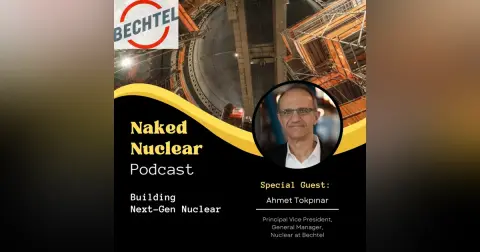
Built By Bechtel: How to Build Advanced Nuclear with Ahmet Tokpinar


 RSS Feed
 Nuclear power is often described as essential for climate goals, grid reliability, and energy security.
But here’s the real question:
Can we actually build it safely, on time, and on budget?
In this episode of Naked Nuclear, Danielle Allen sits down with Ahmet Tokpinar, Principal Vice President and General Manager of Nuclear Power at Bechtel, to unpack the boots-on-the-ground reality of building nuclear power plants in today’s world.
From geotechnical investigations and contractor qualification to long-lead supply chains and workforce development, this conversation moves beyond theory and into execution, exploring what it actually takes to deliver nuclear infrastructure at scale.
What We Cover
- What really happens before construction begins on a nuclear plant
- Why nuclear construction is fundamentally different from other mega-projects
- How contractors and subcontractors become “nuclear-qualified”
- The role of supply chains and long-lead equipment in schedule success
- Lessons learned from Vogtle Units 3 & 4
- What it means to build a first-of-a-kind plant in Poland
- How advanced reactors like Natrium change construction (and what stays the same)
About our Guest
Ahmet Tokpinar is Principal Vice President and General Manager of Nuclear Power at Bechtel.
He leads Bechtel’s global nuclear portfolio, spanning large reactors, advanced reactors, operating plant modifications, and fuel cycle work.
With more than 30 years of experience in nuclear project execution and business strategy, Ahmet has played a leadership role in major projects including Vogtle 3 & 4, Poland’s nuclear deployment, and the Natrium advanced reactor.
About the Season
This episode is part of Season 3: How to Build a Nuclear Power Plant, a deep dive into the companies, people, and systems required to move nuclear from blueprint to grid.
Further Reading:
https://www.bechtel.com/markets/nuclear-power/
https://www.bechtel.com/projects/vogtle-units-3-and-4/
https://www.bechtel.com/projects/poland-ap1000-nuclear-power-plant/
https://www.bechtel.com/projects/natrium-demonstration-project/
**Naked Nuclear** strips down nuclear energy so it actually makes sense. New episodes weekly. 🎙️ [Listen on Apple Podcasts](https://podcasts.apple.com/us/podcast/id1781924674) · [Watch on YouTube](https://www.youtube.com/@TheNakedNuclearPodcast) 💡 Curious about nuclear careers? Visit [nakednuclear.com](https://www.nakednuclear.com) for episodes, resources, and guest spotlights.Danielle Allen: Every plan to decarbonize the grid power data centers or secure energy independence quietly depends on one uncomfortable assumption that we can actually build the infrastructure we're promising. Nuclear power is often described as essential for climate for reliability, national security. But here's the real question:
What if we can't build on time or on budget? Because when these nuclear projects slip up, costs rise, public trusts erodes, projects get canceled, and the door opens for dirtier faster alternatives to take their place. Today we're stepping away from theory and into the reality of building these projects to understand what it really takes to build nuclear power plants that actually get delivered. My guest today is Ahmet Tokpinar Principal, Vice President and General Manager of Nuclear Power at Bechtel.
Ahmet Tokpinar: people don't appreciate the benefits of nuclear power it hits so many objectives, climate change, no carbon base load. It's running at a high capacity without interruption. Very, very reliable source of power. And for any country, it provides energy security.
Danielle Allen: One of the most experienced engineering, procurement, and construction companies in the world with a nuclear track record going back to the very beginning of the industry, Ahmet leads Bechtel's global nuclear portfolio, including large reactors, advance and small modular reactors and projects like Vogtle Units 3 and 4, Poland's First Nuclear Power Plant, and the Natrium Demonstration Project in Kemmerer, Wyoming.
Ahmet Tokpinar: What sets us apart from other international, state supported companies, we bring knowhow when we go to Poland, we don't go to Poland with thousands of Americans. If we're gonna have 1500 maybe 250 will come from US that bring the knowhow.
Danielle Allen: Today we're going to talk about what it takes to actually build nuclear from the ground up. So who is Bechtel? Just a construction company or something more.
Ahmet Tokpinar: We are actually, an EPC company. So it's, it's more than construction. It's the design, engineering, procurement, construction, and commissioning a plant. We can offer turnkey solutions to projects. We operate in different businesses, including nuclear power is just one of the businesses that we operate, and that's what I'm gonna focus on. But just quickly, we are also in the energy business building, LNG, export facilities, infrastructure business, airports, roads, mining and metals and advanced manufacturing that, look at semiconductor fabrication. In addition, we also have a government business that we do the legacy cleanup of, environmental sites within the US for Department of Energy and Department of Defense. So in nuclear, this is really a core business for the company that goes back several generations. We started out in late 1940s, with the construction of the first nuclear test reactor, then the commercial reactor in the US Bechtel was building about 15 units in each decade at the same time in the US and abroad. And there's also the first, we built the first nuclear reactor in India with GE 1962. Not too many people, even in Bechtel would know that we built the first in Taiwan, Korea. Companies like Bechtel, Westinghouse, Combustion Engineering really stood up the nuclear industry in Korea going all the way back to seventies, eighties, nineties. And now, as you can see, they're self-sufficient and became a competitor to ours, which is a good thing for us. That's our model. We go in and we develop and create an industry, bring our know-how for others to learn and prosper. Then we did the first in Spain. So our footprint globally is pretty broad. Obviously nuclear fell out of favor. There were periods where, we thought it was coming back. It didn't. We kept ourselves busy in nuclear in two ways. There was always one or two big project in the US It was mostly around completing existing unfinished units, Browns Ferry, Watts Bar. And we moved that talent that was, heavily experiencing nuclear power projects to other nuclear projects that the US government has been undertaking, like the waste treatment plant in Washington state. The uranium processing facility at the CNS Y 12 Complex. So we were able to maintain the pedigree and the number of resources, and most recently we took over, the Vogtle construction project as the fourth EPC contractor and brought it to a finish.
Danielle Allen: But if you're wondering what's Ahmet's story? How did he get to Bechtel? We'll answer that too.
Ahmet Tokpinar: Had you asked me at the time, would you be running a nuclear business in the US? I would've said, "What are you talking about?" It's, it's a bit accidental. My entry into nuclear, you know, I studied civil engineering at Bosphorus University. Then I came to US to do my master's. As I was finishing my master's, Bechtel was recruiting at the school. I really didn't know anything about Bechtel. I did my research, I did the interview. A couple of weeks later, they gave me an offer, and then that was my first nuclear project. I stayed, I worked, been with the company 34 years, primarily in the power business, about one third in conventional power, oil and gas prior plants, combined cycle plants, and then the rest was in nuclear The last 15 years, without a gap in all nuclear.
Nuclear Boom
Danielle Allen: With 34 years of experience in the industry, I wanted to know what did Ahmet think about the current nuclear boom that's happening?
Ahmet Tokpinar: I mean, nuclear was coming back in early two thousands when the shale gas revolution really brought the price of gas so low that the nuclear economically made no sense. So, you know, us started building gas plants. What changed is first, if you dial back three, four years, is the climate concerns and the penetration of renewables the intermittent source of power started to play a role in, even in the, you know, the non-nuclear advocates started seeing the value in carbon free, base load, reliable energy. This was resonating more in Europe than in the US at the time. Although in the US there was always bipartisan support, but the US as a market economy market should find a solution . The added factor to that with the geopolitical tensions was the, energy security aspects. You know, countries wanted to have their own supply of abundant energy. They didn't wanna rely on gas. You know, when Russia invaded Ukraine, you know, that made the point stronger. And then more recently, especially in the US, the AI demand for power really brought all the drivers together and made a very strong case for nuclear. I mean, when you look in the last two years, what we've seen in AI, the growth, the data centers, and also heavy focus on battery plants, heavy manufacturing, semiconductor. All of this put a significant pressure on US supply, which had been pretty much static in the last 10, 15 years. Now the projections are, you know, the utilities, the developers, they don't know how to keep up with the demand. And then early last year, president Trump's executive order to have, 10 gigawatts of nuclear power under construction by 2030 was the last, you know, piece that we needed, put significant pressure, make something happen. There are good programs in the US but when I look back, you know, in my 34 years, because I came at the tail end of the nuclear build in the US. So it was coming down. I have never seen a moment where all the forces that drives nuclear power, is so strong, persistent, and now it's up to the industry to make sure that we can demonstrate we can build these responsibly on time and on a budget because we, we can't, lose this opportunity to, to showcase that nuclear can be built on time and budget.
Moving Dirt
Danielle Allen: So before we can actually get to building nuclear power plants, what does it take to actually start moving dirt? What testing has to be done before a site can even be selected?
Ahmet Tokpinar: We also help customers with site selection, which is, you know, the very first thing utilities or developers would do. They have to identify sites using a criteria that is well established by NRC, IAEA. Proximity to population centers, other maybe hazardous plants, environmental impact. So you do your site selection. We could play a role in that. We've done it with Terra Power when they were selecting a site in Wyoming. And then the first thing you wanna do is make sure that you understand the geotechnical aspects of the ground for seismic response, soil behavior, water table, access to water, flat how you're gonna level it, the access roads. So all of that is, you know, the first thing you need to do because you need that. Data through geological surveys and drilling, you take out samples where you're gonna the reactor building. Most importantly, you analyze all that data and analysis feeds into your design feeds, into your safety assessment reports. Your foundation design is gonna be informed by the condition underneath it. So that's, that's about a year and a half, two year period. You're also, during that time, collecting data to make sure where the water table is through wells. You have a met tower so that you have, information on, the wind, so that you can base your design on. That gets you to a point where you advancing your design and now you're. We're already getting ready to mobilize to the site, to, the grubbing leveling and, and get ready for excavation that will, house the building foundations.
Danielle Allen: So if there's one big takeaway here, it's this nuclear power plants don't start with concrete. They start with understanding the ground, the data, and the risks long before construction crews arrive, teams are already making decisions that will affect safety costs and schedule years down the line. And once you realize how much planning happens before anything is built, the next question naturally follows what actually makes nuclear construction different from every other big infrastructure project?
Safety Compared to Oil & Gas
Ahmet Tokpinar: Nuclear safety obviously is very, very important. You know, the safety of the public that you wanna cite and build, and ensure that. where you're building it can withstand seismic events, weather events, so that there's more rigor, more data and analysis, with a higher quality required, you know, before you can, start construction and putting the foundations in the buildings. You have different quality standards. There's ISO 9,000 and others that companies, comply with for doing work, right? Nuclear brings in an additional layer of quality assurance requirements to ensure public safety. This is very important, but you do that for the nuclear safety related aspects of design and construction. When you look at a whole plant, not everything on that plant is nuclear safety related you have where you generate the power, the turbines and the turbine generators balance your plant, your cooling. They're not nuclear safety related, so they are subject to your conventional quality requirements. But when it comes to the nuclear reactor, the, the auxiliary systems, the building it's in, it is a different set of standards. And so what it means for a company like Bechtel, you need to have a nuclear quality assurance program that is qualified, certified under NRC, that looks at your organization, of the company undertaking the project, how decisions are made, how people are trained and certified for the work they do. Documentation and records management, how we control our suppliers, how we buy material, how we subcontract, and it's audited on an ongoing basis to ensure that we are adhering to our own processes and procedures along the way. So when we look to work with other companies, suppliers, and, contractors, even if they have their own program, we have to audit and qualify them under ours. So this layer of quality assurance in the supply chain is an, added layer, and it adds cost, and it's an investment if you wanna be a supplier to provide nuclear safety related electrical cable. The cable may be the same cable, but the documentation of where the raw material supply comes from, how it's installed. How well it's inspected. Every step of the way needs to be all documented. So the process is far more rigorous to manufacture that piece of cable compared to a conventional cable. So it's a higher standard of quality checks, or it's the pedigree, maintaining the pedigree and the records requires discipline and a culture, of compliance to ensure, because at the end, you know, if you have missed a step that is critical, it could result in, endangering public safety. That's why it's very important.
Ad Read — Nuclear Talent Scout
Danielle Allen: What you're hearing is that nuclear construction isn't just slower or more complex for the sake of it. It's governed by a completely different set of safety standards, quality and accountability. And that raises a really practical question. If the standards are that high, who is actually allowed to do the work? But first a message from our sponsors. If we're serious about building the next generation of nuclear power plants, we need more than concrete and containment domes. We need people, engineers welders, licensing professionals, project managers, I&C specialists, operators, the people behind the build. That's where a Nuclear Talent Scout comes in. We source directly for companies to find the people who can actually move projects forward, the ones who understand safety culture, regulatory rigor, and how to execute on time and on budget. If you're ready to step into the next phase of nuclear, or you're hiring for it, head over to nucleartalentscout.com . .
Timing & the Supply Chain
Ahmet Tokpinar: Yeah, so in the US there aren't that many nuclear facilities that are being built. You can count with one hand. So the supply chain, to some extent, atrophy. You know the companies that can produce nuclear safety related steel, cable, pipe supports, instrumentation, you name it, all the commodities that you need in a nuclear installation. What we've been doing, you know, we started this effort last year really surveying, qualifying suppliers for each of the commodities that we're gonna need. Not just 1, 2, 3 suppliers for each. If they need help, if they wanna get into being a nuclear supplier, then we're helping them along the way. Here are the things that you need to do, programs you need to develop, and that's an investment. So they need to start early on if they have a program, maintaining the program is also a rigorous effort because it's not like, "I got my certification, I'm good." You need to demonstrate through frequent audits that you are always in compliance your quality assurance program. So it's an effort. it's a high bar, you know, and suppliers rightfully, they're willing to invest. It's not a matter of capability, it's a matter of investing to develop that capability, but they wanna see a pipeline of projects. You know, if you're a supplier and there's only one project, you may think, well, there's plenty of work. Why am I gonna invest so much money just to supply pipe for one project? But that, that is changing now. There's so much discussion and potential work in a pipeline that the landscape is changing. They're gonna invest more and more. So I'm comfortable while there's a gap. Today we're able to identify and work with those that need the support and encourage them to start getting back into nuclear work.
Modularization
Danielle Allen: Who gets to build nuclear power plants? One of the most eye-opening parts of this process is realizing that nuclear projects don't just hire workers. They qualify people, companies, and entire supply chains to meet nuclear standards. but even with the right people in place, there's another massive constraint shaping these projects. The equipment itself. Some parts of a nuclear plant take years to manufacture even before they arrive on site. And with all of the talk of modularization, I wanted to ask Ahmet, what is modularization and how can it help the construction process?
The Vogtle Project
Ahmet Tokpinar: So. Modularization in any industry is a smart way of moving, you wanna move that work offsite and do it in a control environment without worrying about the weather effects, and then ship those modules maybe in smaller pieces, and then you assemble them and put it in place. So I wanna step back and, because, you know, I wanna put some perspective on the role of EPC in the overall picture. And our engagement depends on what the technology provider does. But in a typical world, the EPC for a nuclear power plant is 60 to 70% of the work. Reactor technology brings the core technology and the EPC designs the power plant around the reactor where you get the heat source, but then everything else, An EPC can design, procure, and build. It varies like Westinghouse, made the decision, you know, go back a decade to design what we call the nuclear island, the buildings and the structures around the nuclear equipment and the reactor themselves. So when we work with them, then we design the energy island where the turbine and the turbine generator and the balance of plant the cooling resides. But it's a large part of a project. It's usually the most underrated, but then if you don't get it right, that's where you have the problems and delays and overruns. So depending on the design, you have the gigawatt scale, which in the US today is the AP 1000 design offered by Westinghouse. It's heavily modularized. You know, there were a lot of challenges during the Vogtle project. People heard about it, but the good thing, all those risks are retired now. The supply chain learns, the technology provider learns, so the next ones are gonna be drastically different than the first ones. When you look at the new designs, whether SMRs, advanced reactors, there's a degree of modernization taking place because we're designing the Natrium Reactor for Terra Power. There's the GE SMR, there's Kairos, the different technologies, but they're not built yet. They're still in the design phase. They're all promising to be relatively simpler in design and ease of construction as compared to the gigawatt scale. But they're right now in the stage where they're trying to get their designs completed. You know, we mobilized at the site on Natrium. We're doing the non-power structures and test facilities, and then we're gonna roll in next, this spring actually, to start the energy island construction. So the modularization is a good concept. In some places it doesn't make sense. But in the US, in a lot of the European jurisdictions, modularization has significant advantages lowering the cost. And bringing more certainty during construction on your schedule.
Danielle Allen: A lot of what determines whether a nuclear project stays on track actually happens years before construction peaks, through early procurement decisions and long lead manufacturing. Nowhere are those lessons more visible than in projects that had to figure it out the hard way. That brings us to Vogtle Units Three and Four.
Risks Learned from Vogtle 3 & 4
Ahmet Tokpinar: The main one, which sounds very simple and easy, but it is very difficult for owners utilities, developers to stick to, is ensuring the design is complete before you start construction. When we took over in 2017, we were under the impression that the design was 95% complete. It was 95% complete four years later. What it does is if you are designing as you're building or you're building as you're designing, there are always changes in design that creates a lot of rework. What you do in the field, you install a component, the location may change, so you may have to take it out reinstall. So that was the primary problem. There were supply chain problems because the supply chain, it was the first time a new unit was built in the US after 20, 30 years. There were issues with the modules, there were issues with some of the equipment. So when I look back and there was no integration of how the work was completed between, you know, the technology provider, EPC contractors, zero integration. It was very ad hoc tools. You know, even when we took over, you know, when you take over a project in the middle of construction, you can't bring all your tools. So we had to be very creative, we did the best that we can, turned it around and finished the project.
Danielle Allen: Vogtle showed the industry just how unforgiving nuclear construction can be, but it also created hard won lessons about sequencing, workforce planning and execution that are shaping projects today, not to mention the importance of finalizing your design. Now imagine taking those lessons and applying them in a country that's never built a nuclear power plant before. That's exactly what's happening in Poland.
Digital Integration & Efficiency
Digital Data
Building Nuclear in Poland
Ahmet Tokpinar: Now looking forward, we are working with Westinghouse in Poland and we don't even compare to Vogtle anymore because now we are totally integrated with the technology provider. In a common data environment, all the data that we need to use to design, to build, to buy, resides in a common data environment where we as Bechtel can interface with our tools, whether it's engineering, design tools, procurement, or construction tools a common data environment also is a single source of truth, which is, the data in that database is the only data. There's no risk of duplicating in a different place. Everyone uses the same set of data, and it also helps us to create this digital platform as opposed to carrying binders of paper. Everything flows seamlessly. The workflows in a digital environment. So our goal when we mobilize in the field on Natrium or in Poland or the next AP 1000 in the US, we will execute these projects with tablets, no binders. And there was so much time on Vogtle spent on chasing paperwork because nuclear quality requirements, there's a lot of handoffs, there's a lot of hold points, witness points, inspections. So there are workflows, you wait for a, quality control engineer to come and inspect, before you can close it. All that now is gonna be through a digital platform. So the QC engineer is notified on his tablet iPhone that he has an inspection to do, and it's gonna make a paradigm shift. It also gives the workers more time with, tools in hand to do the actual work as opposed to chasing closing paper packages. Let me add one thing because I think it's important. So we use this digital delivery on other Bechtel projects, but in nuclear, there's an added layer of complexity on using data because of the nuclear quality requirements. You need to ensure the integrity of your data, the integrity of the configuration. So we had to qualify our digital execution platform under our nuclear quality assurance program. The data exchanges, we spent about a year last year because we have hundreds of tools that connect to this database, collect data, use it, but before you have to make sure all these tools are qualified, not just under our quality nuclear quality assurance program, , because that's what the NRC requires, So we're really ready to deploy it when we mobilized at a site, we're doing it in the office with engineering interface, but construction is where really make a difference. So you know, I mentioned, you know, we did this in Korea, Taiwan, Spain, so as a company, we have an institutional knowledge experience of building a nuclear industry. It doesn't happen overnight. It doesn't happen in a year. It takes time. So in Poland there are two big projects. We're executing the first one, three gigawatt scale, AP 1000 units on the Baltic Sea. That program alone is huge, and then there's the opportunity to build it at a second site Utilization of local content is obviously in our best interest too, because it's cheaper, faster, and more reliable, but also in international interest because they wanna, get the most out of these projects by increasing the capability and capacity of the supply chain. So we are working very closely with the Polish supply chain, which is very robust. Yes, they haven't done anything in nuclear, but they have very good quality suppliers, construction companies, subcontractors. So, and then Westinghouse, our partner on this, doing the same for the supply that they bring to the project. You know, fabrication of modules, you work closely with the supply chain. You walk them through, there's the first, the educational part of, okay, what does it take to be a nuclear quality supplier? What are the steps? How long does it take? What is the investment? So we're walking them through the different parts. And you know, as they see their project in Poland is real, they start investing. If you look at the local content, what we buy within the country will increase over time from unit to unit and from site to site. Our goal is that when we mobilize for the second site, the participation from the Polish supply chain is fully maximized. They're not gonna do everything because it doesn't make sense, for example, that you have forging of a reactor capability in the country. You'll see a much bigger participation. The added benefit to them as, as we or others, build more nuclear plants in Bulgaria, in Sweden, in, you know, the neighboring central and eastern European countries, or even in the UK, that will provide an opportunity for Poland to export their supply chain, export their subcontract services to other countries because they would've benefited going through this with us. This is really what sets us apart from other international, you know, state supported companies. We bring knowhow when we go to Poland, we don't go to Poland with thousands of Americans. If we're gonna have 1500 people that we hire in Poland, maybe 250 will come from us that bring the knowhow. So we are not only developing the supply chain, we are investing, training, developing local talent in the ways we do, in the ways we build, in the ways we design and buy nuclear power plants. So I think it's very important. You know when I look and you know, other companies, you know, from China, Russia, or Korea, they're more driven by exports from their country of origin to the host country. They're more export driven. You know, when they go and build a nuclear plant, the primary goal is to boost exports from their country. Whereas we look at how can we help just by bringing a know-how, develop an industry. So in the long term, this is how Korea benefited, how Taiwan benefited, how Spain, because they were able to develop their industries.
Danielle Allen: Poland isn't just building a nuclear power plant, it's building the foundations of an entire nuclear industry from workforce training to supplier qualification to public trust.
Local Supply Chain
Long-Term Planning & the Construction Workforce
Ahmet Tokpinar: When they're fabricating something, what we do is send our people to their shop to ensure they are complying with the process, with the inspections and the witness points. So we are there helping them with that aspect. And the fact that it coming within the country, eliminates the risk of logistics to an extent. You're not shipping it from Korea or China. There's more certainty around the schedule that it's gonna be there in time. You always wanna work with local workforce in any event, they're very productive. Especially in Poland. I think we're lucky because very, very productive workforce there. The challenge for us is be in the number of skilled craft force, these plants. You know, when you talk about three gigawatts scale units require, let's say 10,000 skilled workforce. That's just people doing the work. Nuclear projects are not the only projects. They're always projects, right? Highways, commercial buildings refineries, export facilities, and getting to that level, having the right skillset trained, qualified at the numbers that we need is our biggest challenge in any country. In the US Poland, that's what we worry about. If you mitigate the design risk. Which I think we have with AP 1000 reactors, the bigger risk for us now is gonna be how do we get this level of craft to do the work? You have to incentivize, you have to have the proper training, and then they have to have a reason to work on your project versus working in Germany on a windmill. That's the planning that we're starting. We do these things way ahead of time because you can't just, you know, a month before you start construction, say let's get a couple of hundred people. Where are they coming from? So we do these labor surveys that analyze, you know, we start with where the plant is being built and you keep enlarging the circle 5,000 meter diameter. You start looking at the neighboring countries. And at the end, if you feel like you're not gonna be able to fulfill a hundred percent and you need 20% contingent labor from other countries, then you start working with the government for the permits. You know, and then you look at sources of, labor from, third countries. So in the US this is a big challenge because when you look at the US construction workforce, and look at all the projects, there's a significant shortage today, hundreds of thousands, shortage every industry. Is struggling to find qualified people. US really hasn't built major infrastructure for a very long time. Second is somehow construction work was looked down, like go to college. Why do you wanna be a construction worker? If I tell you how much a welder electrician makes, it's a much better paying job than most professions. So we are working with, you know, the states with federal governments, how do we attract more people into the construction workforce? So that, you know, trade schools, vocational schools, community colleges, were developing programs to recruit, train, you know, and then advertise that these are well paying jobs. It resonates with the new administration and they're doing the same, but you know, this is gonna take time because encourage them to go to vocational school, you know, when they finish high school, learn trade skills, and then bring it to the projects. There's gonna be plenty, I mean, with all the investment targeted in the US if you look the next 20 years, it's crazy. It's very exciting for everyone. But the workforce, you know, we're doing our part and you know, others are hopefully doing the same, but not just to train and develop, but to encourage so that the pool is bigger from which you're recruiting.
Danielle Allen: What's striking here is that even as reactor technologies evolve, the fundamentals of nuclear construction Don't change. Safety culture, quality assurance, and discipline execution still matters most. which brings us to the question everyone asks, and very few people are explaining clearly, What does it actually take to build nuclear safely on time and on budget?
On Time, On Budget?
Ahmet Tokpinar: So I'm gonna draw a parallel to the LNG industry. You know, LNG. These are the liquified gas export facilities. Right now we're building, we're at five different sites and the total value of these facilities are over a hundred billion. We have 18,000 US Craft in the Gulf Back employees 18,000. Very successful. These are big jobs complex. We learned to do these jobs very effectively and they're all under budget, finish ahead of schedule. We turned the LNG industry dialed back 20, 30 years and brought it to a level today where we're able to take a turnkey risk delivered to our customers. A facility that is operating ahead of time, time to market in LNG is very, very critical. It's a huge success story and when we look at from the first LNG train to the ninth, we brought down the cost and schedule over 30%. So there is precedent. We can do it. We know we can. Okay. Nuclear brings added complexity because of the quality nuclear safety related requirements, but they're manageable if you plan it right. The key in nuclear is the discipline that you will finish design before you jump in so you don't have to do any rework. You stay close to your supply chain, making sure the equipment and material you are receiving are meeting the quality standards there. You get ahead of the craft. Make do your surveys plan rigorously to ensure you'll have the right number, not only recruited, but also trained and qualified to do the work. Where, if you do all these things with the proper integration, the digital delivery platform that I talked about, working closely with your technology provider, it's not rocket science. We can do it. We're very, very confident we can do it. But then the first one we do is still not gonna be the ideal. It's the nth of a kind. So what is the nth of a kind? Is it the fourth, sixth tenth unit? It will change, it will depend on the technology. When you have a pipeline of these projects, you know, as you're finishing the first unit, you start moving the people to the second unit. At each unit, you're developing more talent. And then the transfer of knowledge is best done through the people. Each project, you wanna develop talent so that you can deploy to more projects. That's how we're planning it. We're in discussions with US governments, there's right now, a big effort to build, you may hear buzzwords like 10-pack SMRs, 10-pack Gigawatt Scale. Hopefully something will break mid-year or later this year. We're excited. We wanna grow the industry for everyone. And then once the industry grows and we can demonstrate through replication that you can bring the cost down, finish ahead of time, then there's gonna be more and more builds. But one other aspect, very, very important. Keeping the designs standard and fight the temptation, trying to improve the design. If it works, keep it, don't touch it, because any changes you make brings complexity and risk of construction issues. And the good thing is the US nuclear technology companies learned this lesson from the past, and they're disciplined.
Advice on Nuclear Power
Danielle Allen: With over three decades of experience in the industry, I wanted to know if Ahmet believes the nuclear industry can meet this moment. Are we really able to convince the public that nuclear is the way forward?
Ahmet Tokpinar: Yes I do actually. You know, people don't appreciate the benefits of nuclear power. But when you think about it, it hits so many. Objectives, climate change, no carbon base load. It's running at a high capacity without interruption. Very, very reliable source of power. And for any country, it provides energy security. And in this geopolitical environment, you cannot take that for granted. It is an exciting field. Newcomers will benefit, participating in reviving this industry. And then you look back and say," I played a role in reviving this industry that will serve all of us well."
Danielle Allen: Bechtel is making moves around the world, but where exactly are these nuclear projects taking place?
Ahmet Tokpinar: You know, we have Poland, we have Natrium in Wyoming. We are working with, TVA on the Clinch River. This is the GE SMR. They're very limited projects in the industry today. That is, making headline, but I think you're gonna see far more, you know, the wave is coming and we are investing a lot of talent and time so that we are a hundred percent ready when the day comes. Just watch out. The next six to 18 months is things are gonna break loose. It's coming.
Danielle Allen: Thank you so much to my guests, Ahmet Tokpinar of Bechtel. and the Bechtel communication team for making this episode happen. If this episode has showed anything, it's that nuclear isn't impossible to build. It's just demanding. It requires patience, preparation, and people who are willing to do things the hard way to get them done the right way. When we talk about nuclear power, it's easy to get lost in reactor designs, policy debates, or long-term climate targets. But this conversation brings it back to something much simpler because the future of nuclear doesn't hinge on whether the technology works. It hinges on whether we can build it predictably, safely, on time and on budget. If you're looking to follow Bechtel's builds around the world, we'll put those links in the show notes. If this episode changed how you think about what it takes to build nuclear, share it with someone who still thinks it can't be done. I'm Danielle Allen. and this is Naked Nuclear. Until next time, stay curious.