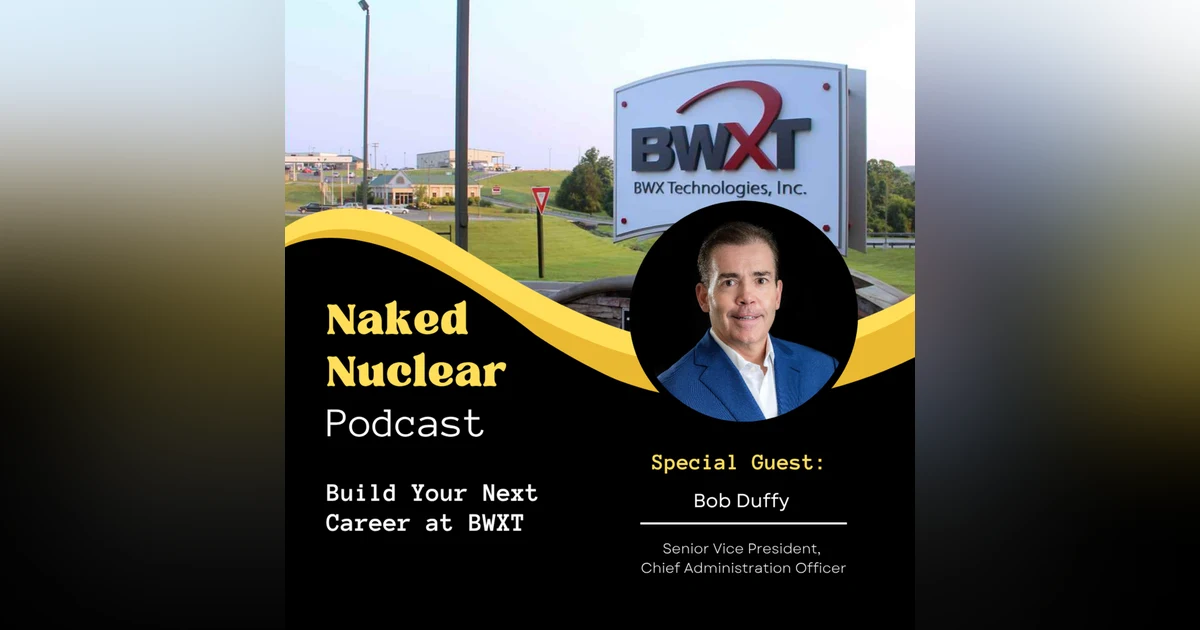
Build Your Next Career at BWXT: Job Talk with Bob Duffy


 RSS Feed
 What makes someone stay at the same company for decades — or even generations?
In this episode of Naked Nuclear, we sit down with Bob Duffy, Senior Vice President and Chief Administrative Officer of BWX Technologies (BWXT), to explore what's behind the company's incredibly low attrition rate, its investment in early talent, and how it's preparing for the next generation of nuclear professionals.
Bob shares how BWXT is going beyond traditional hiring — building weld schools in high schools, ramping up internships, offering internal growth pathways, and supporting students through scholarships and tuition reimbursement.
We also discuss how you can stand out in the hiring process and what kinds of roles are most in demand right now — from engineers to machinists to project managers. With over 700 job openings (at the time of recording) you've gotta see what's cooking at BWXT.
Apply to work at BWXT:
https://www.bwxt.com/careers
Learn more about BWXT:
https://www.bwxt.com
Learn more about Welding School in Mt. Vernon, Indiana
https://investors.bwxt.com/news-releases/news-release-details/bwxt-opens-welding-program-mount-vernon-high-school
BWXT in the News
https://investors.bwxt.com/news-events/news-releases
🎓 2025 BWXT STEM Scholarship Winners:
-
Haris Khan
-
Ella Schmutz
-
Neev Shah
-
Corine Glickstein
-
London Puckett
**Naked Nuclear** strips down nuclear energy so it actually makes sense. New episodes weekly. 🎙️ [Listen on Apple Podcasts](https://podcasts.apple.com/us/podcast/id1781924674) · [Watch on YouTube](https://www.youtube.com/@TheNakedNuclearPodcast) 💡 Curious about nuclear careers? Visit [nakednuclear.com](https://www.nakednuclear.com) for episodes, resources, and guest spotlights.
Full Transcript
[00:00:00] Danielle Allen: Have you ever walked into a really exclusive party, one that you've gotten the invitation for? And the guest list is really amazing Well, I did that a few months ago at the Grand Opening of BWXT's Innovation Campus. And let me say, the guest list was impressive. I wasn't sure what to expect. Security was super tight, for obvious reasons. The Governor of Virginia was there and once inside it was like stepping into the future. A campus where welders, engineers, designers, and physicists can all work under one roof.
Clean rooms, radiation detection labs, cutting edge fabrication tech.
I met scientists who helped construct 3D fabricated reactor components, and I met a tour guide. She worked at BWXT, so did her husband, her husband's dad and their son, three generations, one company. It got me thinking, what is it about BWXT that keeps people coming back decade after decade?
[00:01:06] Bob Duffy: Our attrition, if you take out voluntary retirements is below 4% at BWXT which sends a message to people, if you want to come and join our company, people stay with us.
[00:01:17] Danielle Allen: That's what today's episode is all about.
I am joined by Bob Duffy, senior Vice President and Chief Administration Officer at BWXT.
Bob leads HR and security for the company, and with over 36 years of experience in the field, he's helped shape how BWXT recruits develops and retains the people building the next generation of nuclear technology.
[00:01:38] Bob Duffy: We're realizing that we have to reach students much earlier. Our welding supervisors started going back to the high school we ended up getting, funding and probably put well close to a million dollars into the high school.
[00:01:51] Danielle Allen: We talk about skilled trades, internships, internal career growth, and advice for anyone hoping to break into the field, whether you are a student, a career changer, or just curious. Let's get into it.
So what exactly is BWXT and why are they hiring so aggressively? Bob gives us a quick overview, and it's not just engineers they're after from welders and machinists to project managers and nuclear field technicians. BWXT is ramping up operations across the board.
[00:02:25] Bob Duffy: Let me start with, a little bit about BWXT
We're a Fortune 1000 company. We're about 8,700 employees right now. We're in the midst of an acquisition, which will put us over 10,000 employees with locations primarily in the United States, but also in Canada and other locations in Europe. We're booming right now, as you mentioned, the nuclear renaissance, is the term
you know, we're winning a lot. We continue to look for skilled workers, and I would say, you know, the engineering population is very important to us, but really the skilled trades now, in the United States when I was growing up, there was shop class and you could get welding training and there were apprenticeships and such.
And I think maybe the US overall has gotten away from that, but we haven't. One thing I'm really excited about, recently, we opened up a weld school at a high school in Mount Vernon. Indiana and, we're oversubscribed and we'll continue to grow there. So we are going further into the high schools for our skilled trades and starting to encourage people for welding and machining and inspecting and quality roles.
So the skilled trades are important. Additionally, I mentioned engineering, but also program management. We have a lot of government contracts and as it should be, the expectations on government contractors continue to rise we want to deliver our programs on time and on budget.
So more program managers. Now you ask kind of how do you get into that? We have, many, many programs. We increased our interns. We have probably about 125 interns this summer, college and university interns with a goal to continue to grow that we're measuring conversion, which is really just how many of your interns end up taking a job with you.
So we know exactly where we are from, first year, second year, third year, students, and also our university and college recruiting. We've really double down there. I think you'll see us, the next couple years, hiring two to three to 400 new college grads every year. We have about 20 or so focused schools.
We have executive champions, we have dedicated individuals. And this is not just an HR activity, this is a workforce activity. When I was preparing for this discussion, Danielle, I thought about who are our ambassadors? Our strongest ambassadors are our employees. The communities they live in, the high schools, the universities that they went to, those are our ambassadors to attract talent going forward.
[00:04:46] Danielle Allen: What stands out here is how seriously BWXT takes the skilled trades. Bob isn't just talking about recruiting from universities. BWXT is investing in high schools, building weld shops, creating training pipelines, and offering real career paths to students who may have never considered nuclear before.
And it's working.
Let's hear how their work with the US Navy and Canada's utility sector is shaping their next era of growth.
[00:05:16] Bob Duffy: The exciting thing is I've worked in many different industries, but we have a 30 year build plan with the United States Navy. We are pretty much the sole supplier of the nuclear reactors for our submarines and our aircraft carriers with the United States Navy.
We also have a large business in, Canada, where we are working with the utility companies. Nuclear is very powerful in Canada. It's not only a clean energy piece, but it's a cost effective way. So we do a lot with the utilities in Canada and we do field service where if they have a planned shutdown, we go out and repair things. We provide replacement parts, for steam generators and such. A very, very nice business. an opportunity for people to have a long tenured career. Our attrition, if you take out voluntary retirements is below 4% at BWXT even during the most difficult times over the last five years, we never went to double digit attrition.
We bumped up about eight and a half percent, but we're below 4%. If you take out voluntary retirements, which sends a message to people, if you want to come and join our company people stay with us.
[00:06:22] Danielle Allen: This part of the conversation is where it all started to click. BWXT doesn't just hire people, they keep them. In 2024, the average attrition rate across US companies was nearly 18%. At BWXT it's around 4%. That kind of retention doesn't happen by accident. It's a direct result of meaningful work, clear career pathways, and a culture that genuinely invests in its people.
Their attrition rate is remarkably low, and Bob explains why. Clear performance expectations, opportunities for growth, and a culture of feedback and recognition. You don't need to be a legacy nuclear expert to get into the door, but you do need drive initiative and the ability to show measurable results.
[00:07:13] Bob Duffy: When people enter organizations, it starts with performance objectives.
We have a very robust performance management process where we're proud to say we've had a hundred percent individuals with objectives and then close out. We give feedback on that. Setting up your objectives to be held accountable. when you get a set of objectives and you agree with your supervisor and you achieve those, we give a rating as you perform, you continue to be on the right path for other opportunities.
The good news is we have a kind of an exceeds performance. We have a meet. We have a needs improvement. The meet performance is a strong, rating at our company because not everyone wants to be promoted. So you could come in and have a great job for 30 plus years at BWXT.
If you want to take on more responsibility. You get that opportunity by exceeding expectations. You were asked to achieve five things and you delivered seven things. We're not asking that deliver 50, but seven and eight get you differentiated.
[00:08:13] Danielle Allen: Let's get into what BWXT looks for in a candidate and how people move from factory floors to leadership roles.
[00:08:21] Bob Duffy: The skills, the experiences and educational backgrounds. Are very important. Some understanding or experience in nuclear is a plus.
But we, you don't have to have experience, particularly our entry-level jobs, I guess, transferable skills. We want people to grow in our company. We have a proven track record of development where people have started on the shop floor and made it all the way up to some of the most senior levels of management.
I think a way to stand out is a nice blend. As much in our industry, it's very technical. It's very regulated, so depth in nuclear is very, very important. But breadth is just as important we have a competency model where, focus on results and safety comes first everywhere.
Customer focus communicates effectively, both written, orally. Presentations are important to us. You know, we value differences and it just doesn't mean a male or a female or a color of one skin. It's the diverse backgrounds that they come from. I'm not sure I even knew what, you know, this term the C-suite was my dad was a bricklayer and in the union in New Jersey, and that's kind of what I knew.
If they let a bricklayer's a son from New Jersey in at BWXT, they'll let most everyone in. We have fun with it while we're at it.
We have an internal job posting process that you can bid on roles, and again, it goes back to when you bid on the job, the next leader is gonna ask to see your performance review. So performance management is very important. As far as development, I don't wanna mislead anyone that you can commit to a company, any company, and get promoted the next year without delivering measurable, impactful results.
[00:09:55] Danielle Allen: Okay, so maybe you're listening and thinking, yes, but how do I actually get hired? Bob walks us through BWXT application process from job postings to clearance timelines and shares advice that's relevant, whether you're applying for your first internship or a senior project manager role. Pro tip.
He wants candidates who've done their homework, here's what to know before you apply.
[00:10:21] Bob Duffy: First is do your homework. The phrase is out there that it's kind of a job to get a job sometimes, understand as much about the company, as you can. Be prepared with examples read the press releases that come out every day.
Always have some questions prepared, but I like to go back to how do you differentiate yourself? I use measurable, impactful results, there's something called a star format. It's just out there and it's if you're explaining, explain the situation, summarize exactly what.
You needed to achieve, and then specifically the actions that you took, not that the team took or the company took. And then talk about the results, the measurable results. So, you know, situation, task, action, and results is a way to, I think, differentiate yourself from the interview. And then I always tell I have two sons and you know, I beat 'em on their elevator speech.
I tell 'em like. my oldest son, he'll kill me if he hears me say this, but like, if you make sure your car's clean when you go to the interview, 'cause you pull into next to the interviewer and your car's a mess. I tease him. He's like, "okay dad." But, be prepared and have really crisp, you know, rehearse it.
Have a friend look in the mirror like in 90 seconds. Tell me about, Danielle and if you can't sell yourself, you'll never be able to sell another product and, have fun with it. We have fun, it's not stiff. We have enough regulations and compliance.
We want people that. Play within the lines, but, they're involved in their community. You know, we're very family oriented, so we have something really nice to offer.
From the time of vacancy is posted internally world class is in the forties. Days wise, we're about 55 days right now and continue to work on that. From the time your application is acknowledged. Either you get an interview, let's say a phone screen, to date of hire is about 55 days. We go through a, screening process.
We go through interviews, the offer process, and then the background checks. So it's about 55 days now. Many of our roles require a clearance and that is out of our control. That could add another 50 to 60 days but we've improved here where once you get an offer.
We keep you very involved in where your application is. We try to get a pulse from, the clearance process with the government. We do a lot more there. What we found was we offered people jobs, they went into clearance process, kind of went in a black hole. So they didn't hear anything.
And then the friend, the neighbor, the spouse was like, did you really get a job at that company? So we're working on communication, there's always ways to improve that. Now, if you come with a clearance. A DOD or a DOE. We can do some reciprocal, which is nice when we have people who already have a DO clearance.
It moves really fast.
We're, very competitive. We pay at the market for engineers, so we know exactly, we have all the benchmarking. One differentiator we put in about two years ago, what we call a discretionary vacation. What it is is unlimited vacation. Which is a big attractive for us. We're excited about it. So even day one, you come in, you get a minimum of four weeks vacation. Without any additional approvals and then anything beyond four weeks, you have to have a supervisor and their supervisor approval.
And we have not had an issue with that. So we have discretionary vacation, which is nice. We have comprehensive benefits, which are important. We have our, tuition reimbursement, our employee scholar program where we'll pay for your classes. To continue education. So very competitive on the pay.
[00:13:41] Danielle Allen: But BWXT isn't just hiring. They're also building the talent pipeline between their scholarship programs, tuition reimbursement, and employee development courses. BWXT is actively investing in the next generation of nuclear workers. Whether you're a high school student or a mid-career professional going back to school, they wanna help you grow.
[00:14:04] Bob Duffy: We have individual development plans for those who want them, and I'm gonna throw something out. It's not my original, but it's kind of a 70 20 10 development model.
70% of the development in most companies is experiential, is the job assignments and the activities. 20% of it. Is really kind of, who knows you in the organization? Who did you work on a project with? Who did you work a nonprofit with? Where were you on Saturday at the bowl for big brothers and big sisters and things.
So that little bit of networking but not overplayed, right? And then 10% is formal development. We just kicked off again "Our leading at BWXT" we're about 27 people in a, a very focused development program internally, but we also partner with other schools and education organizations to send people to.
So, for example, in your performance review, if communications, a development need, we'll target, we have a full, online learning, portal for the classes. So all you have to do is say, I need to work on presentation skills. We have a ton of classes you can go to. We're getting better and better and some companies are better than us, that have mastered this, but we're getting better.
A lot of this muscle around development we're building because we know the future we have. Right now I have about, 700 open jobs. I have 700 job postings today. About 400 of those I have candidates in the process, we have the pivot now where we have to develop people as much internally as we'll go acquire externally.
College recruiting October and we'd be finished by March. It's starting as early as late August, and we're running now with people on trimesters and, students go abroad. We're very active, so, we have different employee resource groups that go out into the communities.
So it's a, it's a 24 7, 365 activity for us. If there is someone who wants to know more about BWXT we have our websites.
We're advertising. Over the last 18 months we've done billboards in Ohio, we've done radio campaigns, we've increased our sign-on bonuses. We have a very robust employee referral program two years ago, we hired net employment, about 650 people. 300 of them came out of employee referrals.
So we have a very, where someone can get somewhere between 3000 and $10,000 for an employee referral based on the criticality of the role. We don't have a cap on it. We've had a few that have been very active, which is great. Good people attract good people.
[00:16:33] Danielle Allen: This is critical information. Bob's almost giving us how the recipe is made to their company culture 70, 20 10. And not only that, all the different metrics that they're using in order to grow community, as well as how they're doing outreach into high schools and colleges.
Speaking of high schools. I wanted to zoom in a little bit more on Mount Vernon in Indiana. And how BWXT is building the next generation of talent from the ground up.
[00:17:02] Bob Duffy: There's always these career days that are out there and, you know, we have to take the child to workday and things.
But I'll tell you in Mount Vernon, it started locally where our welding supervisors started going back to the high school a handful of weld booths, three four of them where our supervisors who worked, say three to 11, they would go to school from noon to three on their own time and, start helping people.
And then the first shift supervisors would go from three to four and five. It was a really nice grassroots program we ended up getting, some funding and probably put well close to a million dollars into the community, into the high school.
There were 25 or 26 participants, they just went to a competition. Very diverse. When I was at the high school, went there, there were three or four females in the program, which was amazing. These are game changing careers for folks. And it's built in recruiting.
We hope to retain 'em all. But these jobs are very, I mean, lucrative. These are 60,000, a hundred thousand dollars type jobs with overtime. They'll change lives in that community and we're gonna replicate that across all of our sites and, start bringing back apprenticeship programs
And ultimately they'll become hires of ours. We wanna, hire them as employees. So, again, it's another pipeline. A lot of companies have done work with the college and universities. We're realizing that we have to reach students much earlier. When I was growing up, some doctors and lawyers and professionals came into the high schools.
But now we want folks across all, economic backgrounds to hear from us that we have. Really excellent jobs to offer, if we can get to 'em early in their career in high school, and bring 'em out to our facility for shop tours and things, where you don't need a clearance, if we can get people exposed to this earlier, I think it will serve everyone very well.
Our goal is if we bring in somebody for an internship and they do well, we wanna have 'em as an employee in our company.
So we, we have the executive sponsors of each of our focus schools, go on campus a handful of times a year speak to students meet professors and really get some real nice traction. We started doing more and more with, some of the historical black colleges.
We're, weren't aware of what we had to offer. And now we're out there and it's exciting to see and we're gonna get some real nice wins across all of this for everyone. It's not just about BWXT, we can make impacts in communities. We have a very robust community involvement program, across BWXT, where we do all types of things.
For our communities.
If you wanna be in nuclear, learn what's going on. There's been some significant changes, you know, with, the opening of Three Mile Island again, I grew up outside, went to undergrad in Pennsylvania and knew what that was about.
So I think learn about the nuclear industry. Go to your guidance counselor in high school and understand what programs, and I really want to share this as much for BWXT as other, go to your guidance counselor and understand, when is career night?
Do we have one? What companies? 'cause we're now going to the career nights at the high schools. Versus just the college setting up our tables and getting exposure. I encourage students to go either to the career placement and planning offices at their university or college, or to the high school, to the guidance office and understand, what companies and who's coming around.
I think, you know, send anyone, people can send me an email, ask people in your community that you respect and value. How did they get into the role they're in? What is their role? I didn't know what anybody did when I was a kid.
Now, there's a lot more people willing to get back and spend time, kind of. have these couple things about, challenging status quo or asking questions, being intellectually curious. I think to answer your question, be intellectually curious.
As a young student, you're allowed to ask why. And believe me, I'm shocked the people. I've had some great mentors that have given me some excellent feedback. People are willing to share.
[00:20:53] Danielle Allen: Again, absolutely amazing. A grassroots effort trying to go into high schools and start welding programs, bringing back apprenticeship programs into places that have not seen them, especially due to the fact that nuclear needs welders, nuclear needs tradespeople,
But I wanted to learn a little bit more about Bob and his background with 36 years of experience. What were key moments that shaped his life and his perspective?
[00:21:21] Bob Duffy: Yeah, I would say, for me it's been a lot about communication and accountability. I did want to be involved. I wanted to understand why certain assignments were being, I needed, to know a little bit more about the bigger picture and how to connect dots As an early career person, it helped me when somebody connected dots for me and said, you're working on this because, we're asking you to go out to high schools and talk to them about careers.
Because we've realized that we have to get out earlier. So connecting dots, for me, communication is important. And then accountability. I like a performance management process. A lot of companies have done away with 'em. I'm a fan of performance management. I think we owe it to people, to have, give feedback and be held accountable and quite frankly, differentiation of rewards.
I think if I went the extra mile and received the same rewards as someone who, who perhaps didn't. Me personally, I'm not sure that would've felt so good over the years. I've been very fortunate to work for people who have held me accountable, set a high bar, required high ethics and integrity, recognized me when I performed and when I needed, some feedback.
We kicked off something we call Award Co about almost two years ago where you can get recognition, monetary. What we actually did was you give points now and you use them on Amazon and you can order anything you want with the points that you get, more importantly, we have a scrolling award code board where anyone in the company can recognize a fellow employee for a job well done, or a thank you for helping, or a thanks for picking me up when I was down.
Just the words mean a lot for people, and I see them every day.
[00:23:00] Danielle Allen: Looking to learn more about BWXT. Where should you start?
[00:23:04] Bob Duffy: The best way is to go to our website. We have a career section. It has a lot of information on there, including, we're to the point where we have our salary information on most of our job posting. So, go to, BWXT.com and our career section is the way to go and, hopefully we get to hear from many of you listen to this and I'll be more than happy to field questions over time
and, it comes down to, in the end of the day, it's our mission. We provide national security, we have, the greatest customer in the world in our United States Navy.
And, we're proud of it. And people have tremendous passion.
[00:23:36] Danielle Allen: Before we go, I wanna give a huge shout out to the STEM scholarship recipients.
BWXT's scholarship program is designed to provide deserving students in science, technology, engineering, and math with financial support at any accredited college or university. They award up to five, four year undergraduate scholarships each year worth $2,500 per year to students who are children of eligible employees.
We're gonna post the link in the show notes to that as well. However, we also wanted to give a shout out to the BWXT STEM scholarships recipients this year.
Haris Khan. Ella Schmutz, Neve Shaw, Corine Glickstein, and London Puckett. Congratulations to all of you. You're not just future scientists or engineers. You are the future of the industry, and as Bob said, whether you're entering the trades, applying for an internship, or switching careers into nuclear, BWXT Isn't just looking for perfect resumes.
They're looking for people who are curious, capable, and committed to showing up and growing. If that sounds like you, they've just updated the website, so go check out their career page. Thanks again to Bob Duffy for sitting down and sharing a little bit more about BWXT.
Another thanks to John Dobken for helping make this episode possible.
One last thing before we go:
if you are looking to get into nuclear advocacy, here's a 30 second way to do it. Pause this episode, click follow rate our episode, hopefully five stars helping this podcast get high in the rankings helps disseminate this information to a broader public audience. Thank you for listening to Naked Nuclear. Until next time, stay curious.