Bill Collector to PhD?!? An Unexpected Pivot to Nuclear Pioneer


 RSS Feed
 Thank you for dropping in!
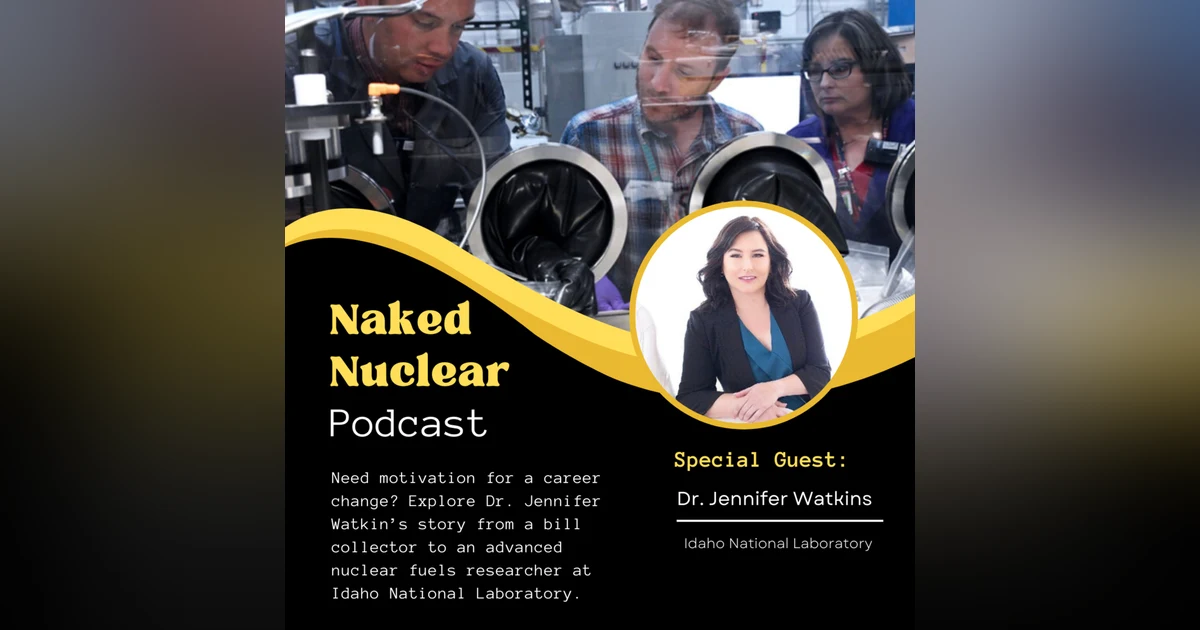
In this inspiring episode of Naked Nuclear , we share the remarkable story of Dr. Jennifer Watkins, who made an unexpected career pivot from bill collector to becoming an advanced nuclear fuels researcher at the Idaho National Laboratory. From growing up in rural Idaho to earning a PhD at Boise State, Dr. Watkins reflects on the pivotal moments that changed the course of her life.
She opens up about the challenges she faced, including jumping back into math at age 36, and shares how her passion for discovery led her to groundbreaking work in nuclear fuels research. This episode highlights how resilience and a willingness to keep learning can propel you toward a career in one of the most critical industries of our time: nuclear energy.
Episode Breakdown:
00:00 – Pivoting Your Career: From Bill Collector to Nuclear Scientist
00:34 – Introducing Dr. Jennifer Watkins
01:07 – Early Life and Initial Career
02:21 – The Decision to Pivot
03:40 – Entering the World of Engineering
05:58 – The Hero's Journey Begins
08:37 – Discovering Nuclear Fuels
09:57 – Advanced Technology Fuels
11:43 – Graduate Studies and Research
15:38 – The Push for Nuclear Energy
19:30 – Breaking Down Nuclear Myths
20:34 – Advice for Aspiring Nuclear Professionals
25:42 – Rapid Fire Questions with Dr. Watkins
28:58 – Final Words and Future Episodes
Dr. Watkins' Publications:
Looking for Dr. Watkins' groundbreaking research?
What's research is happening at Idaho National Laboratory?
https://inl.gov/nuclear-energy/all-research/
Looking to pivot your career into nuclear?
Check out the Center for Energy Workforce Development brochure:
https://cewd.org/wp-content/uploads/2021/03/GIE-Nuclear-Flyer-FINAL.pdf
Full Transcript
[00:00:00] Danielle Allen: Have you seen that episode of friends where Ross and Chandler are taking the sofa up the stairs and Ross keeps saying over and over pivot. Pivot. Pivot. Well, what if that thing you were pivoting, wasn't a sofa, but your entire career.
[00:00:21] Dr. Jennifer Watkins: I was a bill collector for a long, long time. I was freshmen, even though I was in my middle thirties and let me tell you, I, I thought math was going to be the death of me
[00:00:34] Danielle Allen: Today on naked nuclear. We're bringing you the story of Dr. Jennifer Watkins. An advanced nuclear fuels researcher at the Idaho national laboratory. Dr. Waktins obtained her PhD from Boise State in the Micron school of material sciences. On this episode, we're bringing you the story of how she pivoted from a credit card bill collector, to leading a team at one of the most advanced nuclear research labs in the nation.
So, where does this story begin?
[00:01:07] Dr. Jennifer Watkins: I was born and raised in Idaho, so not , not far from Boise. Outside of Boise in the Treasure Valley, , and still most of Idaho, is really rural. , so, I grew up on, like, a little, Farming ranching community, so we had horses and 4 H and,
I was like, I don't really want to do this, I was always interested in, , I was interested in science, but, , not necessarily nuclear because nuclear is not, , With the exception of Idaho National Lab, it's really not in Idaho, right?
We get all of our power from, , hydroelectricity. , not all of it, but most of it.
[00:01:45] Danielle Allen: And like every kid at age 10. They either want to be an astronaut, a Marine biologist, or a doctor when they grew up. And that might've been the case for Dr. Watkins.
[00:01:57] Dr. Jennifer Watkins: You know, actually, I was, I really wanted to be a medical doctor. even up through the time I was getting ready to graduate from high school, , I actually thought I was gonna be a neurosurgeon, that was kind of the, the thought that I had. Now, thankfully, that's not what happened.
don't have the bedside manner for it.
[00:02:15] Danielle Allen (2): Dr. Watkins doesn't become a neurosurgeon. So, what happened instead?
[00:02:21] Dr. Jennifer Watkins: Yeah, so, , it was a little bit strange. did really well in high school and, Probably should have gone straight to college.
, and that was kind of the direction I was headed, but just life circumstances happened. And so I got a job straight out of high school and I got into the collection field. So like I was calling people, I was a bill collector for a long, long time. so it started out like credit cards and, , you transitioned over to the city of Boise.
And, , was, , in the collection office, they're doing like utilities and parking tickets and court fines, all, all that kind of stuff. But, , you know, I was pretty good at it and I enjoyed it for a while, but, it's not a positive job. And, really the people that I worked with made, made my job enjoyable.
the people that I started out with, they kind of transitioned to other things. And I was like, you know what, I need to go do something else. I need to go look at doing something else.
[00:03:25] Danielle Allen: So there's that still small voice calling out saying, pivot, pivot, pivot. So, that's where nuclear energy has to come into the picture, right?
[00:03:40] Dr. Jennifer Watkins: , I actually thought I would go into like biology. So I met with the biology head of the, the biology department at Boise State.
Obviously, I wasn't planning on leaving the Boise area, so, and I was a Boise State fan, so of course.
The head of the biology department said, well, what do you want to do when you're done? Want to just be a lab tech? And I'm like, well, no, not really.
And He's looking at my transcripts and of course it had been a long time since I've been in high school, right? But he's looking at my transcripts and he's like, you know, unless you're planning on getting a doctorate which at the time I was not I just Get , you know my bachelor's degree. He said you need to go be an engineer... and I was really taken aback because the only engineers I knew worked at the city.
[00:04:26] Danielle Allen: All the best hero's journeys, have the answer to the call. And the subsequent questioning of said, call. We've all been in that situation. That's still small voice saying I can't develop that. I'm not a coder. I can't finish a novel. I'm not a writer. I can't talk on stage. I'm not a speaker. But what does it actually mean to be a coder, a writer, a speaker.
And advanced nuclear fuels research engineer. Do you have to do the thing before you can say you are the thing. And if you've never taken any engineering classes or tinkered build anything. How could you call yourself an engineer?
It'd be pretty easy to say. I'm not an engineer. If you've never done engineering. So, what did Dr.
Watkins say?
[00:05:22] Dr. Jennifer Watkins: No , I'm not an engineer.
pretty much kicked me out of his office and sent me over to the engineering building. And I had a meeting with, Dr. Amy Mall, who was material science program there. she just, she was very, , vibrant and passionate about what she did. I had zero idea what material science was. I really wasn't on board with this whole engineering thing, but she had this cool dog in her office and I was just like, all right, you know what?
Fine. I'll try it. And that's how I got into it.
So our hero starts her hero's journey, but it wasn't without fear and apprehension.
[00:06:08] Dr. Jennifer Watkins: Right. Right. I was like starting from scratch. I went part time obviously because, you know, I had big girl bills to pay and so I still needed a full time job , , but after a couple of years and I got through the first little bit of, basics, I was like, man, if I'm going to do this, I really need to be all in on this
thankfully I had some really good Friends and a support system that I was able to leave my full time job, which was really scary We had known for 16 years And yeah, I became a student, full time student, and,
[00:06:42] Danielle Allen: , And a good one at that,
[00:06:44] Dr. Jennifer Watkins: I mean, I did, yeah, I did okay, but I mean, it was hard, you still gotta study, and let me tell you, I, I thought math was going to be the death of me, you get through it and , you know, make those friendships and in college, like everyone does and, study groups
for about a year, year and a half, was suggested to me that I get into one of the research groups
i, looked at a couple that, they said the professors were hiring and, , Dr. Daryl Butt ran the advanced materials lab,
[00:07:13] Danielle Allen: Now, material science is an immensely large field. Think of materials. Tables, floors, doors, marbles, steel, uranium. Boise State, Dr. Watkins alma mater, is currently exploring the use of DNA to program quantum information systems. I don't even know what that means, but for Dr. Watkins, in this immensely large sea of materials, nuclear bobbed up to the surface.
[00:07:45] Dr. Jennifer Watkins: , in the, , at the time it wasn't called the Micron School of Material Science, but it was the material science program. He has, An amazing background, like he's just done all sorts of things, um, and, and has a background in nuclear, right?
So he's , did was doing fuels research, but he was doing a lot of different things. Is a ceramicist and, , an artist and it was just all these different, things that I got to do. And I went in to talk to him and I think he'd already decided yeah, yeah, I'll hire you.
The first thing I got to work on was, , we'd looked at, um, a skull. we did a project with the Walters art museum in Baltimore, where we looked at a mummy portrait, but really I was like, I want to get into this nuclear, you know, I want to do the fuels work.
So finally, our hero has reached her first quest, nuclear fuels. And what is it about nuclear fuels that drew her to this field originally?
[00:08:50] Dr. Jennifer Watkins: You know, and I, I was like, wow, this is really cool.
Cause I had no idea that we had anything like that at a Boise State. What they, they do like radioactive stuff, and just as I started looking into it, I was like, this is so amazing . . , and of course, this isn't really like a scientific answer to this question. Nuclear is kind of like magic so much power in something so small that you can't, right. It's just, it's like mind boggling.
This is so cool. That is just what I tell people. I'm like, I know that's not the scientific thing. I can speak scientifically about it. And I wanted to do it.
So, um, I think being a non traditional student helped with that. They had not had any undergraduates that were Handling the nuclear material at the time. Our lab manager who was getting his PhD , I got to mentor under him and, you know, learned how, , these , ATF fuels or, , they were, , called accident tolerant fuels, but I think we pushed forward to advanced technology fuels , which is more appropriate.
[00:09:57] Danielle Allen: Accident tolerant fuels, now known as advanced technology fuels, what is ATF? So, when people think about nuclear, specifically nuclear energy, reactors, power plants, they most notoriously relate them to nuclear fuel reactor meltdowns. And the fuel sources are one of the sources of power, but also the capability to meltdown.
So an accident tolerant advanced technology fuel is a type of fuel that when put into a stressful situation doesn't, you know, melt down.
[00:10:45] Dr. Jennifer Watkins: I started looking at uranium mononitride. , that was the fuel type that, , my mentor was, was looking at. It is, , one of the accident tolerant candidates or advanced technology candidates. It's got a, more uranium density, higher thermal conductivity. So just a lot of material properties that are better than what our benchmark fuel currently is, but.
It has, , a problem , you know, it's air sensitive and, it's very water sensitive. Yeah, we're going to put it into a, , water reactor.
[00:11:20] Danielle Allen: , so most of my work was on, , looking at, , Methods and ways to improve the corrosion resistance of these ATF fuels, now, Dr. Watkins is studying uranium mononitride. Do you remember earlier in this podcast episode where she mentioned that she wasn't going to get a doctorate?
I, like I said earlier, I didn't plan on getting a doctorate, right.
[00:11:46] Dr. Jennifer Watkins: I but, , my advisor was like, no, no. , you know, my senior year, he was like, I will offer you a grad student position right now. If you'll stay, I'm like, well, let me think about it. I decided, well, yeah, I, I think I'll go ahead and do that.
And do this. About 30 days after I signed my grad student contract, he accepted a position at University of Utah and our lab manager who had graduated with his PhD was taking over. And so we agreed that he would take me on
we have millions of dollars worth of equipment in this lab at Boise State. This is what I'm comfortable with.
This is what I want to do . I stayed to do that.
[00:12:29] Danielle Allen: Now the cogs just seem to align for Dr. Watkins. Because after she decides that she's going to stay at Boise State. She then gets a fellowship from the Department of Energy.
[00:12:45] Dr. Jennifer Watkins: As part of that, was applying for fellowships and I was lucky enough to, , get the Department of Energy nuclear energy university program. That was , a really, , advantageous moment for me but as part of it, you needed to do a 10 week internship at a Department of Energy location. I'm working on fuels. I'm in Idaho I'm going to INL of course.
[00:13:10] Danielle Allen: That's where Dr. Waktins really starts to dig deeper into nuclear fuels research.
[00:13:17] Dr. Jennifer Watkins: We were working on a project for, Westinghouse, where we were doing, , silicide fuel, uranium silicide, , and we were working on making pellets that were going to go into, , lead test rods, that would be the first non oxide fuel that would be irradiated in a commercial reactor.
[00:13:36] Danielle Allen: So let's pause. the first non oxide fuel that would be irradiated in a commercial reactor. What does that even mean? So oxide fuels are the classic fuel types. When you think about nuclear reactors, They can be prone to overheating during a reactor accident, which is why there's such a push for accident tolerant fuels. The new fuels that Dr. Watkins researches includes the nitride and silicides. Nitrogen and Silicon blends instead of oxygen.
[00:14:08] Dr. Jennifer Watkins: So that was what I got to work on during my internship. And of course that was successful. Those pellets have since been pulled out. And so that was a big achievement. And because of that work, I got offered, , the INL Graduate Fellowship, which, meant that I would finish my classes at Boise State. And once I was done with my classwork, then I would come out to INL and finish my research,
[00:14:38] Danielle Allen: this sounds like every researcher's dream. Being awarded fellowships and scholarships in order to do your work. But it didn't come without hard work.
[00:14:49] Dr. Jennifer Watkins: I spent the night in the lab, changing gases and, and running, you know, running synthesis I remember, you know, Working over winter break, , every day I was in the lab that three weeks of winter break, right? Ended up in a pit. So that all went into my dissertation. It was long and, um, it was rough. After I came to INL, um, things just move a little bit slower out there, not, university work where, you're still safe, but I didn't have to have a health physicist and a radiological control and a shift supervisor.
I didn't have to have people with me to get my work done. And then of course COVID, but, during COVID I wrote like three review papers that got put out on ATF. So that was nice.
You know, that time at home allowed me to do that.
[00:15:38] Danielle Allen: Let's step back and take a little bit of perspective. Why the push for accident tolerant fuels in the first place.
What's driving the nuclear resurgence. . What is this new nuclear movement and why is it happening? Well, we need power. We need infrastructure. and we needed clean. and we need it now. So when I asked Dr. Watkins, what's the , big deal about. advanced nuclear fuels research.
She gave me a pretty in-depth answer.
[00:16:08] Dr. Jennifer Watkins: well, I'll start off with explaining what you got uranium, right? Just uranium that you could dig up out of the ground, , is, , just natural uranium. So it has 0. 7 percent of our fissionable isotope, which is U235. So in our current commercial reactors, we have to enrich the fuel to, , no more than 5%. Uh, regulatory, We can't go any further than that. So anything between 5 and 20 percent enriched is what is considered HALEU or high assay, low enriched uranium. And that's what these advanced reactors need so that there's more fissionable material so that they can get more power density out of a smaller sized core.
, that's how they're going to make them smaller, how we're going to make them portable.
Everyone's interested in, , HALEU, right? Whether it's HALEU oxide or HALEU Metal fuel or, the other ceramics, nitrides, .
They've got to have that extra uranium density in there and they all want that. And that's how we're, sizing these reactors down.
[00:17:21] Danielle Allen: So who exactly wants HALEU?
And where are they located?
[00:17:27] Dr. Jennifer Watkins: We've got a lot of work spread out, , some of our group is working with, , TerraPower , I've, I've been heavily involved with, , Global Nuclear Fuel, in, , North Carolina, collaborating with them, , they're the ones that we made the HALEU U024, , And yeah, it seems like everybody's really interested in the nitrides right now.
[00:17:48] Danielle Allen: Another way to think of this is a big, lumbering all wheel drive SUV. versus a certified F1 race car. Now the race car is going to need a lot more efficient, fuel, and a lot more dense, fuel.
[00:18:06] Dr. Jennifer Watkins: You know, like I said before, getting these units smaller, more flexible, so they're less expensive. In order to do that, you've gotta raise your power density, it's gotta have more of that U235, right? So they can't, they can't go with 5%. 5% is not gonna cut it. The neutronics of it it won't work. HALEU is still nuclear fuel but it's more like race car fuel versus, Fuel that I would put in my car, right?
Higher octane, I guess . ,
[00:18:37] Danielle Allen: with new fuel types, higher density, fuel type, better thermal conductivity leading the way for, advanced modular reactor research. It's no wonder that Dr. Watkins is actually pretty hopeful for the future.
[00:18:53] Dr. Jennifer Watkins: Would like to see. A nuclear reactor everywhere, whatever power needs we, have, we'll get from our, own nuclear reactor.
I would love to see that everywhere, , it's not as common, , , in the West, , we don't have many reactors as they do back East. I would like to see that. Obviously I want to have nuclear be automatically connected to green energy. Instead of people thinking, Oh, I don't know anything about nuclear it's not any different than they think about a power plant anywhere else.
[00:19:25] Danielle Allen: There's all this mystery around what a nuclear reactor is or isn't. So how does Dr. Watkins break it down?
[00:19:33] Dr. Jennifer Watkins: Yeah, you know, I, everybody is. Oh , that's so it's like mysterious. It's really not . A nuclear reactor is really just. A different way to boil water just a big . It's a different tea kettle.
It's not any different , than , a coal plant or a natural gas plant. Right. We're just heating water to turn a turbine to generate electricity. It's just how are we generating that heat that's the difference, .
And people should know that they can get into the nuclear industry, right? You need people to work in it and you don't have to work with fuels. . You can work in the nuclear industry and do lots of different things, ?
There's modeling, there's, , nuclear medicine, , transportation, construction , if we're going to build all these new reactors, we've got to have people that are going to come build them. And people shouldn't think that, You have to have a PhD to work in nuclear, right? I mean I do yes, but you don't have to
[00:20:31] Danielle Allen: If you're a listener and you're thinking. right now, how do I pivot? Into the direction of a job or career in the nuclear field. Where, where do I begin with that?
[00:20:42] Dr. Jennifer Watkins: Look, look it up what kind of industry are you, you know, Interested in, ? , you want to be involved in the energy sector. Do you want to do policy? Would you like medical or in safety and security like our safeguards, right?
That's one of the things that, that they always need, ? There's been a couple of times where, , let's say for COVID, for example, when we shut down the site, , I guarantee you, we still had our guards out there, ?
The guards did not go home, , during COVID, ?
If, if they have a research lab, they'll have a website probably. See what piques your interest if you have the ability to go down there and talk to him in person, that's probably where I see if you could get in, look them up, see what kind of research they're doing.
If you're not afraid to pick up the phone and give them a call something like that. Yeah. Um, because they want, they want to see that passion from you too.
You shouldn't worry about if you're too old to start it, right? I was 36 when I started. Yeah. I don't maybe recommend that path, but
[00:21:47] Danielle Allen: going to school with 19 year olds.
[00:21:50] Dr. Jennifer Watkins: That was a, you know, I obviously have some really great friends who are, you know, 20 years younger than me. Yeah. If you are looking at going to university and, , want to get into that area, find a professor that's working in the field that you're interested in.
You just reach out to them and, you know, find out. Do they have a spot in their in their research lab? Because if they're doing nuclear they have a research lab. If you're just looking to switch into the nuclear field into industry , you could , reach out to recruiters linkedin, , see who's hiring in that Industry, and don't be put off by term, you know, the nuclear term, right?
, so a good example is we were looking for a metallurgist in our group and we were not getting any candidates for it, which is like nobody was applying What is it? Like it's pays really well like yeah scientists are you know, yeah, we're interested for the science everything But i'm gonna tell you the money's nice, too Um, so we just couldn't figure out why we weren't getting any candidates and it's like, you know Maybe it's because they don't have the nuclear background, right?
Your skills can be transferable to the nuclear sector, just because you don't have nuclear experience. If there are people that are interested in or considered switching to the nuclear sector, , obviously we're having a resurgence right now, right?
So now's the time to get in, get in on it because that's where you want to be.
[00:23:24] Danielle Allen: Again, there's that word? Resurgence.
[00:23:28] Dr. Jennifer Watkins: Yeah, I think people are coming on board with the fact that we will not meet climate change goals, if nuclear does not mix , it will not happen, the renewables are great, , solar, wind, , hydro, but there's no way we will meet these climate change, , mandates. If we don't have nuclear.
These small, small reactors, that that's how we're going to accomplish that. We have to be able to have something that's stable and able to provide electricity to the power grid. 24 /7 and nothing does that like nuclear.
[00:24:06] Danielle Allen: But what about safety is nuclear safe? , when people think of nuclear reactors, they think of Chernobyl Three Mile Island, Fukushima disaster. How safe is the nuclear industry?
[00:24:20] Dr. Jennifer Watkins: Yeah, I think we've been able to show that. Despite. The fear mongering that some people like to , , immediately jump to , when the word nuclear comes out, , I think shown that it is safe.
You know, it's one of the safest industries actually. , We've been doing it, since the 40s, 1940s and we've been doing it safely, there, you know, there's drawbacks to anything, right? Yeah, we have nuclear waste. We know that that has to be dealt with, , but we've been dealing with it safely for all this time,
it's not as. Big of an issue as I think the perception is, , these advanced reactors also, we'll be able to get less waste out of them as burnups. , so you're burning off some of that, , really radioactive waste. We know how to deal with it safely.
[00:25:14] Danielle Allen: And so as you've been listening to this podcast, if you're anything like me and you hear Dr. Watkin's story and think she's not real, this is not real. She's just casually leading the forefront of advanced nuclear research technology, switch careers, got a PhD and made it look really easy. One of the things I wanted to bring is a little more human aspects.
So here's a quick, rapid fire sequence where we get to learn a little bit more about. Dr. Watkins when she's not involved in the nuclear energy space.
So if you had to give a TED talk, only had four minutes to prepare, what would you talk about if it was not your subject matter that you're an expert in?
[00:26:04] Dr. Jennifer Watkins: Cosmetics and makeup.
[00:26:06] Danielle Allen: , I feel like there's a whole other podcast on that. Okay. So, if you're not in the lab, , what other hobbies are you getting up to?
[00:26:12] Dr. Jennifer Watkins: I like to go golfing, , obviously reading, , being outdoors. I have two national parks that are an hour and a half. away from me, so I like to go hiking. , and, , I also do online gaming.
[00:26:27] Danielle Allen: Oh, nice. Okay. Um, if you weren't a subject matter expert in nuclear fuel types, what other fields would you try to master?
[00:26:36] Dr. Jennifer Watkins: Photography. I like photography and I had this, , vision at one time that I wanted to be a florist.
[00:26:45] Danielle Allen: And lastly, could you describe, , HALEU, with only using candy types?
[00:26:52] Dr. Jennifer Watkins: I think the best analogy I can give to that would be, it's like milk chocolate and dark chocolate. So milk chocolate is like regular LEU, you know, it's got a little less cocoa in it. Dark chocolate has got more cocoa. It's just got a lot more of the good stuff. . It's still chocolate.
[00:27:14] Danielle Allen: Maybe like a little bit better.
And her suggestions for who she would want to hear next on this podcast.
[00:27:23] Dr. Jennifer Watkins: , you know, I think, , if you could find someone, , In industry, right? It's one of the,, get with one of the companies that's, getting these new reactors to market, it's always interesting to hear from policy people as well. , had I not done fuels, I was looking at, , going into like the nuclear forensics portion of it, or like safeguards.
[00:27:46] Danielle Allen: And her final words of advice for those who are maybe interested or so bold to make the pivot.
[00:27:55] Dr. Jennifer Watkins: Yeah, you just have to persevere. , and, don't be a perfectionist, I. Never thought I would flunk a test in my life and I flunked more than one and Guess what? I still get to be called doctor. So , just perseverance. I have a good support system , just don't don't give up.
Obviously if I can go back to school at 36 and not be as strong in math and you know and have an engineering degree, yeah You can do it
[00:28:30] Danielle Allen: So in summary, if you were thinking about a career in nuclear, Number one, look it up. Go find a professor, go to the lab and talk to them. Number two. See what you're already interested in. Number three, see what skill sets might apply that you already have. And number four, it's never too late to go back to school, not even at 36, not even at 46.
For the rest of the season, we're taking Dr. Watkin's advice and we'll be talking to some of the policy-making people. The grass roots efforts and movements around the nation that are championing nuclear. We'll also have radiation technicians. on the show. Talk about. , investing. nuclear energy and uranium mining, the very contentious uranium mining that will be happening potentially in the United States and what that means for indigenous tribal lands.
This has been Naked Nuclear stripping down the topics in nuclear energy and technology. Special, thanks to Dr. Jennifer Watkins for accepting my invitation on this show. Sydney Weeks for coordinating all of the scheduling and followups involved as well as the Idaho National Laboratory for giving us their blessing to record this show. Thanks again for listening.
**Naked Nuclear** strips down nuclear energy so it actually makes sense. New episodes weekly. 🎙️ [Listen on Apple Podcasts](https://podcasts.apple.com/us/podcast/id1781924674) · [Watch on YouTube](https://www.youtube.com/@TheNakedNuclearPodcast) 💡 Curious about nuclear careers? Visit [nakednuclear.com](https://www.nakednuclear.com) for episodes, resources, and guest spotlights.