Becoming the No. 1 University for Nuclear Engineering: University of Michigan Deep Dive with Department Chair, Dr. Todd Allen


 RSS Feed
 What does it mean to be the #1 nuclear engineering program in the country?
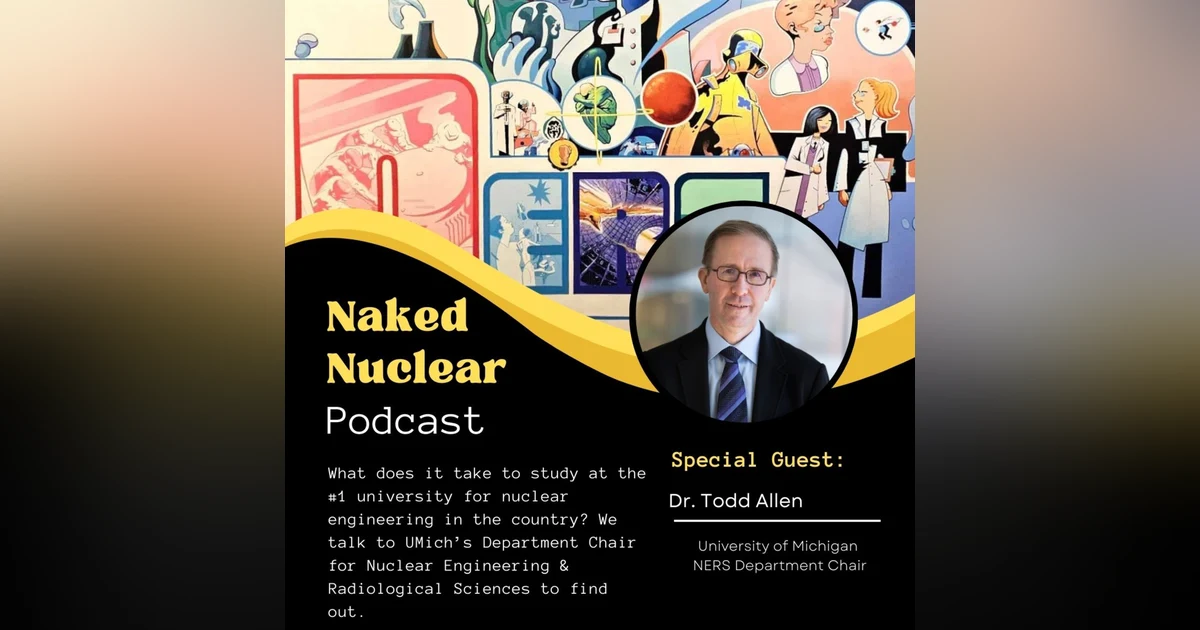
In this episode, we sit down with Dr. Todd Allen, department chair of the University of Michigan's Nuclear Engineering & Radiological Sciences (NERS) program, to explore the history, mission, and future of a department that blends technical excellence with human-centered education. From submarines to art tunnels, this conversation offers a 360° look at what makes Michigan a true nuclear powerhouse.
We cover:
-
How a student-led movement after WWII became the Michigan Memorial Phoenix Project
-
How Michigan is preparing students for advanced nuclear innovation
-
The creation of a living memorial through art and engineering
-
Undergraduate and graduate experiences in one of the world's most well-funded and research-rich departments
-
The Harper All Stars and how mentorship and scholarships are shaping the next generation
-
The OECD Global Forum on Nuclear Energy Science, Technology & Policy, hosted at Michigan this fall
-
🔬 Michigan NERS Main Page
https://ners.engin.umich.edu -
🕊️ History of the Michigan Memorial Phoenix Project
https://ners.engin.umich.edu/academics/harperacademy/
https://www.charlesharpercharities.org/harper-academy-4-future-nuclear-engineers -
🎨 Phoenix-Themed Tunnel Art Installation
https://news.engin.umich.edu/2023/08/a-nuclear-engineering-education-inspired-by-art -
🧑🎓 Harper Academy All Stars (Charles Harper Charities)
https://ners.engin.umich.edu/2024/09/16/harper-academy-all-stars-support-ners-research
https://www.charlesharpercharities.org/harper-academy-4-future-nuclear-engineers -
🌍 OECD Global Forum on Nuclear Energy Science, Technology & Policy – Hosted at U-M
https://ners.engin.umich.edu/2024/07/01/u-m-to-host-oecd-nea-global-forum-on-nuclear-energy
Subscribe, share, and leave a review to help us amplify the future of nuclear energy.
Follow Naked Nuclear for more episodes that strip away the jargon and dive deep into the people, programs, and power behind nuclear science.
**Naked Nuclear** strips down nuclear energy so it actually makes sense. New episodes weekly. 🎙️ [Listen on Apple Podcasts](https://podcasts.apple.com/us/podcast/id1781924674) · [Watch on YouTube](https://www.youtube.com/@TheNakedNuclearPodcast) 💡 Curious about nuclear careers? Visit [nakednuclear.com](https://www.nakednuclear.com) for episodes, resources, and guest spotlights.
Full Transcript
[00:00:00] Danielle Allen: What makes a university the number one program in the country for nuclear engineering? Is it groundbreaking research, legendary history, or a vision that's just shaping the future of energy? Today we find out meet Professor Todd Allen, Glenn F, and Gladys H Knoll department Chair of Nuclear Engineering and Radiological Sciences at the University of Michigan. Also the director of the Fastest Path to Zero Initiative and an ANS Board member.
[00:00:31] Todd Randall Allen: We've got the largest faculty, of a all the departments and we don't have the most students. It allows us to have depth and breadth across a bunch of different technical areas,
[00:00:39] Danielle Allen: In this episode, we uncover how Michigan's nuclear engineering department blends cutting edge research with a legacy, born from a living memorial. Explore opportunities for students
[00:00:50] Todd Randall Allen: Giving them research opportunities as an undergrad helps them understand whether they really like doing research, you get a PhD, it's a five year degree and if that's not what you wanna do, you should not spend five years doing it.
[00:01:02] Danielle Allen: And look how they're preparing for the next era of nuclear energy.
At At the end of this episode, we're going to be highlighting an opportunity for high school students to get real life research at Michigan.
So how did Dr. Allen get into nuclear engineering and become the department chair to the number one university for nuclear engineering.
[00:01:21] Todd Randall Allen: You know, it,, like for a lot of people it all got started a little bit serendipitously. Like I didn't know anything about the Navy, and that these recruiters showed up and said, you all, you and your friends can skip history class.
If you go listen to the recruiter, and of course. we're out. Right. But then, yeah, I, I applied for the ROTC scholarship and got one and that allowed me to go to Northwestern, which I really couldn't have done otherwise. And then that's where I learned that submarines are powered by nuclear power.
And I actually had applied to be a computer science major, but I switched over to nuclear. And then there you go.
I got here in January of 2019, so it's about six and a half years now.
We've got the largest faculty, of a. All the departments and we don't have the most students. There are some schools like Texas a and m that have really large undergraduate programs, which we just have chosen not to do. But, I think we differentiate a bit by having such a large faculty. It allows us to have depth and breadth across a bunch of different technical areas, right? So we've got people who do what you would consider fision reactors. So. heat transfer. We've got another group that does material science specific issues for nuclear reactors, so radiation, damage and corrosion. We've got a big group that does radiation detection and measurements, both for operating nuclear plants but also for national security. we have got a plasmas and fusion group and then we really have started and are building out more of a policy social engagement, part of the department that wasn't historically there. But the nice thing about having that large of a faculty is, from a student perspective, we can teach all the same undergrad courses that everyone teaches, but we have enough faculty to do specialized graduate level courses, which might not be possible in a place with a smaller faculty. So it is nice, it gives us a chance to do some interesting things.
And what's funny is my reason for taking the job is I really felt that nuclear engineering departments to a great extent, were getting a little bit sort of, separated or isolated.
They weren't really working in the interdisciplinary space. And I really wanted to use the opportunity at Michigan 'cause it's this big department and we were about to. Retire and then hire a bunch of new faculty. So we get to reset what the faculty looks like. I really wanted to get everyone engaged in nuclear , across the campus.
Right. Be interdisciplinary.
[00:03:31] Danielle Allen: Michigan's NERS department isn't just a program. It is rooted in the Michigan Memorial Phoenix Project. A living memorial, born out of World War II, aimed at advancing civilian nuclear applications.
[00:03:43] Todd Randall Allen: I thought this was a novel concept, but it turns out that after World War II... the students at the University of Michigan petitioned the administration, the leaders of the university, and they wanted a tribute the students who had gone and lost their lives in World War II...
It's 585 students, the request was very specific. They wanted something that was not like a static memorials. They didn't want a plaque or a statue. They wanted a living ongoing memorial. So this would've been right around the times of, President Eisenhower's Atoms for Peace Talk.
And so out of all these conversations, they decided that this tribute to Fallen War Vets was gonna be a campus-wide study of the newly emerging civilian applications of nuclear energy, It's called the Michigan Memorial Phoenix Project. So Michigan, because it's the University of Michigan Memorial because it's a tribute to war vets Phoenix after the mythical that sort of dies and reinvents itself. Right. So their thought, I think was most people at that time would've heard the word nuclear around weapons in World War II, and it's like, we want you to rethink that they're useful civilian applications. And so the Phoenix Project was born and it was the first ever fundraiser the university did. And you think, wow, they do 'em all the time. Why this one? Well, at the time, so much of nuclear was wrapped up in defense programs and classified work, and they said, if we're gonna lead in. Looking at the civilian applications, then we should be independent of the government. And so they said, we're gonna go out, we're gonna raise money to do that. As part of that, they raised money. Ford Motor Company came up with the money to build the campus' research reactor. so in the early days of the Phoenix Project, there were like cross campus studies, right? You can imagine the law school is trying to figure out what are the new legal implications of this technology. And we've got a, you know, in the historical records of one of our professors was writing law briefs for the then Atomic Energy Commission. That became law and how they did. So everyone was engaged. They had atomic days on campus.
And so, I thought my motivation to be cross-disciplinary was novel. It's really going back to history, right? So we were born out of that, and then a few years after the Phoenix Project got going, there was enough momentum on campus to create a graduate program, then a department, and then eventually an undergraduate program. We lost that reactor. The university shut it down 2003.
So it's been a little over 20 years. And honestly, the history of the Phoenix Project had gotten lost in the interim, but it's one of my, my quest in life here is to get the campus to remember. It's a really fascinating history and it's almost embarrassing to me that I never knew this history even though I got my PhD here, right? I learned everything after I came back as the department chair.
[00:06:29] Danielle Allen: So how does the department's origin story shape its identity today? Let's look at how Michigan's unique beginnings still influence its mission and vision for students.
[00:06:40] Todd Randall Allen: So we just finished year two of a bit of experiment. We're trying to do some things that are sort of novel in that space. I teach a course, which is our sophomore introduction to nuclear engineering. So the first course you take. As an undergraduate engineer in nuclear course, I teach, and we made a deal with the Art Institute on campus we partnered with a local Detroit area artist, and we had him come in and talk to the students about their motivations for being engineers. Right. But as part of this, he also learned about the Phoenix project and the history of the department. And we are primarily in two buildings that are connected by an underground tunnel, which traditionally was just a, dark creepy tunnel where you would go if there was a tornado, but we resurfaced all the walls so that are paintable. And he painted the first mural last summer and then he's in the process of painting panel two in the story. But the idea is each year we repeat this, right? And we sort of work this history of what our students were thinking about in nuclear as it go down the wall, and I was super happy. the way the students picked up on the Phoenix story.
So if you get a chance, you can Google it. But, if you look at the panel one, there are three Phoenix images embedded. In, the first mural. Right. Which I'm really proud of. And I think that, I mean there's lots of reasons for doing this. One is like, engineering in theory should be a very creative field, right?
But we tend to invite students into engineering. And in high school they may be musicians, they may have been artists but we tend to say like, that's not important. We want you to study Schrodinger's equation. So this is meant to be like a little signal to the students, like, don't, don't check your creativity at the door. Hopefully it becomes like a living history of the department that alumni are proud to come back of. And then there's a, like a subversive motive, which is, I want the art itself to get known enough that people come to campus to see it, and then maybe learn a little bit about us.
[00:08:31] Danielle Allen: From its earliest days, Michigan embraced an interdisciplinary approach that brought together engineering, law, policy, and creativity. But what happens when a nuclear engineering department becomes a hub for collaboration across an entire campus? You'll hear how Michigan uses its size and expertise to push boundaries in education and research.
[00:08:53] Todd Randall Allen: Within the specific research areas, I think they've really grown organically. I mean, if you go back to the start of the department, it was really around fission reactors,. We have a core and we still have a number of faculty in that area. And then we had, and. Faculty were sort of leaders, maybe even creating the field of radiation detection. Like you need to measure radiation. Right. And so you, you know, you start with people who are physicists, but then they go in a direction. And so, uh, lots of nuclear engineers, when they study radiation detection, used this textbook by Glen Knoll. So he was our faculty member, right. Glen Knoll was a pioneer in this field and like his legacy lives on in that group of faculty. At some point people get interested in fusion reactions , and fusion processes as separate from fission reactors.
And now that's a big, group and the laser lab that we have, we've got a big ultra fast laser lab is part of that, which most people would not think of as a nuclear engineering facility. And, you know, 40 years ago they recognized that , changes to material properties unique in a reactor.
So they hired a young faculty member who then built up what's now the Michigan Ion Beam Lab. He's retired, but we've got this world class laboratory now that people from around the, the country come to. So I think to a great extent, it grows out because of the needs of the field to grow. even Even our most recent foray into policy and climate and social engagement is based on that, right?
The nuclear engineering field, I think to a great extent, ceded the discussion around social interactions and stuff to non-engineers. And I don't know why we did that, right?
I mean, I think as engineers we need to study that as a science, ask hard questions. But the default position should not be people who want to limit the technology. Are doing those kind of studies, right? So I think you know it, it grows that way as you see opportunity.
[00:10:43] Danielle Allen: The department's faculty spans across every corner of nuclear science from radiation detection to advanced materials fusion and policy. So with so many pathways, how do students carve out their niche? Let's dive into how undergrads and grads find their footing and discover where they fit in the nuclear landscape.
[00:11:05] Todd Randall Allen: At least at Michigan, you're not required to declare a major until you're a sophomore. Are right now, some of our students come to the university knowing what they wanna do. Others try to figure it out. So part of the, goal with incoming freshmen is to at least let them know we exist, right?
Because most of them have heard of computer science or mechanical or other things. Not all of them know what a nuclear engineer does. When students pick their degree. Or even sometimes beforehand, we try to make it really obvious that if they're interested in a research experience, and that could be you just go work in a research lab, one of the faculty's research labs as an hourly make some money and do research.
Or it could be as part of a course project. So we make sure those. opportunities are known and we try to advertise them. And then I think for some of our students, they get in sort of one of two tracks. A lot of them want to go to graduate school.
I think traditionally we're known more for the graduate program than the undergraduate program, but we do, have a good number of undergraduates and like a lot of places around the country the last couple years, the undergraduate numbers are really jumping up. And it's, I wish I could say it's something special we did, but it's a national phenomena. Some of our students will, just wanna finish the undergrad and they'll take courses and they'll go get a job, meet with industry or something else. A lot of them are really trying to prepare to go to graduate school someplace.
A lot of 'em as a PhD. So giving them research opportunities as an undergrad helps them understand whether they really like doing research, do they wanna spend. Time, right? You get a PhD, it's a five year degree and it's a five year degree to become a professional researcher. And if that's not what you wanna do, you should not spend five years doing it.
So I think giving people that opportunity is an important part, of the undergraduate experience.
In some cases they will want to go get an experience at a national lab or at a, industry, summer opportunity. And so it varies. Uh, but, you'll see both pathways.
if you show up as the number one rank department. I think, like I mentioned before, the large number of faculty provides a lot of different research opportunities, right? Because. Some students will wanna be an experimentalist.
Some students will want to do theory or computation, right? And so we, we have those pathways, within specific technical options. So when I mentioned we have a material science group, some of those students do theory and computation, some of them do experimental stuff.
I think we also try hard to be visible and recruit beyond nuclear engineering majors. Right. So in, in some cases in radiation detection or plasma, the best students may come from electrical engineering or physics, where they've got this really strong background in, electromagnetic theory, I think that. Along with, um, we try really hard to have strategic partnerships with national labs so that our students have an opportunity to go do some of their research at a national lab.
Maybe there's a, a facility or a piece of equipment that the lab has that we don't. sometimes students, we get on a degree pathway where it just makes sense for them to finish up their coursework and then go do the last couple years of their degree at the lab itself. But we do try to make those connections, and a lot of the national labs that have nuclear engineering related programs.
For anyone who's listening to this who's never been in a national lab, they're big enough, right, to be able to support big facilities or big programs, right? So in a lot of cases, some university research is sort of single professor, single investigator. Smaller projects, you may be able to do your project to a great extent by yourself and the national labs try to take it up to the, you need teams.
Broad expertise to work on different facilities. So as an example, if you work at the National Lab and you wanna do fuels experimentation, need people who can. Understand the material science of nuclear fuel. You need people who are mechanical engineers who can build an assembly that will maintain its integrity and the right temperature that you want while it's getting exposed to neutrons in a reactor, right?
And so it's very complicated. So you need a large team of people to do that. So going to the national labs. Some of the advantages are, you learn to work in that big team science environment. Some of it is, when you graduate, you're gonna wanna get a job someplace. It allows you to understand how National Labs work, right?
Like, if you don't know, you're, think to yourself, maybe I wanna be an industrial researcher, or maybe I wanna be an academic. Well go, go check it out, right? Go spend some time at the lab. And in some cases, the labs have programs that are specifically designed to help students finish their degree. And the lab obviously is trying to recruit the best students. Part of it could just be like you're trying to make sure you have a job when you graduate.
We try to make sure they understand that if you're gonna get into nuclear engineering degree, we are a math heavy physics, heavy degree, right? If math is not. Your thing, recognize you will struggle more than others. Every pathway in nuclear ends up being math heavy, but just the degree core is, because we're a smaller department, we've got staff,
who. As part of their counseling of the students. Right. Get really good reviews for a staff member who interfaces with all our undergrads, just does a really good job. The students really appreciate how she connects with them and make sure to spend the time and, is invested in their success. And then I think we also try, and sometimes this happens at the PhD level more than undergrad, but we also try to a student comes along and they say, I'm just struggling with this, or I'm not enjoying this, is to just say that's okay. Sometimes you think oh, I said I was gonna be a nuclear engineer.
I'm struggling, or, I don't like it, but I'm, committed. I think it's better to just, if you figure out that's not the thing you want to do, as a PhD student, you might have. Thought you wanted to do material science, but you take some classes and you really wanna do neutronics, that's okay.
Like, we try to figure out ways for them to shift over and do the thing they want. , And just be honest about that. But one of the things I learned as department chair is, students sometimes wouldn't say it, but they felt like they were committed, they had made this initial choice and that was it.
We try to, to make hard, like we want you to be success, we want you to be happy with the thing that you study. and sometimes those are, they can be challenging, right? Because the students don't, they don't wanna seem like. giving up or they don't wanna seem like, oh, I committed to this faculty member and now I, I don't wanna disappoint them. But in reality, it's like, sometimes you make choices, sometimes pretty, pretty quickly, right? I mean, I still remember, you know, I mentioned I switched degrees as soon as I got to college.
I don't think I was that sophisticated about what the different degrees were. I don't even remember why I signed up for computer science. I like it's okay.
[00:17:27] Danielle Allen: Parts of this conversation reminded me of a previous episode with Lisa Marshall, former a ANS President. Sometimes students get pigeonholed feeling like they have to stick to their decision, not recognizing that maybe they're over committed. Of course. Engineering and a lot of STEM roles can be difficult. However, it's kind of like you have to choose your flavor of difficulty. It's difficult, but do you enjoy what you're doing?
Students at Michigan not only learn the fundamentals, but also get access to unique labs, mentorships and opportunities that shape their careers. , What makes the Michigan experience stand out for students and what do they say when they reflect on their time there?
But first a message from our sponsors. How do you become successful in the job market? If you are listening to season two of the podcast, you know that networking is key. Why? Because networking connects you to opportunities you didn't know existed. Here's the truth. In nuclear, a lot of the best jobs get filled before they even hit a job board.
That's why you need Nuclear Talent Scout. Their recruiters know the companies, the hiring managers, and what it takes to get your resume noticed. When you register, you are putting your name in front of decision makers who are already looking for someone like you.
Go to nuclear talent boost.com and get started today. Now back to the show. I.
[00:19:03] Todd Randall Allen: I always do a few, end of. Program interviews with students and I think a lot of what we hear is they like the fact that it's a smaller degree program, so they know their cohort, right? There's a group of people that they go through the same classes with, year after year, and they sort of build out those professional networks together. Um. It's easier for them to come talk to faculty, right? Like in computer science, the faculty may be teaching a course with a thousand students and the chance of one of those students talking to the faculty for an extended period of time just gets hard, just the numbers. Whereas in a smaller program, that we're just more approachable. And I think the students really appreciate that. I do think they appreciate that. We give 'em research opportunities, we connect 'em to the national labs. We try to help them professionally, understand what their options are after graduation. think those are the things that generally come up.
[00:19:53] Danielle Allen: Funding is a key part of making advanced degrees possible, and Michigan offers several pathways to help students succeed. So what resources exist for students who worry about the financial side of education? Here's how Michigan supports its future nuclear leaders.
[00:20:10] Todd Randall Allen: If students listening to this don't know at the PhD level in engineering schools across the US your schooling it. Almost every case is paid for, The faculty members write research grants to federal agencies, department of Energy, national Science Foundation, DOD agencies, they get money to do the research.
The primary people doing that research are the PhD students, right? And so out of those research programs, your tuition's paid, your salary is paid, your, you know, your, uh, the cost of your medical benefits and stuff. And so if you get into a PhD program, um, you are not incurring debt anymore. Right, which is nice. For the undergrads and master's students, um, to a great extent, they are self-funded, but like a lot of universities , at the undergraduate level, they look at your financial situation and there's financial aid packages. And then on top of that we do have some dedicated, scholarships and things. You know, we write proposals. So right now we have a approved proposal with the Nuclear Regulatory Commission they have given us money and we give those out as scholarships to our students. So there are, there are opportunities like that. And then I, as I mentioned, there are paid work opportunities in faculty laboratories.
To a great extent. We try to, to help the students out. We want them to be, be successful if they get here.
I should say it's not just students who are, wanting a nuclear engineering degree. We're seeing more and more students who want to take our classes, meaning they're an electrical engineer or they're a mechanical engineer, but they want to learn. Something about that.
So because of that, we recently got approval from the College of Engineering for a certificate program. So like your degree would say that you got your. Bachelor's of science degree in mechanical engineering with a certificate in nuclear. Right. It will say that you have taken some time to have more expertise in nuclear than an average mechanical engineer. So what this means in practice is our classes are getting bigger. and so it's more workload on the faculty just 'cause there's more, but there's also, along with that, there are teaching opportunities for students, right? So we tend to have teaching opportunities for undergrads or graduate students. And they tend to be available when we have bigger classes. So for those students who are interested either to understand might they want to be in an academic position, what's teaching like, um, or just sounds like a fun thing to do to make some extra money on the side. Those opportunities, coming along.
And as I mentioned, the fact that we have such a large faculty, we're able to accommodate that. While still being able to do those specialized grad courses. Because you could imagine if you're in a school with a smaller faculty, you may have to self-teach your things at the PhD level.
'cause there's just not enough people to teach the class. Whereas we have the opportunity to teach it in a structured way.
You think as a student, oh, I think my faculty member does research and they teach, right? But if you get to know your faculty member, they all run their own little research group. It's more like being a small business owner, right?
The faculty have to raise money for the group. They recruit everyone. And so. You end up as a faculty member, actually not getting to do as much of your own hands-on research, right? You're, you are working through your student groups to get stuff done. And I think, helping students see that, who think they wanna be part of academia is important. 'cause if you're not the entrepreneurial type, right, you may not like this job as much as you think you will.
[00:23:30] Danielle Allen: Michigan alumni are stepping up into roles at National Labs, startups, and even shaping policy. We have an previous episode with a Michigan alumni and how they're using their TikTok presence to inform a Malaysian public of the benefits of nuclear energy.
So, where does a Michigan degree take you? Let's explore the wide range of opportunities and success stories that come from this program.
[00:23:53] Todd Randall Allen: So traditionally at the grad level, they would go into national labs or maybe academic positions. Over the last 10 years or so, the number of privately funded, reactor design companies, and some associated federal support has just skyrocketed. So there are industrial. some of which look very much like startup firms, right?
Because traditionally a big industry is, is sort of, it's big in nuclear, right? Big corporations like Westinghouse or something. But there's a lot more of 'em that actually look more like startups. A lot of our students are going into industry far more than we used to. I think for the undergrads it's always been they go off to industry or they go off to grad school, sometimes government service, right?
They might wanna work for the nuclear regulatory commission to be one of the regulators. They might work for another federal agency, a fraction of them who get really interested in the medical applications of radiation. We'll go into health physics. Sometimes they'll go get a master's degree or maybe even a PhD, in sort of the medical applications of nuclear.
[00:24:58] Danielle Allen: The industry is undergoing what some might call a renaissance, and Michigan is preparing its students to lead it. So how does a top program stay ahead of the curve? In a rapidly evolving field, you'll need to hear how Michigan is shaping the next decade of nuclear energy.
[00:25:15] Todd Randall Allen: I like to try to do things here that make us visible. So we have hosted the National Nuclear Science Week event in the past, and normally that's something national labs or big businesses do, but I wanted to be the host of that. Right. Last year we did this first ever.
Symposium on the sociotechnical aspects of nuclear energy, right? So the one this fall is called the Global Forum, on nuclear energy science, technology and policy. So for your listeners, the OECD is an international organization, primarily. European, Asian as in Japan, Korea, north America, Canada. They came out of the Marshall Plan. So, you know, post World War II.., the Marshall Plan was set up to sort of rebuild Europe, that bureaucracy. Sort of became the OECD. And they tend to do a lot of cross country studies and things, you know, comparing what's going on in Europe, what's going on in the US within O-E-C-D-A.
They have a nuclear energy agency, right. The Nuclear Energy Agency, well, five years ago started something called the Global Forum, and it's got seven different working groups and they've got lots of different things. They look at the fuel cycle, they look at innovation in nuclear, they look at pipelines. There's one of 'em looking at whether we need nuclear law degree programs. So they've got these working groups. They've never held an event. Right. So the head of the NEA asked me if we would host their first event. So we're gonna do that this fall. And there's different elements to it, but essentially in the core part of the global forum, we're gonna have a bunch of panels asking two questions.
What's the changing story in nuclear? Right? And given that, what's the impact on workforce and academic programs? And we're gonna ask that question. From six different perspectives, right? So from industry, how do you answer those two questions from government? How do you answer those two questions from young leaders?
How do you answer that question from community leaders, right? So we're sort of go through that, and then do a tabletop exercise with all the participants to see if we can come up with interesting ideas then, woven into that. We're doing a young professionals forum. Primarily undergrad, grad, maybe couple years after, after degree, from all around the country. So, um, we were just selecting the now, but some from Europe, some from Asia, some from Africa, some from the US, Canada. And they're gonna have a program of, professional development activities before everything else started.
And then we're gonna try to weave them into the overall global forum program. So when I say one of the perspectives on answering those two questions is gonna be from young professionals, some of the people on the panel, I'm gonna try and get out of the young professionals for.
[00:27:56] Danielle Allen: Michigan isn't just educating engineers, it's hosting global conversations about nuclear's role in the world.
Now that we've explored Michigan's history, research, and vision. Let's get into our rapid fire questions.
And so the first one is do you have any hobbies? And I know baseball is one of them, but outside of baseball.
[00:28:17] Todd Randall Allen: So I would, just to clarify, it's not only is baseball, it's going to various baseball stadiums around the country. So like, um, every summer I try some, some summers I go crazy. So one summer, which would've been 2016. I got to 64 different stadiums over the course of the summer, which takes a lot of planning, by the way, and hopefully it never rains. I'd say other than that, despite my advanced age, I still do like to go out running, It was hobby and reading, much the time.
[00:28:45] Danielle Allen: Amazing. I am, I'm still blown away by the 64 stadiums. I'm like, wow, that is a lot of planning. Do you prefer coffee or tea?
[00:28:52] Todd Randall Allen: Absolutely tea. I do not understand how people drink coffee, say, how could you have been in the Navy and not drank coffee? I was in China once
[00:28:58] Danielle Allen: mm-hmm.
[00:28:58] Todd Randall Allen: me to a tea tasting parlor.
[00:29:00] Danielle Allen: Ooh.
[00:29:01] Todd Randall Allen: have never done this. So they take you in and they ask you to do things that in our society would be considered impolite, almost garling. But the whole point was they ask you to put the various teas and hold it on different parts of your tongue where you have different taste buds. you will find you are missing the action, right. By just drinking and let it go fly to your throat. It was amazing. Anyway,
[00:29:24] Danielle Allen: I do have a trip to China planned. I'm like, tea is on the list now. Are there any like nuclear myths that you find yourself trying to bust within like the larger public or talking to with people who aren't familiar with nuclear energy.
[00:29:39] Todd Randall Allen: Yeah, I think it's usually simple ones like the tiniest bit of radiation will hurt you. I mean, there's a sense in the, in the public that don't study or understand radiation that if you, if you're exposed to just like the tiniest bit, then it will be harmful and you should protect yourself from it.
Right? And if you get into the field a bit, you realize the world is radioactive, right? Or my first job, I was in a submarine, we drove around the ocean on a new floating nuclear reactor, right? If the myth was true, we just have dead sailors all over the place, right? And so getting people to understand like a lot of things, your body can handle a certain amount of radiation, right?
We've developed in that environment and we're fine with it. It's only if you get excessive amounts. So I think that's the one that, I like to talk about a lot. And then I think the other is more for our own community, right? Is to teach engineers that like. technical aspects of your design might alone not be enough to get it deployed. Like you need to figure out the societal aspects of why people like or do not like technology and do it earlier rather than later.
[00:30:47] Danielle Allen: Amazing our next question is are there. Any technological trends that you're seeing that you're excited about for kind of like the next 10 years or so?
[00:30:56] Todd Randall Allen: Yeah, so it's, I would say the nuclear engineers will call it a technology trend because you've got all these companies and they're looking at different fuel forms, different reactor, coolants, right? But within that same story, I actually think what is more interesting is the different business models, right?
The idea of modularity or the idea of a micro reactor being something you could possibly put closer to population centers and still have people be comfortable with, it, opens up different business opportunities than if everything is a gigawatt scale. Reactor, right? Like the equivalent in cars would be if the first car ever invented was a semi, and then we insisted that everyone just drive semis everywhere.
Like you would never do that. But that's kind of how we've treated nuclear, right? Every nuclear plant should be giant. So I find fascinating the fact that the private companies not only think in technology terms, but what's the business model? How do you get that deployed? How do you make money?
[00:31:50] Danielle Allen: That's a fascinating insight. If you had to design the city of the future, what would be two or three things that would be features of it?
[00:31:57] Todd Randall Allen: Baseball stadium downtown.
[00:31:59] Danielle Allen: Oh.
[00:31:59] Todd Randall Allen: like those ones out in the suburbs that are hard to get to. I like walkable cities. If you've ever been to Vienna or other places where it's just yeah. Or even, the years I've spent in DC right. The fact that you can just walk, hop on a train get places without having to jump in your car is very nice. I think those are probably my biggest wants.
[00:32:18] Danielle Allen: I love a walkable city and especially one that has like a public form of transportation to and from the stadium. Where can listeners go to if they're looking to find out more about the program,
[00:32:29] Todd Randall Allen: Yeah, they could start at the NERS website. We put out a monthly newsletter called, Re-activity. This my Comms person came up with this with, I think is brilliant 'cause of the double meaning. And there's just a lot of stories in there. Some of 'em are. Scientifically, some of 'em are like, you know, we were talking earlier today about, our graduate student who's the pitcher on the now national champion, women's club, softball team.
Right. I mean, we try to have all sorts of stories about the department like that so you can get a sense of who we are. Me and others are doing podcasts and things, and you can hear us do long form.
[00:32:58] Danielle Allen: Any final thoughts or perspectives for students, professionals, folks that are interested in the nuclear industry?
[00:33:04] Todd Randall Allen: I just think there are way more opportunities for people starting their careers, than there has ever been, uh, in this field. Whether that's in industry, whether that's in. Public policy, right? When I got my degree, like there were no NGOs in, in Washington DC arguing for more, more federal support for nuclear programs, right?
It just wasn't done. And now there's a bunch of 'em, right? And they're hiring people. And so I just think that it's a much, um, more varied and interesting place and very exciting time to, to get a nuclear engineering degree.
[00:33:33] Danielle Allen: Throughout this episode, we've seen how Michigan combines history, innovation, and mentorship to shape its students. But behind the scenes, partnerships are making these opportunities even more impactful, especially for high schoolers. The Harper Academy All Stars program is one of those game changing initiatives.
Founded by Jeff Harper through Charles Harper Charities. This academy provides scholarships, mentorships, and hands-on research opportunities for high schoolers, and it's more than just funding. It's a pipeline for future leaders within the industry.
If you wanna learn more about this initiative, check out the links in the show notes.
Thanks again to the University of Michigan department Chair Todd Allen. And the communications team. Thanks for making this episode possible. If you're curious about Michigan's NERS department or want to learn more about their program, research and events, check out the links in the show notes and subscribe to their reactivity newsletter.
And thank you for listening to today's episode of Naked Nuclear. Until next time, stay curious.