A Nuclear Opera with Eric Meyer


 RSS Feed
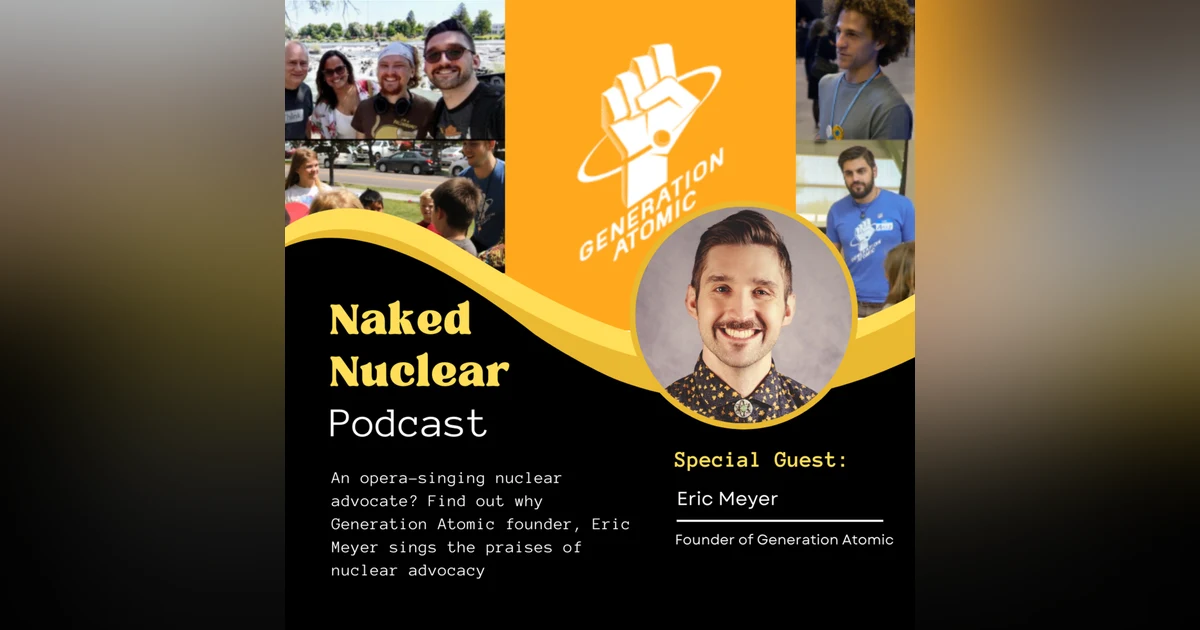
 A Nuclear Opera with Eric Meyer of Generation Atomic: Merging Energy and Advocacy In this episode of Naked Nuclear, we explore the unlikely parallels between nuclear energy and opera. Host Danielle Allen chats with the founder of Generation Atomic, Eric Meyer, about his journey from an opera singer to a nuclear energy advocate.
Meyer discusses his early misconceptions of nuclear power, his groundbreaking work to keep power plants open, and how he uses opera to engage communities in nuclear advocacy. The episode dives into the world of nonprofit organization building, legislative successes in the nuclear sector, and the importance of effective communication in promoting nuclear energy.
Meyer shares insights into the bipartisan support for nuclear energy in the U.S. and emphasizes the need for innovation in reactor production. The story concludes with a vision for the future of nuclear energy and how listeners can get involved. 00:00 Introduction: Nuclear Energy and Opera 00:33 Meet Eric Meyer: From Opera to Nuclear Advocacy 01:26 Act One: The Early Beginnings 05:32 Act Two: Building a Nonprofit 17:58 Act Three: The Future of Nuclear 25:32 Conclusion and Personal Insights
Get involved with Generation Atomic:
https://www.generationatomic.org
Learn more about climate policy:
https://world-nuclear.org/information-library/country-profiles/countries-t-z/usa-nuclear-power-policy
Global Climate Initiatives:
https://www.energy.gov/articles/cop28-countries-launch-declaration-triple-nuclear-energy-capacity-2050-recognizing-key
Full Transcript
[00:00:00] Danielle Allen: Nuclear energy and the opera. They might not have a lot in common at first glance, but here's how I see it. Opera is seen as stuffy. Nuclear energy conferences also seen as stuffy. The opera has a long dramatic history of trials and triumphs and tribulations.
Nuclear energy also has a long and dramatic history of trials and triumphs and tribulations. So at closer inspection, they're not all that different.
On today's episode of Naked Nuclear, we're checking in with Eric Meyer of Generation Atomic to find out how he weaved together this symphony between nuclear energy and community collective action.
[00:00:44] Eric Meyer: So my piece of this is like, hey, I'm going to sing opera music , I'll rewrite lyrics to the Toreador song from Carmen. And we were able to hand out, almost 5, 000, books,
[00:00:56] Danielle Allen: And today we're digging into how he went from singing opera on the streets of France to keeping power plants open in Illinois.
[00:01:05] Eric Meyer: it looked like four nuclear plants were going to shut down and that, that was like 40 percent of Illinois's clean electricity we sent over a thousand fax messages to the governor's chief negotiator.
[00:01:18] Danielle Allen: So without further do. We bring you a Nuclear Opera in three acts.
Act One. The early beginning.
[00:01:30] Eric Meyer: As a kid, I was a big fan of the Simpsons. And, I think because of that, I had taken this fact that nuclear energy is Far too dangerous and too dirty to be pursued. So, at that point in my life, I was probably vacillating between, being a filmmaker.
We used to do little, ninja movies. Messing around with the camcorder, a rock rock star, playing, playing a little bit in a band or professional video game player.
I wish I could say at age 10, I had, , the kind of global awareness, that I do now, but it took a few more years to get there.
I always had a love of, of math science and engineering, but hadn't really studied it seriously since, high school taking physics making potato guns trebuchets and kites love that stuff. But, you know, in high school, I didn't have anybody saying, Hey, you're really good at physics and math and science, maybe engineering. It was like, Hey, you're the only person who's won both the vocalist and instrumentalists of the year award in the history of our school.
You should be a musician. I think, some of that is like, medium fish in a small pond . You get some accolades and, you start to form your identity around that.
I think I really started being more aware of the challenges and decarbonizing, just a few years later, I remember a few conversations, with my dad, driving around, we were doing, , roofing mainly for businesses and dad, my dad's business to commercial flat roofing and we go by a lot of windmills.
Very big in Southwest, Minnesota, go by a lot of signs, speaking to the benefits of, , corn for ethanol production. Remember having conversations like how, you know, wouldn't it be amazing if we could get all of our energy from the wind and from, corn,
Would be pretty amazing.
I think, you know, high school college, you start to. See the limitations of that strategy, start to realize, Hey, actually ethanol has not been great, in terms of, land conservation, in terms of food prices, it's had a lot of negative side effects, and, the wind doesn't always blow.
So you start to realize these things.
Realizing, that Nuclear energy was this really, really powerful technology in terms of, providing reliable, clean energy, yet it's so misunderstood. I realized, maybe I should try to do something about this.
And it was about that time, in college, a friend of mine sent me a video, about a type of advanced reactor called the molten salt reactor that can, recycle nuclear waste, that can run on nuclear weapons, like, was meltdown proof.
Like all, all of the concerns I, had about nuclear energy were, completely absolved by this one advanced reactor.
Or the stories, the actual reality is a little more nuanced than that, but that Ted talk, video, he sent me, he got me to take another look at the technology, you know, writ large.
It was a current Kirk Sorenson about, LFTR liquid fluoride, thorium reactors at the time. It's kind of funny because a lot of people, that are active in the advocacy space and who ended up going to study nuclear engineering in college will cite, some of his videos, which are made by this, Canadian, stay at home dad slash IT guy shows like, uh, the power that individuals can have, by putting out those videos, he shaped the lives of a lot of people
Between that and experiencing a 500 year flood. Losing my car, know, put all that together and you get a music major changing directions in life and going to, eventually start a nonprofit.
[00:05:13] Danielle Allen: In act. One, we saw our hero. Eric, go from cam cording, ninja filmmaker. To want to be rockstar. To opera star. And noticing a trend within nuclear energy decides to start a nonprofit after experiencing a 500 year flood.
So now we'll bring you act two. The nonprofit profit.
[00:05:37] Eric Meyer: The seed for it really started in grad school.
Got a degree in applied public policy and learned how to run a nonprofit and file all the right, you know, the taxes. And then, learn kind of some of the movement building skills and communications and messaging skills, that you need to do that kind of stuff.
My first international, advocacy, came about at the climate talks in Paris in 2015, where I was there handing out, these books.
I still have a couple copies of them, called "Climate Gamble, Is anti nuclear environmentalism endangering our future" I think is the subtitle .
So my piece of this is like, hey, I'm going to sing opera music I'll rewrite lyrics to the Toreador song from Carmen. Especially if you're like a random French person,
I definitely did catch some attention and we were able to hand out, almost 5, 000, books, during that week or so that we were doing that.
Me and a couple of Finnish authors, but yeah, you know, singing, you can only do so much like singing opera about nuclear and books to strangers. Not exactly, like a winning political strategy.
[00:06:43] Danielle Allen: So Eric starts a nonprofit, but how did he build a
team? How did he source people together? Where do they live? What were they doing? And how do you organize so many people around a singular cause?
[00:06:57] Eric Meyer: Oh, yeah. Well, that the first year of Gen A, seems like a completely different lifetime. I had a co founder, who, was no longer with the organization a year later.
He, he's still doing good work in, in nuclear. It just, you know, not all the partnerships always work out. But yeah, that first year was great. It was crazy. We were, living in Ohio, breaking fire codes, I'm sure, in this two bedroom duplex. We, which had, we had like eight, eight people living in for a little while, going out, canvassing all day long, making, making videos.
Holding events, in support of savings and nuclear plants in Ohio. It was wild stuff that first year. It was a good crash course, and a realization that, door to door campaigning is. One very expensive, logistically complicated, a little bit questionable as far as the, the efficacy.
We did, drum up about 9, 000 postcards, worth of advocacy from individuals at their doors, sending out to the politicians and stuff. So maybe move the needle, needle a little bit, but wow, what a lot of work.
[00:08:04] Eric Meyer: . And I learned a little bit in, campaigns I'd worked in college I managed a couple, local campaigns, a county commissioner campaign, so I did know how to do all that stuff, after that first year, we transitioned sort of into a new, era where we, focus more on training, recruiting and training volunteers, making, really persuasive and memorable, online content, memes, short videos, articles, things like that.
Inspiring people, to look in more into nuclear and then empowering those people to make a difference in their communities when it comes to this technology. And that's, that's been a, a more, sustainable and rewarding, model, kind of leaning, leaning on volunteers, more than like, let's hire a bunch of random people
Since then we've had a, solid team for the last three years, anytime I find somebody who, , shares. , this passion and has some skills, self starting is at the top of that list.
You know, we're a lot remote, so it's super important and I'm not gonna micromanage anybody. But yeah, it ended up being one of our long term volunteers, Philip Holt is our development coordinator. My brother, I convinced him to sell his CrossFit gym And, come work with us and coach people on being, volunteers instead of, getting bigger biceps.
Some talented folks from all around the country working with us to, make videos Kirsten makes a lot of our social media videos.
Mary manages our social media stuff . Then we got Jeff and Madison doing policy, coordination and then a couple, international policy fellows, Vlad and Gayatri, doing, doing good work, surrounding the climate talks. So yeah, it's been, it's been awesome.
I love the team that we have now and, they've been doing amazing work.
[00:09:50] Danielle Allen: Every good opera has a source of drama. For the United States, it's usually partisan drama the politics and the policymaking that can tear households apart. So is that the same with nuclear energy? Does nuclear energy cause the same amount of partisan drama?
[00:10:08] Eric Meyer: It is the most bipartisan climate policy, that we have. The timing for that , couldn't be better. When you talk about , President Biden's landmark pieces of legislation. Have been amazing for nuclear.
The first one is a bipartisan, infrastructure law, which had , the Civil Nuclear Credit in it, used, to fund, extending the Diablo Canyon nuclear plant in California, which is one eighth of the clean electricity there. It also funded the, advanced reactor demonstration project.
So we have the Bill Gates, Natrium project getting funding from that. As well as X Energy, making their high temperature gas reactor. So really kind of jump starting an industry that has been, in, cryo sleep,
I mean, we haven't really built a nuclear plant for almost 40 years, in this country.
So we kind of forgot how to do it. Don't have the supply chain and the way these types of projects are funded in the West is you need like private investor, private capital to do this kind of stuff. And nobody's willing to put up billions of dollars for like a decade, to try to do this.
The government really needed to step in the bipartisan Infrastructure Law, Inflation Reduction Acts awesome as well, providing, tax incentives to build, nuclear plants and produce hydrogen with them. The Chips Act had, some provisions in it called the Vision For the Future, which puts, extra incentives for placing nuclear and frontline communities, in places like environmental justice.
Issues, going back to, brownfields from either chemical plants, fossil fuels, stuff like that. And then the most recently, NEICA, Nuclear Energy Innovation Capabilities Act, NEMA, things that have helped modernize, the regulatory, structure, and then most recently the, Advance Act further funding and, securing our supply of fuel. So we don't have to rely on, Russia, for, a percentage, of the nuclear fuel, we get here. I think the Biden administration has been the most pro nuclear administration in the last like 50 years.
I mean, maybe go back to Nixon when he was talking about like having a thousand reactors by the year 2000.
They talked to big talk back then. But, yeah, it's been great on a federal level. State level, it's improving.
A few nuclear moratoriums have come down, like, Kentucky, West Virginia, in the last couple of years, Montana, Illinois, Illinois. Got rid of their ban on nuclear for reactors, 300 megawatts and less.
It's better than nothing, but why so prescriptive about it? You know, The only reactor we have experienced building right now is a big one. We still, have, over 10 States that have some type of ban, building new nuclear, including my home state of Minnesota.
That's our big policy focus right now
[00:12:59] Danielle Allen: If partisan squabbling, isn't the reason these reactors have been banned, then what is it?
Historical fears. Chernobyl Fukushima. A hair trigger reaction to closing down a nuclear plant when a large profile accident takes place.
[00:13:18] Eric Meyer: I think a lot of lawmakers saw what happened with Germany when they shut down their reactors. They have delayed their decarbonization, by at least a decade, the coal's hopefully going to come down finally in the 2030s, but they've taken more, nuclear off their grid than the amount of coal they had.
So if they would have taken the coal off instead, they'd already be a close, close to a hundred percent clean , but they, prioritize getting rid of nuclear first and that was a huge, huge mistake. Meanwhile, you have, France next door, , producing, about 70 percent of the electricity from nuclear, Sweden, as well, about half.
Both of those countries decarbonize their entire electricity grids in the 70s and 80s.
The places that have shut down, their nuclear plants, have really struggled to keep the lights on, without burning a ton of fossil fuels.
The word's getting out in part due to advocacy efforts of, lots and lots of people.
[00:14:15] Danielle Allen: And a typical day in the life of the Generation Atomic founder.
[00:14:20] Eric Meyer: Yeah, like just looking around my desk and there's like, six different types of stickers and a stack of 200 business cards. There's a lot of plates spinning, for sure. So a typical day. Like a lot of people has emails and there's meetings.
You know, a lot of that is building to, one of the atypical days where you're at the Twin Cities Pride Festival, handing out, close to 4, 000 bananas in a weekend and having, well over 3, 000 conversations with people about nuclear energy,
I just got pages and pages of signups. And so hopefully all the meetings and, emails are building towards real impact in the world. I shouldn't, uh, throw too much shade at meetings because sometimes the meetings are with elected officials and those are important. I always try to ask myself, is this a meeting that could be an email? You know, what, what are we really doing here? Let's make sure everybody knows that within the first five minutes.
You do get those little dopamine rushes when you have a really successful, advocacy event where you thought you really got to talk to a lot of people. But of course all of that, is just, rungs in the ladder to actually changing the law.
That will be the big win in Minnesota when we get that. I think we're pushing for that in 2025 to legalize nuclear here. The big wins, over the last few years that come to mind are, 2022, passed, a piece of legislation this is before the Inflation Reduction Act, which kind of changed everything.
If this piece of legislation in, late 2021, in Illinois didn't pass, it looked like four nuclear plants were going to shut down and that, that was like 40 percent of Illinois's clean electricity. It was, it was a lot.
And we, we met with members of the energy committees. We organized letter writing. We sent over a thousand fax messages to the governor's chief negotiator. And then on the day the state Senate, passed the bill, the last person to testify, was one of our star volunteers, Alyssa Hayes.
And she like crushed it. She's like from Illinois and from a community that used to have a power plant. They shut it down in the nineties she had been growing up her entire life, seeing the ramifications of that, losing that business, losing all those tax dollars, what it did to the schools everything was just rough.
So she could really speak to it from a personal level. And right after they voted and, passed the law. That was awesome.
The other one was, getting Diablo Canyon extended. We can't take all the credit for this. I think a good chunk actually goes to, the blackouts that were happening in California. If you're a governor he saw the value of that. We organized a coalition of agricultural organizations to, write letters, to the legislature in support of that, saying like, Hey, if we keep Diablo, We have the chance to also use it for desalination, because they were facing horrible droughts California needs water and MIT Stanford had just released this awesome report showing like, "Hey, this is what Diablo could do in terms of, of de sal."
Those are kind of the big ones, like recent ones are like the banana thing. And then, we had a, 2 million view video, like a month and a half ago, which is cool.
It's about nuclear waste. It was like 20 seconds long and there's a lot of glue involved.
It's like trying to make slime, and sometimes the weirdest videos will gets people, interested in the topic. That's what we're trying to do.
And then, they can kind of climb the ladder of engagement.
[00:17:58] Danielle Allen: Act three. The future, of nuclear.
[00:18:03] Eric Meyer: Well, I hope that Generation Atomic is no longer necessary. That would be good, to, have enough success, that, the value of nuclear energy is more universally known.
If that happens, then we will, have achieved our vision of atomic energy being broadly used for the benefit of people on the planet.
To get there. We gotta make reactors like we make airplanes, like one a day coming off the assembly line, being shipped to where it is needed and plugged in, or built in shipyards and sent on boats we can't get to where we need to be with artisanal stick built nuclear plants with you know, 5, 000 people, working on site for six years. That's tough. You can get good at that and, definitely make it work. Japan was able to finish a large nuclear plant, a first of a kind in under four years. One of their advanced boiling water reactors.
I feel like we really need to make, nuclear power into more of a product. Rather than a huge construction project. So, you know, get to that assembly line reactor. I think 50 years should be plenty to do that.
Hopefully we can do in 20. Or 10 would be ideal, so breakthroughs innovations and how reactors are made and also how that technology is used. Not just for electricity, but for, district heating systems.
Instead of, having all the little power plants, furnaces in people's houses and sending the fuel, like natural gas, like we currently do. Why not have a central power plant and send the hot water, and have that heat homes, I mean, , they do that in a lot of places already in, in Europe there's a Finnish company called Steady Energy that's working on district heating.
Really simple nuclear plants that don't produce electricity. District heat, carbon neutral fuels, we're not going to be flying planes with batteries.
We're not going to be shipping things across the ocean with batteries. So it's really comes down to sustainable carbon neutral fuels. We know the chemistry, we've done things on a small scale. We just, we don't have the reliable large amount of energy and clean energy to do this yet and nuclear would definitely be able to provide that.
So yeah, fuels, chemicals, fertilizer, cement and then if you're Have more reactors on the world. You have more opportunities to produce medical isotopes as well. So bring, bring the cost of cancer treatment. And all those diagnostic procedures we do with medical isotopes, down quite a bit by just flooding the market,
waste and, safety. Right. Nuclear waste, people think it is the worst kind of waste. It's actually the best kind of waste.
It's very, easily contained. We have overly engineered containers to contain it. There's not a lot of it. You can't say that about the waste stream , of very many things out there.
I'd love to be able to recycle it at some point, but I understand that, the economics of that have to be improved in the early days of recycling, it was, how can we make this cheap?
Safety, is another thing where we already have, among the safest of energy sources. And even in the worst case accidents, we're looking at deaths in the low hundreds, like nobody died at Fukushima.
Chernobyl looks like it's going to be around 200, maybe all said and done but it's way less than they initially thought. And, you know, the, the UN world health organization have had to like revise their numbers. Cause they're like, wow, actually many people, not that many people died.
Yeah, that was a reactor with no containment in an illegal test in the middle of the night with all the safety systems disabled.
Literally every possible thing. And they didn't tell anybody to take iodine tablets they didn't throw out the contaminated milk they did everything wrong.
It's hard to imagine, anything ever approaching that again. And, we just don't have reactors like that. Without containment running in the world today. Now engineers, we're like, oh, I bet we can, we can make people feel safe by engineering the perfect reactor.
It's meltdown proof.
We actually had. The experimental breeder reactor number two in Idaho, which is like pretty substantial for an experimental reactor is like 60 megawatts. You know, it could power a town of 60, 000 roughly. Just two weeks before Chernobyl happened.
They did a meltdown proof test. They showed. That they could disable all the cooling systems and just like hands off the controls and the reactor would shut itself down, with physics alone. No engineered system, or anything like that, but nobody ever hears about that one.
are the odds?
Like two weeks before, the worst nuclear disaster.
I think those. questions we can only do so much engineering to address the waste and safety, issues. And I think we've kind of done it all already. So I think those need to be addressed, with more social engineering,
Talking to folks at, education, we'd like to put things on the human scale, whenever, we can. So, we have a couple of charts that show like, you know, how, how much raw material does it take to generate electricity, for this number of people for, for a year. And we try to pick a number of people, where the quantity of stuff is something you could visualize in front of you, it's on our website. How much raw material is required to make clean energy? How many kilograms per megawatt hour? And I said, megawatt hour, that's enough to support the electricity use of about 1300 people for an hour.
For an hour, of of hydro, you'd need about 16 kilograms. For, for wind, 12 kilograms . Solar is about, seven kilograms and you of nuclear. So this is like all the stuff that goes into a nuclear power plant. Is five kilograms or like 11 pounds. It's something you can imagine, holding, in your hand.
A pellet of uranium, is the same as a ton of coal in terms of energy value.
If you get your entire lifetime supply of electricity from nuclear power, the waste product would fit in a can, which is actually what this says on this, can koozie. It's really important to give people. Examples they can wrap their heads around.
The reason we were handing out bananas, at the pride festival was, was trying to human scale radiation a little bit because, it turns out, you know, bananas famous, of course, for, what, what nutrient? It turns out a small fraction of all the potassium in the world, including that in the banana is a radioactive version called potassium 40. And, eating a single banana as a result of this will dose you with more radiation than living next door to a nuclear plant for a year.
Then that really, you know, that was a good hook. Get the foot in the door. And at that point, it's like, did you know we have nuclear?
And we say, you have a guest with the largest source of lower carbon electricity in our state might be.
And so many people were like, Bananas? No. Get your blood sugar up and try again. People didn't know it's, it is, it's nuclear power, in Minnesota, in North America, in Europe, largest source of low carbon generation. Still despite having not really built it for decades.
[00:25:25] Danielle Allen: This has been a nuclear opera. In three acts. And now. Our final curtain.
What is your personal philosophy in five words?
[00:25:37] Eric Meyer: Make future you say, thanks.
[00:25:41] Danielle Allen: When you're not advocating for nuclear energy, what activities and hobbies are you typically getting up to?
[00:25:48] Eric Meyer: There's definitely some Dungeons and Dragons happening up in here. I run a game for my nieces and nephews and there's often energy themes.
Oh, this, this dragon has been enslaved to, to power, uh, the, the heat of this town, but if they take it away, the town will freeze, like trying, trying to work in some environmental themes there.
I play, it plays in a, in a couple D& D groups as well. Mountain biking, yeah, you know, board games, video games. Lots of fun, but I'd be lying if I didn't say that like 90 percent of my personality is connected to nuclear energy.
[00:26:27] Danielle Allen: So another question, you've got four minutes to prepare a TED talk on a completely different subject. What are you going to talk about?
[00:26:36] Eric Meyer: Probably, learning through play. I'm a big believer in this. We've developed a tag game that elementary kids, could play to learn about different energy sources and, intermittency and things like that.
There's also this card game that we've been the, North American distributor for, called, called Megawatt, where, kids or whoever adults can play too, are tasked to build, an electricity grid and then put it to the test against natural disasters and, you know, cyber attacks.
All kinds of, event cards that are pulled from the news, and upgrade your grid and then compete to try to have, the most power and the least environmental impact. I'm a big believer in learning through like self directed activities and play like that.
[00:27:22] Danielle Allen: And last. Question , would be your top three favorite songs to sing.
[00:27:29] Eric Meyer: Number one is easy. Is it the impossible dream? From man of La Mancha.
[00:27:33] Danielle Allen: Oh, that's a great one. It's like my mom's favorite.
[00:27:36] Eric Meyer: It just resonates, right. Cause it's about devoting your life to an important cause. Even if there's like no guarantee, of success, even if , it seems hopeless, just the attempt, in itself is, a noble, endeavor.
And worth it. And I like to change, so the original lyrics are very much, about I, me, first person, and I like to change it to be we, instead and make it inclusive
if I want to, flex the vocal cords a little bit, I'll sing, something from Handel's Messiah, like, why do the nations so furiously rage together? Or, you know, you got this really complicated, melismas with, fast triplets and fireworks.
Or if I want to have a good emotional sing, I might do some Brahms, like the four series songs, get the acting going, you know, tap back into that, art song, opera past,
I'm sure everybody will know those look up Brahms right now.
[00:28:32] Danielle Allen: I think because my mom was a ballerina, I just thought it was like normal to listen to an absurd amount of opera growing up.
[00:28:40] Eric Meyer: You do notice though, that there are a few opera ditties that are just in a bunch of commercials were like, Oh, that's Puccini. That's from Geeky. Yep. Or Carmen
which the opera itself, not great. The story doesn't really hold up. Music's amazing. That's probably like 80 percent of opera though.
[00:29:00] Danielle Allen: Kind of recapping because you said you built, Generation Atomic mainly off of volunteers.
How does somebody get involved and become an atomic ambassador? And how do you like jump right in?
[00:29:10] Eric Meyer: Yeah. You can literally go on the website and click, get involved,
yeah. And that will, sends you an email and you get to set up a one on one with us and get on boarded into one of our different volunteer groups, of which, we have, three big ones.
Then we have some state based groups, but the big ones are, the government team, the tech research team, and the education communication outreach or eco team. They meet either weekly or bi weekly depending on the team. The atomic ambassadors is nice because it teaches you a lot about the technology, but also about how to talk to people in ways, that are, persuasive friendly and memorable and how to address the concerns people have about, nuclear, which is understandable.
People do have concerns there's history there. No energy source is perfect, . How to talk through that. The ambassador training gives, a toolkit of, different things you can do in your community to build up your local network and make progress in your area.
That's a really good one to get involved with. After doing it for three years, with, GAIN, through the Idaho National Lab, a Gateway to Accelerated Innovation and Nuclear. We, we've really like honed the training really well. So it's, it's super good
[00:30:23] Danielle Allen: And what Eric would like to hear on future episodes.
[00:30:27] Eric Meyer: I'd like to hear a discussion, maybe a debate between, different strategies of dealing with nuclear waste, cause there's, you know, there's a few different schools thought within the nuclear advocacy community on this, some of these areas of disagreement and tension, are really interesting to me because there's good points to be made, all, all around, and there's advantages, different strategies from, from like, economics, from messaging perspective.
Also just as a communicator, I'd love to love to hear, other communicators and, their experiences and ideas.
I think we're a pretty good follow. We have a lot of awesome videos and things, so you shan't be disappointed.
And you can get to them all from, our website generationatomic. org or just like searching anything. Everybody who's listening to this knows how to use the internet. So I won't explain it.
[00:31:18] Danielle Allen: Thank you again for listening to: A, Nuclear Opera in Three Parts with Eric Meyer from Generation Atomic. If you'd like to get involved with Generation Atomic, you can go to generation atomic.org and search Atomic Ambassador. And thanks again to Eric for accepting the invitation to come on this podcast and the amazing work that he's doing in the nuclear advocacy space. . Don't forget to check out the after pop brief explanation of policies in this episode with Eric Meyer. Again, I'm your host, Danielle Allen and you've been listening to Naked Nuclear.
**Naked Nuclear** strips down nuclear energy so it actually makes sense. New episodes weekly. 🎙️ [Listen on Apple Podcasts](https://podcasts.apple.com/us/podcast/id1781924674) · [Watch on YouTube](https://www.youtube.com/@TheNakedNuclearPodcast) 💡 Curious about nuclear careers? Visit [nakednuclear.com](https://www.nakednuclear.com) for episodes, resources, and guest spotlights.