3-Dimensional Chess?! Nah, that's just Nuclear Ethics


 RSS Feed
 Navigating Nuclear Ethics: A Three-Dimensional Chess Game
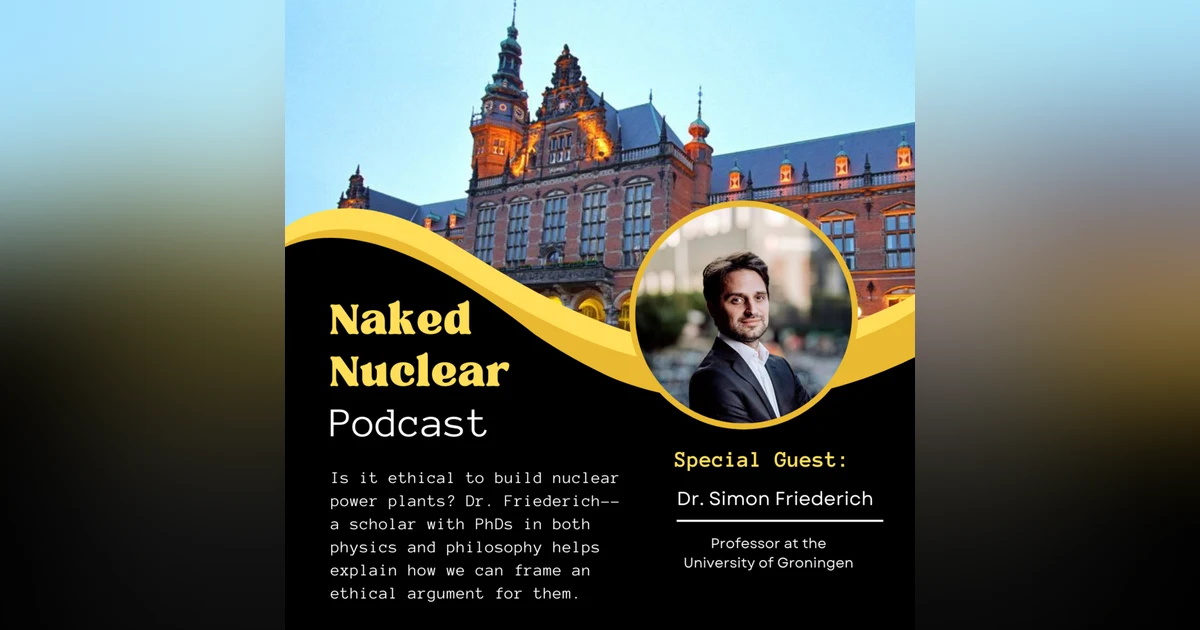
In this episode of Naked Nuclear, host Danielle dives into the complex world of nuclear ethics, drawing parallels with the intricate game of three-dimensional chess . The discussion is centered around the work of Dr. Simone Friederich from the University of Groningen, who, with his background in both philosophy and physics, explores the ethical obligations of investing in nuclear energy to mitigate climate change.
Through the analysis of Dr. Friederich's paper, ethical frameworks for evaluating energy systems are discussed, emphasizing the importance of quick action, achieving zero emissions, and facilitating technology advancements. The episode also covers Dr. Friederich's insights on existing versus new nuclear reactors, and public attitudes towards nuclear energy.
The overarching message is clear: ethical and pragmatic approaches are necessary to navigate the future of energy systems.
Read Dr. Friederich's Paper Here!
https://link.springer.com/article/10.1007/s13347-022-00527-1
What exactly is normative ethics?
https://link.springer.com/referenceworkentry/10.1007/978-3-319-23514-1_1222-1
What will it take to reach 100% Clean Energy by 2035?
https://www.nrel.gov/analysis/100-percent-clean-electricity-by-2035-study.html
When 100% renewable energy doesn't mean zero carbon
https://sustainability.stanford.edu/news/when-100-renewable-energy-doesnt-mean-zero-carbon
Full Transcript
[00:00:00] Danielle Allen: Have you ever played a game of three-dimensional chess? Now if you're a Star Trek nerd, you know, Spock often played games of three-dimensional chess. It's quite complicated. With every move, you have to think of a different move in every direction.
Forward, backwards, up, down left, right. Today's episode feels no different.
Today, we're going to be talking about nuclear ethics.
[00:00:25] Simon: The biggest discrepancy between us and maybe the energy ethics, community is that these people, tend to focus on what can go wrong in certain circumstances,
[00:00:35] Danielle Allen: That's Dr. Simone Friederich from the University of Groningen in the Netherlands. Dr. Friederich not only has a PhD in philosophy, but also physics. Most of his arguments are in the realm of quantum physics, which makes him probably better than me at three-dimensional chess. I stumbled across a paper. He wrote titled ethics of nuclear energy in times of climate change. Escaping the collective action problem.
[00:01:01] Simon: The collective action problem aspect is more that, in a global economy, or even on a more regional level other people will jump in and will deliver the services, and maybe they will be the less scrupulous ones.
[00:01:12] Danielle Allen: Here's the overarching question, Dr. Friederich and his colleague decided to use to create this paper. To what extent should we be investing in nuclear, energy as a strategy to mitigate climate change? And how can we evaluate current energy systems in place from an ethical framework?
Some of those answers, spin out questions. Some of those questions. spin out answers. It's like the 3d chess thing. And so throughout this episode, we're going to be breaking down the criteria. He and his colleague used to create this assessment and what they found.
The answer to this question is yes. Yes, it is ethically required to invest in nuclear energy.
But first let's get some more background on Dr. Friederich and how he got here.
[00:02:01] Simon: I am usually a philosopher of physics. Mostly I try to solve fundamental problems in quantum foundations, but I also do some philosophy of technology and I got interested in nuclear energy. Roughly, 12 years ago a bit after the Fukushima accident, when I read up on what really the fatalities had been.
I hadn't been socialized in Germany in a very anti nuclear, background. I, I became, pretty enthusiastic about the technology, , even though my country of origin, Germany was phasing out the technology. I got the idea to, write a paper on this in maybe 2018 or 2019, around the time of the Fukushima accident, they had set up an ethics commission.
To assess whether it was ethically defensible for Germany to continue to use nuclear energy for some time as it was really a heavyweight commission with people experts from especially the social sciences and also philosophers a few engineers and they recommended that Germany exit the technology quickly. And I thought, this is weird, right?
These people are maybe smarter than I, so when they come to a different conclusion, so let's that's engaged with that. I got into contact with a, with a Belgian, colleague who had similar views to me. And we, we ended up writing that paper, which appeared, I think, two years ago.
[00:03:22] Danielle Allen: If you're not up to speed with what happened in Germany, here's a bit of context. Germany is now looked at as a cautionary tale of what happens when you shut down all of your reactors without really insightful forethought of how you're going to replace that power lost within the grid.
So, how did Dr. Friederich come up with a completely different analysis? Then that of Germany's ethics commission.
[00:03:48] Simon: It gives a very different assessment of what the key ethical issues are, and also provides some reasons for thinking that in given certain plausible assumptions might actually be, ethically, mandatory for certain countries, to invest quite heavily in further nuclear capacity rather than phasing it out.
When reading this, this German study with the view of its authors, I think the biggest discrepancy between us and maybe the entire energy ethics, community is that these people, tend to focus on what can go wrong in certain circumstances, in terms of people's health and in particular, how can we use less energy?
I think these are all valid concerns, of course, but, to Martin, my colleague and to me, I mean, the bigger picture was really that, humans have fared so much better since we have been able to use a lot more energy, right? The nice developments of the last few decades, or maybe 2 centuries in terms of, how long people live, how much education people can have more gender equality have to do with the fact that humans have just more energy at their disposal.
The collective action problem aspect is more that, in a global economy, or even on a more regional level. Because energy is so useful for, getting around, keeping you warm and to produce all kinds of industrial goods, cement and steel you need quite a lot of energy for that.
If you, for the sake of, protecting the climate in order not to have any emissions , if you don't do it, then it's to be expected that other people will jump in and will deliver the services, and maybe they will be the less scrupulous ones. This kind of reasoning is often used with dubious intention to just not take any responsibility, but that doesn't mean this mechanism is not active. That's the collective action problem.
[00:05:34] Danielle Allen: This is an important point to reiterate. Humans have fared so much better since we have been able to use energy. We can educate ourselves faster, build things better. and live overall better lives. However, in the spirit of clean energy and protecting the environment. If State A decides to cut back then it's likely that State B might just take its place. And State B might not be as adherent to clean energy practices. But like Dr. Friederich said this doesn't mean there's no use in trying to improve our energy systems and taking responsibility for our actions.
[00:06:11] Simon: If we try to solve the problem by emitting significantly less, but others are happy to take over, then not so much as gain. The better way, if possible, is to substitute for the energy delivered from fossil fuels and preferably have substitutes that are similarly affordable or even cheaper.
That is not going to work for all parts of industry where we use fossil fuels. So some carbon capture would probably be necessary to get to net zero, but without relatively cheap carbon free energy, it's not going to work. According to the analysis of of Martin and me, the use of, nuclear power must be analyzed from an ethical standpoint against that background.
[00:06:54] Danielle Allen: In their paper, this is what it's referred to as substitutes must be cheap or SMC. In the game of three-dimensional chess or as I like to call it nuclear ethics. Completely altruistic actions can actually have adverse effects. This is the collective action problem. There are numerous players. So with more pragmatic approaches, such as substitutes must be cheap we can start to play the game in a way that has positive outcomes.
[00:07:24] Simon: If the vast majority is happy to use other sources, and those sources are just as cheap or even cheaper so that the fossil fuel users will have an economic disadvantage, then we are in reach of getting to very low or zero emissions
I am not a professional ethicist. Usually I do a lot of physics, but I mean, we all have, a basic, education and ethics and , something that maybe some of your listeners have that have had that as well.
So some of the most elementary things are that there are very different normative theories of ethics or theories about what people should do. It's useful to distinguish roughly three types. One could distinguish more maybe, but three types are useful to distinguish.
One are broadly, consequentialist. These are approaches that say you should do whatever, has the best consequences, so what would be a good outcome? What would be a great outcome? What would be a bad outcome?
Another is to is, duty based. So to say that there is a canon of duties, and people should do what their duty is. What's your duty to not do any harm or at least not avoidable harm or disproportionate harm and that could lead to very different verdicts, right? It could be, for instance, that from the consequentialist perspective, you realize relatively good outcomes by killing someone or, sorry, doing them a lot of harm.
A third kind of approach would be based on character. So good is what goes together with a good character. That centers the individual, not the action. So again, very different. And we wanted to look at the ethics of nuclear energy use while being relatively neutral.
I don't know which of these approaches I prefer. I guess I'm a kind of pluralist. But, I don't want to commit to one of them. And so we try to come up with criteria for what is what a good energy system development strategies strategies of energy system development in the light of different approaches of normative ethics. And we thought, well, there are 3 criteria that makes sense irrespective of which approach to normative ethics they prefer.
[00:09:26] Danielle Allen: So instead of setting up this framework based on normative. ethics, Dr. Friederich and his colleagues decided that they were going to create a different set of criteria to evaluate energy systems. So, what are they?
[00:09:40] Simon: The first would be, QUICK. That is basically the criterion that if you are an energy system developer, then you should try to reduce your emissions quickly, right? For the next few years or so, try to bring them down.
Another criterion would be, ZERO that means that says, bring down your net emissions to zero. On a reasonably quick, timescale. That sounds similar to QUICK, but it's pretty different, because the horizon is really to have an idea of how you get to zero emissions.
So, the recommendations might be rather different, because deep decarbonization is quite different from shallow decarbonization, if you want to, just, , go for the low hanging fruit I think a couple of, renewables can be installed pretty fast.
They can lower the utilization rates of coal and gas plants and so on. That makes a lot of sense from the perspective of QUICK, whereas, a large nuclear plant takes a relatively long time to build so that is probably not quick.
But if you want to go to zero, on a reasonable time scale, that actually might be pretty good, to have, reliable, 24 7, year round, electricity in form of a nuclear plant.
And the 3rd criterion that we consider this, we call it FACILITATE that would be that you that you invest in such a way. develop your energy system in such a way, that you try to bring down the costs or the hurdles for technology that are generally useful to fully, decarbonize
[00:11:11] Danielle Allen: and not wanting to play into one specific camp created a different framework to analyze energy systems.
The criteria they use consists of quick zero. And facilitate.
Quick means that energy system providers should try to quickly reduce their. carbon emissions. That could look like oil and gas companies trying to use solar panels to power, their field operations.
Zero means that energy system providers should be adjusting their horizons to make sure their emissions are reaching net zero over time. This could look like wind turbine, factories using carbon capture to offset carbon emissions from the steel manufacturing process. This timeline, it should be done in a responsible manner though.
Facilitate. This means that we as a collective or government should make it easier to build energy systems that align with net zero initiatives. This could look like the department of energy or the nuclear regulatory commission. Launching a new website to make it easier to file paperwork and submit funding requests.
The key here is to use these three criteria in order to evaluate all parts of an energy system.
[00:12:26] Simon: I think something that set apart our ethical analysis from that of, my German colleagues or from the past few decades, also others mentioned that we really looked at the energy system modeling literature and economics papers what does the evidence say about how one can relatively quickly, more or less fully decarbonize.
There are a couple of studies that suggest that going now all in on variable renewables, is the most affordable option and will get us to zero emissions. My impression from the literature is that these studies are not reliable.
The evidence that we have from countries that already have very low carbon electricity is that it's more responsible option in the light of getting to 0 emissions.
to , invest some of the resources in firm, low carbon power. So that is one that can be, switched on and off and is often going at, full throttle. I think is the expression right? The work by Jesse Jenkins and coworkers is very compelling in that regard.
I think, all the other works point in a similar direction. Besides, geothermal energy, nuclear energy is really the prime option here. From a US point of view, where nuclear energy is regarded as supremely expensive, we think that precisely an economic analysis, somewhat supports, investment in, nuclear energy.
[00:13:47] Danielle Allen: So if we evaluate an energy system that already has pretty low carbon emissions. We find that the only way to really get them to zero emissions is through investment and either geothermal energy or nuclear energy. The second point made here is that even in the light of nuclear energy in the United States being expensive to start building. The economic analysis still supports that investment in new nuclear energy is ethically required. So let's take a look at the arguments for existing reactors, building new reactors and small modular reactors.
[00:14:26] Simon: So first thing I want to say is that from my point of view in the paper, it's usually said that the case for keeping existing reactors running is very strong, but for new reactors, much more shaky.
If you build a new reactor and predict that it will be, horrendously more expensive and take many decades or so. Yeah, then that's probably a bad service. But if you think you can do it, critically thought about this on time and budget.
And even if those are currently pretty high, because of the effect that this will have globally people see what can be done that has more of an impact. So, at least in the sense of our criterion facilitate that might have the better ethical, evaluation.
Than just keeping a plant running the question is, do you keep it for 10 20 or 30 years it's not so clear even if the carbon avoiding costs are lower in the latter case.
Then there's the question, what kind of reactors if we're talking about new build, should be assessed how?
Preferably, in the light of what I've been saying, it would be good to find a way of undercutting fossil fuels on price, to produce energy more cheaply. Currently, I think, as my understanding is, for most applications, we are quite far from that, for new reactors. There are groups, like, Radiant Energy that push for large scale build out of large scale reactors. And they hope that, that this will bring down, costs significantly. I think this is most realistic.
But on the other hand, if the build times stay what they are right now, part of the problem with climate change is that we are relatively short term oriented creatures, right? So we really don't want to, refrain from flying now for uncertain benefits for our children or whoever down the road.
If we are invited to mitigate climate change by deploying something that asks heavy sacrifices now, but pays off maybe 20 years down the road with relatively affordable energy that is sort of solving the problem with the same kind of problem, So it would be better to have something that can be implemented much more quickly.
So compared to when I wrote the paper, I've become even more convinced. It would be really desirable, strengthen the ethical case if, the industry could be deregulated in some way to make it faster and more affordable.
[00:16:42] Danielle Allen: So the ethical case for keeping existing nuclear reactors in place. Pretty good. The ethical case for building new reactors. Depends. If we can build new nuclear reactors on budget and on time, that makes the ethical defense for new nuclear reactors, pretty strong. It also facilitates more people around the world, able to build them as well. However. in our three-dimensional game of chess, affordable now is better than affordable later.
There needs to be heavy legwork in the facilitate department of this energy system or else it might be increasingly difficult to have public and government buy-in if the economics show that the affordability will pay out 30 years down the line. Instead, we need something a little bit faster..
[00:17:37] Simon: I think the ethically most, desirable actions are the ones that contribute to more widespread access to carbon free energy and, helps with getting to zero emissions.
That would be a win win. I just want to highlight how different we are in our focus from the more traditional ethics literature, deregulating this technology is quite alien, but on the other hand, the excellent safety record of the nuclear industry in part has to do with a fantastic safety culture that's my impression from talking to people And of course, that, should stay good.
[00:18:09] Danielle Allen: But what's the public, reaction to all of this?
[00:18:12] Simon: Yes, let's come to this question. How the public attitudes, might have to change. There was a philosopher or ethicist from Norway, in the seventies he wrote a paper on, energy ethics and he said that for environmental reasons developing countries we'll use nuclear energy because it's better for their environment than using renewables. But because of the proliferation issue, we should hope that they use, fossil fuels or preferably hydropower.
From the modern point of view, it's completely orthogonal to the discussion but you're asking about how people's attitudes would have to change.
These are, largely empirical questions, where we have specialists here at my university in Groningen specialized in the acceptance of energy infrastructure. They can answer this kind of question more competently. I think a lot has changed for the better people are slightly more pro-nuclear than they used to be, I think 10 years ago. And maybe that trend will continue, but it might still be quite a challenge, to find communities that are, that are happy to host
In Germany, specifically, nuclear energy, in the broad population was always considered very cheap, when the reactors were there, they were really running very, very affordably, I think, at, something like operating costs of two cents per kilowatt hour.
Considerably below what they do in the US. And now, yeah, I think once they were switched off that happened, that happened almost two years ago for the last reactors, I think, in around that time, public opinion became more supportive of the technology.
As long as it's not in their backyard, I think politicians have an eye on how difficult it would be to convince. communities, how strong the opposition would be so they don't want to get into this.
Here in the Netherlands, actually, there is a pretty stable consensus, except for the left parties to build new plants. And actually, it's very sad in my community, right? We had a place reserved for a large nuclear plant for decades. And then the prime minister two years ago said, well, that would be so great for the province if we built one there, but the people weren't ready.
They protested. And now it has been taken off.
In the Netherlands, the population density is 400 something per square kilometer. So that's really dense.
[00:20:25] Danielle Allen: One of the sections in Dr. Friederichs paper discusses, land usage. And I think that's a really important topic when we're evaluating energy systems. What land is available to use for energy production. Wastewater treatment, agricultural development, urban planning. What role does proximity play in relation to the adoption of nuclear technologies? I E. If it's close to you, are you still going to want it?
[00:20:53] Simon: A lot of the demands of climate protesters is probably counterproductive because they, regularly block highways and that really divides society, I think, there is a minority of people who think that's great and that is really the kind of action that we need but I think most, especially the people who really keep society going, It gets on their nerves, I think this mainly backfires, right?
My hunch would be, let's try to get out of that blockade mood and see how we can, without sacrificing the achievements of, safety we can deploy, technologies, that allow us to live as well as before and maybe better while without emitting,
[00:21:33] Danielle Allen: If you're listening to this podcast and you're wondering. Does this even apply to you? Well, yeah. Whether you're arguing in favor of, or against nuclear energy.
I think it's important. to be able to start to discuss some of these ethical frameworks. And how we decide to evaluate our energy systems and what we want to do about it on a daily basis. Even if that's a middle of a road approach.
It might not sound exciting, but keeping existing nuclear reactor plants open. Finding cheap and ethical replacements for fossil fuels. Facilitating the faster production of new nuclear power plants and remembering, and this 3d game of chess, choosing the right move, 100% of the time might not actually be the right move.
Now it's time for our rapid fire questions.
What drew you to both physics and philosophy?
[00:22:27] Simon: I studied these two disciplines with this, tailor made construction at the University of Gottingen I've always been enthusiastic about philosophy, but I always had respect also for physics.
When I studied them, what really shocked me was that, the basic language for all fundamental physics is quantum theory,
but, but it's actually pretty mysterious how the world can possibly be such that quantum theory works, how this can really describe the world or be effective as a means of interacting with the world that is condensed in the so called measurement problem of quantum theory.
I learned about that 20 years ago and, it has never lost its grip on me.
[00:23:04] Danielle Allen: Are there any, favorite questions or philosophical questions that you like to ask your students?
[00:23:10] Simon: Oh, yeah. There are lots of things that I asked my students, I often like to shock my students a bit by making it appear in the beginning of a course that is going to be super difficult and then they are happy if they can do some things and get decent grades .
When students that I, know a bit better maybe after a course when we have drinks I like to ask them about, their plans for whether they want to have kids and so on. So not just, not personally , but in general, there's this low fertility, thing, going on, and it's interesting to see whether, students are aware that fertility peaks at their age there is the connection between this and , the energy and climate questions, because I think we want the next generations.
To flourish have decent amount of energy that they can use and a climate that allows us to preserve a lot of the beautiful nature.
[00:24:02] Danielle Allen: Do you have any hobbies that you like to get up to? Anything that you do in your spare time that you find pretty fun and exciting?
[00:24:08] Simon: My hobbies. I love, being in the mountains here in Europe, in the Alps of Pyrenees, I do a lot of, Classical music, not very original, but I really carry forward this, traditional Western, culture and my children's, children participate.
[00:24:24] Danielle Allen: And then my final question on this is, if you had to give a speech or a TED Talk on a topic that, is not related to philosophy or physics or anything that you've studied, what, other, passion would you have that you would want to give a talk about?
[00:24:39] Simon: Yeah, I like to talk about lots of things, but I always need to remind me that there are always people who know better, right? And I can tell you that in 2023, I spent the year after having written on nuclear energy, I spent the year. writing papers related to advanced AI and how it might interact with society, even though I'm not a machine learning expert. I feel a bit inadequate, but the papers have appeared in good venues. And whether AI systems will be subject to natural selection in the future and will become selfish and, driven towards resource acquisition.
I have given sort of Ted talks on this to certain, audiences. And I've had, fun because I'm always a bit scared about these things, so I could mention that.
[00:25:28] Danielle Allen: So just kind of closing up. Would like to hear about or think should be had around nuclear energy or things that you want to, know more about?
[00:25:36] Simon: I would really like to have some clear ideas, get some clear ideas, what kind of concrete measures could be taken to make, to make this technology better deployable, especially here in Europe, because that's where I live.
Right. But also debate about, Alara, based on LNT, I hope your listeners know what we're talking about, how low radiation levels must be in the operation of nuclear plants and so on.
So, it's unclear to me. How good this justification for ALARA is, I wish I had some colleagues, who would, with a, with a constructive motivation would look into this, right?
So that would be really nice.
[00:26:16] Danielle Allen: Taking the time to frame ethical. arguments can help us understand long-term effects and consequences for our actions. Even if we might be intending to do something good, it might have a bad outcome. That's why it's also necessary to evaluate our current energy systems. Under an ethical framework. That way we can understand what parts aren't beneficial to all parts of society and how we can improve them. That's something. I think nuclear energy has the capacity to be able to do.
A special, thanks to Dr. Simone Friederich. for taking time out of his day to come sit. down with us and talk about his paper.
In addition, I wanted to thank him for even writing the paper. Even though nuclear ethics is not his specialty. I think it's important for everybody in the energy space who cares about the climate. To work on projects that they might not be specialists in. It can have far greater impact than I think we all realize.
Thank you so much for taking the time to listen to this episode and work through this three-dimensional game of nuclear ethics, chess with me. I know I learned a lot and I hope you did too. If you enjoyed this episode, please rate it or leave a comment. And what other questions on ethics and philosophy should we ask in relation to nuclear energy or just energy systems in general?
Thanks again for listening to this episode of Naked Nuclear. I'm your host, Danielle. Stay curious.
**Naked Nuclear** strips down nuclear energy so it actually makes sense. New episodes weekly. 🎙️ [Listen on Apple Podcasts](https://podcasts.apple.com/us/podcast/id1781924674) · [Watch on YouTube](https://www.youtube.com/@TheNakedNuclearPodcast) 💡 Curious about nuclear careers? Visit [nakednuclear.com](https://www.nakednuclear.com) for episodes, resources, and guest spotlights.